Seeing flashing lights in your rearview mirror can make your stomach drop fast. Maybe you were driving home from dinner, heading back from work, or just trying to get across town. In that moment, it's easy to talk too much, agree to things you don't understand, or make a simple stop worse.
That's why knowing your rights during a traffic stop in texas criminal cases matters so much. A traffic stop can turn into a DWI, drug possession, weapons, assault, or warrant case in minutes. What you say, what you hand over, and what you agree to can shape what happens next in court.
If you're dealing with a stop that already led to charges, the roadside encounter is not the end of the story. In many cases, the main fight starts later, when a defense lawyer reviews the stop, the search, the body-cam footage, and the officer's stated reason for detaining you.
Seeing Flashing Lights The First Moments of a Traffic Stop
The first few seconds matter. Pull over safely, turn off the car, and keep your hands where the officer can see them. Don't start digging through a glove box or center console before the officer gets to your window, especially if there's anything in the car that could be misunderstood.

A lot of people think a traffic stop is just a quick conversation. It isn't. It's a legal event. If the stop later leads to charges for DWI, drug possession, unlawful carrying allegations, theft discovered through a warrant check, or even an assault arrest tied to an earlier report, the officer's actions and your responses will be examined closely.
What helps right away
You want to look calm and controlled, even if you don't feel that way. That doesn't mean you have to be chatty. It means you should avoid sudden movements, avoid arguments on the roadside, and focus on a few basic steps:
- Pull over safely: Use your signal, slow down, and stop in a place that doesn't create more risk.
- Stay visible: Keep your hands on the wheel if possible.
- Wait before reaching: If your documents are in the glove box or console, tell the officer where they are before moving.
- Keep your voice even: A respectful tone protects you better than roadside debate.
Practical rule: Your goal during the stop is not to win the argument. Your goal is to avoid giving the State extra evidence.
What doesn't help
People often hurt their own cases by trying to explain too much. They volunteer where they were, who they were with, whether they had “just one drink,” or why there might be something in the vehicle. Those statements can end up in a police report and later in court.
The better approach is simple. Be polite. Follow lawful instructions. Save your defense for your lawyer.
Why Were You Pulled Over Understanding the Legal Standard
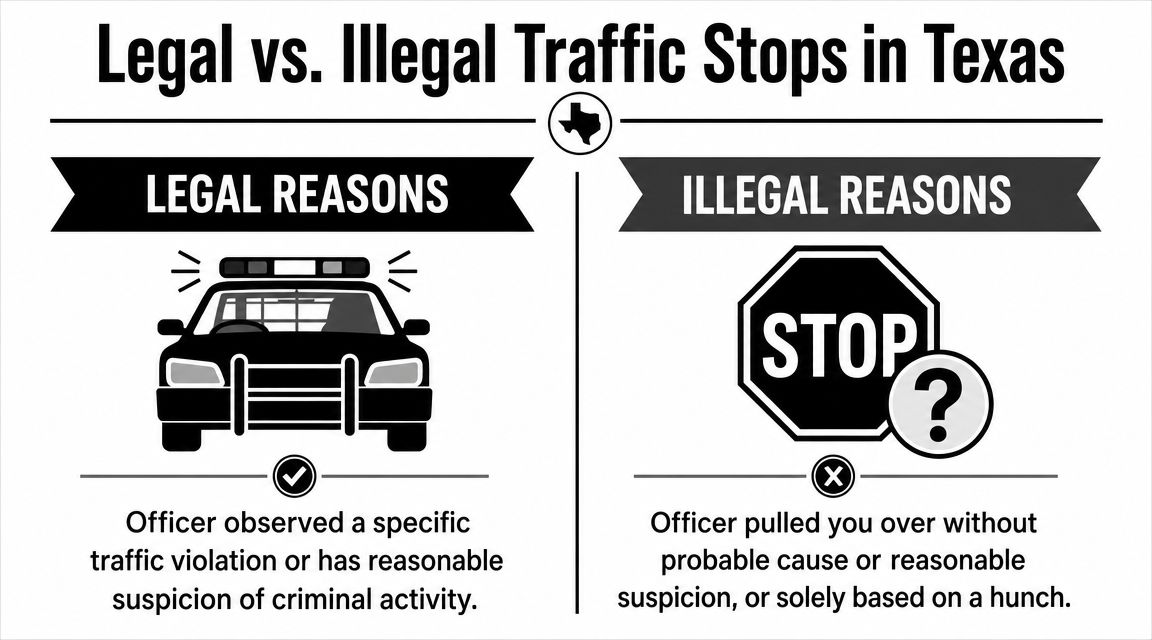
Police in Texas can't legally stop a car just because an officer feels curious or suspicious in a general way. A traffic stop is a constitutional seizure under the Fourth Amendment, which means the officer needs a lawful basis to make the stop. The Institute for Justice's Texas traffic-stop case page explains that police must have reasonable suspicion based on specific, articulable facts, not just a hunch, and notes that police stop more than 50,000 drivers on a typical day in the United States.
Reasonable suspicion and probable cause
These two phrases get used together, but they are not the same.
Reasonable suspicion is the lower standard. It means the officer can point to specific facts that suggest a law violation or criminal activity. Think of it as enough facts to justify pulling over the car and checking further.
Probable cause is a stronger standard. It usually matters more when an arrest or search is involved. It means the known facts are strong enough to justify believing an offense occurred or that evidence may be found.
Here's a simple comparison:
| Standard | What it means in plain English | Why it matters |
|---|---|---|
| Reasonable suspicion | The officer can describe specific facts, not just a guess | Can justify the initial stop |
| Probable cause | The facts are stronger and support a search or arrest | Often comes up later in the encounter |
Why this matters in a criminal case
If the officer lacked a lawful reason to stop you in the first place, the rest of the case may be vulnerable. That includes evidence in a DWI case, drugs found in a car, a firearm discovered after a search, or statements made after a detention.
That doesn't mean the case disappears automatically. It means your lawyer may have grounds to challenge the stop and ask the court to suppress evidence. If the judge agrees the stop was unlawful, the prosecution can lose key parts of its case.
Courts don't ask whether the stop felt unfair. They ask whether the officer had enough specific facts to justify it.
What to pay attention to
If you've already been charged, try to remember:
- The stated reason for the stop: Speeding, lane use, equipment issue, expired registration, or something else.
- How long the stop lasted: A stop can become unlawful if it is extended without a valid reason.
- What happened before the search or arrest: Statements, observations, commands, and timing all matter.
Those details often matter more than people think.
Your Script During the Stop What to Say and Do
When the officer gets to your window, keep it simple. You generally must provide your driver's license, registration, and proof of insurance when asked. But you don't have to answer investigatory questions about where you were, where you're going, whether you've been drinking, or whether there is anything illegal in the car.
The Texas failure-to-identify discussion by Saputo Law explains the difference clearly. You must provide required identifying documents, but you can lawfully decline investigatory questions. It also explains an important point for criminal cases: your silence cannot be used against you as evidence of guilt, while false statements can lead to additional charges under Texas law.
A practical roadside script
You don't need a speech. Short answers work better.
Try this:
- When asked for documents: “Yes, officer. My license is in my wallet, and my insurance is in the glove box.”
- When asked investigatory questions: “I'm choosing to remain silent.”
- If asked to discuss the case: “I don't want to answer questions without a lawyer.”
- If asked for consent to search: “I do not consent to any searches.”
That language is firm without being hostile. Don't argue. Don't lecture the officer about the Constitution. Don't try to sound clever.
What you must do and what you can refuse
Many individuals become confused at this stage.
You should comply with lawful requests to produce documents and basic instructions tied to officer safety. But a request for conversation is not the same as a legal requirement to answer.
A quick comparison helps:
| You generally must do this | You can usually decline this |
|---|---|
| Provide license | Explain where you've been |
| Provide registration and proof of insurance | Answer whether you've been drinking |
| Follow lawful safety instructions | Consent to a vehicle search |
| Identify yourself when legally required | Make casual “helpful” statements |
Why silence often works better than explanations
Many clients think they can talk their way out of trouble. Usually, they talk their way deeper into it. A half-true answer, a nervous joke, or a minimization like “it's not mine” can become evidence.
Silence is often the safer choice. If officers already suspect DWI, drug possession, or another offense, they are collecting facts. You don't have to help them build the case.
If you want more guidance on exactly how to handle questioning, this guide on what to say and not say during a police interrogation in Texas is a useful next step.
Say less. Hand over the required documents. Don't guess, explain, or fill the silence.
A word about Penal Code and procedure issues
Traffic-stop cases often lead into charges under the Texas Penal Code, such as assault, theft, unlawful weapon allegations, or drug-related offenses. The stop itself is governed mainly by constitutional rules and criminal procedure, but what you say during the stop can later support or weaken those Penal Code charges.
That's one reason a careful roadside response matters. It protects you now, and it preserves defenses later.
Understanding Vehicle Searches and Consent
One of the most important moments in any stop is when the officer asks, “Do you mind if I take a look?” Many people say yes because they feel pressured, scared, or worried that refusing will make them look guilty.
You can refuse consent. You usually should.
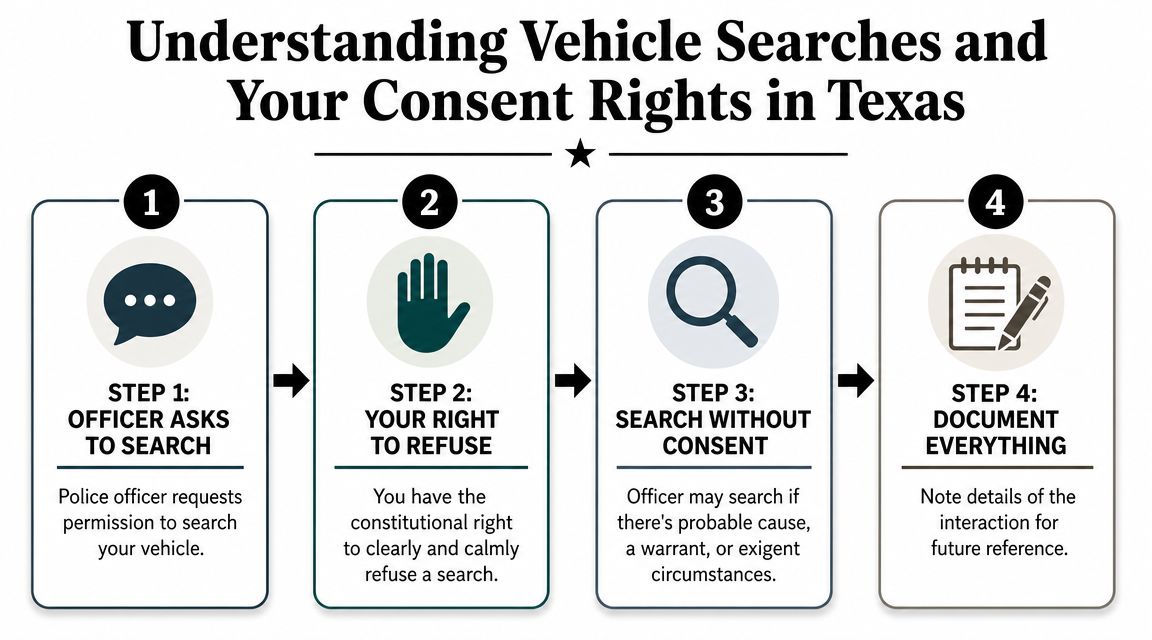
The key point is this. Refusing consent does not automatically end the encounter. The Daniel Stark article on traffic-stop rights and practical guidance notes that officers may still search if they claim another legal justification such as probable cause, and that the actual legal contest later focuses on whether that justification was valid.
What to say when asked for consent
Keep your answer plain:
“I do not consent to any searches.”
That's enough. Don't add, “but I have nothing to hide.” Don't start explaining what might be in the car. Don't physically interfere if the officer searches anyway.
Here's a helpful walkthrough before we go further:
What can happen after you say no
This is the part many articles leave out. Your refusal may preserve an important legal issue, but it doesn't force the officer to stop investigating. The officer may claim another basis to search. If that happens, the case usually turns on whether the claimed reason holds up in court.
Common flashpoints include:
- Statements by the officer: What exactly did the officer say justified the search?
- Body-cam and dashcam footage: Does the video match the report?
- Timing: Did the officer prolong the stop before searching?
- Scope: Did the search go beyond what the law allowed?
The courtroom fight matters more than the roadside debate
If charges follow, your lawyer may file a motion to suppress and challenge the search under the Fourth Amendment. In practice, that often means reviewing the report line by line, comparing it to video, and testing whether the officer's explanation really supports the search.
If the evidence was found through an illegal search, the court may exclude it. In some cases, that can seriously damage the prosecution's case.
For a broader explanation of these issues, see this page on illegal search and seizure in Texas.
What to document after the stop
As soon as you safely can, write down what happened. Include:
- The officer's words: Especially the stated reason for the stop and the search.
- Your response: Whether you refused consent clearly.
- Sequence of events: When you were asked to step out, when the search began, and what was found.
- Witnesses and recordings: Passengers, dashcams, receipts, or location history can all matter.
That information can help your lawyer challenge the stop or search later.
Special Rules for Texas DWI and DUI Stops
DWI stops carry their own set of risks. A simple traffic stop can quickly become an impaired-driving investigation based on the officer's observations, your statements, or what happens after you're asked to step out.
One point causes confusion again and again. You may preserve some rights by staying silent and refusing consent to a search, but that doesn't mean you can refuse every order.
The public guidance discussed in this video about Texas traffic-stop commands makes a critical point clear: Texas law allows police to order the driver and passengers out of the vehicle during a lawful stop, and complying with that order is mandatory. Refusing can complicate your case.
Getting out of the car is different from consenting to a search
These are not the same thing.
If an officer tells you to step out, comply calmly. That doesn't waive your right to remain silent. It also doesn't mean you have consented to a search. It means you followed a lawful command.
That distinction matters in DWI cases because officers often use the exit from the vehicle to observe balance, coordination, speech, and other details they may later describe in reports or testimony.
Field sobriety tests and chemical tests
People often lump these together, but they are different decisions with different consequences.
Field sobriety tests are roadside exercises. They become evidence if you perform them, and they can be challenged later based on how they were instructed, administered, and recorded.
Chemical testing raises a separate issue under Texas implied-consent rules. If an officer makes a lawful request for a breath or blood test, refusing can trigger driver's license consequences. That decision can affect both the criminal case and your ability to drive.
If you're dealing with that issue, this page on whether you can refuse a breathalyzer test in Texas can help you understand the trade-offs.
Practical mistakes that hurt DWI defenses
The most common ones are simple:
- Talking too much: “I only had two drinks” is still an admission.
- Arguing on camera: It rarely helps and often hurts.
- Refusing to exit the vehicle: That creates a separate problem.
- Trying to perform for the officer: Nervous explanations and volunteered details become evidence.
If a DWI arrest follows, your defense may focus on the reason for the stop, the officer's observations, the tests, the video, and whether the investigation followed constitutional rules and proper procedure.
From Handcuffs to a Phone Call Navigating an Arrest
If the stop ends in handcuffs, the experience can feel fast and unreal. First comes the arrest. Then transport. Then booking.
At the jail or station, officers usually take fingerprints, a photograph, and inventory your personal property. You may be placed in a holding area while the case is entered and release conditions are considered.

What happens next in the criminal process
The next stages depend on the charge, but the path often includes:
Magistration or initial appearance
You're informed of the accusation and possible conditions of release.Bond and release
Some people post bond and leave quickly. Others wait longer depending on the charge and county procedures.Arraignment and early court settings
The case begins moving through the court system. A not guilty plea is common at the start while the defense investigates.Plea bargaining or pretrial litigation
Some cases resolve through negotiation. Others require motions, including suppression issues tied to the stop.Trial and sentencing if needed
If no agreement is reached, the case may go to trial. If there is a conviction or plea, sentencing follows.
Your first call matters
After an arrest, the safest move is usually to stop talking about the facts of the case with police, cellmates, or anyone else who may repeat what you said.
Call a lawyer. If family is helping from the outside, they should focus on bond, medical needs, and getting your defense started, not on gathering your version of events through a chain of phone calls or text messages.
If the case ends favorably, or if you later qualify under Texas law, you may also have options involving expunction, nondisclosure, or other post-conviction relief. Those issues are separate from the stop itself, but they matter if you're trying to protect your future after a criminal case.
How a Lawyer Defends Your Rights After a Traffic Stop
A strong defense often begins with one question. Was the stop legal?
That isn't abstract. It drives suppression motions, plea decisions, trial strategy, and whether key evidence comes in at all. The reasonable-suspicion analysis discussing Hernandez v. State notes that in 2025, the Texas Court of Criminal Appeals reversed a conviction because the initial traffic stop lacked reasonable suspicion. That kind of ruling shows why the first few minutes on the roadside can decide the whole case.
What a defense lawyer actually reviews
A careful lawyer doesn't just read the offense report and move on. The work usually includes:
- Testing the stated basis for the stop
- Reviewing body-cam and dashcam footage
- Comparing video to the officer's report
- Examining whether the stop was prolonged unlawfully
- Challenging searches, statements, and arrest decisions
When appropriate, a lawyer may file a motion to suppress. If the court excludes evidence from an illegal stop or search, the State may lose what it needs to prove a DWI, drug possession, weapons, theft, or assault-related case that grew out of the traffic encounter.
The Law Office of Bryan Fagan PLLC handles criminal defense matters across Texas, including cases where a traffic stop raises suppression issues, search challenges, bond concerns, plea negotiations, trial strategy, and later record-clearing questions such as expunction or nondisclosure when the law allows.
Your conduct during the stop matters here. If you provided the required documents, stayed silent, and refused consent clearly, you may have preserved arguments that are far more useful in court than any roadside explanation ever would have been.
If you've been charged with a crime in Texas, call The Law Office of Bryan Fagan, PLLC for a free and confidential consultation. Our defense team is ready to protect your rights.