Discovering there’s a warrant for your arrest in Texas can be terrifying — but you don’t have to face it alone. The shock is real, but it's critical to understand that you have rights and options. This guide is the first step toward understanding your situation, taking control, and fighting for your future.
What to Do the Moment You Discover a Texas Arrest Warrant

The second you find out there’s a warrant with your name on it, your world can feel like it's spinning out of control. Whether you found out from a friend, saw your name online, or had a tense moment during a traffic stop, the feeling of dread is immediate. You’re likely filled with fear and uncertainty about what happens next.
Here’s the hard truth: ignoring the problem is the worst thing you can do. An active arrest warrant in Texas doesn't just expire or fade away. It stays in the system, waiting. That means any interaction with law enforcement, even for something as minor as a broken taillight, could lead to an immediate and public arrest.
You Are Not Alone and You Have Options
The most important thing to know right now is that you have rights, and you have choices. Facing the warrant head-on with a clear strategy is always better than waiting for a knock on the door or a roadside arrest. Taking proactive steps can completely change the outcome.
An experienced criminal defense lawyer can help you take control. Here are the first steps we take:
- Verify the warrant: First, we confirm the warrant is legitimate and find out exactly what charges you're facing.
- Plan a surrender: We can arrange a quiet, discreet "walk-through" surrender at the jail, so you can avoid the embarrassment and disruption of a surprise arrest at home or work.
- Fight for your release: Your attorney will immediately start fighting for a reasonable bond amount or even a personal recognizance bond, which would let you stay free while your case is pending.
A proactive approach shows the court you're taking this seriously, which often leads to a better outcome than if you’re dragged in unexpectedly. It gives your attorney the high ground to start building a defense from day one.
Understanding the full scope of what happens when you get arrested in Texas can also help you prepare for the road ahead. By partnering with a lawyer, you replace fear with a clear, actionable plan. Our job is to show you a path forward that protects your rights, your reputation, and your future.
Understanding the Different Types of Warrants in Texas
Not all warrants are created equal. The word itself is enough to make anyone’s heart pound, but understanding exactly what kind of warrant you’re facing is the first step toward taking control of the situation. Different warrants serve different legal purposes, and each one requires a unique strategy. Knowing the difference is key to protecting your freedom.
The most common type is an arrest warrant. This is an official order, signed by a judge, based on a sworn statement from a police officer called a "probable cause affidavit." This document gives law enforcement the authority to take you into custody because a judge agrees there's probable cause—a reasonable belief—that you committed a crime. This is how most criminal cases begin.
Arrest Warrants vs. Bench Warrants
While an arrest warrant kicks off a new criminal case, a bench warrant is different. It’s called a "bench" warrant because it’s issued directly from the judge's bench, usually because you failed to follow a court order.
Common reasons a judge might issue a bench warrant include:
- Missing a mandatory court appearance for a pending case.
- Failing to pay court-ordered fines or restitution.
- Violating the terms of your probation or parole.
A bench warrant isn't about a new crime. It's the court's way of commanding you to appear, and it gives police the power to arrest you to make sure that happens.
The sheer volume of warrants is staggering. A 2020 Bureau of Justice Statistics survey found over 6.6 million active warrant records across 40 states, including 1.4 million for felonies and 3.4 million for misdemeanors. This shows just how easily a local issue can escalate. You can read the full research on national warrant statistics to see the scale of these systems.
What is a Capias Warrant?
Another type you’ll see in Texas is a capias warrant. The term "capias" is Latin for "that you take," and these warrants operate much like bench warrants but for specific situations. Under the Texas Code of Criminal Procedure, a judge issues a capias warrant to have you arrested and brought to court, often after a final judgment has already been entered.
For instance, if you were found guilty of a traffic ticket, ordered to pay a fine, and then never paid it, the judge could issue a capias warrant. This authorizes your arrest so the court can deal with the unpaid fine. You can learn more about what a capias charge means in Texas in our article for a deeper dive into this specific legal tool.
Knowing whether you’re up against an arrest warrant for a new charge, a bench warrant for a missed court date, or a capias for an old fine is absolutely critical. Each requires a different plan. An experienced Houston criminal lawyer can quickly identify the warrant type, explain what it means for you, and start building the right strategy to resolve it with minimal damage to your life.
How to Safely Check for an Active Arrest Warrant in Texas
The thought that a warrant might be out for your arrest is a heavy weight to carry. That constant worry can affect your job, your family, and your peace of mind. The good news is you can find out for sure, but how you check for that arrest warrant in Texas matters just as much as what you find.
Discovering a warrant is the first step, but you have a few ways to go about it. Some are far riskier than others, and it’s critical to pick the method that protects your rights and gives you a strategic advantage.
Searching Online Databases: A Risky First Step
Many Texas counties, like Harris, Dallas, Travis, and Bexar, have online portals where you can search for active warrants. It’s tempting to start here—you can check from the privacy of your home.
But these online systems come with serious problems:
- They can be inaccurate or outdated. A judge might have signed a warrant yesterday that hasn’t been uploaded to the public site yet.
- They might not be complete. Some databases only show warrants for certain offenses like unpaid tickets or misdemeanors, while serious felony warrants are often kept private.
- Mistaken identity is a real possibility. Finding a warrant for someone with a similar name can cause unnecessary panic.
Relying only on an online search can give you a false sense of security or create anxiety over something that isn't your problem. It's a tool, but it should never be your only source of information.
Going to the Courthouse: A High-Stakes Gamble
Another option is to walk into the county courthouse and ask the clerk to run a search for you. This approach is more direct and will likely give you accurate, up-to-the-minute information. It also carries a massive risk.
If an active warrant for your arrest does exist and you are standing right there in the courthouse, you could be arrested on the spot. Courthouses are full of law enforcement officers, and a clerk who finds a warrant is often obligated to let them know. This turns your fact-finding mission into an unplanned surrender on the worst possible terms.
The Smartest Move: Hiring a Criminal Defense Attorney
Without a doubt, the safest and most effective way to check for an arrest warrant in Texas is to have an experienced criminal defense attorney handle it for you. This strategy gives you critical advantages you simply can't get by going it alone.
An attorney acts as a confidential buffer between you and law enforcement. We can make inquiries on your behalf without alerting the authorities to your location, ensuring your privacy and safety throughout the process.
Here’s why this is the only truly safe move:
- Total Confidentiality: Everything you tell your lawyer is protected by attorney-client privilege.
- Zero Risk of Arrest: You won't be anywhere near the courthouse when the search is done, eliminating the chance of being detained.
- An Immediate Action Plan: If we find a warrant, we are already in place to start planning your defense, arranging a voluntary surrender on your terms, and preparing for a bond hearing.
This proactive approach puts you back in control. Instead of reacting to a shocking arrest at work or home, you and your legal team are already prepared to face the problem head-on, setting the stage for a much better outcome.
Your Immediate Next Steps If a Warrant Exists
Finding out there’s a warrant for your arrest is a punch to the gut. It’s a moment filled with dread and uncertainty, but what you do next is absolutely critical. The single worst mistake you can make is to do nothing, hoping it will all just blow over.
An outstanding arrest warrant in Texas never expires. Trying to hide from it only makes things worse, leading to a surprise arrest at the worst possible time and putting you on the defensive from day one. Taking control of the situation now is your best—and only—real option.
An experienced attorney can step in immediately and manage the process for you. We often arrange what’s called a “walk-through” surrender, a strategic move that shows the court you’re taking this seriously and can make a huge difference in how your case is handled.
The Power of a Proactive Surrender
A walk-through isn’t about just giving up; it’s a strategic choice. Instead of waiting for the embarrassment and chaos of an arrest at home, during a traffic stop, or at your job, you handle it on your own terms. Your attorney coordinates with law enforcement and the court to have you booked and released, often in just a few hours.
The advantages are massive:
- Dignity and Discretion: You avoid a public spectacle in front of your family, friends, or coworkers.
- Favorable Bond Conditions: When you show the court you aren't a flight risk, you dramatically improve your chances of getting a favorable bond. This might mean a lower bail amount or even a personal recognizance (PR) bond, which lets you go home on a written promise to appear without paying any money.
- Strategic Advantage: Your defense starts on the offensive, not from a jail cell trying to play catch-up.
This flowchart breaks down the safest ways to confirm a warrant and move forward.
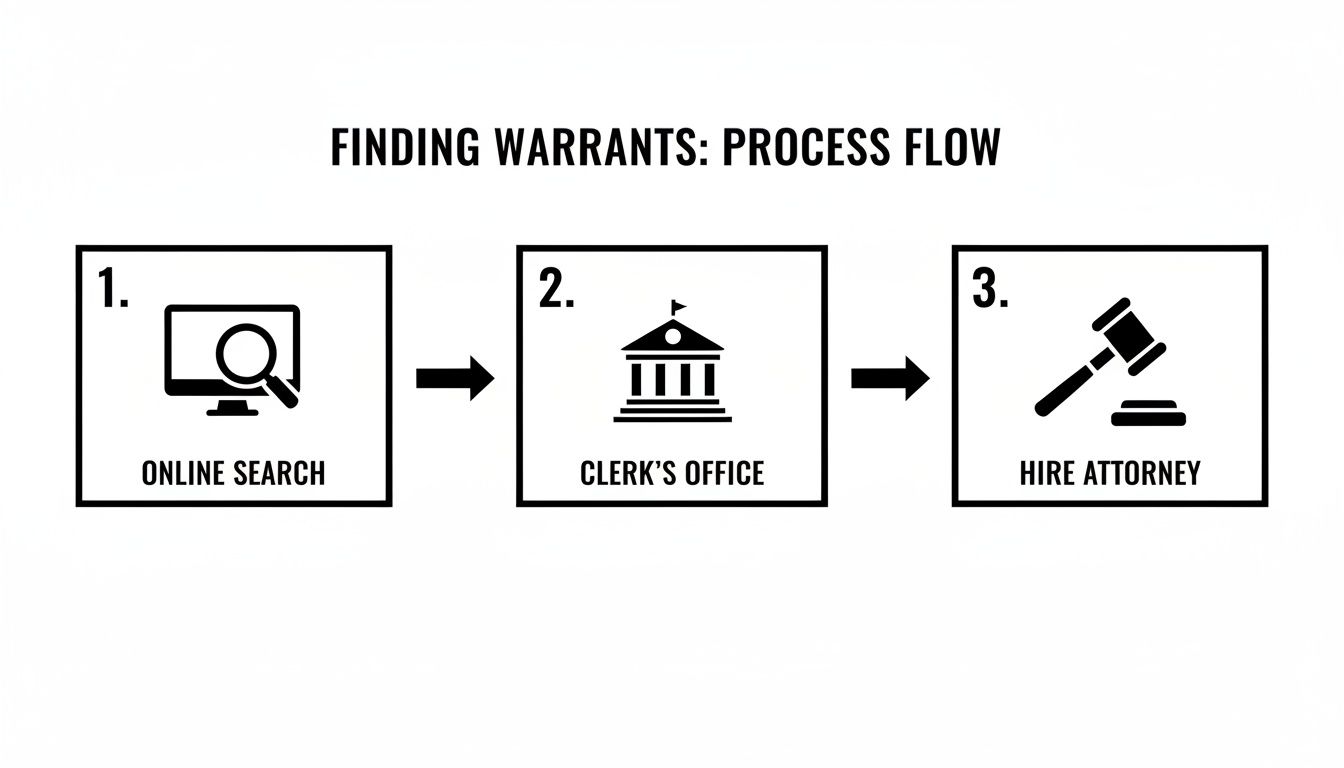
As you can see, while you can search public records yourself, the only method that’s completely risk-free—and prepares you for what comes next—is working through an attorney.
What Happens at an Arraignment and Bail Hearing
Once you’re in custody, whether from a walk-through or a surprise arrest, you’ll be brought before a judge for your arraignment. This is your first official court appearance. The judge will read the charges against you, inform you of your rights, and—most importantly—set the terms of your release, known as bail.
Bail is the money or bond you post to get out of jail while your case moves forward. It’s meant to guarantee you’ll show up for future court dates. A good attorney will fight for the lowest possible bail amount or a PR bond by painting a clear picture of you as a responsible person with ties to the community. You can learn more about bail and bond in Texas in our article to get a better handle on this crucial stage.
Crucial Takeaway: The moments after you confirm a warrant are a turning point. A strategic, attorney-led surrender can lead to a quick release and set your defense up for success. Ignoring the warrant almost guarantees a public arrest and a much harder fight.
From the moment you hire an attorney, they can start attacking the warrant itself. By digging into the probable cause affidavit—the sworn statement police used to get the warrant in the first place—your lawyer will hunt for errors, misstatements, or constitutional violations that can be used to build your defense.
Building a Defense Against the Criminal Charges
Getting an active warrant handled is a huge relief, but it’s only the first step. The real fight begins now—defending against the criminal charges that triggered the warrant in the first place. A successful defense isn't about just showing up and hoping for the best. It’s about methodically taking the state’s case apart, piece by piece.
An experienced defense attorney never takes a police report at face value. We start by digging into the probable cause affidavit. This is the sworn statement an officer wrote to convince a judge to issue the arrest warrant in Texas. Often, this document is the weakest link in the prosecution's entire case.
Challenging the Evidence and the Warrant
Was the warrant built on flimsy evidence, a questionable informant, or a violation of your constitutional rights? If we can prove the warrant was obtained improperly or that officers seized evidence illegally, we file a motion to suppress.
A successful motion to suppress acts as a legal shield. It blocks the prosecutor from using that tainted evidence against you in court. This single move can cripple their case, sometimes forcing a complete dismissal before a trial even starts. Common grounds for a motion to suppress include:
- Lack of Probable Cause: The affidavit simply didn't have enough solid facts to justify a warrant.
- Illegal Search and Seizure: Police collected evidence without a valid warrant or a legitimate reason to skip getting one, violating your Fourth Amendment rights.
- Miranda Rights Violations: You were questioned by police while in custody but were never read your rights.
Crafting a powerful defense means doing our homework. It involves deep investigation and serious legal research to find laws and past cases that support our argument. Using effective legal research tools helps us uncover precedents that can completely turn a case around.
Negotiating for a Better Outcome
Not every case ends in a dramatic jury trial. In fact, many are resolved through careful, strategic negotiations with the prosecutor. This process, known as plea bargaining, can often secure a much better outcome, such as:
- Reduced Charges: For instance, getting a felony DWI charge knocked down to a misdemeanor obstruction of a highway.
- Deferred Adjudication: This is a special kind of probation. If you complete it successfully, the charge is dismissed, and you avoid a final conviction. This is a great option for assault, theft, or drug possession cases.
- Pre-Trial Diversion: A program, often for first-time offenders, that can also lead to a full dismissal and keep your record clean.
Our goal is always to secure the best possible result, whether that means a complete dismissal, a not-guilty verdict at trial, or a plea agreement that minimizes the damage and allows you to move forward.
Clearing Your Name for the Future
Even when a case is dismissed or you finish probation, that arrest can hang over your head for years. It shows up on background checks, creating hurdles for jobs, housing, and even loans. This is why our work doesn't stop when the case closes. We also focus on what comes next.
Depending on how your case ended, you might be eligible for an expunction, which completely destroys all records of the arrest, or an order of nondisclosure, which seals them from public view. This is more important than ever. The Texas Judiciary's Annual Statistical Report for FY2024 noted a statewide 6% increase in criminal case filings. You can learn more about Texas court statistics to see how these trends affect people every day. Clearing your record is the final, crucial step to truly putting an incident behind you and getting your life back.
Why an Experienced Attorney Is Your Strongest Ally

Discovering there’s an arrest warrant in Texas with your name on it is a high-stakes moment. Trying to handle it alone is like walking into a maze blindfolded. The justice system is packed with complex procedures, unforgiving deadlines, and unwritten rules where one wrong step can follow you for years. This is precisely when a skilled criminal defense attorney isn't just an option—they're your most critical ally.
Think about the two very different paths you can take. Going it alone means you’re facing a surprise arrest at any moment, risking saying the wrong thing to investigators, and fumbling through a process designed to secure convictions. But partnering with The Law Office of Bryan Fagan, PLLC, means you have a professional advocate in your corner from the very beginning.
The Shield and Guide You Need
From day one, a good lawyer serves two key roles: they are your shield and your guide. As your shield, we protect you from direct police questioning and ensure your constitutional rights are upheld at every turn. As your guide, we translate legal jargon into plain English so you always know where you stand and what your options are.
Here is what our experienced legal team brings to your defense:
- Strategic Planning: We don't just react. We build a clear plan tailored to your case, whether that means arranging a quiet surrender or aggressively challenging the warrant's validity.
- Skilled Negotiation: Our attorneys have spent years building relationships with prosecutors across Texas. This allows us to negotiate effectively for reduced charges, alternative programs, or even a full dismissal of the case.
- Courtroom Advocacy: If your case goes to trial, you need a battle-tested litigator in your corner who can confidently dismantle the prosecution's arguments and fight for a "not guilty" verdict.
With a team of experienced attorneys, including former prosecutors, we have successfully represented thousands of clients against everything from simple misdemeanors to the most serious felonies.
Choosing the right attorney is the single most important decision you can make. It's the difference between facing the full power of the state by yourself or having a seasoned defender fighting to protect your freedom, your reputation, and your future. We are committed to giving you the aggressive defense you need and the compassionate guidance you deserve.
Frequently Asked Questions About Texas Arrest Warrants
When you learn there might be a warrant out for your arrest in Texas, your mind starts racing. The uncertainty and stress can be overwhelming. We understand. Here are clear, plain-English answers to the most common questions we hear from people in your situation.
How Long Does an Arrest Warrant Last in Texas?
This is a critical question, and the answer is serious: a Texas arrest warrant never expires.
Once a judge signs that warrant, it remains active forever. It doesn't matter if it's for a misdemeanor or a felony, and it won’t just "go away" after a few years. It will follow you indefinitely until you are arrested or the warrant is formally cleared by the court. This is why trying to wait it out is one of the worst mistakes you can make.
Can I Be Arrested for a Warrant From Another County?
Yes, and it happens all the time. An arrest warrant is valid throughout the entire state of Texas. Law enforcement agencies are all connected through statewide databases.
Imagine you get pulled over for speeding in Dallas. If you have an outstanding warrant for a misdemeanor case in Harris County, that officer's computer will likely flag it. The next thing you know, you're being arrested and held until you can be transferred. For serious felonies, these warrants can even follow you across state lines.
What Is a "No-Knock" Warrant?
A "no-knock" warrant is a special court order that gives police the authority to enter a property without announcing themselves first.
Under the Texas Code of Criminal Procedure, these are reserved for high-risk situations. To get one, police must provide solid evidence to a judge that knocking and announcing their presence would be dangerous, allow someone to escape, or give them time to destroy critical evidence (like drugs). These are not standard procedure and are meant for exceptional circumstances.
Will a Warrant Show Up on a Background Check?
Absolutely. An active warrant is a major red flag that will almost certainly appear on any detailed criminal background check. This can cause immediate problems when you're applying for a job, trying to rent an apartment, or seeking a professional license.
Even after you resolve the warrant, the arrest and the original charge can still linger on your record. That's why your first step is addressing the warrant, but the final step should be exploring legal options like expunctions and record sealing to truly clear your name and protect your future.
The single most important thing to remember is this: a warrant is a legal landmine. Trying to navigate it on your own is a huge risk with severe consequences.
An experienced Texas DWI attorney or Houston criminal lawyer can discreetly verify the warrant, explain exactly what you're facing, and start building a strategy to get it resolved. Your best move is always to get a professional in your corner.
If you’ve been charged with a crime in Texas, call The Law Office of Bryan Fagan, PLLC for a free and confidential consultation. Our defense team is ready to protect your rights. You can reach us at texascriminallawyer.net.