Being arrested in Texas can be terrifying, especially when your first thought isn't jail, bond, or court. It's your kids. You may be asking whether one bad night, one accusation, or one pending case can cost you custody.
The short answer is yes, a criminal case can affect child custody in Texas. But it does not mean you automatically lose your rights as a parent.
What matters is how the family court views risk. Judges want to know whether your child is safe, whether your home is stable, and whether the conduct behind the criminal case says something serious about your judgment or ability to parent. If you're dealing with both a criminal charge and a custody dispute, you need to treat them as connected from day one. If you still have only an arrest and no conviction, it also helps to understand how Texas treats an arrest without a conviction, because the family court may still react before the criminal case is finished.
A lot of parents make the same mistake. They focus on beating the charge and assume custody can wait. That's often what causes the family case to spiral. The smarter move is to protect both cases at the same time.
The Unsettling Link Between an Arrest and Your Child Custody Case
A parent gets arrested after an argument at home. Another is stopped for DWI with a child exchange scheduled the next morning. Someone else is charged with drug possession after a traffic stop, then gets served with custody papers days later. Different facts, same panic.
The fear is real because criminal allegations can change how the other parent, the court, and sometimes CPS view your role overnight. A pending charge gives the other side something concrete to put in front of a judge. Even before anyone proves the case, the accusation can shape the story being told about you.
Why the custody case can move faster than the criminal case
Criminal courts move on one track. Family courts move on another. Those tracks don't wait for each other.
In practical terms, that means the family judge may make temporary decisions about possession, exchanges, supervision, testing, or decision-making rights long before your criminal case reaches plea bargaining, trial, or sentencing. You might still be at the bond stage while the other parent is already asking for restrictions.
Practical rule: If your criminal case touches violence, intoxication, drugs, or unsafe behavior around the child, assume the custody case is already being affected.
What usually helps and what usually hurts
Some responses make things better. Others make them worse fast.
Helps early
Calm compliance with bond conditions, clean communication, and fast legal action in both courts.Hurts early
Angry texts, social media posts, violating no-contact terms, or talking about the facts of the case to “clear things up.”
If you're wondering, can a criminal case affect child custody in Texas, the answer depends less on labels like misdemeanor or felony and more on what the alleged conduct says about child safety. That's the lens every next decision will pass through.
Understanding the Best Interest of the Child Standard in Texas
Texas custody decisions turn on one core idea. The best interest of the child.
That standard sounds broad, but judges don't decide it by guesswork. They look at facts that point to safety, stability, parenting ability, and the child's needs. When a criminal case enters the picture, the court asks a blunt question. Does this charge suggest danger, instability, or impaired judgment that could affect the child?
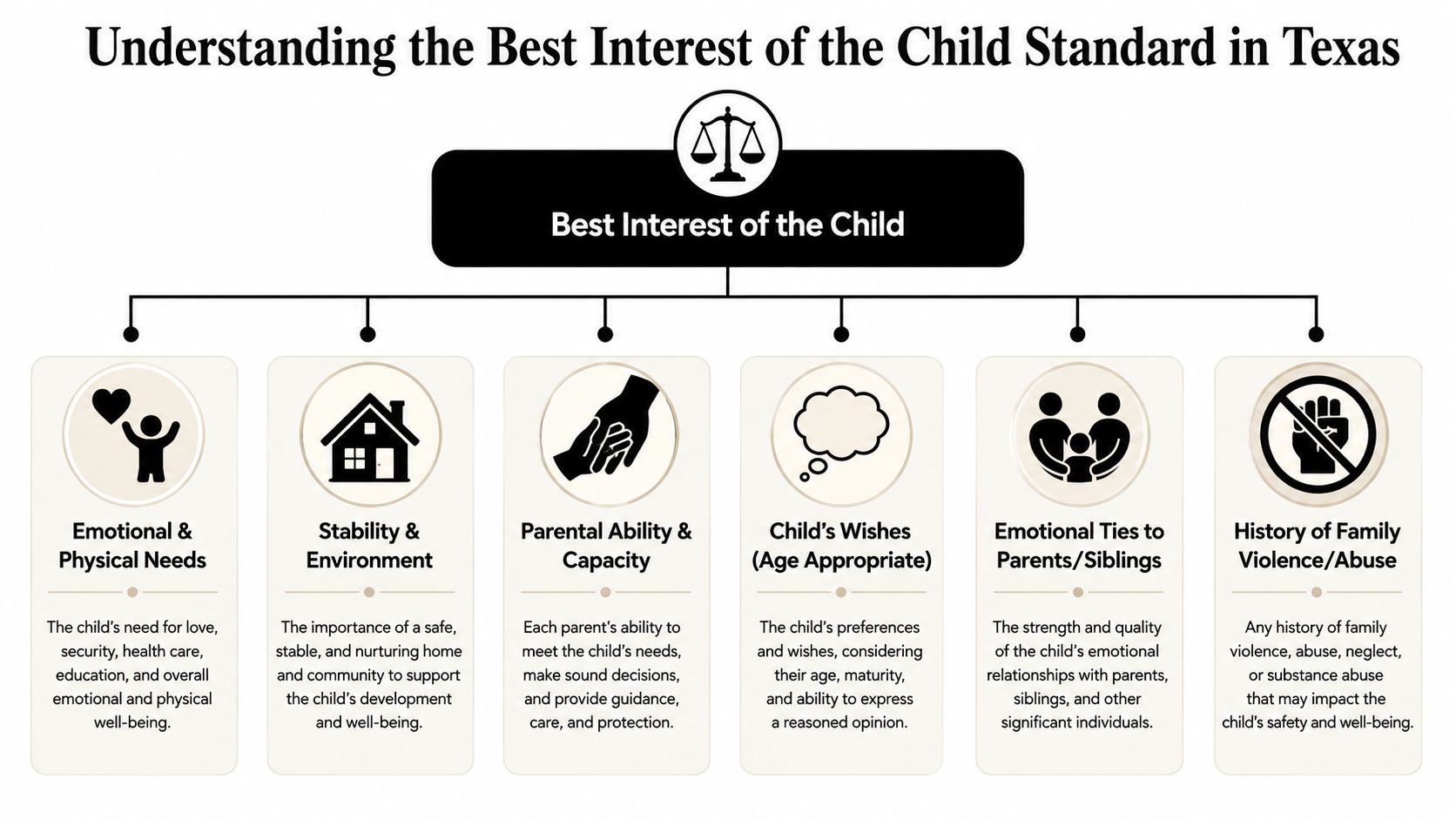
What judges look at in plain English
Texas courts often consider factors commonly known as the Holley factors. In everyday terms, that includes things like:
Your child's needs
Emotional support, physical care, routine, and safety now and later.Risk of harm
Whether anything in your conduct suggests present or future danger.Parenting ability
Whether you can make sound decisions and provide consistent care.Home stability
Whether your living situation is calm, safe, and dependable.Your conduct toward the child or family
Acts or failures to act that may show an unhealthy parent-child relationship.History of violence or abuse
This carries major weight because it goes straight to safety.
Where criminal allegations matter most
Texas does not automatically strip a parent of custody or visitation because of a criminal charge or conviction. Courts focus on the child's best interests and the specific facts of the offense. Under Texas Family Code § 153.131, there is a rebuttable presumption that appointing a parent as a sole or joint managing conservator is not in the child's best interest if the parent has a history of child abuse, neglect, or family violence, and domestic-violence findings can prevent a parent from being named a joint managing conservator, as explained in this discussion of how a felony affects child custody in Texas.
That's why two criminal cases with the same punishment range can create very different custody outcomes. A nonviolent theft case and an assault involving the other parent do not land the same way in family court.
The family judge isn't deciding whether to punish you for a charge. The judge is deciding whether your child should be protected from the facts behind it.
What this means for your defense
Your criminal defense has to do more than attack the charge. It also has to answer the family court's concerns about safety, judgment, and stability. If your lawyer only looks at jail exposure and ignores the custody record being created at the same time, you're leaving one of the biggest risks untouched.
How Different Criminal Charges Uniquely Impact Custody
Not every charge carries the same custody danger. Family courts usually sort these cases by one main issue. How closely does the alleged conduct relate to the child's safety and your parenting judgment?
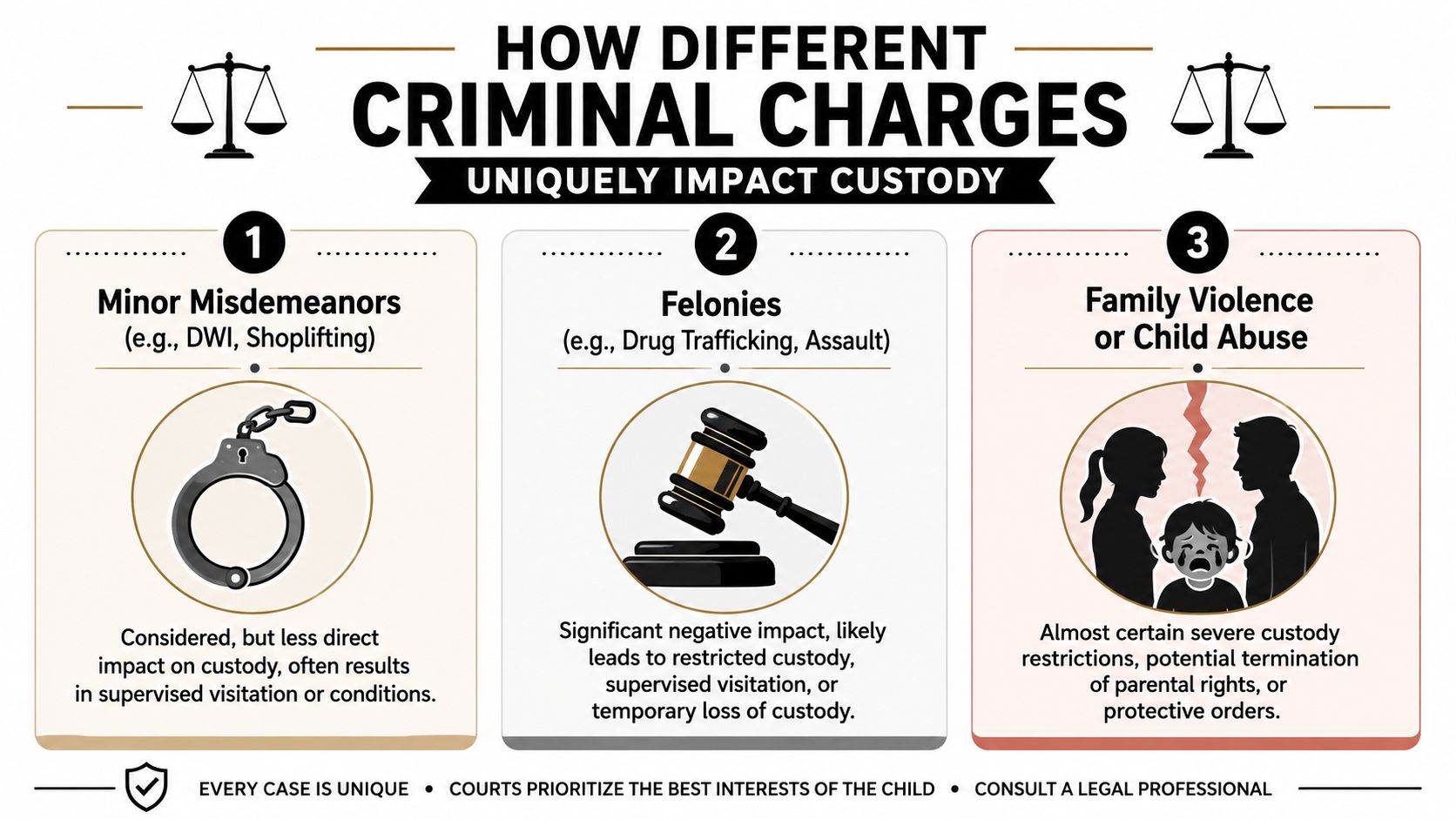
Family violence and assault charges
These are usually the most dangerous charges for custody. If the allegation involves the other parent, a household member, or conduct near the child, the family court may see the criminal case as direct evidence of possible harm inside the home.
Under the Texas Penal Code, assault charges often arise under Section 22.01. The criminal court will focus on proof, intent, injuries, witness credibility, and defenses such as self-defense. The family court looks at the same event through a different lens. It asks whether the child may be exposed to violence, fear, chaos, or coercive behavior.
If there's an arrest for assault tied to a domestic dispute, common custody risks include:
Restricted exchanges
Parents may have to use third-party exchange locations or neutral sites.Supervised time
A judge may require another adult or facility to monitor visits.Decision-making limits
The accused parent may lose ground on education or medical authority.No-contact complications
Bond terms or protective orders can interfere with parenting time.
Wording holds significant importance. A plea bargain that resolves the criminal case may still create family-law damage if it leaves behind findings or admissions tied to violence.
DWI and drug charges
A DWI charge may not involve family violence, but it can still hit custody hard if the facts suggest impaired parenting or child endangerment. In Texas, DWI is commonly prosecuted under Penal Code Section 49.04. If the allegation includes a child passenger, the family court will usually take a much harder look at your judgment.
Drug possession cases raise a similar problem. Under the Texas Controlled Substances Act, prosecutors look at possession, intent, and the substance involved. Family courts ask different questions. Were drugs accessible in the home? Was the child exposed to unsafe people or unsafe conditions? Is substance use affecting reliability, transportation, school attendance, or supervision?
What tends to work in these cases is proof of stability. Missed tests, missed visits, and excuses usually hurt. Clean testing, treatment compliance, steady housing, and a boring routine help.
Theft, fraud, and other nonviolent offenses
Theft and fraud charges usually present a lower direct safety concern than violence or intoxication-based cases. Theft often falls under Penal Code Section 31.03. Fraud-related charges can arise in several ways depending on the allegation, such as forgery, credit card abuse, or other white-collar offenses.
That said, lower risk doesn't mean no risk. The other parent may still argue that repeated dishonest conduct shows poor judgment, instability, or bad moral example. If the case affects your employment, income, or housing, the custody issue may become practical instead of moral. Can you still provide a stable environment?
A judge in Houston, Dallas, Austin, or San Antonio may not react strongly to a remote, nonviolent offense standing alone. But if the charge is recent, part of a pattern, or combined with probation violations or financial instability, it can still shape temporary orders.
A quick comparison
| Charge category | Main family court concern | Common custody response |
|---|---|---|
| Family violence or assault | Safety and fear in the home | Strong restrictions, supervision, limited conservatorship |
| DWI or drug offense | Endangerment, impairment, instability | Testing, treatment conditions, supervision, modified possession |
| Theft or fraud | Judgment, honesty, financial stability | Context-specific limits, often less direct impact |
If you're facing arraignment or another first appearance, remember that what you say and agree to there can echo into custody. The criminal process moves through arrest, magistrate warnings, bond conditions, charging decisions, plea talks, trial preparation, and sentencing. Every stage can create records the family court may see later.
Immediate Threats After an Arrest Temporary Orders and CPS
The custody danger often starts before you've even hired a criminal lawyer. An arrest can trigger emergency action fast.
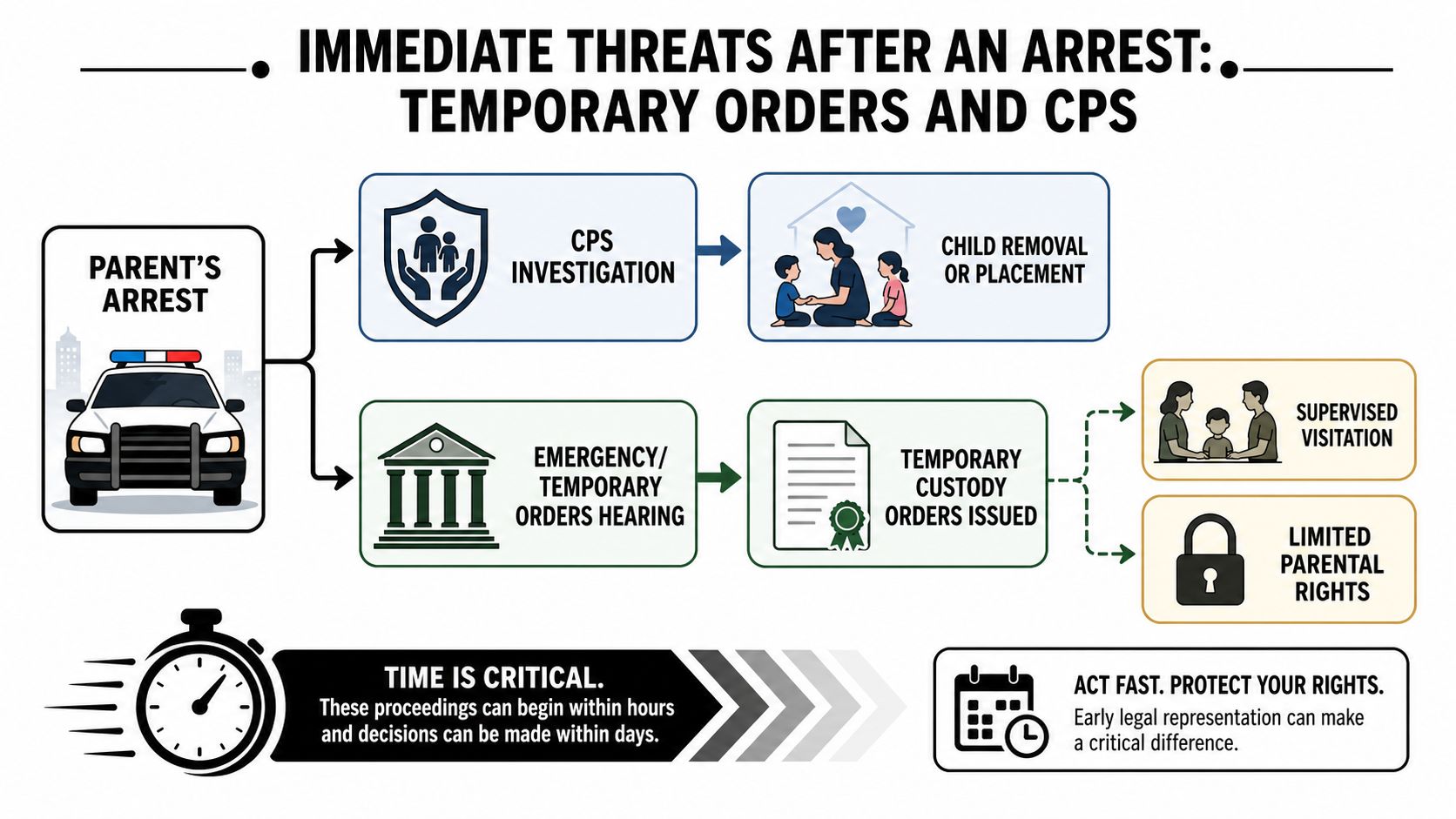
Temporary orders can arrive before any conviction
A criminal case can have an immediate procedural effect even before conviction. Pending charges may justify temporary custody changes, supervised visitation, drug or alcohol testing, or other protective conditions while the family court assesses risk. Texas courts may also deny or limit joint managing conservatorship and, in severe cases, restrict access altogether when the evidence suggests family violence or endangerment. A conviction is not required for these interim restrictions if the court finds the child's safety is at risk, as discussed in this article on domestic violence charges and child custody risks.
If police were called to a home, the criminal court may also issue protective conditions that affect contact with the other parent or household. To understand how that can limit communication, exchanges, and access, review how an emergency protective order in Texas works.
CPS may open a separate front
CPS doesn't need to wait on the criminal court either. If the allegation involves violence, drugs, intoxication around children, or unsafe living conditions, CPS may begin its own investigation.
That creates a three-front problem:
- Criminal court decides guilt, bond terms, and case outcome.
- Family court decides temporary possession and conservatorship.
- CPS evaluates safety, supervision, and placement concerns.
When parents get into trouble, the first hearing often matters more than the final one. Temporary orders shape the new normal.
What to do in the first stretch after arrest
Follow every release condition
A bond violation can damage both cases at once.Preserve records
Save messages, exchange logs, school records, and names of witnesses.Don't contact people you've been told to avoid
Trying to “fix it” informally often creates new allegations.Get both strategies aligned immediately
You need one plan for the criminal file, custody case, and any CPS contact.
The Evidence Used Against You in Family Court
Many parents assume the family judge will wait for a conviction. That's a mistake. Family court often considers a much wider set of information than people expect.
A prosecutor trying a criminal case has to meet a high burden and follow strict evidentiary rules. A family court hearing about temporary custody is different. The judge may hear about the incident through multiple channels and make short-term decisions based on risk, not just final guilt.
What may show up in a custody hearing
The other parent may try to use:
Police reports
Even when the report contains one-sided allegations.Photos and videos
Injuries, property damage, or conditions inside the home.Texts, emails, and voicemails
Especially threats, apologies, angry outbursts, or intoxicated messages.Social media posts
Photos from bars, comments about the case, or posts that contradict your story.Affidavits and live testimony
Friends, relatives, neighbors, teachers, or exchange witnesses.Drug or alcohol testing history
Missed tests can be framed badly, even if you believe you had a reason.
The practical mistake people keep making
They defend the criminal case in public. They post explanations, attack the other parent online, or send long emotional messages that sound like admissions. None of that helps.
Case advice: If you wouldn't want a family judge reading it out loud in court, don't text it, post it, or send it.
Why dismissed charges can still leave damage
Even if the criminal case later ends well, the family court may still remember the conduct allegations, the temporary hearing testimony, and how you acted during the crisis. That's why your behavior after arrest matters almost as much as the charge itself. Judges notice consistency. They also notice chaos.
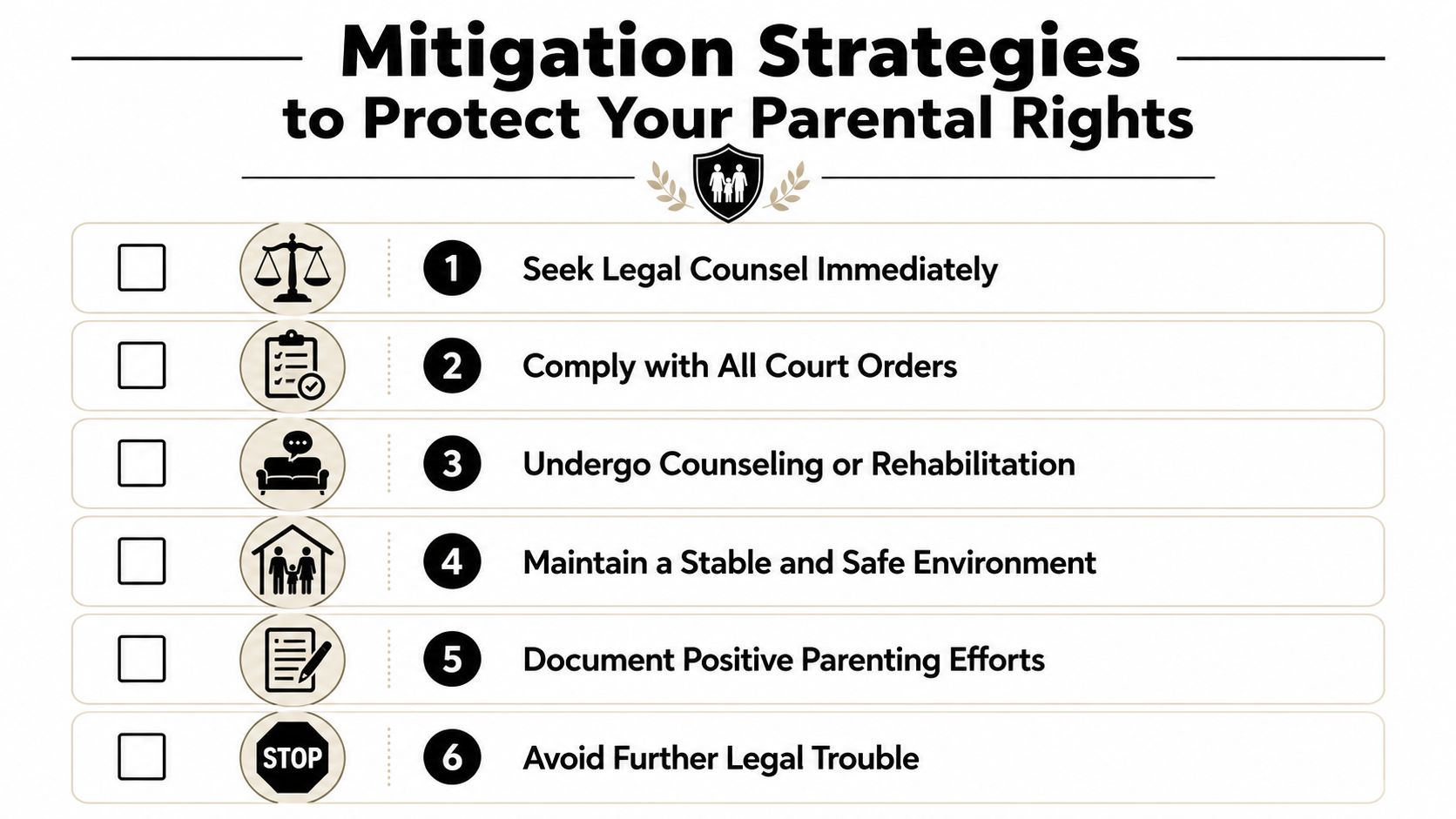
Mitigation Strategies to Protect Your Parental Rights
If you're facing charges, waiting for the system to sort itself out is not a strategy. You need to build a record that shows control, accountability, and safety.
Texas custody law has moved toward evidence-based, child-safety-centered decisions rather than automatic punishment for a parent's criminal record. Courts may impose temporary restrictions such as supervised visitation while a case is pending, but they also allow parents to remain involved when the alleged conduct does not threaten the child. The practical takeaway is that serious charges like family violence, child endangerment, or felony DWI can trigger a fast response, while a nonviolent conviction may have little or no custody impact if the judge finds the child is not at risk, as noted in this overview of whether criminal charges affect child custody in Texas.
Build a mitigation file early
Don't wait for the other side to define you. Start gathering proof that supports your role as a safe parent.
Good mitigation often includes:
Treatment records
Counseling, substance abuse assessment, anger management, or therapy attendance.Clean testing
If substance use is an issue, reliable test results matter.Parenting records
School pickup logs, medical appointments, homework routines, and exchange compliance.Stable living proof
Lease documents, home setup, and evidence of regular care arrangements.Work and community support
Letters or testimony from people who can speak to your consistency and character.
Be smart about plea bargaining
Plea negotiations are often where criminal and custody strategy collide. A deal that looks acceptable on the criminal side may carry language or consequences that make family court much harder.
At this stage, your lawyer should think through questions like these:
| Criminal decision | Family law concern |
|---|---|
| Plea to an offense tied to violence | Can it trigger severe custody restrictions |
| Deferred outcome with strict conditions | Can you realistically comply without harming visitation |
| No contest or guilty plea | How will the other parent describe it in custody court |
This is also where it helps to have counsel that handles criminal matters intersecting with family-law issues. Law Office of Bryan Fagan PLLC represents Texans in criminal cases and related protective-order and family-law conflicts, which is the kind of overlap you need to account for when one court decision can affect another.
Think beyond the pending case
After arrest, the criminal process may include arraignment or first appearance, pretrial settings, plea bargaining, trial, sentencing, and then the longer work of rebuilding. For some people, that means looking at expunction, nondisclosure, or other post-conviction relief when eligible. Those tools don't erase the immediate custody fight, but they can matter later when you're trying to move forward with employment, housing, and a cleaner public record.
If the charge is assault, DWI, theft, or drug possession, the same principle applies. Judges respond better to concrete steps than promises. A parent who says, “I've changed,” is one thing. A parent who can show compliance, treatment, steady work, and calm behavior is another.
Why a Coordinated Criminal and Family Law Defense Is Essential
The biggest mistake in these cases is treating the criminal case and custody case like separate worlds. They aren't.
A criminal lawyer may focus on avoiding jail, reducing a charge, or negotiating a fast plea. A family lawyer may focus on possession schedules and conservatorship. If they don't coordinate, one decision can undercut the other. A statement made for a criminal advantage may become an exhibit in family court. A rushed custody affidavit may lock you into facts that hurt your defense.
One strategy has to drive both cases
Your defense should answer all of these at once:
- What can be said now without damaging the criminal case
- What orders must be obeyed to avoid looking unsafe in family court
- What record should be built to show stability and responsible parenting
- What resolution makes sense if protecting custody is part of the goal
If you need local family-law guidance while a criminal case is pending, it can also help to find child custody support in Austin or in the Texas city where your case is being heard, especially when emergency hearings are moving fast.
For the criminal side, it helps to understand how criminal defense attorneys build a defense strategy because your custody position may depend on the sequence of motions, negotiations, and factual defenses raised early in the case.
If you're asking can a criminal case affect child custody in Texas, the answer is yes. But a charge is not the end of your relationship with your child. What you do next matters. Fast action, disciplined behavior, and one coordinated legal plan give you the strongest chance to protect both your freedom and your place in your child's life.
If you've been charged with a crime in Texas, call Law Office of Bryan Fagan PLLC for a free and confidential consultation. Our defense team is ready to protect your rights.