A Texas arrest is usually valid even if you aren't read your rights immediately. The warning is only required before police question you in custody, and the main consequence of a failure to warn is that your answers may be kept out of court.
Being arrested in Texas can be terrifying. You may be in handcuffs, sitting in the back of a patrol car, waiting to hear the words you know from TV, and when they never come, it's easy to think the whole case must fall apart.
Usually, that isn't how it works.
If you're asking can you be arrested without being read your rights in Texas, the short answer is yes. That does not mean your rights don't matter. It means the legal fight is often about what police can use against you, not whether the arrest itself happened lawfully.
That distinction matters in cases involving DWI, assault, theft, drug possession, and other charges under the Texas Penal Code. A calm, careful defense starts by separating myth from procedure, then looking closely at what officers did, what they asked, what you said, and when each step happened.
The Hollywood Myth vs Texas Reality on Miranda Rights
A lot of people expect an arrest to follow a script.
An officer puts you in handcuffs. You hear the warning. If you don't hear it, you assume the arrest was illegal. That idea is common, but Texas criminal cases don't turn on movie rules.
In real life, police don't have to recite Miranda warnings the moment they arrest you. The legal issue is narrower than is commonly understood. What matters is whether officers questioned you while you were in custody.
Why people get this wrong
TV blends several different moments into one scene. Arrest, transport, questioning, and booking all happen at once on screen. In reality, those are separate stages, and the law treats them differently.
If officers arrest you, place you in a patrol car, and say nothing about the alleged offense, the lack of a warning at that point usually does not make the arrest invalid.
Practical rule: The absence of Miranda warnings at the moment of arrest usually does not erase the case.
What this means for your case
That may feel unfair at first. But it helps to know where the actual defense issues are.
A lawyer usually looks at questions like these:
- When did custody begin: Were you under arrest, restrained, or otherwise not free to leave?
- What did officers ask: Were they gathering basic information, or trying to get incriminating answers?
- What evidence exists besides your statements: Did police rely on witness accounts, field observations, body-cam footage, or physical evidence?
- Was there a separate search issue: If officers searched your car, home, or phone, that can raise a different constitutional question, apart from Miranda.
That last point matters because a case can involve more than one defense angle. An unwarned statement, an improper search, and a weak charging theory are all different issues, and each one has to be analyzed on its own.
What Are Miranda Rights and Where Do They Come From
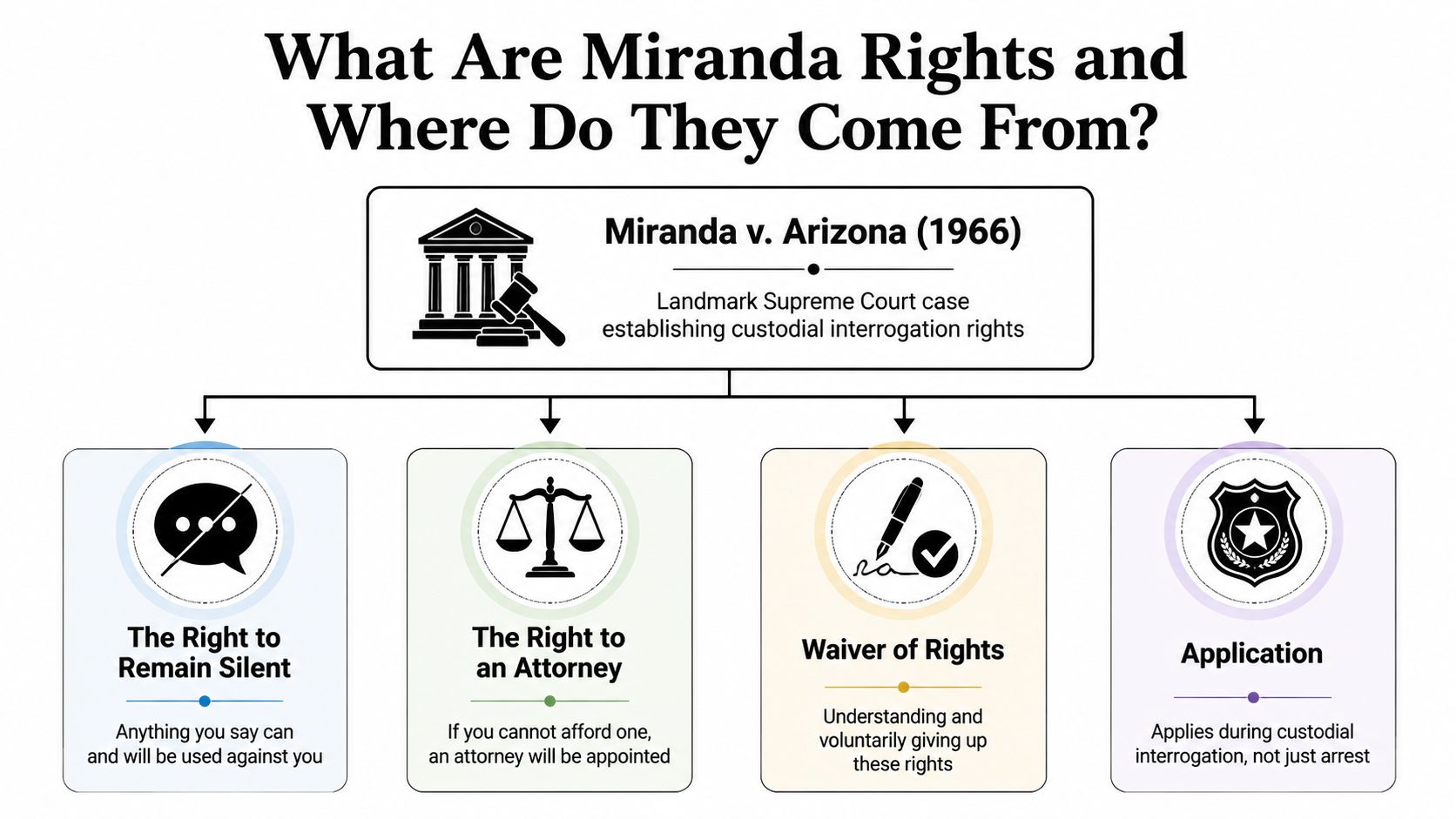
The modern Miranda rule comes from Miranda v. Arizona (1966), the U.S. Supreme Court decision that created the familiar warning used during custodial interrogation, and that rule remains the foundation for Texas practice today, as explained in this overview of Miranda warnings.
What the warning means in plain English
The warning's sound is well-known, yet its meaning is not always clear. In everyday terms, the core rights are these:
- You can remain silent. You don't have to answer questions about the alleged crime.
- Your words can be used against you. Even a statement you think is harmless can later be used by a prosecutor.
- You can ask for a lawyer. If questioning is about to happen while you are in custody, you can say you want an attorney.
- If you cannot afford a lawyer, one can be appointed. The justice system still recognizes the right to counsel.
There is also the idea of a waiver. That means a person chooses to speak after being informed of these rights. Whether that waiver was valid can become an important issue in court.
When Miranda applies
Miranda is tied to a specific event. It applies when there is custody plus interrogation. It is not a general arrest ritual.
That is why officers may ask questions in some settings without first giving the warning. Texas defense discussions commonly point to exceptions such as routine traffic stops, booking questions, and public-safety questioning.
Miranda protects against compelled self-incrimination during questioning. It is not an automatic step that must happen every time officers make an arrest.
Why this matters beyond the courtroom
Understanding Miranda is only one part of protecting your future. A conviction can affect much more than a sentence, including work, housing, and legal rights. That broader impact is discussed in The Collateral Consequences of a Texas Conviction.
Arrest vs Custodial Interrogation The Critical Distinction
This is the line that drives most Miranda disputes.
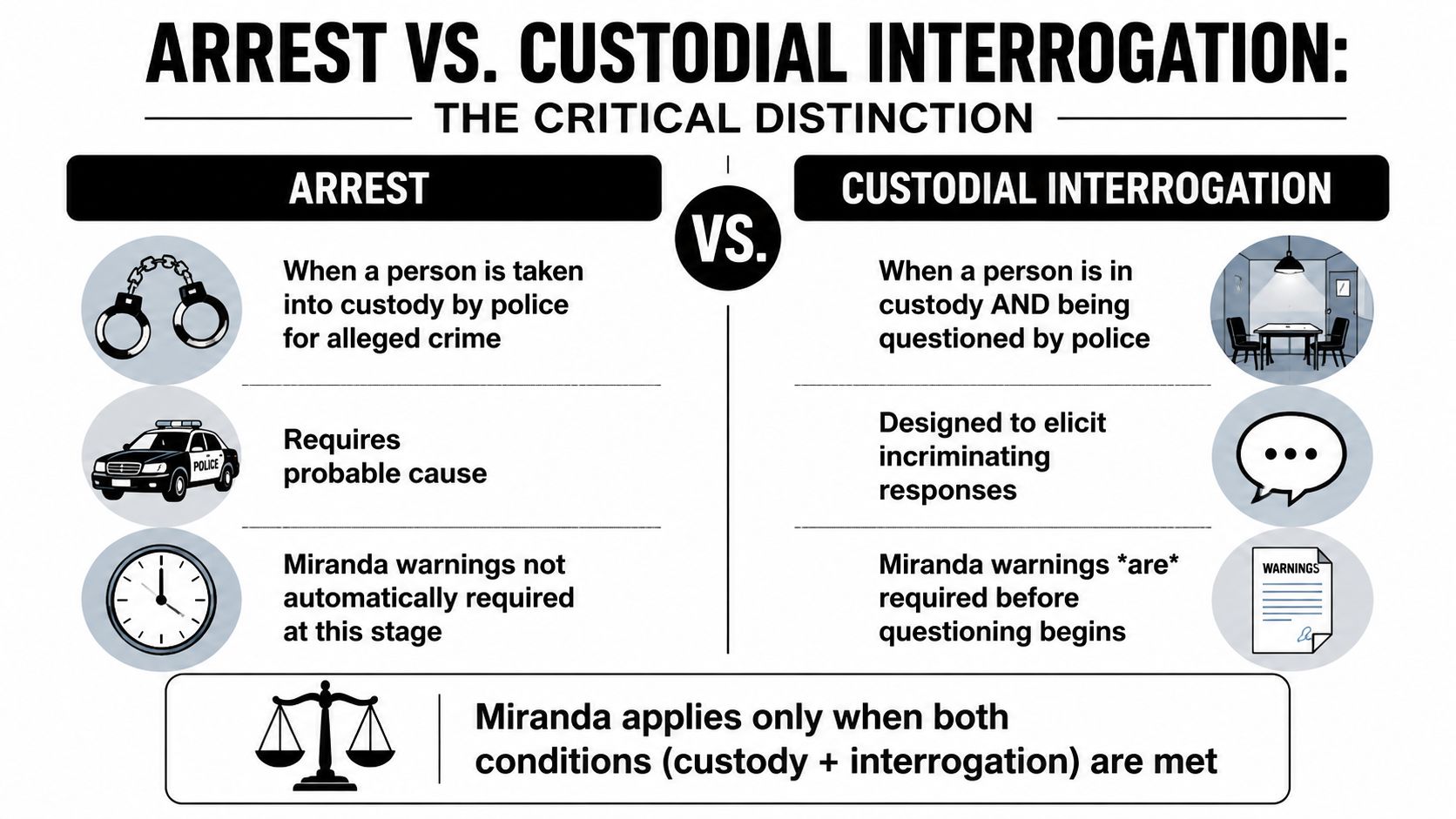
Federal doctrine says Miranda is triggered by custodial interrogation, not by arrest alone. That means the central question is often whether police started questioning you after you were in custody, not whether handcuffs went on before anyone read a warning, as noted in this discussion of arrest versus custodial questioning.
Think of it as two separate doors
Door one is custody. That means you are not free to leave.
Door two is interrogation. That means officers are asking questions or making statements designed to get an incriminating response.
Miranda usually matters only when both doors are open.
Here is a simple comparison:
| Situation | In custody | Being interrogated | Miranda usually required first |
|---|---|---|---|
| Officer arrests you and says nothing about the case | Yes | No | Usually no |
| Officer books you and asks for name and address | Yes | Usually no | Usually no |
| Officer arrests you, then asks if you had been drinking or carrying drugs | Yes | Yes | Usually yes |
| Officer speaks with you during a routine traffic stop before arrest | Usually no | Not in the Miranda sense | Usually no |
That is why many people feel shocked when they learn their arrest can stand even without immediate warnings.
Common moments that confuse people
A lot of confusion comes from what happens between arrest and formal questioning.
You may be:
- Handcuffed at the scene
- Transported in a patrol car
- Placed in a holding cell
- Booked into jail
- Asked basic identifying questions
None of those moments automatically means Miranda had to be read right then.
Later, though, the situation can change fast. If an officer in the patrol car says, “Tell me where you got the pills,” or a detective at the station says, “Start from the beginning and explain what happened,” that can move the encounter into custodial interrogation territory.
A separate issue may also arise if police searched your property. If that happened, review what makes a search illegal in Texas criminal law because search problems and Miranda problems are related but not identical.
Here is a helpful overview if you're deciding how quickly to get counsel involved after an arrest or investigation: When to Hire a Criminal Defense Lawyer in Texas.
A short video can also help make the distinction easier to follow:
What Happens If Police Fail to Read Your Rights
The main legal effect is usually about evidence, not automatic dismissal.
Under U.S. constitutional law, police are not required to give Miranda warnings the moment someone is arrested in Texas. The duty begins when a person is both in custody and being interrogated, and if you are arrested but not questioned, no warning is required at that stage. If officers fail to warn before custodial interrogation, the statements made in that setting may be excluded from evidence, but the case itself does not automatically disappear, as explained in this Texas-focused Miranda discussion.

What suppression means
If your lawyer believes police obtained statements in violation of Miranda, one common tool is a motion to suppress. That asks the court to keep certain statements out of the prosecution's evidence.
That can matter a great deal. In some cases, a statement is the centerpiece of the prosecution's theory. In others, it is only one small part of a larger file.
Why charges may still continue
Prosecutors may still move forward if they have other admissible evidence, such as:
- Officer observations
- Witness testimony
- Physical evidence
- Body-cam or dash-cam footage
- Voluntary statements made outside custodial interrogation
So if you were hoping, “They didn't read me my rights, so the whole thing gets thrown out,” I want to be honest with you. That result is not automatic.
A Miranda problem can still be powerful. It just usually changes the evidence battle, not the existence of the case.
If you think questioning crossed the line, this guide on Miranda rights violations in Texas cases gives a practical look at how those issues are challenged.
Common Scenarios Where Miranda Warnings Are Not Required
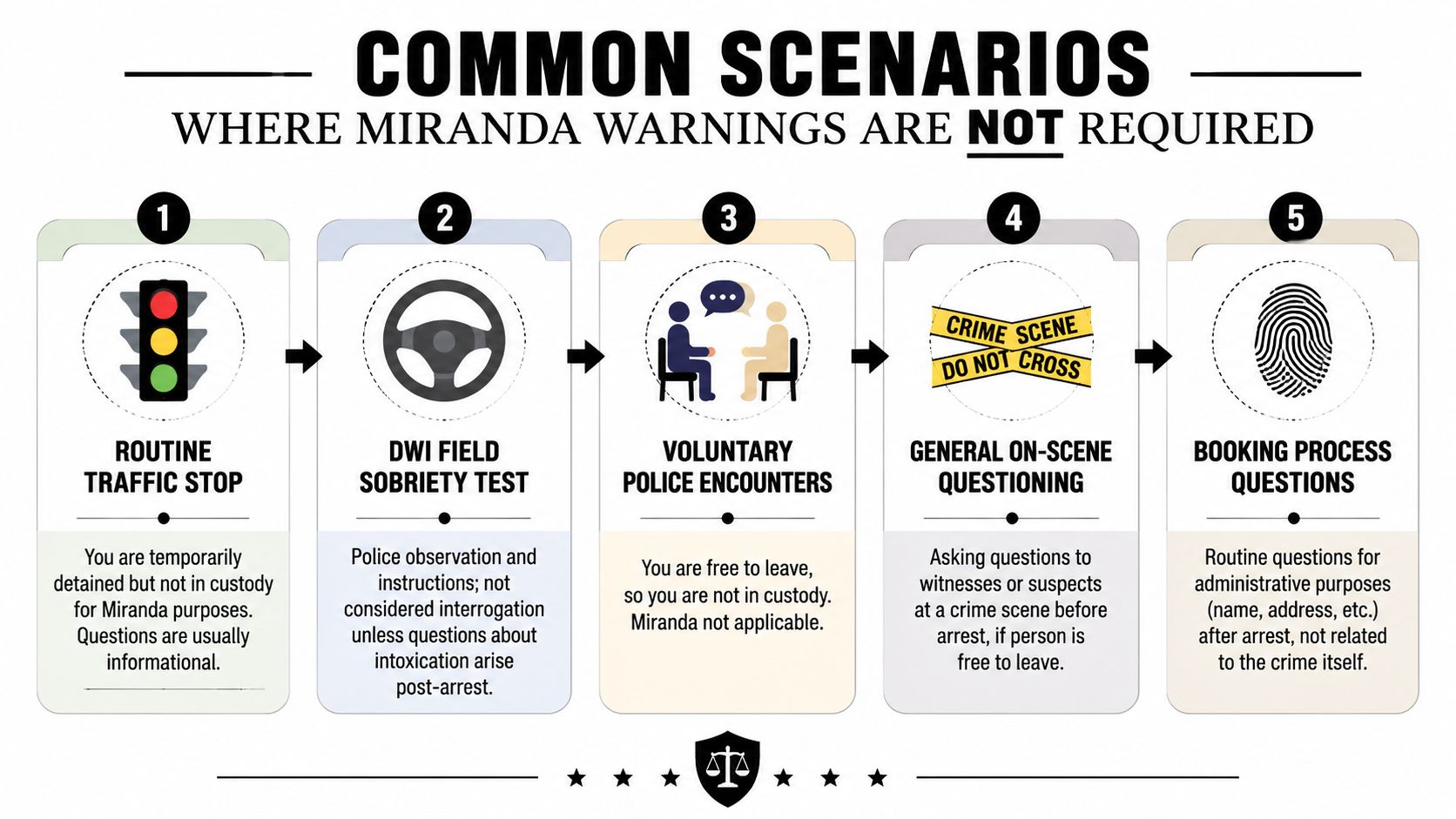
Many people run into Miranda questions during ordinary police encounters, especially traffic stops and DWI investigations. Existing Texas explanations often note that routine traffic stops and basic identification questions are exceptions, but the more useful issue is where the line shifts from roadside investigation to custodial questioning after arrest. Police may still gather usable evidence through field observations, booking questions, body-cam footage, and voluntary statements, as discussed in this overview of common Miranda exceptions.
Traffic stop and DWI examples
Suppose an officer stops you and asks for your license and insurance. That usually does not require Miranda warnings.
Suppose the officer asks you to step out of the car, follow instructions, or perform roadside tasks during a DWI investigation. Those moments often involve observation and investigation, not custodial interrogation in the Miranda sense.
If you want more background on how these cases are built, DWI Defense in Texas: An Overview gives a high-level look at DWI charges and related defense issues.
Other common exceptions
A few situations regularly surprise people:
- Booking questions: Asking for your name, address, and date of birth is usually treated as administrative processing.
- Voluntary encounters: If you are free to walk away, Miranda usually does not apply.
- General on-scene questions: Officers may ask basic questions while sorting out what happened before an arrest occurs.
- Public-safety questions: Officers may ask immediate safety-related questions without first giving warnings.
A simple way to evaluate your own situation
Ask yourself these three questions:
- Was I in custody at that point?
- Were officers trying to get me to admit something?
- Did the questioning happen before any warning?
If the answer to all three is yes, you may have a real suppression issue to discuss with a Texas DWI attorney, Houston criminal lawyer, or Texas assault defense attorney, depending on the charge.
What to Do After an Arrest and How a Lawyer Can Help
After an arrest, your job is not to talk your way out of it. Your job is to protect yourself.
Start with these steps:
- Stay calm and respectful. Don't argue on the street or in the booking area.
- Give basic identifying information if required. Keep it short.
- Say you want to remain silent. Use clear words.
- Ask for a lawyer. Say it plainly.
- Do not explain, justify, or fill silence. Many people damage their case by trying to sound cooperative.
- Do not sign statements without legal advice.
- Write down what happened as soon as you can. Time, place, officers, questions asked, and any witnesses all matter.
“I want to remain silent, and I want a lawyer” is often the safest sentence you can use after an arrest.
What happens next in a Texas criminal case
Even when Miranda is part of the issue, your case still moves through the normal criminal process.
That can include:
- Arrest and booking
- Magistration or arraignment
- Bond conditions
- Case review and evidence gathering
- Plea bargaining
- Motions practice, including suppression issues
- Trial, if the case does not resolve
- Sentencing, if there is a conviction
A defense lawyer's work is broader than one Miranda argument. In a DWI, assault, theft, or drug possession case, counsel reviews police reports, video, witness accounts, charging language, searches, statements, and weaknesses in the prosecution's theory. If there is a valid basis, counsel can move to suppress statements. If the state's proof is weak for other reasons, those arguments matter too.
If bond issues are part of your situation, it also helps to learn about bond forfeiture with TheLawGPT, especially if you're worried about missed court dates and the consequences that can follow.
Looking beyond the immediate charge
Some readers are facing their first arrest. Others are already thinking about how to move forward after the case. Depending on the outcome, options may include expunction, nondisclosure, record sealing, or other post-conviction relief.
That's one reason early legal advice matters. The choices made right after arrest can affect plea negotiations, trial strategy, sentencing exposure, and what relief may be available later. If police tried to question you, review what to say and not say during a police interrogation in Texas before you have another encounter.
The Law Office of Bryan Fagan PLLC represents Texans in criminal matters including DWI, assault, theft, drug charges, and record-clearing matters such as expunctions and nondisclosures.
If you've been charged with a crime in Texas, call The Law Office of Bryan Fagan, PLLC for a free and confidential consultation. Our defense team is ready to protect your rights.