Being stopped by police in Texas can rattle you fast. A traffic stop turns serious, an officer asks to “take a quick look,” or police show up at your door and act like you have no choice. In that moment, individuals often aren't thinking about constitutional law. They're thinking, “Can they do this?”
You have rights, and knowing them is the first step to building a strong defense. In many cases, the fight isn't only about whether the police found evidence. It's about how they got it. That issue matters in DWI, drug possession, theft, assault, and many other criminal cases across Texas.
Understanding Your Rights When Facing a Search
If you're trying to understand what makes a search illegal in Texas criminal law, start with one simple idea. Police usually can't search your home, your body, or your property just because they want to. They need legal authority.
That authority often comes from a warrant. Sometimes it comes from a narrow exception to the warrant rule. If officers don't have either one, the search may be illegal. That can change the direction of a criminal case.
A lot of clients come in worried that because police found something, their case is over. That's not always true. Evidence found during an unlawful search can often be challenged. In some cases, that challenge becomes the center of the defense.
Practical rule: Don't assume a search was legal just because an officer sounded confident. Police authority has limits, and those limits matter in court.
Here's where people get tripped up:
- An officer's suspicion isn't enough: A hunch is not the same thing as legal cause to search.
- A warrant isn't automatically valid: The paperwork and facts behind it matter.
- Consent can change everything: If you said yes, even under pressure, that becomes a major issue.
- Timing matters: What officers knew, when they knew it, and what they did next often decides whether the search stands.
You also need to know that search issues don't exist in a vacuum. If you've been arrested, the case keeps moving. You may face booking, bail decisions, a first court appearance, plea discussions, motions, trial preparation, sentencing, and later questions about expunction or record sealing if your case qualifies. Early action helps at every stage.
The Foundation Your Constitutional Right to Privacy
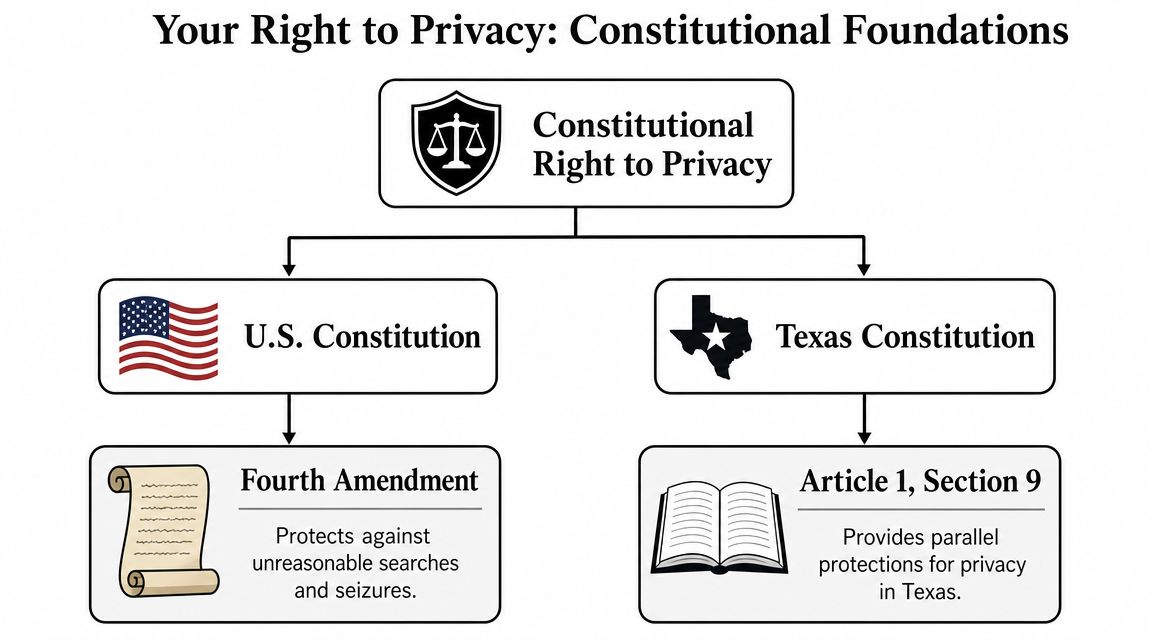
Your protection against an illegal search starts with the Fourth Amendment and Article 1, Section 9 of the Texas Constitution. Think of them as a legal shield. They exist to limit when the government can intrude into your private life.
Under Texas law, a search is most likely to be deemed illegal when police lack a valid warrant and no recognized exception applies. Texas law also mirrors the Fourth Amendment's rule that warrants must be supported by probable cause, backed by a sworn oath or affirmation, and must particularly describe the place to be searched and the items to be seized, as discussed in this overview of improper searches under Texas law.
What counts as a search
A search happens when police enter or inspect an area where the law recognizes your privacy interest. The clearest examples are your home, your person, and many parts of your vehicle.
Your phone can raise separate and serious privacy issues too, because it holds messages, photos, location history, and app data. In a modern criminal case, a search issue may involve a backpack, a console, a bedroom, or a digital device.
What reasonable means in plain English
The law often uses the word reasonable. In real life, that means officers need a lawful basis for what they did. They can't search first and justify it later with guesswork.
That principle matters whether you're accused under the Texas Penal Code of assault, theft, drug possession, or another offense. The charge itself doesn't erase your constitutional rights. Criminal procedure still controls what police may do, what prosecutors may use, and what a judge may exclude.
A few examples help:
| Place searched | Privacy protection |
|---|---|
| Home | Highest protection |
| Person | Strong protection |
| Vehicle | Protected, but less than a home |
| Items in plain view | May be reachable if officers are lawfully present |
Your rights attach before trial. They apply during the investigation, at the moment of the stop, and during any search that leads to charges.
The Warrant Requirement What Makes a Search Legal
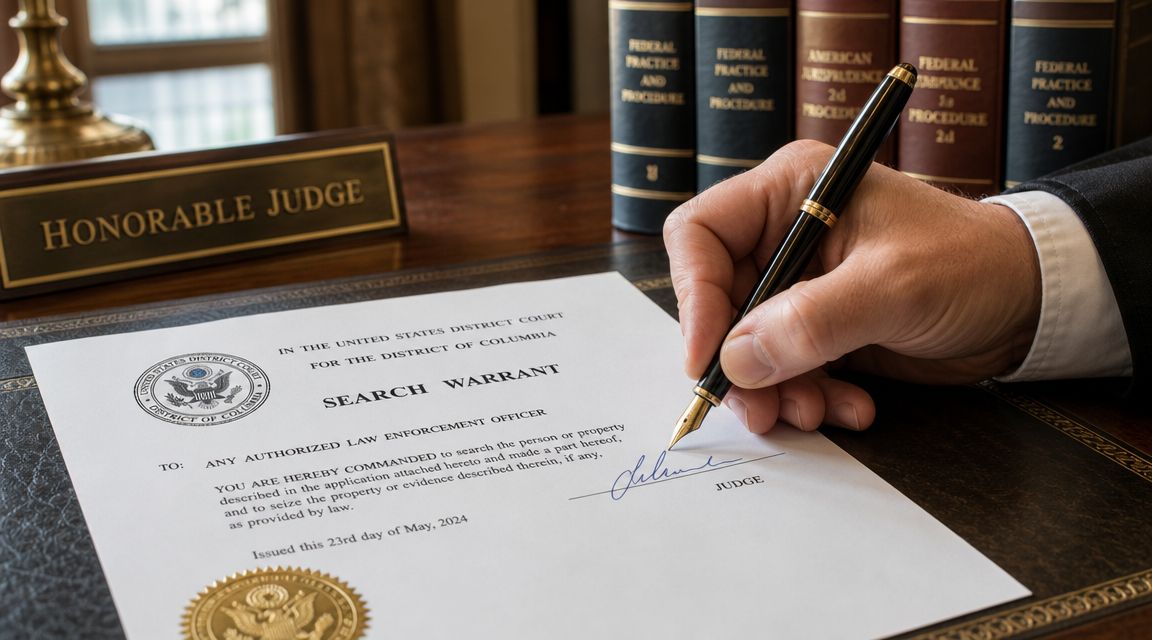
A valid search usually starts with a warrant signed by a judge. That's the basic rule. Texas search warrants are governed by Chapter 18 of the Texas Code of Criminal Procedure, and the process is supposed to force police to slow down and justify the intrusion before it happens.
Probable cause is more than a guess
Probable cause is not a gut feeling. It means officers must present facts that create a fair basis to believe evidence of a crime will be found in a specific place.
That last part matters. The law doesn't just ask whether police suspect wrongdoing. It asks whether the facts connect the alleged offense to the exact place they want to search.
For many clients, this is the hidden issue. A warrant may look official, but that doesn't mean it rests on enough facts. As noted in this discussion of Texas search and seizure law and warrant defects, a search can still be illegal if officers rely on a warrant that is technically valid on its face but not supported by enough probable cause or particularity.
What a Texas warrant must do
A lawful warrant is supposed to be specific. It should identify where officers may search and what they may seize. It also needs supporting paperwork, usually a sworn affidavit laying out the facts for the judge.
If any part of that process is weak, the defense has room to challenge it.
- Weak affidavit: The officer's written statement may rely on vague claims instead of concrete facts.
- Poor nexus: The affidavit may fail to show why evidence would likely be at that location.
- Overbroad scope: The warrant may describe the place or items too loosely.
- Paperwork gaps: Missing or insufficient sworn support can undercut the warrant.
What works and what doesn't
What works for the State is a careful, fact-based affidavit that ties a suspected crime to a specific location. What doesn't work is a hunch dressed up as probable cause.
In practice, many people focus on the wrong question. They ask, “Did police have a warrant?” The better question is, “Was the warrant supported, specific, and properly limited?” That's often where the key fight is.
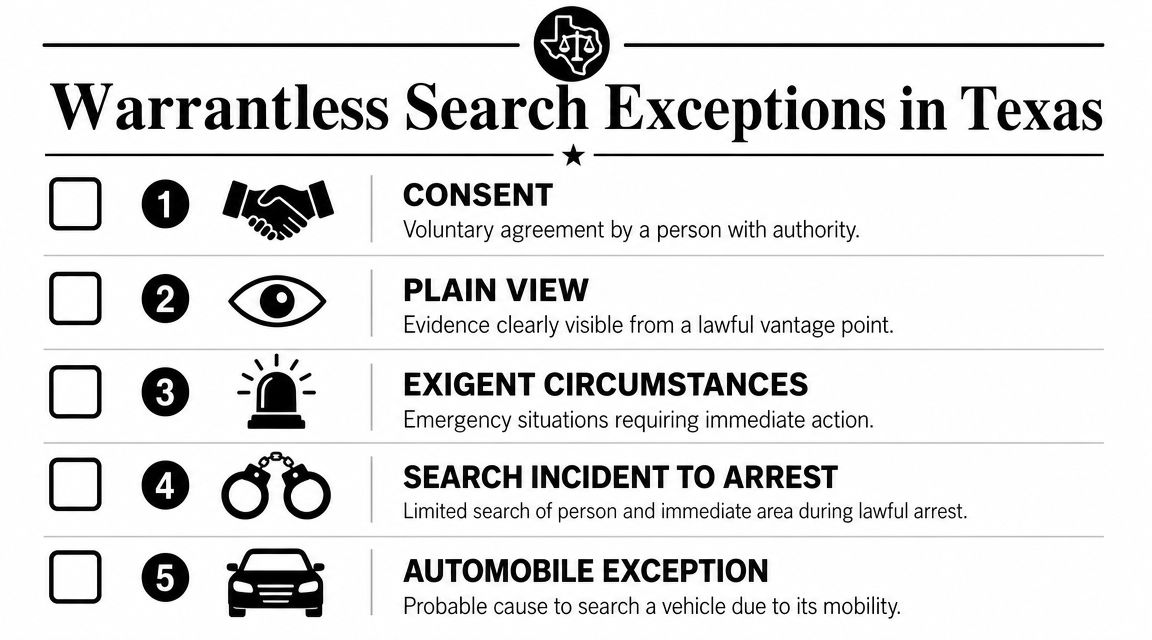
Common Exceptions to the Warrant Rule in Texas
Police don't always need a warrant. But the exceptions are narrower than officers sometimes make them sound. When a case turns on a warrantless search, the details matter.
Consent searches
If you give consent, police may not need a warrant. That's why officers often ask in a casual way, especially during traffic stops. They know many people feel pressure to cooperate.
Consent has to be voluntary. It also matters who gave consent and what they agreed to. Permission to look in the car isn't always permission to dig through every container or search a passenger's private property.
If you want to refuse, stay calm and clear. You can say, “I do not consent to any searches.”
- What helps you: Saying no clearly and politely.
- What hurts you: Arguing, physically resisting, or making inconsistent statements.
- What attorneys examine later: Your words, your tone, body camera footage, and whether the situation felt coercive.
Plain view
The plain view doctrine sounds simple, but it has limits. Officers must already be in a place where they're legally allowed to be. They don't get to create a better view by unlawfully entering a protected area.
If an officer lawfully stops a car and sees contraband sitting openly on the seat, that raises one issue. If the officer opens a door, moves objects around, or reaches into a private space to “confirm” suspicion, that raises another.
Police can seize what is truly in plain view from a lawful vantage point. They can't expand that rule into a general license to explore.
Search incident to lawful arrest
When police make a lawful arrest, they can usually search the person arrested and the area within immediate reach. The main reasons are officer safety and preservation of evidence.
This exception has boundaries. It does not automatically justify a full search of a home, a locked container across the room, or unrelated property outside the arrestee's immediate control.
For people charged with assault, theft, or drug possession, this often comes up fast. A routine encounter becomes an arrest, and then the State argues the search was automatic. It wasn't automatic. It had to stay within lawful limits.
A short explanation from the courtroom side can help:
Automobile exception
Cars get less privacy protection than homes because they're mobile. But this exception still doesn't mean police may search every vehicle whenever they want.
Officers generally need probable cause to believe the vehicle contains evidence or contraband. The issue is often whether the facts at the scene really added up to probable cause, or whether police moved from suspicion to search too quickly.
That matters in DWI and drug cases. An odor, a statement, visible items, or the driver's condition may become part of the State's argument. The defense then tests each fact and the officer's timeline.
Exigent circumstances
This is the emergency exception, and Texas courts treat it seriously, especially in home-entry cases. Warrantless home entries are especially vulnerable unless the State can prove an emergency-level justification, such as preventing destruction of evidence, stopping escape, or addressing an imminent threat to safety, as explained in this review of challenging illegal search and seizure in Texas drug cases.
For your home, the law is stricter. Convenience isn't enough. An officer must point to facts showing an immediate need, not just say it would have been faster to go in now and explain later. If you're dealing with a home-entry issue, this guide on when police can enter your home without a warrant in Texas can help you spot the key questions.
How Illegal Searches Happen in Real Texas Cases
Individuals often don't ask about search law until they're already charged. By then, the facts are messy, the police report sounds one-sided, and you're trying to figure out whether the officer crossed a line.
A search is most likely to be illegal in Texas criminal cases when officers enter or inspect a constitutionally protected area without a valid warrant and without a recognized exception. In practice, defense lawyers often focus on whether the warrant truly connected the suspected offense to the place searched, because a weak nexus is a frequent issue in suppression litigation in drug, DWI, and firearm cases, as discussed in this analysis of Texas search and seizure laws.
DWI stop and a deeper search
A driver gets pulled over late at night. The officer says he smells alcohol and asks the driver to step out. So far, that may be a normal DWI investigation.
Then the officer opens a closed bag in the back seat or pops open a locked compartment without consent and without facts supporting probable cause for that area. If that search leads to drug possession charges or another allegation, the defense may challenge the jump from a DWI stop to a broader evidence hunt.
Drug possession and a weak home warrant
Police receive a tip that someone is dealing drugs. They later search the person's home and find narcotics in a bedroom drawer.
The key question isn't just whether there was a warrant. The question is whether the affidavit gave the judge enough reliable facts to believe evidence would likely be found in that home. A vague tip, stale information, or a thin link between the alleged conduct and the address can become central to the defense.
Theft case and a phone search
In theft and fraud cases, phones often become targets because they may contain messages, photos, banking records, or app activity. But officers don't get unlimited access to your device just because they seize it.
If police searched your digital data without proper authority, that issue can become as important as any physical search. This article on whether police can search your phone without a warrant in Texas addresses some of the most common concerns.
The facts that matter most are often small. Who opened the container. Who gave consent. What the officer saw before reaching inside. Whether the warrant actually matched the place searched.
That's why a Houston criminal lawyer or Texas DWI attorney shouldn't rely on the arrest report alone. Body camera footage, dash camera video, dispatch logs, warrant affidavits, and officer timing often tell a fuller story.
Challenging an Illegal Search The Motion to Suppress
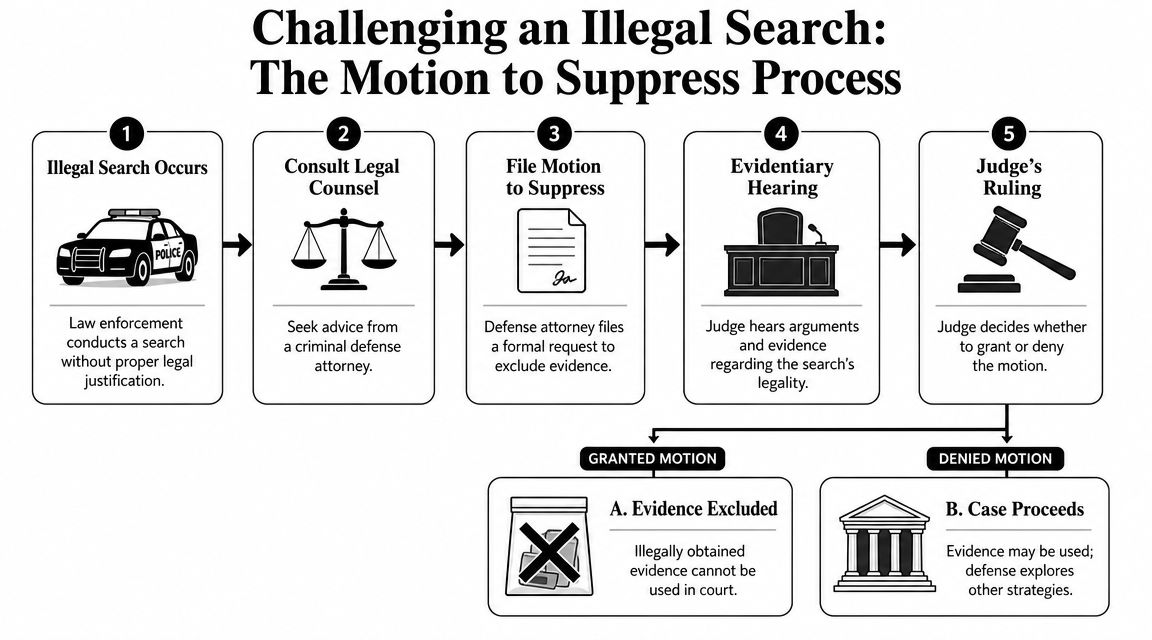
If police found evidence through an unlawful search, your attorney can ask the court to keep that evidence out. The main tool for doing that is a motion to suppress.
How the process usually works
A motion to suppress tells the judge that the search violated your rights and that the State should not be allowed to use the evidence. The court may then hold a hearing where officers testify, documents are examined, and the judge decides whether the search was lawful.
The hearing often turns on details that didn't seem important at the time of arrest.
- Your lawyer reviews the facts: Reports, videos, affidavits, and witness accounts are compared.
- The legal theory is identified: No warrant, bad consent, weak probable cause, overbroad warrant, unlawful entry, or another issue.
- The motion is filed: The defense asks the judge to exclude the challenged evidence.
- A hearing is held: The State tries to justify the search. The defense tests that claim.
- The judge rules: If the motion is granted, the evidence may be excluded.
Fruit of the poisonous tree
Texas courts may also exclude evidence that flows from the original illegal act. If the first search was unlawful, later discoveries based on that search may be vulnerable too. That's the basic idea behind the “fruit of the poisonous tree” doctrine.
For a practical overview, you can read more about the exclusionary rule in Texas criminal cases.
Courtroom reality: A suppression issue can change plea bargaining, trial strategy, and even whether the prosecution can continue at all.
If the judge suppresses key evidence, the State may have a much weaker case. That can affect negotiations, pretrial strategy, and sometimes the viability of the charge itself.
What to Do If You've Been Arrested in Texas
If you've been arrested and you think the police searched you, your car, your home, or your phone illegally, act carefully from this point forward. What you do next can help your defense or make it harder.
The first steps that protect you
- Stay silent: Give your name and basic identifying information, but don't try to explain the situation.
- Don't consent to more searches: If officers ask, state clearly that you do not consent.
- Ask for a lawyer: Once you request counsel, stop answering substantive questions.
- Write down what happened: As soon as you can, note the time, location, what officers said, whether they asked for consent, and what they searched.
- Preserve documents: Keep bond paperwork, inventory sheets, warnings, and any property receipts.
What happens after arrest
Your case may move through booking, bail, arraignment or first appearance, pretrial hearings, plea bargaining, motions, trial, and sentencing. In some cases, early defense work leads to a dismissal, a reduction, or a stronger negotiating position. In others, the best path is trial.
If there is a conviction or a case resolves favorably, you may also need advice about expunctions, nondisclosures, record sealing, or post-conviction relief. Those options can matter for work, housing, professional licensing, and your future.
For many people, the most useful next step is a case review with a defense lawyer who handles search issues regularly. That can include private counsel, a court-appointed attorney if you qualify, or a firm such as The Law Office of Bryan Fagan, PLLC, which handles Texas criminal defense matters including DWI, drug, theft, assault, and post-case record relief.
If you've been charged with a crime in Texas, call The Law Office of Bryan Fagan, PLLC for a free and confidential consultation. Our defense team is ready to protect your rights.