Being arrested in Texas can be terrifying, especially if you spent years building a career that depends on a professional license. In a single night, you may be worrying about jail, court dates, your job, your reputation, and whether your board is about to come after the license that pays your bills.
The short answer is yes, you can lose your professional license after a criminal charge in Texas. But a charge does not mean automatic license loss. That distinction matters, and the steps you take right away can make a major difference for both your criminal case and your livelihood.
If you're facing DWI, assault, theft, drug possession, or another charge, you need to think on two tracks at the same time. One track is the criminal court. The other is your licensing board. Those tracks affect each other, and mistakes in one can hurt you in the other.
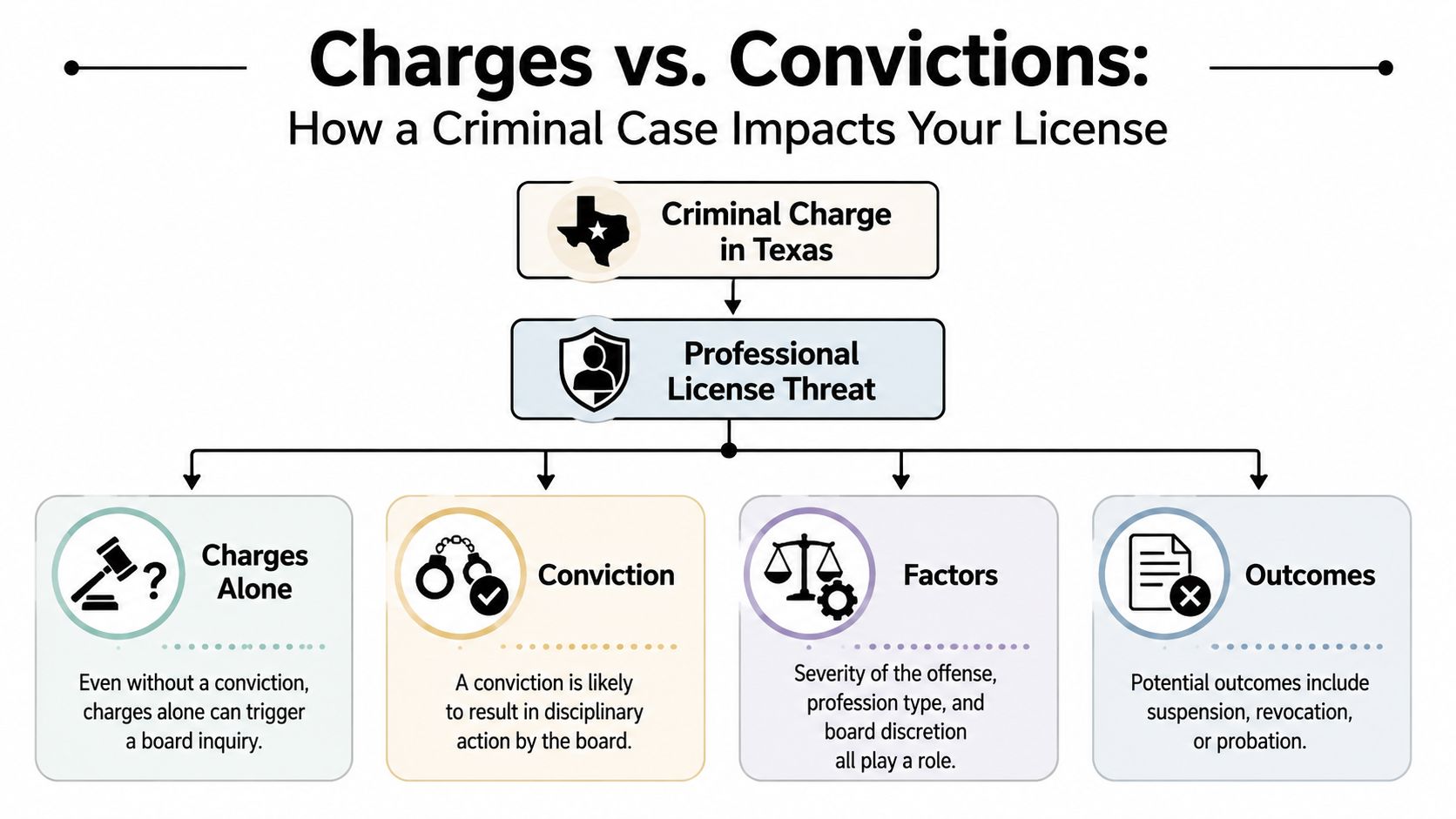
Charges vs Convictions How a Criminal Case Impacts Your License
A lot of professionals ask the same question in panic: can you lose your professional license after a criminal charge in Texas?
You can face a board inquiry after a charge, but Texas law does not treat a criminal charge as an automatic license loss. The Texas Department of Licensing and Regulation explains that boards can suspend, revoke, or deny a license when a conviction is directly related to the occupation or when the offense shows the person is unsuitable, and boards consider four factors under Texas Occupations Code § 53.025: the nature and seriousness of the crime, its relation to the occupation, whether the license could facilitate similar crime, and how the offense relates to the person's fitness to do the job, as described by TDLR's criminal conviction guidance.
Why a charge still matters
A charge is an accusation. A conviction is a formal finding of guilt, whether by plea or trial. Licensing boards consider that difference important.
Still, many boards don't sit back and wait. They may learn about an arrest through self-reporting, an employer report, a background check, a renewal disclosure, or their own monitoring systems. Once that happens, the board may open an investigation even while your criminal case is still pending.
That creates a real problem. You may feel pressure to “explain everything” to the board. In many cases, that's exactly what hurts people.
Practical rule: Your criminal defense should be built with your license in mind from day one. A rushed statement to a board investigator can lock you into facts that later damage your court defense.
What boards look for
Boards usually focus less on the name of the offense and more on the connection between the alleged conduct and your work.
A quick way to think about it is this:
| Issue | What it means for you |
|---|---|
| Charge only | May trigger review, but not automatic discipline |
| Pending case | Board may investigate before court finishes |
| Conviction | Much higher risk of denial, suspension, or revocation |
| Direct relationship | Risk rises when the conduct overlaps with job duties, trust, safety, or honesty |
If you're trying to understand the job side of the problem, this related guide on how a criminal charge affects employment in Texas can help you see how employers and boards often react differently.
Good moral character is often part of the fight
Many licenses require proof that you're fit to hold a position of trust. In plain English, that usually means the board is asking whether the public can safely rely on you.
That doesn't mean every arrest proves bad character. It does mean charges involving alcohol, violence, drugs, dishonesty, or misuse of money often get close attention. A DWI may raise questions about judgment. A theft case may raise questions about honesty. An assault allegation may raise concerns about safety and self-control.
The best early defense is usually simple. Protect your criminal case, avoid careless disclosures, and start preparing for the board before the board contacts you.
How Different Texas Professions Are Affected by Criminal Charges
Two people can face the same misdemeanor and have very different licensing risk. The reason is the nexus between the alleged conduct and the work.
Texas boards can discipline license holders even for misdemeanors, and the risk increases when the offense directly relates to the profession or involves public safety, moral turpitude, or serious violent felonies, according to this Texas licensing summary on criminal convictions and professional licenses.
Healthcare professionals
Take a nurse arrested for DWI after leaving a weekend event. The charge may have nothing to do with patient care, but the board may still ask whether substance use, judgment, or impairment could affect safe practice.
A physician or pharmacist with a drug possession charge can face even sharper scrutiny if the alleged facts suggest misuse of medications or controlled substances. Boards that regulate healthcare often focus on patient safety first.
For healthcare workers, these charges often create two separate risks:
- Board review: The licensing agency may investigate fitness to practice.
- Workplace review: A hospital, clinic, or staffing company may impose its own limits.
- Credentialing trouble: If your job depends on privileges or internal approval, your employer may act even before the board does.
Teachers, lawyers, and other trust-based professions
Now consider a teacher charged with theft. Even if the dollar value is small, the board may see it as a trust issue. Schools and certification authorities care about honesty, judgment, and whether the conduct reflects on your role around students.
Lawyers face similar problems. A criminal charge can raise questions about fitness, candor, and professional responsibility. For attorneys, the board may care as much about disclosure and truthfulness during the process as the underlying offense itself.
A board often asks one basic question: does this conduct make the public less safe or make the license holder less trustworthy in this role?
Real estate, finance, and contractors
A real estate agent charged with credit card abuse or fraud-related conduct will usually face more licensing danger than one charged with a disorderly conduct type offense. Why? Because real estate work involves money, client trust, and fiduciary duties.
Contractors, electricians, HVAC technicians, and similar license holders may see more board concern when the facts suggest danger to the public, dishonesty in business, or conduct that could be repeated through the license itself.
Here is how that often plays out in practice:
| Profession | Charges boards may view as closely related |
|---|---|
| Nurse or doctor | DWI, drug possession, prescription-related conduct |
| Teacher | Assault, theft, drug-related offenses |
| Lawyer | DWI, theft, fraud, obstruction, dishonesty-based offenses |
| Real estate agent | Theft, fraud, forgery, embezzlement |
| Contractor or tradesperson | Fraud, theft, dangerous conduct affecting public safety |
Common charges that trigger licensing concern
If you're facing one of these, assume your board may care:
- DWI under Texas Penal Code related procedure and transportation laws: Common because boards may see it as a judgment or substance issue.
- Assault under Texas Penal Code Chapter 22: Often raises safety and violence concerns.
- Theft under Texas Penal Code Chapter 31: Directly affects trust-based professions.
- Drug possession under the Texas Controlled Substances Act: Can lead to questions about impairment, reliability, or access to drugs.
The key point is this. Your profession changes the analysis. A plea that looks manageable in criminal court may still create serious licensing fallout if it matches the exact risk your board watches for.
The Licensing Boards Investigation and Disciplinary Process
For many professionals, the first sign of danger is a letter, email, or notice from the board. It may ask for a written response, certified court records, or an explanation of the arrest. That moment feels urgent. It is urgent, but you still need to slow down.
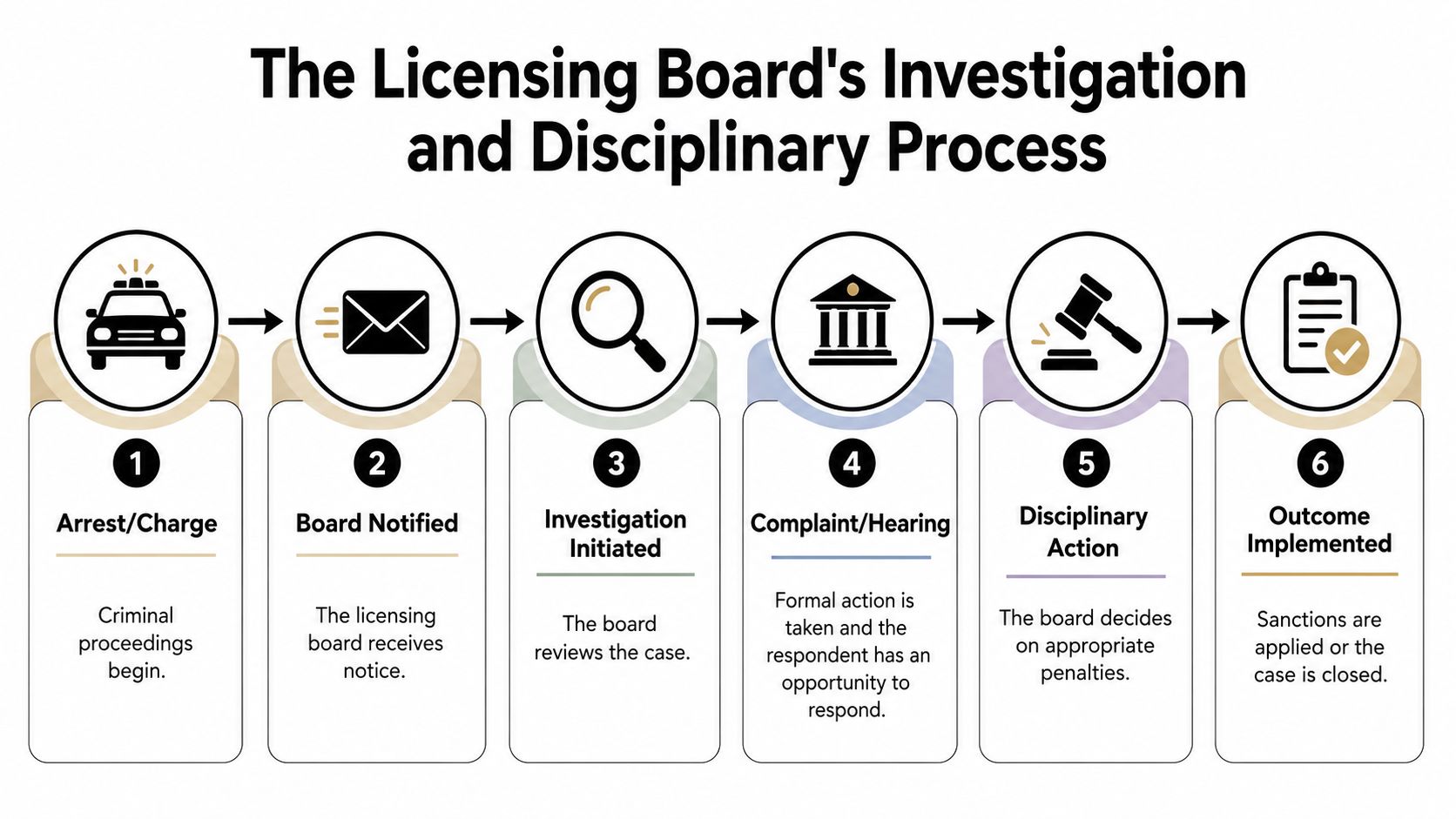
Most board cases follow a path. The exact rules depend on the profession, but the basic process looks similar across many Texas agencies.
How a case usually begins
A board investigation often starts after one of these events:
- An arrest or charge is reported
- A renewal application discloses pending criminal history
- An employer, coworker, or member of the public files a complaint
- The board receives court or background information
Once the file opens, an investigator may request documents and statements. That investigator is not your defense lawyer. Their job is to gather information for the board.
If your criminal case is pending, anything you submit can affect plea talks, trial strategy, and future testimony. That's why professionals get into trouble when they try to “clear things up” informally.
What happens after the first notice
Boards often move through these stages:
| Stage | What usually happens |
|---|---|
| Initial notice | You learn the board is reviewing the case |
| Investigation | The board gathers reports, records, and responses |
| Proposed action | You may receive allegations or a settlement offer |
| Informal conference | Some boards allow discussion or negotiated resolution |
| Formal hearing | A contested case may go to an administrative hearing |
| Final order | The board imposes discipline or closes the case |
At the hearing stage, the case may go before an administrative law judge, often through the State Office of Administrative Hearings. That process is separate from your criminal court. Different rules apply. Different evidence can matter.
Your rights during the investigation
You still have rights, even when a board is asking questions.
- You can seek counsel before responding: This is often the safest move.
- You don't have to guess: If a notice is vague, your lawyer can request clarity and records.
- You shouldn't volunteer harmful facts: Extra detail often creates extra problems.
- You can challenge the board's theory: A charge does not prove the offense is job-related.
When a board asks for a statement, many professionals think silence looks bad. In reality, an unplanned statement is often worse than a delayed, carefully prepared response.
A good defense lawyer will coordinate the timing. Sometimes the best move is a narrow response. Sometimes it's requesting more time. Sometimes it involves producing records that help without exposing your criminal defense.
Potential Outcomes and Penalties for Your License
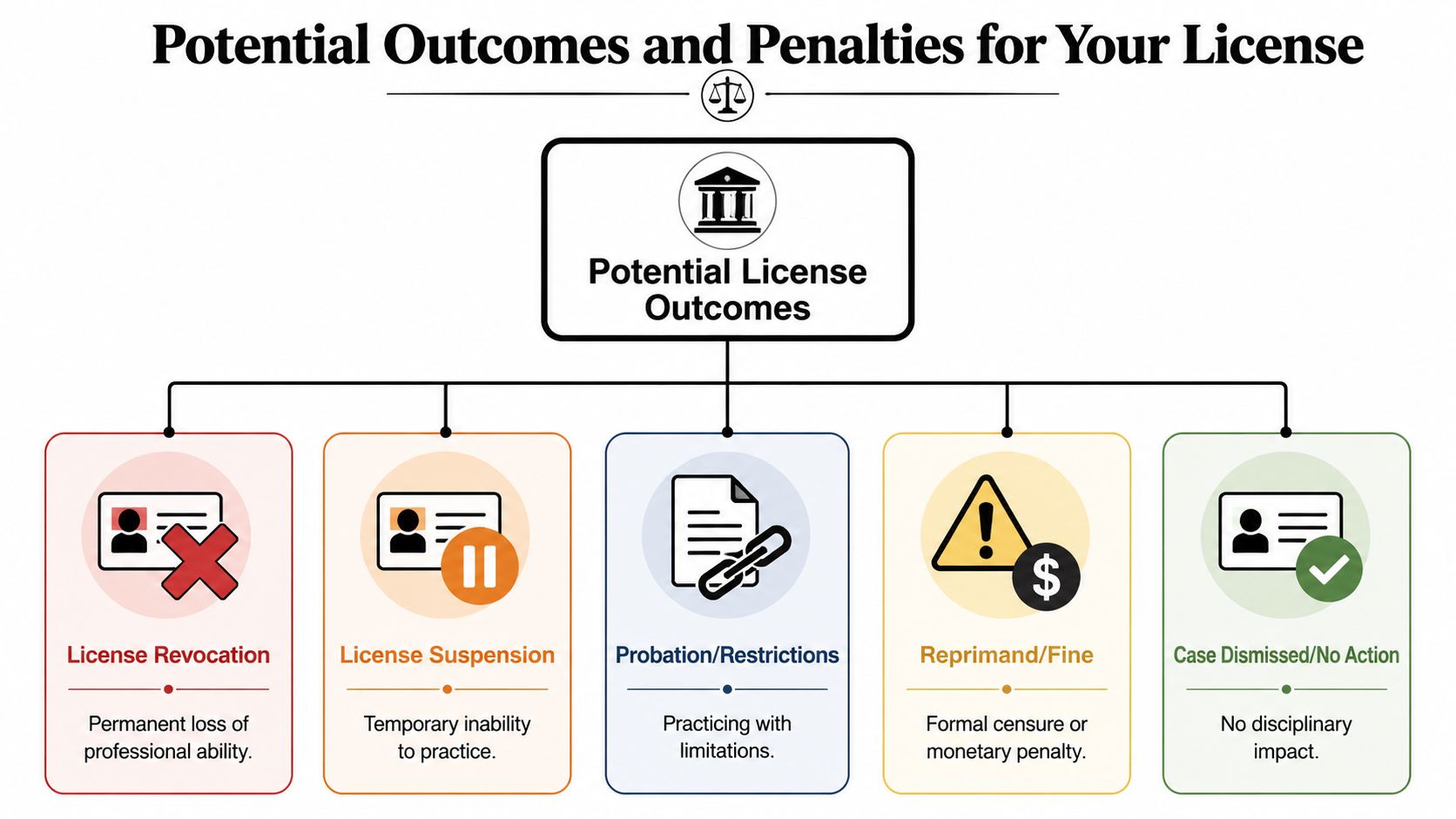
The result of a board case is not always suspension or revocation. There is a full range of possible outcomes, from no action at all to losing the license completely.
That range matters because your strategy should match the actual risk. If the facts support a dismissal or limited sanction, you don't want to hand the board reasons to escalate. If the facts are serious, you need to present mitigation early and carefully.
The full spectrum of possible outcomes
Some cases resolve with little impact. Others reshape a career.
Here are common results boards may impose:
- Case dismissed or closed: The board decides not to proceed.
- Warning or reprimand: A formal mark on your record, sometimes public.
- Fines or required courses: You keep the license but must satisfy conditions.
- Probation or practice restrictions: You can work, but under limits or monitoring.
- Suspension: Your license is paused for a period of time.
- Revocation: Your license is taken away, sometimes permanently.
How boards choose the penalty
Boards usually weigh the nature of the offense, the connection to the work, your prior history, your honesty during the process, and whether you show rehabilitation.
A first-time misdemeanor with weak connection to the profession may lead to no action or a lesser sanction. A felony tied to violence, fraud, patient safety, student safety, or client money creates much more danger.
The cost is not only the sanction itself. A peer-reviewed legal-economic study estimated annual earnings losses of about $5,100 for a misdemeanor conviction and $6,400 for a felony conviction, and a Texas-focused policy analysis estimated $9 billion in annual earnings loss tied to missed second-chance sealing and relicensing opportunities, as discussed in this legal-economic analysis of criminal records, sealing, and relicensing.
What works and what usually doesn't
Some professionals improve their position by being organized, credible, and strategic. Others make the board's job easier.
| Usually helps | Usually hurts |
|---|---|
| Coordinated legal response | Talking to investigators casually |
| Accurate, limited disclosures | Overexplaining or minimizing facts |
| Proof of compliance and stability | Ignoring deadlines |
| A criminal defense aimed at avoiding a damaging conviction | Taking a plea without checking licensing fallout |
Bottom line: The best licensing outcome often starts with the best criminal case outcome. If you can avoid a conviction that directly relates to your profession, you usually reduce the board's leverage.
If you're charged with DWI, assault, theft, or drug possession, that means every stage matters. Arrest, arraignment, plea bargaining, trial, and sentencing each create records and admissions that can follow you into the administrative case.
Using Expunctions and Nondisclosures to Protect Your Career
Even after the court case ends, the record can keep causing trouble. That's where expunctions and orders of nondisclosure come in.
In plain English, an expunction removes records of an arrest and case when you're eligible. A nondisclosure seals the record from public view in many situations. They do different jobs, and choosing the right one matters for your career.
If you want a side-by-side explanation, this guide on expungement vs. nondisclosure in Texas is a helpful starting point.
Why post-case relief matters for professionals
A dismissed case can still appear in background checks unless you take additional action. That's a problem for professionals who renew licenses, change jobs, apply for new credentials, or move into regulated fields later.
For many people, the long-term goal isn't only to beat the present charge. It's to keep one bad chapter from becoming a permanent barrier.
Here is the practical difference:
- Expunction: Best when the law allows you to erase the arrest and case records.
- Nondisclosure: Useful when expunction isn't available but sealing can limit who sees the record.
- Career planning: Important if you may apply for another license, promotion, or regulated role later.
Where professionals get tripped up
Some licensing systems and regulated industries use disclosure forms that reach beyond ordinary job applications. That's why it helps to read the exact wording before answering criminal history questions.
For example, people in financial services often deal with industry reporting forms after separation from employment. If that issue touches your career, Kons Law's Form U5 insights offer useful context on how disclosures in regulated fields can affect future opportunities.
Timing matters
You shouldn't wait until a license denial or renewal problem to ask about clearing your record. In many cases, the smartest move is to evaluate eligibility as soon as your criminal case ends.
A favorable result in court may open the door to record relief. A poorly chosen plea may close that door. That is one more reason your defense strategy should consider the endgame from the beginning.
Immediate Steps to Protect Your License After an Arrest
At 6:30 on a Monday morning, a nurse, teacher, engineer, or realtor can be dealing with two problems at once. There is the criminal case, and there is the question nobody expects to face so suddenly: do I need to do something right now to keep my license safe?
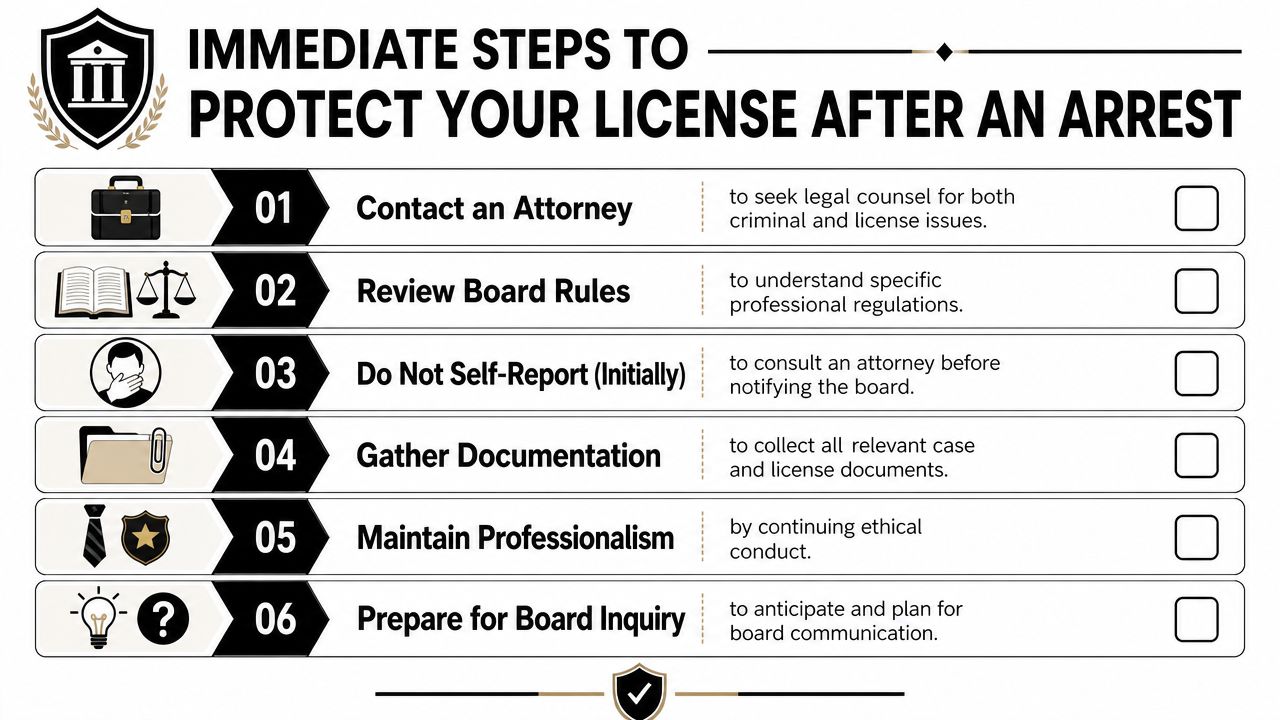
The first week matters because early choices shape both files. A quick explanation to an employer, a rushed report to a board, or a casual statement to an investigator can create problems that are much harder to fix later.
Get legal advice before you make career-affecting decisions
A licensed professional needs more than a standard bond hearing strategy. The defense plan should account for reporting duties, board rules, employment consequences, and whether a plea that looks manageable in criminal court could trigger discipline later.
That is why I tell professionals to ask direct questions at the start. Does your lawyer understand your licensing board's process? Have they handled cases where the criminal outcome and the board response had to be coordinated? Can they help you avoid admissions that solve one problem while making the other worse?
For a practical overview of the first things to do after an arrest, read this guide on what to do immediately after getting arrested in Texas.
Check your reporting duties before you say anything
Many professionals get into trouble by guessing. Some boards require prompt reporting of certain charges. Others do not require disclosure until renewal, a formal complaint, or a conviction. Your employer may have a separate rule, and it may not match the board's rule.
Read the exact language.
Look at the statute, board rule, renewal form, application questions, and any employment policy that applies to your role. Then have your lawyer review the same documents. A missed disclosure can become its own issue. So can an overbroad disclosure that gives the board facts it did not ask for and the State may later use.
Your employer, your licensing board, and the criminal court are different audiences. A statement that feels responsible in one setting can be harmful in another.
Do not create evidence the board can use against you
Board investigators often contact professionals in a calm, informal way. The risk is that the conversation feels administrative when it is really evidentiary.
Common mistakes include:
- Giving a phone statement without preparation. Small wording choices can sound like admissions.
- Sending an apology or explanation letter too early. Once written, it is hard to control how that statement will be read.
- Signing broad medical, employment, or treatment releases. You may expose far more information than the board is entitled to see at that stage.
- Repeating criminal allegations as if they are established facts. Charging documents contain accusations, not findings.
Here is a useful video that walks through early protective steps after an arrest.
Build your license defense while the criminal case is still new
This is the part many professionals miss. The best time to protect a license is often before the board opens a formal disciplinary case.
Start preserving favorable evidence immediately. Save text messages, emails, call logs, photographs, body-camera references, witness names, calendar entries, and anything else that fixes the timeline. Keep copies of bond conditions, charging papers, court settings, and every notice from your employer or board in one place. If the allegation involves alcohol, medication, or a workplace incident, discuss with counsel whether a voluntary evaluation, treatment, or work restriction helps your position or creates new disclosure issues. The right answer depends on the facts and the board involved.
A coordinated plan usually includes:
- A clear timeline of what happened before, during, and after the arrest.
- A document file with court papers, board correspondence, and employment notices.
- A deadline system for court dates, renewal dates, and reporting obligations.
- A communications plan for supervisors, HR, investigators, and board staff.
- A plea analysis that looks beyond fines or probation and asks what the license consequences could be.
Act like every decision may be reviewed later
Boards often look at conduct after the arrest, not just the allegation itself. That means bond compliance matters. Attendance at work matters. New accusations matter. Social media posts matter.
Keep your routine disciplined. Follow bond conditions exactly. Do not discuss facts of the case by text or online. If your job permits you to keep working, show up on time and protect your professional record. If substance use, stress, or mental health played any role, get advice before starting programs or making disclosures so the help you receive fits your defense strategy instead of complicating it.
An arrest does not automatically end a professional career in Texas. But waiting for the board to contact you is usually the wrong approach. Early, careful action gives you a better chance to protect both the criminal case and the license you worked hard to earn.