Skip to content
Being arrested in Texas can be terrifying — but you don’t have to face it alone. When the charge is a Class A misdemeanor, especially for a first offense, your world can feel like it's been turned upside down. You are likely filled with questions about what this means for your job, your family, and your future. The Texas Penal Code sets the maximum penalties at up to one year in county jail and a fine of up to $4,000, making this the most serious misdemeanor charge in the state.
Understanding what you’re up against is the first step toward building a strong defense. This guide will walk you through the process, explain your rights, and show you there is a path forward.
What a Class A Misdemeanor Charge Means for You

When you're charged with a Class A misdemeanor, the state is accusing you of a serious crime that falls just below a felony. Imagine Texas law as a ladder of offenses. A Class A misdemeanor sits on the highest rung for misdemeanors, right under state jail felonies. While it’s not a felony, a conviction still carries significant weight and can disrupt your life in profound ways.
The Texas Penal Code outlines the punishment range, but those maximums don’t tell the whole story. For a first-time offense, a judge has a lot of discretion to consider other options, like probation or even a dismissal through a program called deferred adjudication. However, it's crucial to remember that a positive outcome is never guaranteed without a strong legal strategy.
The Immediate Penalties You Face
The law is clear about the potential consequences if you are convicted. A judge can impose any combination of the penalties below.
Here is a plain-English breakdown of what you could be facing:
Class A Misdemeanor Penalties at a Glance
| Penalty Type | Potential Outcome (Texas Penal Code) |
|---|---|
| Jail Time | Up to one year in a county jail |
| Fines | Up to $4,000 |
| Probation | Up to two years of community supervision with strict conditions |
These penalties aren't just numbers on a page; they have real-world impacts.
Imagine a first-time offender caught in a heated argument that escalates into an Assault Bodily Injury—a common Class A misdemeanor. This happens more often than you might think. For example, Harris County filed 1,247 of these assault cases in a single year, while Dallas County filed 1,513. A judge might lean toward probation for a first offense, but a conviction still leaves a permanent mark on your record, making it harder to get a job, rent an apartment, or maintain a professional license.
A criminal charge is an accusation, not a conviction. Your story is not over, and with the right legal strategy, you can fight to protect your record and your freedom.
Understanding where this charge fits within the broader legal landscape is vital. To get a better handle on how a Class A misdemeanor compares to other charges, take a look at our guide on the classes of misdemeanors in Texas. This context helps you appreciate the seriousness of your situation and why having an experienced Houston criminal lawyer is so important. A skilled attorney can navigate the system for you and fight for a resolution that avoids these harsh outcomes.
Common Offenses Charged as Class A Misdemeanors
Knowing the potential penalties for a class a misdemeanor in texas first offense is one thing. Understanding how those laws apply in real-life situations is another. These are not abstract legal theories—they are charges that good people face every day, often after a single mistake or a situation that spiraled out of control.
Let’s walk through some of the most common offenses that are filed as Class A misdemeanors. You might be surprised by how easily a seemingly minor incident can escalate to this serious level.
Driving While Intoxicated Second Offense
In Texas, a first-time DWI is almost always a Class B misdemeanor. However, if you are arrested for a second DWI, the charge is automatically enhanced to a Class A misdemeanor. This upgrade brings much harsher penalties, including mandatory jail time.
The law views a second offense not as an isolated incident, but as a potential pattern of behavior. That's why the stakes get so much higher. It's also worth noting that even a first-time DWI can be charged as a Class A if your Blood Alcohol Concentration (BAC) is 0.15 or higher—nearly double the legal limit. A Texas DWI attorney can help you challenge the evidence in these complex cases.
Assault Causing Bodily Injury
An argument that turns physical can lead to a Class A misdemeanor charge for Assault Causing Bodily Injury faster than you might realize. Under the Texas Penal Code, this occurs when someone intentionally, knowingly, or recklessly causes physical pain to another person.
This is one of the most frequent Class A charges we see. A simple bar fight, a heated domestic dispute, or a confrontation that goes too far can all end with an arrest. The critical part is that the injury doesn't have to be severe. A bruise, a scratch, or any complaint of pain can be enough for the state to file these serious charges. A strong Texas assault defense can make all the difference.
Burglary of a Vehicle
Most people associate burglary with breaking into a home, but in Texas, breaking into a car is just as serious. Burglary of a Vehicle is defined under Texas Penal Code § 30.04 as entering someone’s vehicle without their permission with the intent to commit a theft or any felony.
This charge doesn’t require you to actually steal anything. The prosecutor only needs to prove you broke in with the intent to steal. Merely opening an unlocked car door to rummage through the console can be enough to lead to a Class A misdemeanor arrest.
This is a very common class a misdemeanor in texas first offense and it carries the full range of penalties, including up to a year in county jail.
Theft of Property Valued Between $750 and $2,500
When it comes to theft, the value of the property is everything. Stealing something worth less than $750 is typically a lower-level misdemeanor. However, the moment the value of the allegedly stolen goods or services crosses the $750 threshold, the charge jumps to a Class A misdemeanor.
Theft between $750 and $2,500—think shoplifting expensive electronics or an employee pocketing cash from the register over time—is a serious charge for a first-time offender in Texas. Recent statistics show just how common this is, with Harris County logging 1,468 such theft cases, Dallas County 1,803, and Tarrant County 871 in one year. You can discover more insights about Texas criminal charges and see that you are not alone in facing this.
Other common Class A misdemeanors include:
- Unlawfully Carrying a Weapon (UCW): Carrying a handgun in certain restricted places, even with a license.
- Violation of a Protective Order: Contacting someone in a way that violates a court-issued protective or restraining order.
- Resisting Arrest: Using force against a police officer to prevent an arrest.
Navigating the Texas Criminal Court Process
The moments after an arrest can feel like a blur. One minute you're in handcuffs, the next you're released with a stack of paperwork, a looming court date, and no clear instructions on what to do next. The legal system is a maze, and when you're facing it alone, it's easy to feel overwhelmed and powerless.
But understanding the path ahead is the first step toward taking back control. A criminal case isn’t a single event; it's a series of stages, each with its own rules, deadlines, and opportunities to fight back. We're here to provide a clear roadmap so you feel prepared, not lost.
From Arrest to Your First Court Date: Step-by-Step
The journey begins the moment you're arrested for a Class A misdemeanor. From that point on, every step is critical. Here’s what you can generally expect to happen next.
Booking and Bail: After your arrest, you will be taken to a local jail for booking. This is where they take your fingerprints, photo, and personal information. Soon after, a magistrate judge will set your bail—the amount of money required to secure your release while the case is pending.
Hiring an Attorney: This is the single most important decision you can make. The time between getting out of jail and your first court appearance is precious. It gives your defense lawyer a head start on gathering evidence, contacting the prosecutor, and building a strategy before the state's case gains momentum.
The Arraignment: This is your first formal appearance in court. The judge will read the official charges against you and ask for your plea: "guilty," "not guilty," or "no contest." Pleading "not guilty" is almost always the correct move at this stage. It preserves all your legal options and gives your attorney the time needed to build your defense.
The flowchart below shows how different charges, from a second DWI to vehicle burglary, all enter this same complex legal process.
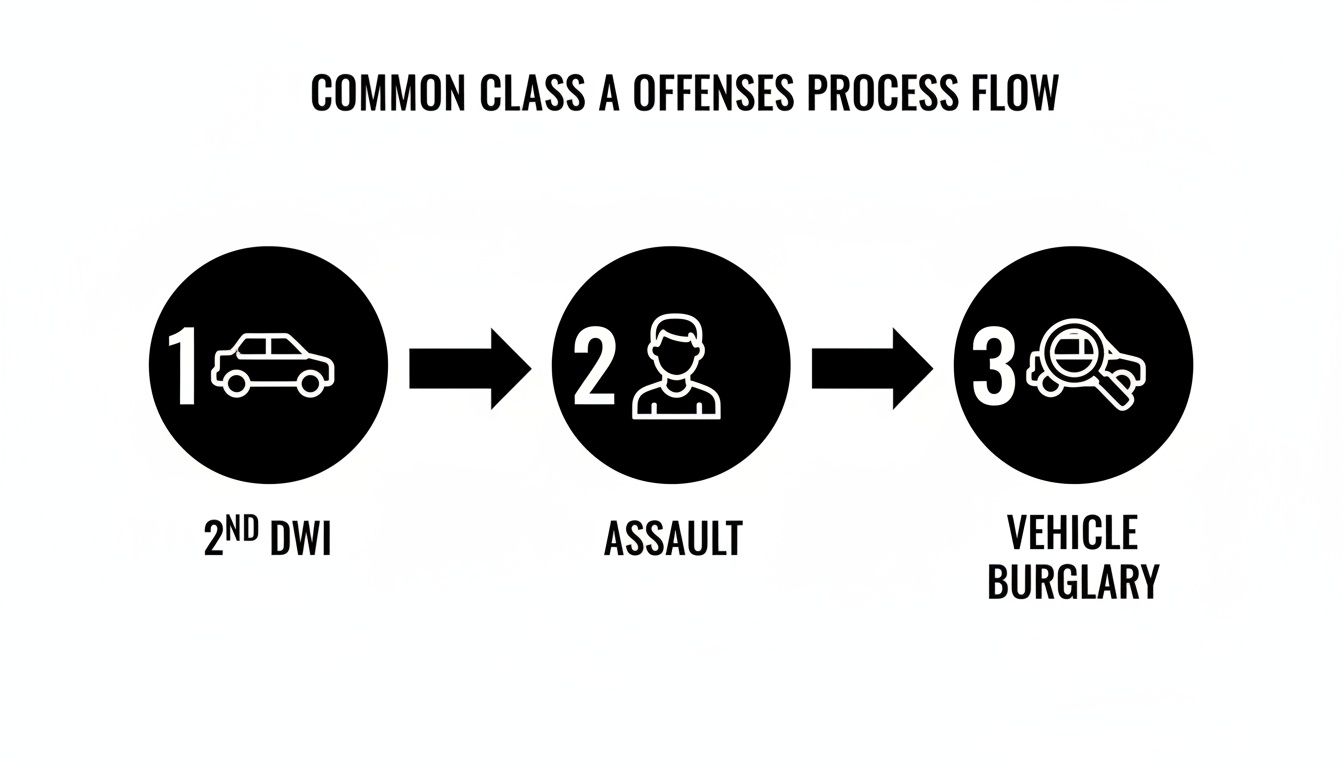
While the charges may differ, the court process is largely the same. Each case requires a defense tailored to its specific facts and circumstances.
Pre-Trial Negotiations and Plea Bargaining
Once the arraignment is over, your case moves into the pre-trial phase. This is where the real work begins and where a skilled negotiator can make all the difference. Your lawyer will immediately file a "discovery motion," which is a legal demand forcing the prosecutor to turn over every piece of evidence they have—police reports, witness statements, lab results, and any video footage.
We comb through this evidence looking for weaknesses, constitutional violations, and mistakes.
For example, did the officer have a legal reason to pull you over for that DWI? Was the evidence in your vehicle burglary case found during an illegal search of your car? If we find these kinds of errors, we can file a motion to suppress the evidence, which prevents the prosecutor from using it against you.
This is also where plea bargaining happens. Your attorney uses weaknesses in the state's case as leverage to negotiate a better outcome. For a class a misdemeanor in texas first offense, our primary goal is often to secure one of three things:
- A complete dismissal of all charges.
- A reduction to a less serious offense, such as a Class B misdemeanor.
- An offer for a pretrial diversion program or deferred adjudication, which allows you to earn a dismissal and keep the charge off your permanent record.
If you want to dig deeper into these phases, our guide on the steps in the criminal justice process provides a more detailed breakdown.
The Possibility of Trial and Sentencing
If we cannot reach a fair agreement with the prosecutor, your case may proceed to trial. You have a constitutional right to have your case heard by a jury of your peers or, in some cases, by a judge alone in a "bench trial." This is your opportunity to formally challenge the state's narrative and present your side of the story.
At trial, your attorney will cross-examine the state's witnesses, challenge their evidence, and argue why you should be found not guilty. If a conviction occurs, the case moves to sentencing, where your lawyer will present evidence and arguments to minimize the penalties. We prepare every single case as if it's going to trial. That level of preparation gives us the strength to negotiate effectively and secure the best possible results for the people we represent.
Exploring Your Defense Options and Strategies

An arrest for a class a misdemeanor in texas first offense can make you feel like your world is collapsing. But a charge is just an accusation—it's the opening statement in a long conversation, not the final word. You have the absolute right to challenge it.
The key is understanding that you have options. A skilled criminal defense lawyer doesn’t just show up to court; they investigate every detail to find a path forward. Often, the best results are achieved through behind-the-scenes negotiations and sharp legal challenges, not a dramatic trial.
Setting Realistic Goals for Your Case
When you're facing a serious charge, it's easy to feel overwhelmed. Your main goal might be a complete dismissal, or it could be simply minimizing the damage to your future. An experienced attorney helps you set practical goals based on the hard facts of your case: the evidence, the prosecutor, and the specific circumstances.
We typically aim for one of three primary outcomes:
- Case Dismissal: This is always our top priority. We fight to get the charges dropped entirely, often by showing the prosecutor their case is too weak to win at trial or that your rights were violated.
- Reduced Charges: We can often negotiate a Class A misdemeanor down to a less serious offense, like a Class B. This move significantly lowers the potential penalties and looks far better on your record.
- Trial and Acquittal: If the state won't offer a fair resolution, we prepare to tell your side of the story to a jury and fight for a "not guilty" verdict.
Knowing these paths exist is the first step toward building a defense strategy that fits your unique situation.
Common Defense Tactics in Misdemeanor Cases
An effective defense starts by dissecting the state's case from every angle. We never take a police report at face value.
One of the first things we examine is the initial police encounter.
Did the officer have a legitimate reason—what the law calls "reasonable suspicion"—to stop or detain you in the first place? If not, any evidence they gathered after that illegal stop can be thrown out of court. This is done with a "motion to suppress," a powerful tool that can gut the prosecutor's entire case.
Other common defense strategies we employ include:
- Challenging the Evidence: We scrutinize everything. Were the breathalyzer results reliable in a DWI case? Did witnesses give conflicting stories in an assault case? Was the property value inflated to justify a higher theft charge?
- Proving Lack of Intent: Many Class A misdemeanors, like burglary of a vehicle or assault, require the prosecutor to prove you acted intentionally. We can build a defense showing your actions were an accident, a misunderstanding, or that you simply lacked the criminal intent required for a conviction.
- Asserting Self-Defense: If you are charged with assault, we may be able to prove you were justifiably defending yourself or someone else from harm. In Texas, that is your right.
A Critical Option: Deferred Adjudication
For a class a misdemeanor in texas first offense, one of the most valuable outcomes is deferred adjudication. This is not a conviction. Think of it as a special type of probation that offers a second chance.
When a judge grants deferred adjudication, you enter a plea of "guilty" or "no contest," but the judge defers a finding of guilt. You will be placed on community supervision and given conditions to complete, such as paying a fine, taking classes, or doing community service. If you successfully complete the probation period without any new arrests, the judge dismisses the case.
The biggest benefit? Since you were never formally convicted, you can later petition the court for an order of nondisclosure. This seals the record of your arrest from public view, preventing one mistake from following you for the rest of your life.
Comparing Your Legal Options
Making a decision about how to handle your case can be daunting. This table breaks down the most common legal paths to help you see the pros and cons of each strategy.
| Legal Option | Potential Outcome | Best For… |
|---|---|---|
| Plea Bargain | Reduced charge (e.g., Class B), lighter sentence. | Cases where the evidence is strong but a conviction for the original charge can be avoided. |
| Deferred Adjudication | Case dismissal after successful probation; record may be sealed. | First-time offenders with a strong chance of completing probation successfully. |
| Trial | A "not guilty" verdict (acquittal) and a completely clear record. | Cases where the state's evidence is weak, or a fundamental right was violated. |
Ultimately, the right choice depends entirely on the unique facts of your case. An experienced lawyer can walk you through each option and advise you on the strategy that gives you the best shot at protecting your future.
How to Protect Your Future and Clear Your Record

Even after the court case is over, a criminal record can linger, creating roadblocks you never anticipated. It can appear when you apply for a job, try to rent an apartment, or seek a professional license. But a charge for a class a misdemeanor in texas first offense does not have to define your future.
Fortunately, Texas law provides powerful legal tools to help you get a clean slate. Understanding these post-conviction relief options is the final, and most critical, step in truly moving on.
Expunctions and Nondisclosures: Sealing vs. Destroying Your Record
When it’s time to clear your name, you will hear lawyers talk about two key options: expunctions and nondisclosures. They might sound similar, but they offer very different levels of protection.
Expunction: This is the best-case scenario. An expunction, also called an expungement, legally destroys the records of your arrest. It is as if it never happened. You can legally deny the arrest ever occurred on applications for jobs, housing, and more.
Order of Nondisclosure: This is what most people mean when they talk about "sealing" a record. An order of nondisclosure hides your criminal record from the public, including most private employers and landlords. While government and law enforcement agencies can still access it, it's a huge step toward protecting your privacy.
The path available to you depends entirely on the outcome of your case. Knowing the difference is key to reclaiming your life.
Who Qualifies for an Expunction?
An expunction is the gold standard for clearing a record, but it is reserved for cases that end in a complete victory. You are generally eligible to seek an expunction if your Class A misdemeanor case resulted in one of these outcomes:
- A full acquittal (a "not guilty" verdict) at trial.
- A complete dismissal of the charges by the prosecutor.
- You were arrested but never formally charged before the statute of limitations expired.
If your case was dismissed or you were found not guilty, you have a right to a fresh start. We guide clients through the detailed process of filing a Petition for Expunction to ensure every trace of the arrest is wiped from your record. To dig deeper, you can learn more about how to get a misdemeanor expunged in Texas in our comprehensive guide.
Who Qualifies for an Order of Nondisclosure?
What if your case didn't end in a dismissal or acquittal? You may still have a path forward. An order of nondisclosure is the go-to solution for people who successfully completed deferred adjudication.
Deferred adjudication is a unique form of community supervision that allows you to avoid a final conviction. Once you complete the probation period and meet all conditions, the judge dismisses the case. While this outcome doesn't qualify for an expunction, a successful dismissal makes you eligible to petition the court to seal your record.
This is a life-changing remedy. It stops a past mistake from appearing on the background checks that can lock you out of opportunities. When it comes to your career, it's vital to understand the impact of a public criminal record check for employers. Sealing that record ensures your past doesn't define your professional future.
The waiting periods and eligibility rules for both options can be complex, but you don't have to figure it out alone. Our team is dedicated to helping clients navigate this final stage of the legal process and secure the clean slate they deserve.
Common Questions About Texas Misdemeanors
When you’re facing a charge like a Class A misdemeanor in Texas, especially for a first offense, the questions can pile up quickly. The uncertainty is overwhelming. You need clear, straightforward answers to cut through the legal jargon and understand what happens next. Here are the questions our clients ask us most, answered directly to address your biggest concerns.
Can I Go to Jail for a First-Offense Class A Misdemeanor?
Yes, jail time is legally a possibility. A Class A misdemeanor conviction in Texas carries a potential sentence of up to one year in county jail. However, for a first offense, this is far from a guaranteed outcome.
Judges have significant discretion. They often prefer alternatives like probation (which courts call "community supervision"), deferred adjudication, fines, or community service. A primary goal for a defense attorney is to negotiate an outcome that keeps you out of a jail cell entirely.
Whether you face incarceration depends on the specifics of your case, your personal history, and the strength of your defense. We work to show the prosecutor and the judge who you are as a person—not just a case number—to prove that jail time is not a just or necessary outcome.
How Much Does a Lawyer Cost for a Misdemeanor?
The cost of hiring a criminal defense lawyer varies based on the complexity of your case, the attorney's experience, and the county where you were charged. While it is an investment, it is an investment in your future.
Consider the alternative. The long-term costs of a conviction—losing out on jobs, being denied for an apartment, and carrying a permanent criminal record—almost always outweigh the expense of hiring a strong legal advocate.
Any reputable firm, including ours, will offer a free, confidential consultation. This is your chance to discuss the facts of your case, understand your legal options, and receive a clear explanation of the fees involved. We believe in transparent pricing and are committed to delivering real value by fighting for the best possible result for you.
Will a Class A Misdemeanor Show Up on a Background Check?
Yes, an arrest for a Class A misdemeanor—and any resulting conviction—will absolutely appear on public background checks. This is one of the most damaging and lasting consequences of a criminal charge. It can follow you for years, making it harder to get a job, secure a loan, or even volunteer at your child's school.
However, a positive outcome in court can unlock powerful legal tools to fix this problem.
- If your case is dismissed or you’re found not guilty at trial, you can often get an expunction, which completely destroys the record of the arrest.
- If you successfully complete deferred adjudication, you can typically seek an order of nondisclosure, which seals the record from the public’s view.
Pursuing these post-conviction remedies is a crucial part of a complete defense strategy. Clearing your name is the final, most important step to truly putting this behind you.
Should I Just Plead Guilty to Get It Over With?
Pleading guilty at your first court date just to "get it over with" is almost always a mistake, especially without first speaking to an attorney. The prosecutor's initial plea offer might seem like a quick fix, but it locks in a permanent criminal conviction on your record.
Accepting that first deal means giving up before the fight even begins. A skilled defense lawyer can achieve a much better outcome by taking the time to properly investigate your case.
Here’s what an attorney does for you:
- Analyzes the Evidence: We scrutinize every piece of the state's evidence, from police reports to witness statements, looking for mistakes, inconsistencies, and constitutional violations.
- Identifies Your Defenses: We explore every possible defense, whether it’s an illegal traffic stop, a faulty search, lack of intent, or self-defense.
- Negotiates from Strength: Armed with this leverage, we negotiate with the prosecutor to achieve a dismissal, a reduction to a lesser charge, or a deferred adjudication offer that keeps a conviction off your record.
Never sign away your rights without fully understanding what you are giving up. Your future is too important to leave to chance. Always talk to a defense lawyer before making a decision that will follow you for the rest of your life.
If you’ve been charged with a crime in Texas, call The Law Office of Bryan Fagan, PLLC for a free and confidential consultation. Our defense team is ready to protect your rights. Visit us online at https://texascriminallawyer.net.