Skip to content
Being arrested in Texas can be terrifying, especially when the officer says the charge is deadly conduct and you have no idea what that really means. Maybe it started with a road rage argument, a heated dispute outside a house party, or a reckless moment with a firearm that got reported before anyone was hurt. Now you're worried about jail, your job, your family, and what happens next.
Understanding Deadly Conduct Texas law can be a source of significant stress. The good news is that an accusation is not a conviction. A strong defense often starts with understanding the exact charge, because deadly conduct cases turn on details that many people, and many websites, get wrong.
An Accusation of Deadly Conduct Can Be Terrifying
One of the most unsettling parts of this charge is how fast ordinary life can flip upside down. You may have thought you were just trying to scare someone off, vent your anger, or react in a tense situation. Then police arrive, witnesses give statements, and suddenly you're being treated like you committed a violent crime.
A common example looks like this. Two drivers get into an aggressive confrontation. One swerves too close, follows the other car, or gets out while yelling. No one is physically injured, but another person says they feared serious harm. In a different case, someone points a gun during an argument without firing it. In both situations, the state may still consider the conduct criminal.
That shock often leads people to make mistakes right away. They try to explain everything to police, apologize to the other person, or post their side of the story online. Those choices can make the case harder to defend.
Practical rule: When you're facing a charge that sounds severe, your first job is to protect your rights, not to win the argument in the parking lot or on your phone.
Deadly conduct cases also create confusion because the same label can describe very different allegations. Some involve reckless behavior without a shot fired. Others involve the discharge of a firearm and carry much harsher consequences. If you don't understand which version of the law applies to you, it's hard to make good decisions about bond conditions, plea offers, trial risk, or your long-term record.
That's why calm, accurate legal guidance matters. You need to know what Texas law states, what prosecutors must prove, where defenses often come from, and what steps can help you regain control.
Understanding Deadly Conduct Under Texas Law
Texas Penal Code §22.05 is the statute behind a deadly conduct charge. The name sounds broad, and that is part of what makes these cases confusing. Under this law, the state does not have to prove someone was injured. The focus is on whether your actions created an immediate risk of very serious harm.
That last point matters more than many people realize.
What the law is really targeting
At the misdemeanor level, the statute says a person commits deadly conduct by recklessly engaging in conduct that places another in imminent danger of serious bodily injury.
Those words carry a lot of weight, so it helps to slow them down:
- Recklessly means the state is claiming you were aware of a substantial risk and went ahead anyway. It is more than carelessness, but it is different from acting on purpose.
- Conduct means something you did. Angry words alone usually do not satisfy this statute unless they are tied to dangerous actions.
- Imminent danger of serious bodily injury means the alleged danger had to be immediate and severe. A later possibility or a general feeling of fear is not enough by itself.
A simple way to read this statute is that Texas is punishing dangerous behavior before someone ends up in the hospital or worse.
The part people often misunderstand
Deadly conduct is not a one-size-fits-all charge. The law draws a sharp line between recklessly creating danger and knowingly discharging a firearm in a dangerous direction. That distinction changes how the case is charged, how prosecutors build it, and how the defense should attack it.
For example, waving a gun during an argument and firing a gun toward a person, car, or building are not treated the same way under Texas law. They may share the same offense label, but they involve different mental states and different proof problems.
That is also why people sometimes confuse deadly conduct with assault. If you want a clearer side-by-side explanation of how those charges can overlap, this guide to assault vs. deadly conduct charges in Texas helps show where the lines are.
Why firearm cases need careful analysis
Texas law creates a presumption of recklessness if a person knowingly points a firearm at or in the direction of another person, even if the gun was not loaded.
That surprises many clients. They tell me, "I was trying to scare him, not shoot him," or "The gun wasn't even loaded." Under this statute, those facts do not automatically end the case. They can still leave room for defense arguments, but they do not make the charge disappear.
The mental state is the key. Reckless conduct means the state is saying you ignored a serious risk. Knowing discharge means the state is saying you intentionally fired the weapon, while being reckless about whether someone or something occupied was in the line of fire. That difference may sound technical, but in criminal court it can mean the difference between a misdemeanor allegation and a felony accusation.
Why small facts matter so much
In deadly conduct cases, details work like switches. One fact can turn the whole case.
Where was everyone standing? How close were they? Was there an actual line of fire or only a heated argument? Did a witness clearly see what happened, or fill in gaps after hearing yelling and seeing panic? Did police arrive after the event and rely on emotional statements rather than direct observation?
A strong defense often starts with a very disciplined question: can the state prove each legal element, with real evidence, rather than just prove that the situation looked bad?
That is the right way to evaluate a deadly conduct accusation. Prosecutors must prove the statutory elements. They do not win merely because the scene was tense, somebody felt frightened, or the police assumed the worst.
Misdemeanor vs Felony The Critical Distinction
A lot of fear in these cases comes from one hard truth. Two people can both be accused of "deadly conduct," but one is facing a misdemeanor and the other is facing a felony.
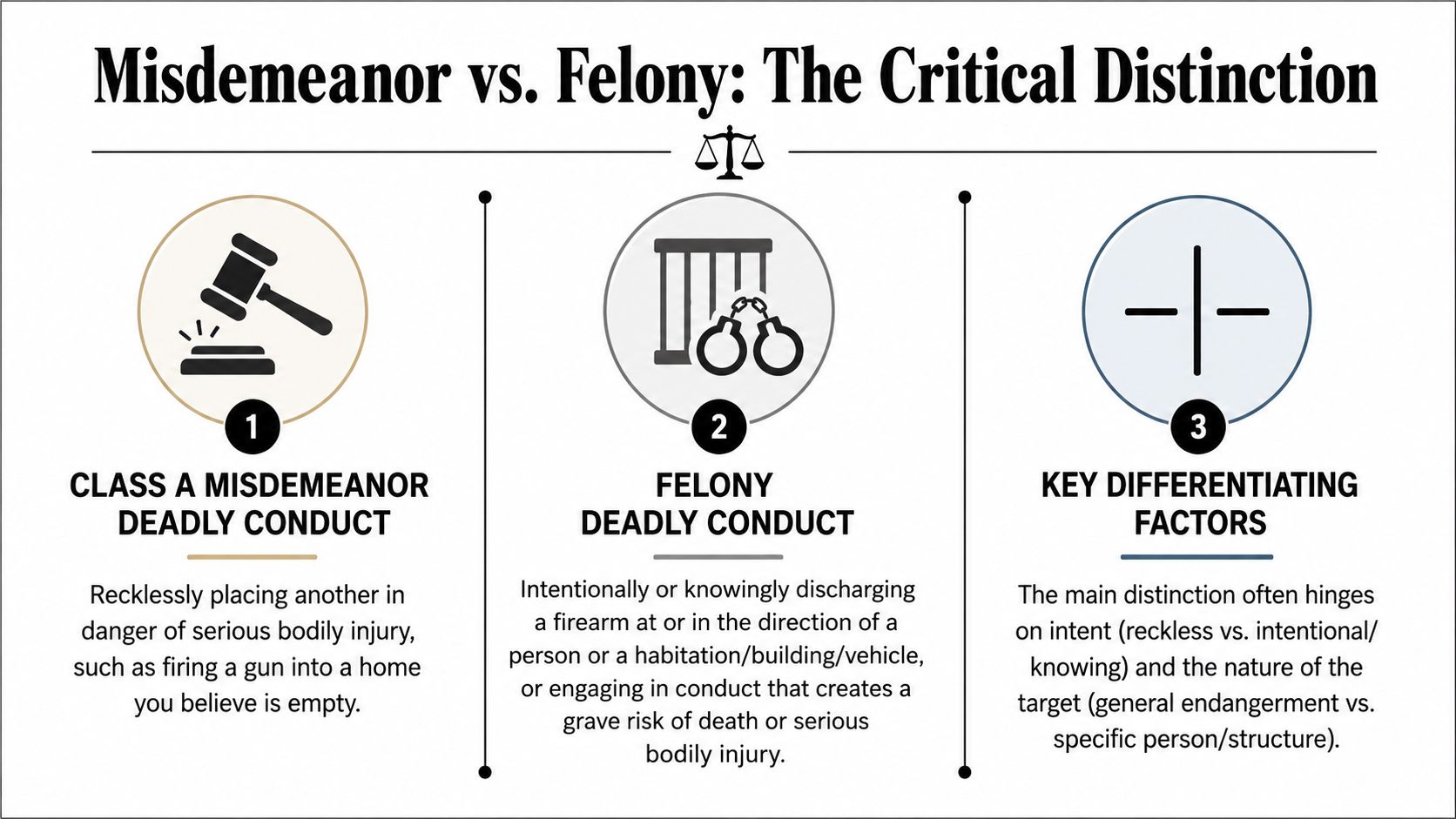
That difference usually turns on a narrow legal question about mental state and the specific act the State says occurred. If you understand that distinction early, you can read the charging papers more clearly, spot weak points in the allegation, and make better decisions about your defense.
When deadly conduct is a misdemeanor
A Class A misdemeanor case usually means the prosecutor is relying on the part of the law that says a person recklessly places another in imminent danger of serious bodily injury.
"Recklessly" matters here. In plain English, the State is not saying you meant to hurt someone. It is saying you were aware of a serious risk and ignored it anyway.
That can show up in cases involving:
- handling a weapon in an unsafe way without firing it
- driving or acting in a way that allegedly put someone in immediate danger
- threatening conduct during a heated confrontation
- behavior that created a serious risk even though no one was physically injured
One common point of confusion is that the law can treat a firearm as dangerous even if no shot was fired. In some situations, the allegation is built around the danger created in the moment, not around an actual injury.
When deadly conduct becomes a felony
A third-degree felony deadly conduct case usually involves a different theory entirely. Here, the State alleges you knowingly discharged a firearm at or in the direction of a person, home, building, or vehicle, while also claiming you were reckless about whether it was occupied.
This is the nuance many articles gloss over.
The misdemeanor version focuses on recklessly creating danger. The felony version focuses on knowingly firing the gun. Those are related ideas, but they are not the same. One is about risky conduct that puts someone in danger. The other is about an intentional discharge, combined with recklessness about who might be in harm's way.
A simple way to picture it is this. The misdemeanor allegation says, "you handled a dangerous situation in a reckless way." The felony allegation says, "you knowingly pulled the trigger in a prohibited direction."
A side by side comparison
| Charge level | What the state alleges | Potential punishment |
|---|---|---|
| Class A misdemeanor | Recklessly placing another in imminent danger of serious bodily injury | Jail time in county jail and a significant fine |
| Third-degree felony | Knowingly discharging a firearm at or in the direction of a person, habitation, building, or vehicle while reckless about occupancy | Prison exposure and a much higher fine ceiling |
For a broader explanation of how Texas separates offense levels, see misdemeanor vs. felony charges in Texas.
Why this distinction changes the whole defense
The subsection the State chooses affects almost everything. It changes what prosecutors must prove, what evidence matters most, how plea discussions are handled, and how much exposure you face if the case goes to trial.
For example, if the allegation is misdemeanor deadly conduct, the defense may focus heavily on whether there was an imminent danger of serious bodily injury. If the allegation is felony deadly conduct, the fight may center on whether the gun was discharged, the direction of the shot, whether the location was occupied, and what you knew at that moment.
The label "deadly conduct" is only the starting point. The question that usually matters most is which subsection the State filed and whether the evidence actually matches that charge.
That is why small factual differences can carry enormous weight. A witness who says you waved a gun is describing a very different case from a witness who says you knowingly fired toward a vehicle. In one case, the State may be trying to prove reckless endangerment. In the other, it may be trying to prove felony discharge.
If you are charged, do not assume the offense label tells you everything. In deadly conduct cases, the details underneath that label often decide the path of the case.
Penalties and Long-Term Consequences You Face
A deadly conduct case can change your life in two different ways at once. First, there is the sentence the court can impose. Second, there are the practical problems that can follow you into work, housing, licensing, and family life long after the case is over.
Direct criminal penalties
The punishment depends on which version of deadly conduct the State filed. That distinction matters here just as much as it matters in the defense.
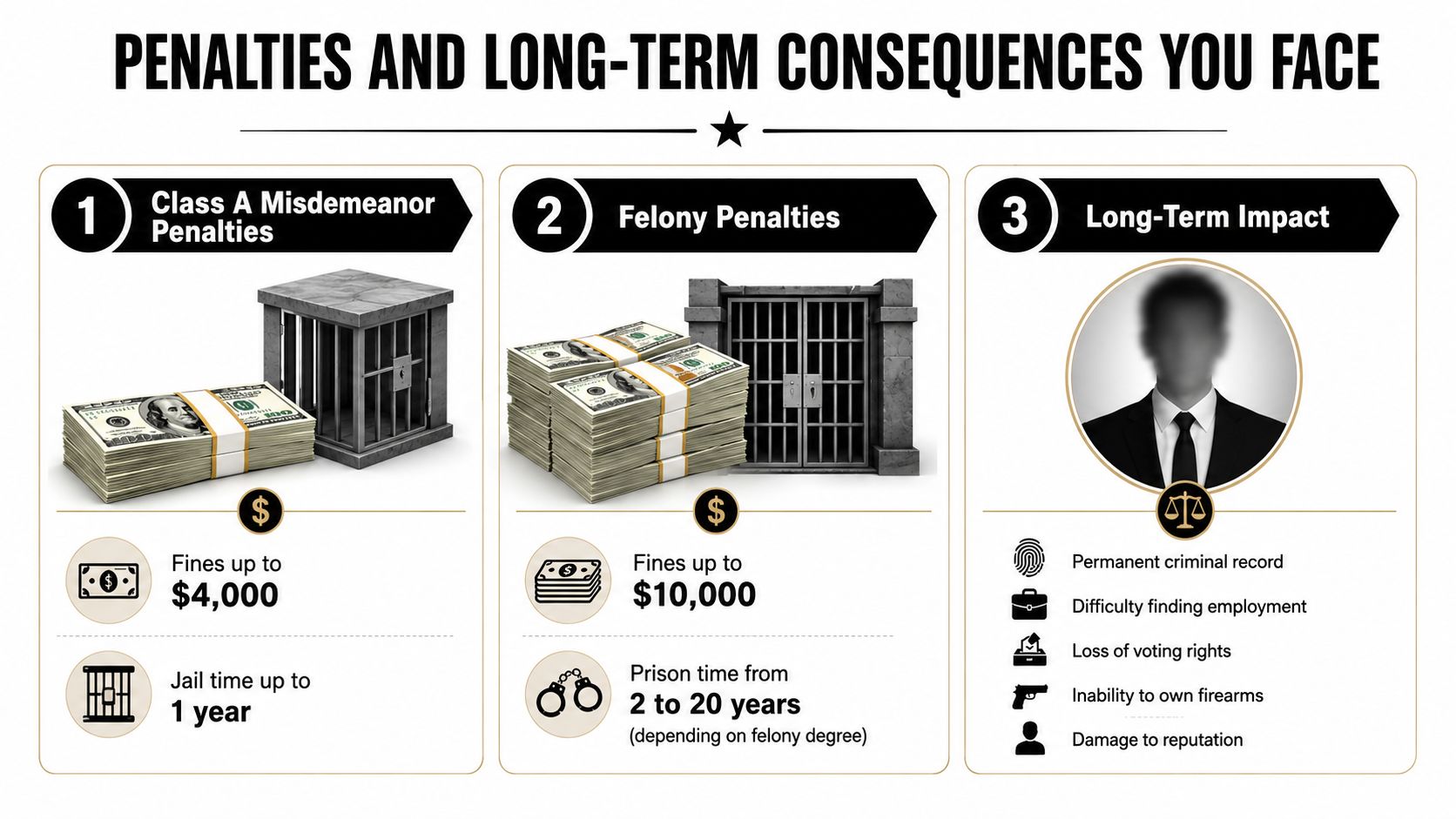
A Class A misdemeanor can expose you to up to 1 year in county jail and a fine of up to $4,000. This is the charge prosecutors often use when they claim someone acted recklessly and placed another person in imminent danger of serious bodily injury.
A third-degree felony carries a much steeper range: 2 to 10 years in prison and a fine of up to $10,000. That is the version often tied to allegations that someone knowingly discharged a firearm at or in the direction of a person, habitation, building, or vehicle.
That difference is not just a matter of labels. It can shape bond conditions, plea negotiations, sentencing exposure, and how a prosecutor presents you to the court.
Texas also gives the State different filing deadlines depending on the offense level, as noted earlier. Those deadlines can matter in a close case, but the immediate concern for those involved is simpler. The felony version puts far more at risk, much faster.
Consequences outside the courtroom
A sentence is only part of the picture.
Even a pending charge can trigger problems before any conviction happens. Employers may pause a hiring decision. A landlord may reject an application. A licensing board may start asking questions you never expected to answer.
You may also run into issues involving:
- Employment, especially if the allegation appears violent or firearm-related
- Housing, if a background check raises concerns for a landlord or property manager
- Firearm possession, depending on the final outcome and your broader legal history
- Professional licenses, including jobs that require state approval or renewal
- Immigration status, if you are not a U.S. citizen
For many clients, these consequences feel like a second punishment. That reaction is understandable. A criminal charge can affect your reputation and your options even before the case reaches a final result.
Record relief and rebuilding after the case
Many people fear that an arrest or charge will stay on their record forever. Sometimes it does. Sometimes it does not.
What happens next depends on how the case ends. If your case is dismissed, refused, or resolved in a way that makes you eligible, you may be able to pursue expunction, record sealing, nondisclosure, or other post-conviction remedies. Those options work a bit like different tools for different problems. One may erase a record in limited situations. Another may restrict who can see it. The right option depends on the exact outcome of your case.
That is one reason the early defense strategy matters so much. A result that looks acceptable in the moment may create avoidable record problems later.
The Law Office of Bryan Fagan, PLLC handles criminal defense matters along with expunctions, nondisclosures, record sealing, and post-conviction relief for Texans who want a path forward after an arrest or conviction.
Common Defenses to a Deadly Conduct Charge
A deadly conduct charge often starts with a few frightening words in a police report. "He acted recklessly." "She fired toward people." Those phrases sound settled and final, but a criminal case does not turn on labels. It turns on what can be proven.
Challenging the required mental state
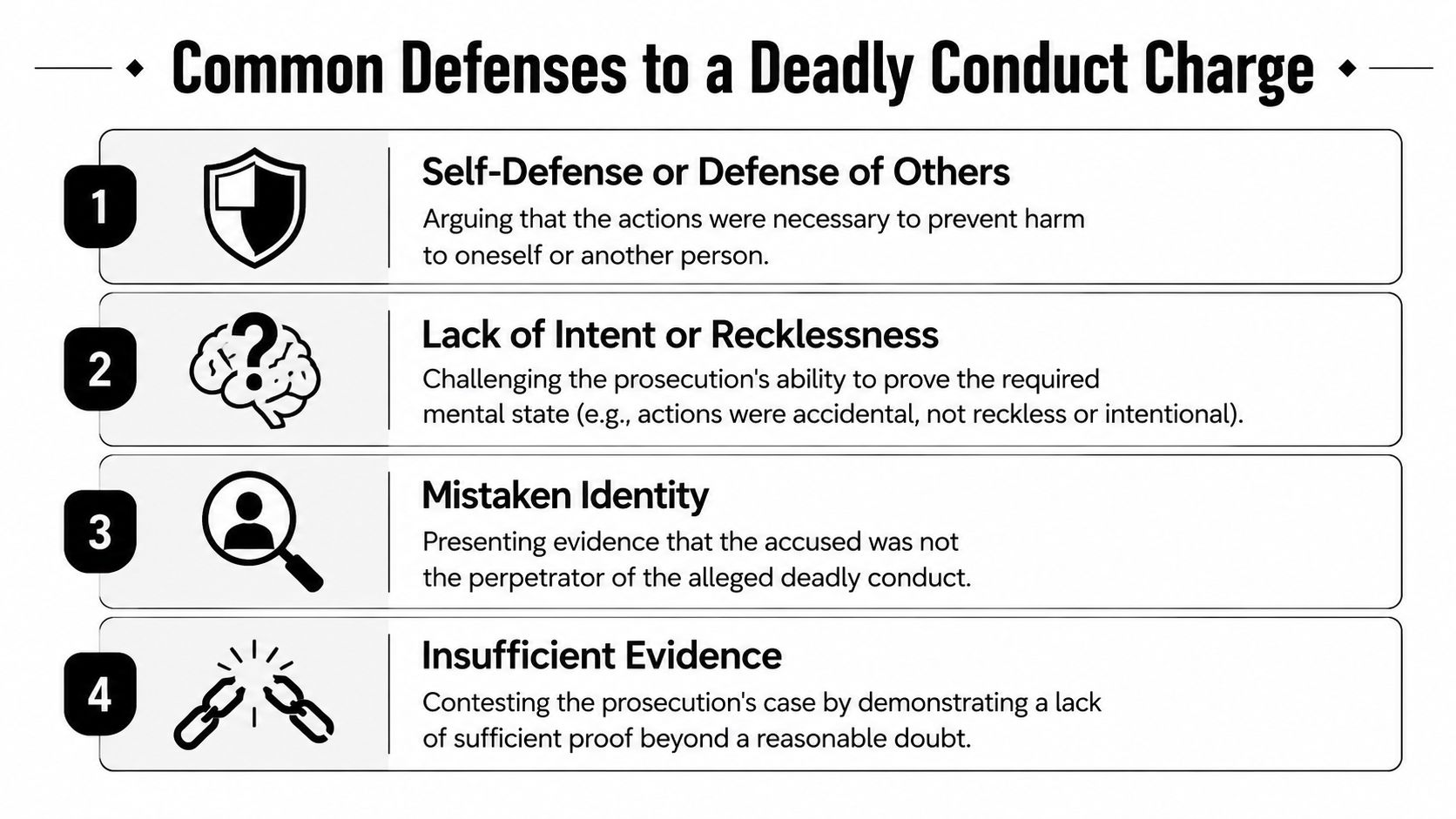
One of the first defense issues is the mental state. That matters a great deal in deadly conduct cases because Texas law draws a sharp line between two different ideas that people often blur together.
For the misdemeanor version, the state must usually show you acted recklessly and placed another person in imminent danger of serious bodily injury. For the firearm discharge version, the state must prove you knowingly discharged a firearm at or in the direction of people, a home, a building, or a vehicle in the circumstances described by the statute.
That difference is not technical wordplay. It is the engine of the case.
Recklessly usually means you were aware of a substantial and unjustifiable risk and ignored it. Knowingly is a different level of intent. It focuses on awareness of what you were doing and where you were doing it. A strong defense often begins by slowing the case down and asking, "What exactly does the evidence show about your state of mind at that moment?"
Your lawyer may examine:
- conflicting witness accounts about what you said or did
- poor visibility, noise, or confusion at the scene
- physical evidence that does not fit the accusation
- whether the event was accidental rather than reckless
- whether the state is trying to infer "knowing" conduct from assumptions instead of proof
That distinction can change everything. If prosecutors cannot prove the higher mental state required for a felony firearm allegation, the case may look very different than the charging document suggests.
Arguing there was no imminent danger
In the misdemeanor form of deadly conduct, the prosecution has to prove more than fear, anger, or a bad argument. It has to show imminent danger of serious bodily injury.
"Imminent" means immediate, not possible at some later point. A good way to understand it is to compare a near collision with a vague worry that something bad could have happened. The law is aimed at immediate danger.
That can lead to practical defense questions:
- Was anyone close enough to be in immediate danger?
- Was the risk real, or was it speculative?
- Did the complaining witness assume a threat that the physical scene does not support?
- Do photos, distances, or object placement contradict the accusation?
Sometimes the facts describe reckless behavior. Sometimes they describe poor judgment that does not meet this statute. That line matters.
Self-defense or defense of others
Some cases arise out of a confrontation that escalated in seconds. If you acted because you reasonably believed you or another person faced unlawful force, self-defense or defense of others may be part of the case.
Jurors and prosecutors need the full sequence of events. Who moved first. Who made threats. Who had a weapon. Whether you were trying to protect someone. Context matters because a short police summary often strips out the part that explains why you acted.
A justification defense is not automatic. It has to fit the facts and the law. But in the right case, it can be the difference between a frightening accusation and a defensible act.
Identity, witness credibility, and police error
Deadly conduct accusations are often built on stressful, fast-moving events. That creates room for mistakes. People misidentify voices, cars, gestures, and even weapons, especially at night or during a chaotic argument.
Witness credibility can become a central issue. One person may say a gun was pointed directly at them. Another may say it never left the ground. Video may tell a different story than either witness. When accounts shift, the defense can use those gaps to challenge whether the state has met its burden.
Police mistakes also matter. An unlawful search, a rushed interview, missing body camera footage, or a statement taken after a rights violation can weaken the prosecution's case. If key evidence is kept out, the charge may become much harder to prove.
Even cases involving an unloaded firearm can be treated very seriously under Texas law. That is why the defense has to be precise from the start. The question is never just whether the event looked bad. The question is whether the state can prove each element of this specific charge, with reliable evidence, beyond a reasonable doubt.
How Deadly Conduct Intersects with DWI and Family Violence
Deadly conduct charges often don't stand alone. They can appear alongside allegations that started in a car, in a relationship, or during a family conflict. That overlap can change how prosecutors view the case and how the defense should respond.
Road rage and DWI allegations
A driver may be stopped after weaving through traffic, chasing another vehicle, or making aggressive movements that scare other people. If officers believe alcohol or drugs played a role, the case may also involve a DWI investigation.
That creates two different fronts. One side of the case may focus on intoxication evidence. The other may focus on whether your driving or actions placed someone in immediate danger. A person looking for a Texas DWI attorney or a Houston criminal lawyer often doesn't realize those issues can combine into a much more complicated prosecution.
Domestic disputes and family violence claims
A heated argument at home can also turn into overlapping allegations. If someone says you displayed a weapon, threatened them, or acted in a way that created immediate danger, police may investigate deadly conduct along with assault or family violence related charges.
That overlap matters because criminal court isn't the only concern. Protective orders, no-contact conditions, and family law consequences can affect where you live, whether you can see your children, and what happens in related court proceedings.
Why a joined-up defense matters
When cases overlap, you don't want to treat each accusation like a separate island. A statement that seems helpful in a DWI case might hurt you in a deadly conduct case. A family text message might affect both a criminal charge and a protective order hearing. The same witness may appear in several proceedings and tell slightly different versions each time.
If your situation also involves other allegations such as Texas assault defense concerns or drug-related accusations, your legal strategy has to account for the whole picture, not just the name of one charge on the booking sheet.
Your Next Steps After a Deadly Conduct Arrest
The hours after an arrest matter. So do the days that follow. You don't have to know everything, but you do need to avoid the mistakes that damage a defense before it starts.
Early action can protect your case.
What to do first
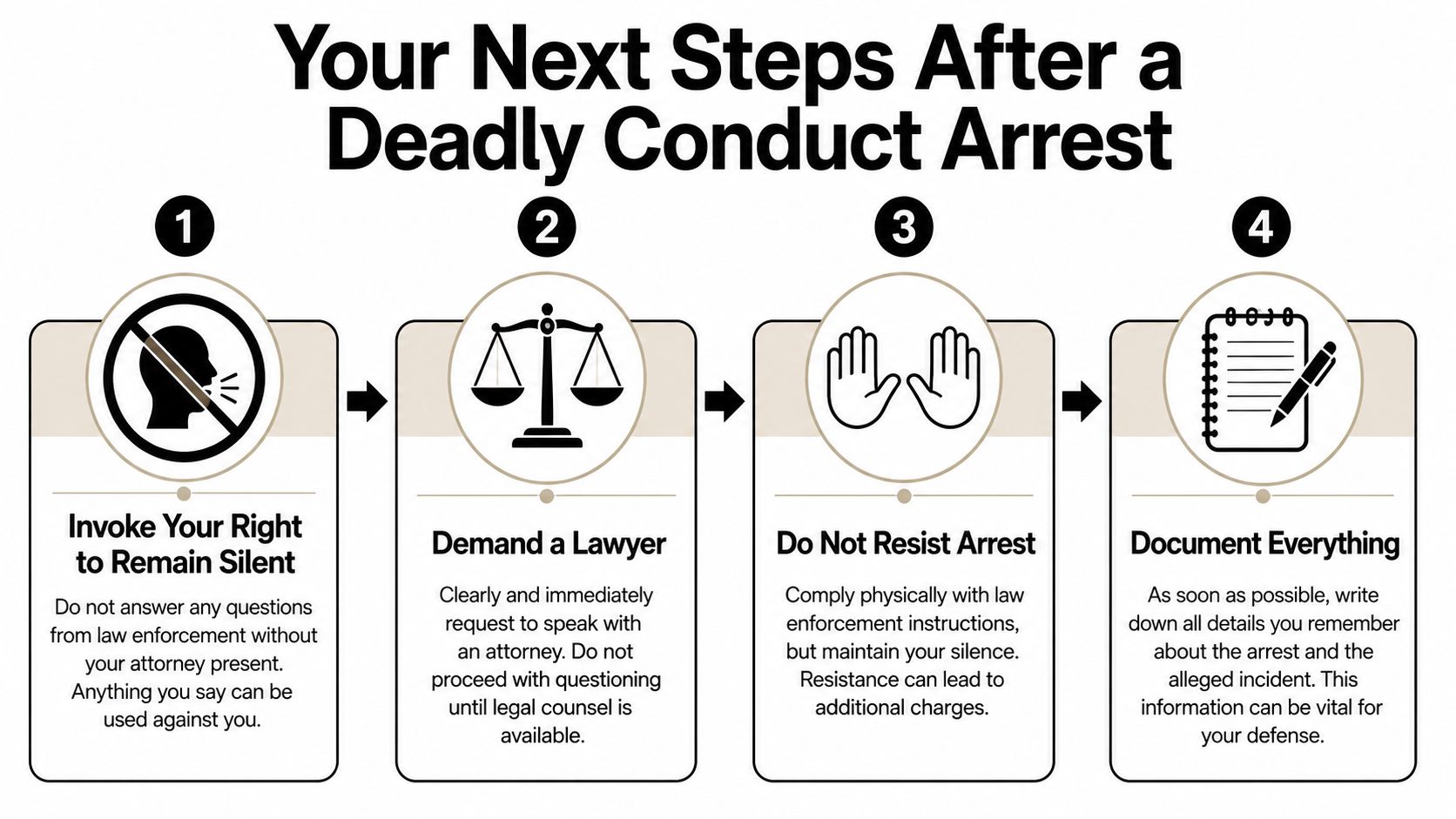
- Stay silent. Tell police you want to remain silent and want a lawyer.
- Don't resist. Even if the arrest feels unfair, resisting can create new charges.
- Don't discuss the case. That includes calls from jail, texts, social media posts, and conversations with friends.
- Write down what happened. As soon as you can, record names, locations, timing, and what each person did or said.
If you want a broader checklist, this guide on what to do immediately after getting arrested in Texas is a useful starting point.
What usually happens in court
Most cases move through several stages:
Arrest and booking
Police process the charge and collect basic information.Bail or bond conditions
The court may set conditions that restrict contact, travel, firearm possession, or alcohol use.Arraignment or first appearance
You hear the accusation and enter an initial plea.Case investigation and plea bargaining
Your lawyer reviews evidence, identifies weaknesses, negotiates where appropriate, and prepares for trial if needed.Trial and sentencing
If the case doesn't resolve earlier, the prosecution must prove guilt beyond a reasonable doubt. If there is a conviction, sentencing follows.
Watch related issues closely
Some arrests involve alcohol, prescription stimulants, or other substances that affect judgment and escalate conflict. If substance use may have played a role in what happened, educational resources can also help you make sense of the bigger picture, including understanding Adderall and alcohol health risks.
This video also walks through important rights after an arrest.
You don't need to solve your whole case in one day. You do need to stop making it easier for the prosecution.
The next smart step is to get legal advice before you answer questions, agree to conditions you don't understand, or assume the charge can't be fought.
If you've been charged with a crime in Texas, call The Law Office of Bryan Fagan PLLC for a free and confidential consultation. Our defense team is ready to protect your rights.