Being arrested in Texas can be terrifying, especially if someone tells you the charge is aggravated assault. You may be wondering whether you're going to jail, whether this is a felony, and whether one bad night is about to change your whole life.
That fear is real. So is the confusion. Many people hear the word "assault" and assume the case must involve a serious injury or a weapon that everyone would recognize right away. Texas law is broader than that, and that's one reason these cases feel so overwhelming at first.
Introduction Being Charged with Aggravated Assault in Texas
If you're facing aggravated assault charges, the first thing to know is that you're not alone, and you don't have to guess your way through the system. Aggravated assault cases remain a major issue nationwide. The 2023 aggravated assault rate was 264.1 cases per 100,000 people, and that was still 8% higher than the 2019 baseline, according to the Council on Criminal Justice assault fact sheet.
In Texas, the legal question usually turns on two things. Did the allegation involve serious bodily injury, or did it involve the use or display of a deadly weapon? Those phrases sound technical, but they matter because they can turn a lower-level assault accusation into a felony with life-changing consequences.
A simple way to think about it is this. A bruise and a scrape may be evidence in a case, but they aren't automatically "serious bodily injury" under the law. On the other hand, an injury that creates a substantial risk of death, leaves permanent disfigurement, or affects how a body part works can move the charge into aggravated territory. A "deadly weapon" can also mean more than a firearm. In some cases, prosecutors argue that an everyday object became deadly because of how someone allegedly used it.
Why understanding the process matters
When you're scared, clear information helps. Knowing what police must prove, what happens after arrest, and where defenses can be raised gives you something solid to hold onto.
Some lawyers and case teams also use tools like legal software for criminal defense cases to organize evidence, timelines, witness statements, and court deadlines. For you, that means the facts of your case can be reviewed carefully instead of treated like just another file.
Practical rule: An arrest is not a conviction. A charge is the state's accusation, not the final word.
Defining Aggravated Assault Under Texas Law
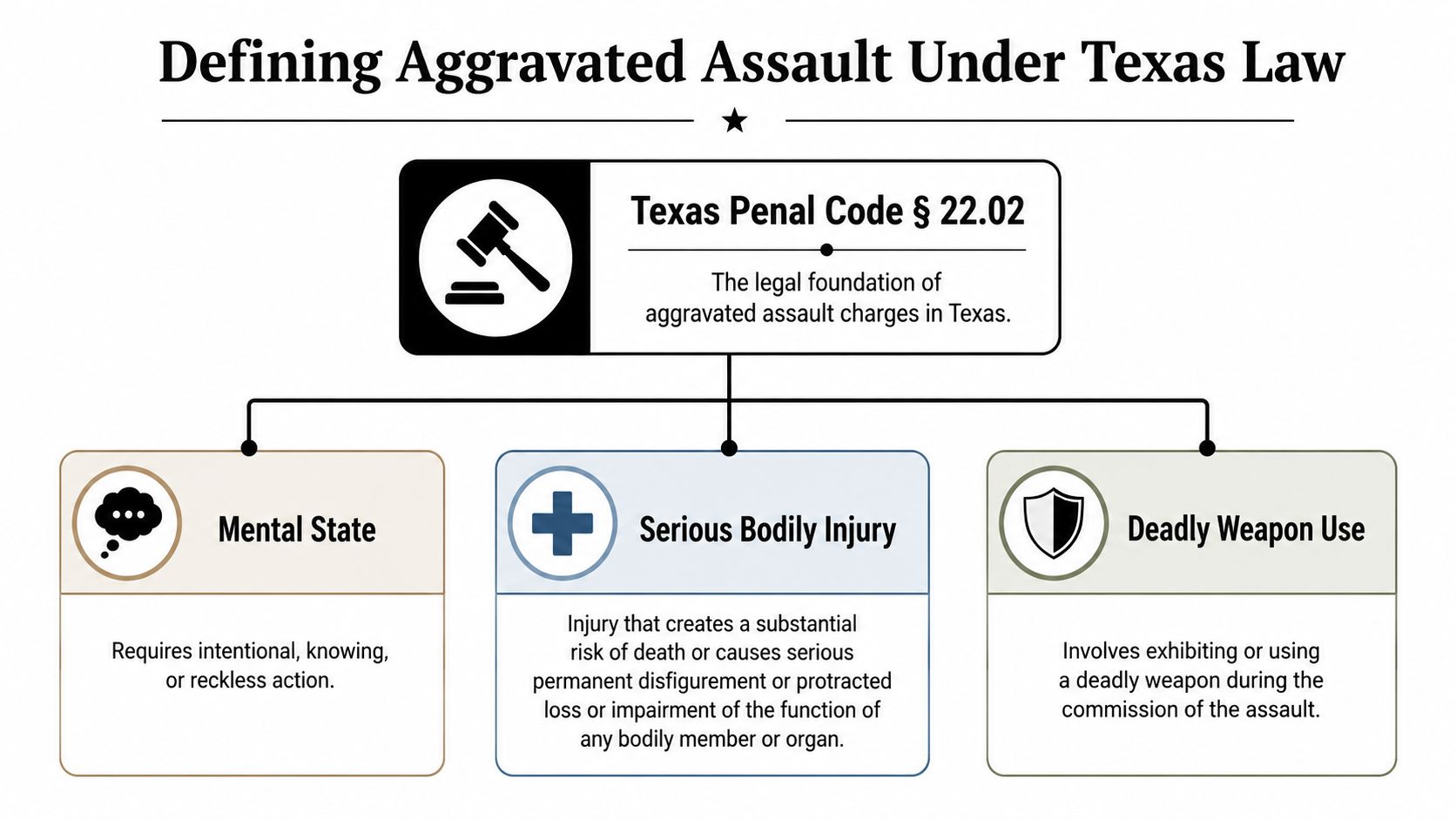
Texas Penal Code § 22.02 is where aggravated assault charges usually begin. In plain English, the state must first show there was an assault, then show an added factor that makes it "aggravated."
Under Texas law, aggravated assault happens when a person causes serious bodily injury or uses or exhibits a deadly weapon during an assault, as explained in this discussion of Texas Penal Code § 22.02 and serious bodily injury.
The two main ways a charge gets elevated
It is a common misconception that aggravated assault always requires both severe injury and a weapon. It doesn't. Prosecutors usually pursue the charge through one path or the other.
| Legal issue | What it means in plain language |
|---|---|
| Serious bodily injury | An injury that creates a substantial risk of death, causes permanent disfigurement, or leads to loss of organ function |
| Deadly weapon use or exhibition | The alleged use or display of an item in a way that can cause death or serious injury |
That second part surprises people. A deadly weapon isn't limited to a gun or knife. The real issue is how the object was allegedly used. That's why everyday items can become central in these cases.
What prosecutors focus on
The state doesn't just look at the final result. Prosecutors often build the case around the surrounding facts, including:
- The nature of the injury: Was it temporary, or does the state claim it caused lasting damage?
- The object involved: Was it obviously dangerous, or are police saying it became dangerous in the moment?
- The conduct itself: Was there alleged striking, threatening, chasing, or brandishing?
- The accused mental state: Did the state claim the act was intentional, knowing, or reckless?
The words in the statute matter, but the facts around the incident matter just as much.
Why the details can change everything
A strong defense often starts by challenging the part that makes the charge aggravated in the first place. If the alleged injury doesn't meet the legal standard, or if the object shouldn't be treated as a deadly weapon, the case can look very different.
That is one reason these cases deserve careful review instead of panic. Even when police file a felony, the final outcome can depend on narrow legal issues and disputed facts. If you want a broader look at Assault and Violent Crime Defense in Texas, that practice area covers defense for assault charges ranging from misdemeanor to felony.
Understanding Texas Felony Penalties and Enhancements
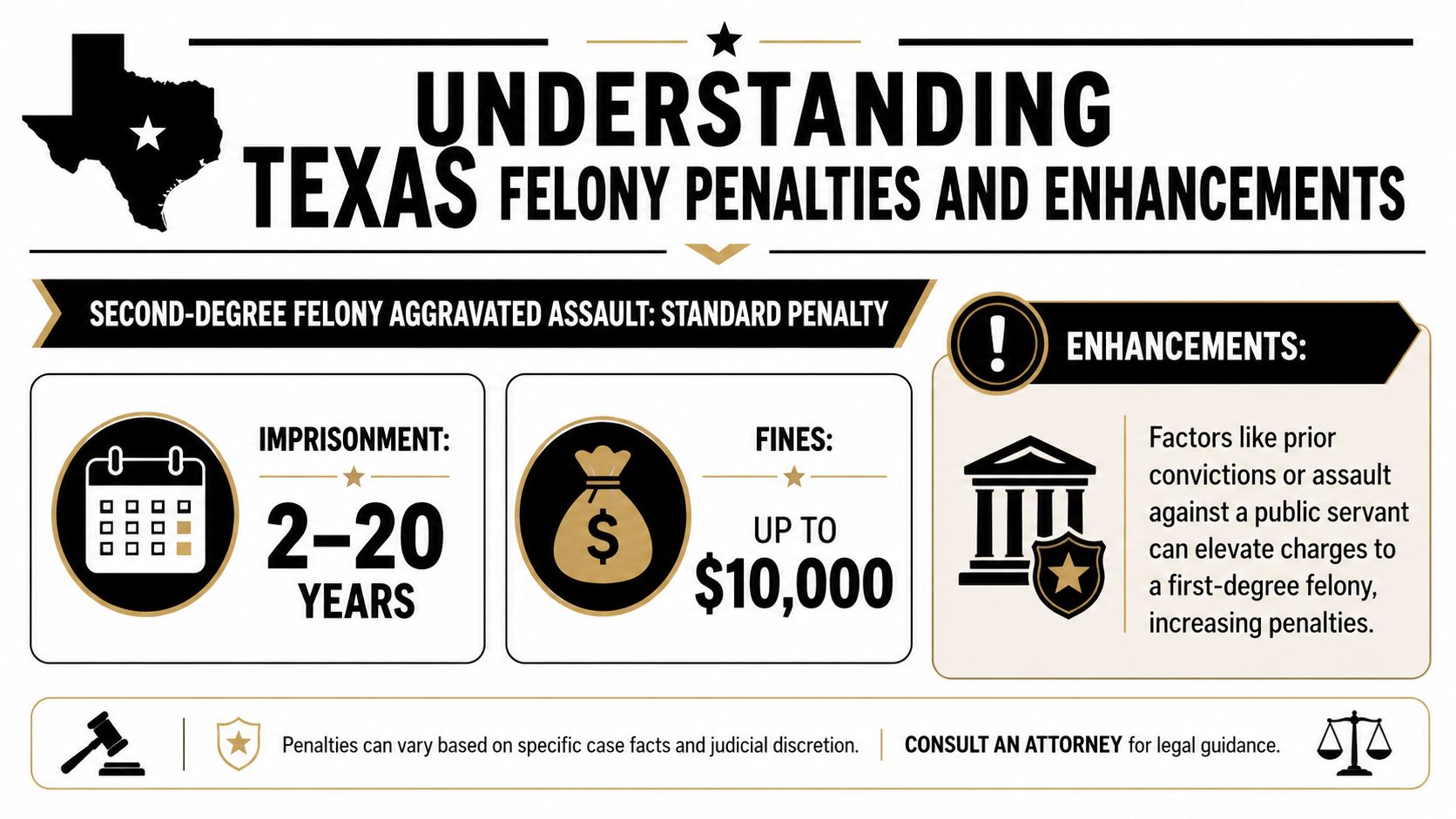
Once aggravated assault is charged, the next question is usually punishment. In Texas, the standard penalty for aggravated assault is severe even before any enhancement applies.
The usual range for aggravated assault with a deadly weapon is 2 to 20 years in prison and a fine up to $10,000, based on this explanation of Texas aggravated assault punishment ranges and threat-based charges. But some facts can push the case much higher.
When the charge becomes even more serious
Aggravated assault can become a first-degree felony with a punishment range of 5 to 99 years or life if the victim is a family member, public servant, or witness, or if a deadly weapon causes traumatic brain or spine injury leading to a vegetative state, among other enhancements that took effect on September 1, 2023, as outlined in this discussion of first-degree felony enhancements for aggravated assault in Texas.
That means prosecutors don't only look at what happened. They also look at who the alleged victim is and whether the law gives that person added protection.
The charge can be based on a threat
Another point that catches people off guard is this. Texas courts can treat a case as aggravated assault even if nobody was physically injured, if the allegation is that someone intentionally threatened imminent injury while using or exhibiting a deadly weapon. In those cases, the displayed weapon becomes the center of the prosecution's theory.
This is why two cases that sound similar in conversation can be charged very differently in court.
A simple roadmap from arrest to possible punishment
If you're trying to understand where penalties fit into the bigger picture, the path usually looks like this:
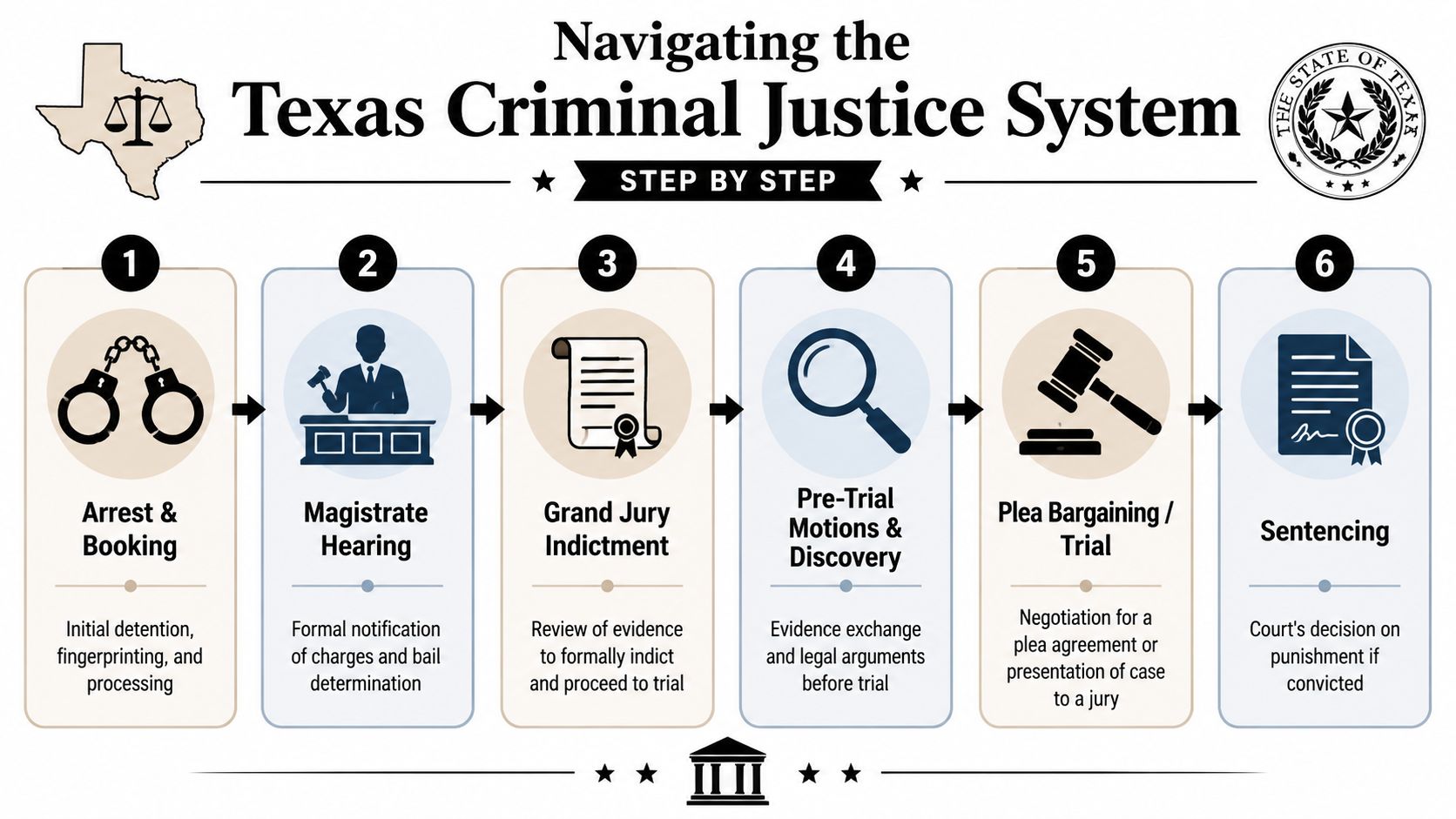
- Arrest and booking happen first. Police process the case and list the initial charge.
- A magistrate or bond hearing follows. The court addresses the accusation and bond conditions.
- Formal charging decisions shape the case. Enhancement issues often become critical at this stage.
- Plea discussions or trial preparation develop next. Your lawyer challenges the state's version of events.
- Sentencing only happens if there is a conviction or plea. That is when the penalty range becomes immediate and real.
For a closer look at Texas aggravated assault penalties and sentencing ranges, it's useful to compare the base felony level with enhancement scenarios.
Navigating the Texas Criminal Justice System Step by Step
Most clients don't just want legal definitions. They want to know what happens next. The criminal process feels less chaotic when you can see it as a series of stages instead of one giant unknown.
This visual lays out the usual sequence.
Arrest and early hearings
After an arrest, police take you through booking. That usually includes fingerprints, photographs, and basic processing. The initial charge may sound final, but it often isn't. Early paperwork reflects the state's starting position, not the full defense analysis.
Then comes the first court appearance, often before a magistrate, where you hear the accusation formally and bond can be addressed. Conditions may be imposed, and in some assault cases those conditions can affect where you live, who you contact, and whether a protective order request follows.
Stay calm, say as little as possible, and let your lawyer do the talking once the case enters court.
A grand jury may also review the case in felony matters. If the grand jury indicts, the case proceeds in district court. That step sounds dramatic, but it doesn't mean the evidence can't still be challenged.
Pre-trial work is where many cases are shaped
A large part of criminal defense happens before a jury is ever seated. This stage includes reviewing police reports, body camera footage, medical records, witness accounts, and any statements attributed to you.
Your attorney may file motions to exclude evidence, challenge the way police obtained statements, or argue that the facts don't support the charged offense. Plea bargaining also happens here. That doesn't always mean pleading guilty. It can involve pushing for a reduced charge, a better outcome, or a dismissal where the evidence is weak.
Trial and sentencing
If the case doesn't resolve in pre-trial negotiations, it moves to trial. In Texas, that may be a jury trial or, in some situations, a bench trial before a judge. At trial, the prosecutor presents witnesses and evidence first. Your defense lawyer cross-examines those witnesses, raises legal objections, and presents the defense side of the case if that helps your position.
Here are some of the main decisions that matter at trial:
- Witness credibility: Did the witness see what they claim to have seen?
- Intent: Did the evidence show a criminal mental state, or is the event being misread?
- Injury level: Does the medical evidence support the level of charge filed?
- Weapon status: Was the object used in a way that fits the legal definition the state is relying on?
If there is a conviction or plea, sentencing comes after that. Sentencing can involve legal arguments about the proper range, the facts of the case, and your background.
Why this step-by-step view matters
When you know the order of events, you can make better decisions. You can also stop assuming that the first version of the story is the one that will control the whole case.
Many people charged with aggravated assault, DWI, theft, or drug possession make the same mistake. They talk too much early, panic at the charging language, and miss the fact that criminal cases are built and challenged over time. Your defense works best when each stage is handled deliberately.
Building a Strong Defense Against Aggravated Assault
An aggravated assault accusation is serious, but it is still an accusation. The state has to prove the case. Your lawyer's job is to test every weak point in that proof.
Start with the immediate checklist
If you've just been arrested or think charges are coming, take these steps in this order:
- Use your right to remain silent. Don't try to "clear things up" with police.
- Ask for a lawyer right away. Once you ask, stop answering questions.
- Preserve evidence. Save texts, photos, call logs, videos, and names of witnesses.
- Follow bond conditions exactly. Even a small violation can create new problems.
- Stay off social media. Posts, comments, and messages can become evidence.
One resource that explains how defense lawyers organize this work is how criminal defense attorneys build a defense strategy.
Common defense approaches
Not every defense fits every case. The right strategy depends on the facts, the witnesses, and the evidence the state has.
- Self-defense or defense of others: If you acted to protect yourself or someone else, that can change the entire legal picture.
- Mistaken identity: This matters when the witness account is unreliable, rushed, or affected by stress.
- Lack of intent: An accident, misunderstanding, or reckless allegation may not match what really happened.
- Disputing serious bodily injury: The state may overstate the injury level. Medical records and expert review can matter here.
- Disputing deadly weapon status: An object may sound dangerous in a police report but not satisfy the legal standard when the facts are tested.
Defense focus: In many cases, the smartest strategy is not arguing about every detail. It's targeting the one element that turns an ordinary assault allegation into a felony aggravated assault charge.
Building the case, not just reacting to it
A solid defense is proactive. Your attorney may compare witness statements for contradictions, review video frame by frame, challenge hearsay, and show that the alleged victim's description changed over time.
The Law Office of Bryan Fagan, PLLC handles criminal defense matters including aggravated assault, DWI, drug cases, theft, and related protective order issues. In a case like this, coordinated defense work matters because the criminal case can affect bond conditions, family contact, and future record-clearing options.
Immediate Steps to Take If You Are Charged
The hours after an arrest matter. What you do right away can either protect your case or make it harder to defend later.
A practical guide to what to do immediately after getting arrested in Texas can help you avoid common mistakes, but the core rules are simple.
Do these things first
- Say you want a lawyer: Use clear words and stop talking after that.
- Keep your explanation for court, not the roadside or interview room: Police are collecting evidence, not helping you build a defense.
- Write down what happened as soon as you can: Include times, locations, witnesses, and anything recorded on video.
- Take bond conditions seriously: No-contact orders and location restrictions can affect both your freedom and your case.
Avoid these mistakes
- Don't contact the alleged victim to explain or apologize: That can be used against you.
- Don't post online about the incident: Even indirect posts can become evidence.
- Don't assume the case is only criminal: Assault allegations often overlap with family law issues.
If the allegation involves a spouse, partner, household member, or co-parent, the case may trigger a request for a protective order. It can also affect child custody or possession disputes. That overlap is one reason you need legal advice that looks at the full situation, not just the next court date.
Keep hope in view
If your case ends favorably, or if you qualify later, Texas law may offer ways to limit the damage a criminal record causes. Expunction generally refers to removing and destroying eligible records. Nondisclosure usually means sealing eligible records from public view while allowing access in limited situations. Which option fits depends on how the case ended and your legal eligibility.
Life After the Case Rebuilding Your Future
Even after the court process ends, you still have a future to protect. Many people worry about jobs, housing, licenses, and reputation long after the criminal case is over. That concern is valid, and it's one reason post-case planning matters.
In aggravated assault cases, the legal theory itself can affect how the public sees the accusation. Texas courts may allow the state to proceed on a threat theory, meaning a person can face aggravated assault charges for intentionally threatening imminent injury while using or exhibiting a deadly weapon, even if no physical harm occurs, as discussed earlier in the linked Texas punishment source. The allegation can sound overwhelming, but the final result still depends on proof, defenses, and how the case is resolved.
Record clearing and post-conviction options
If your case was dismissed, resulted in an acquittal, or otherwise qualifies, expunction may allow the records to be destroyed. If expunction isn't available, an order of nondisclosure may still help in some cases by sealing the record from public view.
For readers focused on rehabilitation, post-conviction relief can also include reviewing whether there are lawful paths to reduce the long-term impact of the case. The right option depends on the charge, the outcome, and your record.
A criminal case can interrupt your life. It doesn't have to define the rest of it.
The key is to think beyond the first court date. Defense strategy, plea decisions, trial choices, and record-clearing options all connect. When those pieces are handled carefully, you give yourself the best chance to move forward.
If you've been charged with a crime in Texas, call Law Office of Bryan Fagan PLLC for a free and confidential consultation. Our defense team is ready to protect your rights.