Skip to content
You're sitting at your kitchen table, trying to remember whether that traffic stop from months ago ever got handled. Maybe you moved. Maybe you lost the paperwork. Maybe you searched online once, saw nothing, and hoped that meant the problem was gone.
That worry is common, and in Texas it's also understandable. The hard part isn't just the ticket itself. It's that Texas uses a fragmented system. A recent state trooper citation may appear in one place, a city ticket in another, and an older failure to appear in a completely different database. If you're asking, how can I check if I have tickets in Texas, the answer usually depends on who issued the ticket and how old the matter is.
The good news is that you can work through this in an organized way. Start with the state portal if you think the citation came from Texas Highway Patrol. Then check the local city or county court that likely handled the case. If you're worried the case turned into a past-due problem, search the Failure to Appear system. That sequence works better than guessing, and it lowers the chance that you miss something important.
That Sinking Feeling About an Old Texas Ticket
Being arrested in Texas can be terrifying, but you don't have to face it alone. Even before an arrest happens, many people feel that same fear when they suspect an old ticket may still be out there. You may be worried about a warrant, a hold tied to your driver's license, or a surprise problem the next time an officer runs your information during a traffic stop.

That fear gets worse when you don't know where to look. In Texas, a ticket can “live” in different places depending on whether it came from a state trooper, a city police officer, or a county or Justice of the Peace court. A basic online search often misses part of the picture.
Why people get confused
A lot of drivers assume there's one statewide ticket database. There isn't. You may need to check a Texas DPS citation search, a municipal court portal, and a Failure to Appear database before you have a dependable answer.
Practical rule: A clean search in one database doesn't always mean you're clear everywhere.
That distinction matters because unresolved ticket issues can overlap with broader criminal concerns. A missed court date can trigger warrant problems. An arrest on a warrant can move you into the criminal process, including booking, arraignment, plea discussions, trial preparation, and sentencing if a case isn't resolved favorably. In more serious cases involving DWI, assault, theft, or drug possession, the process becomes even more important to understand.
Keep the first goal simple
Don't start by trying to solve everything at once. Start by identifying which system should have your record.
Use this order:
- State citation first: Check the Texas DPS portal if you think a Texas Highway Patrol officer issued the citation.
- Local court second: Search the city or county court where the stop happened.
- Past-due record third: If the case may be old or unresolved, search the Failure to Appear system.
If you later discover the situation is bigger than a ticket, such as a warrant or a criminal charge, then legal strategy matters. Texas criminal cases can involve rights under the Texas Penal Code, court appearances, plea offers, and long-term record issues. For some people, that also leads to questions about expunction, nondisclosure, and post-conviction relief after the case is resolved.
Start with the Texas DPS Online Citation Search
If you believe a Texas Highway Patrol officer issued the ticket, your first stop should be the Texas Department of Public Safety portal. Texas DPS states that to check for Texas Highway Patrol citations, you must use its free online citation search tool, and that tool is limited to records issued within the last 24 months at the Texas DPS online citation search.
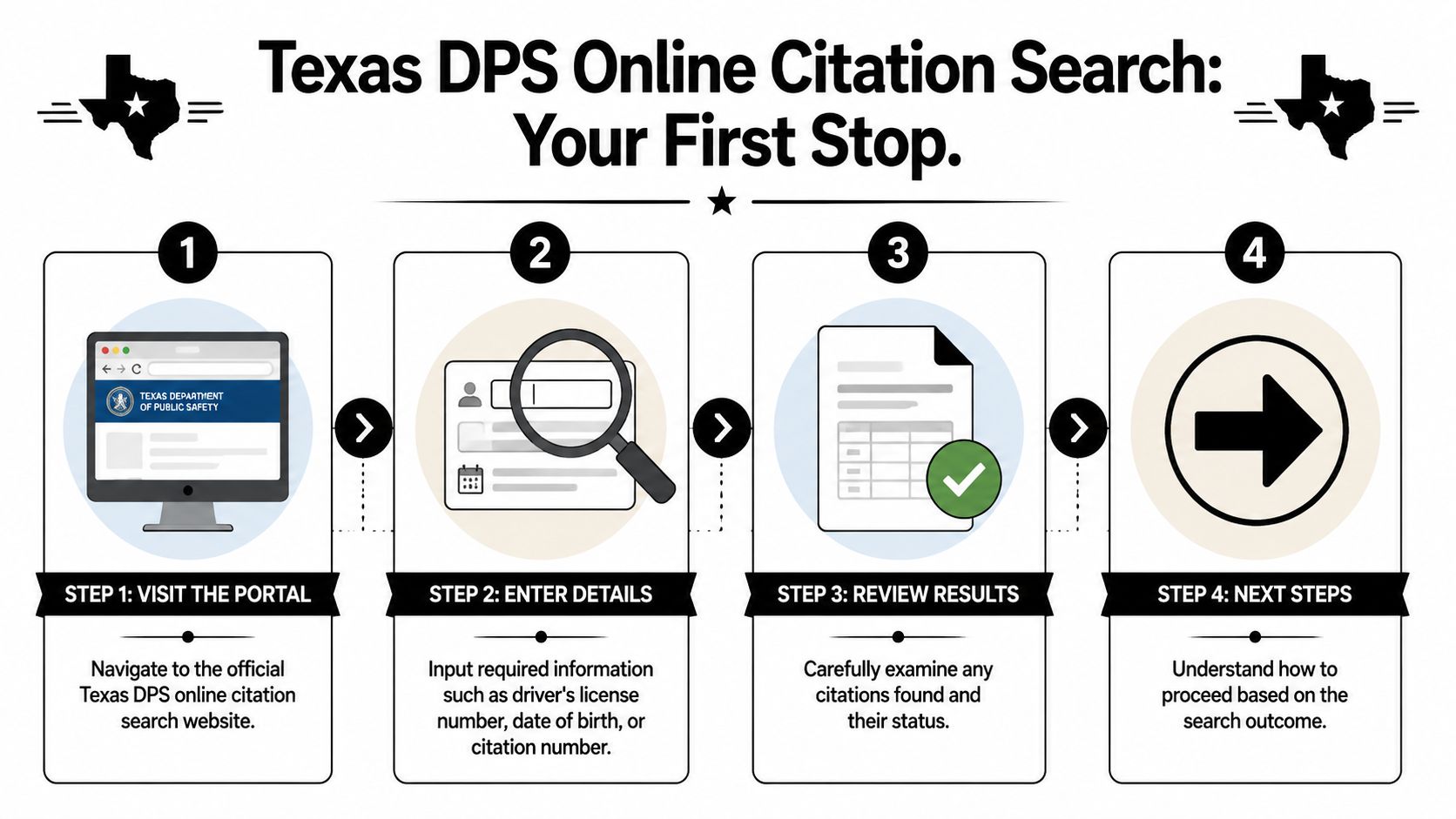
That 24-month limit is one of the biggest reasons people get misled. If the ticket is older than that, the portal may return nothing even if the issue still matters.
What you need before you search
The DPS search works best when you enter information exactly as it appears on your license or citation. In practice, small mistakes can lead to a “no results” response that has nothing to do with whether a ticket exists.
Gather these items first:
- Citation number if you have it: This is often the fastest way to pull the record.
- Driver's license number: Use the exact number from your Texas license.
- Date of birth: Match the format requested by the portal.
- Exact matching details: If your name or data entry doesn't match the license record, the search may fail.
Don't treat a failed search as a legal answer until you've checked your entries carefully.
A related issue comes up after a case is over. If a ticket or criminal matter affects your record, some people later look into Expunction and Nondisclosure in Texas, which addresses how to clear or seal a criminal record under Texas law.
What the DPS portal can and cannot tell you
The state tool is useful, but narrow. It's for THP-issued citations in the recent window maintained by DPS. It does not function as a complete statewide ticket search for city and county cases.
A practical way to read the results:
| Search result | What it usually means |
|---|---|
| Ticket appears | You likely found a recent THP citation, and you should review the listed status and instructions carefully. |
| No result | The citation may be older, local, entered differently, or not in the DPS system at all. |
| Unclear record | You may need to contact the listed court or move to local court and FTA checks. |
Later criminal procedure can turn on small details. If a driver ignores a citation, misses court, and gets arrested, the process can move from a traffic matter to bail questions, arraignment, plea bargaining, trial preparation, and sentencing exposure. That is also where a Texas DWI attorney, Houston criminal lawyer, or Texas assault defense lawyer may become relevant if the stop involved more than a simple citation.
For a quick visual walk-through, this video can help orient you before you search:
Searching Local City and County Court Records
If the state trooper search doesn't solve it, the next step is local. The City of Houston explains that over 90% of Texas cities of any size operate independent online portals where citizens can search for citations, and for county-level citations, especially in Justice of the Peace courts, the search often defaults to local systems or OmniBase through the Houston Municipal Courts traffic ticket guidance.
That single fact explains most of the frustration people have. A Houston ticket won't show up in a Dallas court search. A county ticket may not appear in the same place as a city citation. You have to identify the right court before the search becomes useful.
How to identify the right local court
Start with the paperwork if you still have it. The issuing agency name matters. So does the location of the stop.
Use this checklist:
- Look at the officer's agency. City police usually point to a municipal court. A sheriff's deputy or rural citation may point to a county or JP court.
- Pin down where the stop happened. Inside city limits and outside city limits can lead to different courts.
- Check the county if you're unsure. Justice of the Peace courts often handle tickets from unincorporated areas.
- Search that specific court portal. Don't assume another county or city database will have the same information.
If you search the wrong court, the result is often “nothing found,” even when a case exists.
City courts and JP courts work differently
Municipal courts usually give you an online portal with search options tied to your name, date of birth, or license details. Justice of the Peace courts can be more uneven. Some have direct portals. Others push you toward separate payment or case lookup systems.
That matters because local tickets can carry consequences that reach beyond a fine. A conviction can affect insurance, employment, housing, and professional licensing. For a broader look at those risks, The Collateral Consequences of a Texas Conviction discusses how a conviction affects employment, housing, and rights beyond the sentence.
A practical example from county courts
In Harris County JP courts, some violations can be corrected rather than paid. The Harris County Justice Courts note that violations such as expired inspection certificates can be dismissed if corrected within 10 working days of the violation with proof, although a $10.00 administrative fee still applies through the Harris County JP traffic information page.
That's a good example of why you shouldn't assume every ticket has only one option. Sometimes paying is the wrong move because paying usually means resolving the case against yourself instead of exploring dismissal or another outcome.
What works better than random searching
When people are anxious, they often jump from website to website. A more reliable method is to build a short list of likely courts and check them one by one.
Try this format:
- Most likely city court: Search the city where the stop occurred.
- Backup county court: If the stop happened outside city limits, look for the county JP court.
- Warrant-related concern: If you suspect the problem may be older or tied to a missed appearance, also review resources on a Travis County warrant search to understand how local warrant issues can be tracked.
If your traffic stop turned into something more serious, such as DWI, drug possession, or assault, your exposure may involve the Texas Penal Code and standard criminal procedure. After an arrest, you may face booking, magistration or arraignment, bail decisions, plea negotiations, trial settings, and sentencing ranges that depend on the charge level. Those are very different stakes than an ordinary ticket search, which is why early clarity matters.
Uncovering Old Tickets with the Failure to Appear System
A recent citation search and a local court search answer one question. The Failure to Appear system answers a different one. It helps you find whether an unresolved matter has been reported as a past-due obligation.
That's the hidden danger in Texas. Many people search for a citation, find nothing, and stop there. But an old case may no longer be easy to find as a citation. It may instead appear as a Failure to Appear or Failure to Pay problem reported by a court.
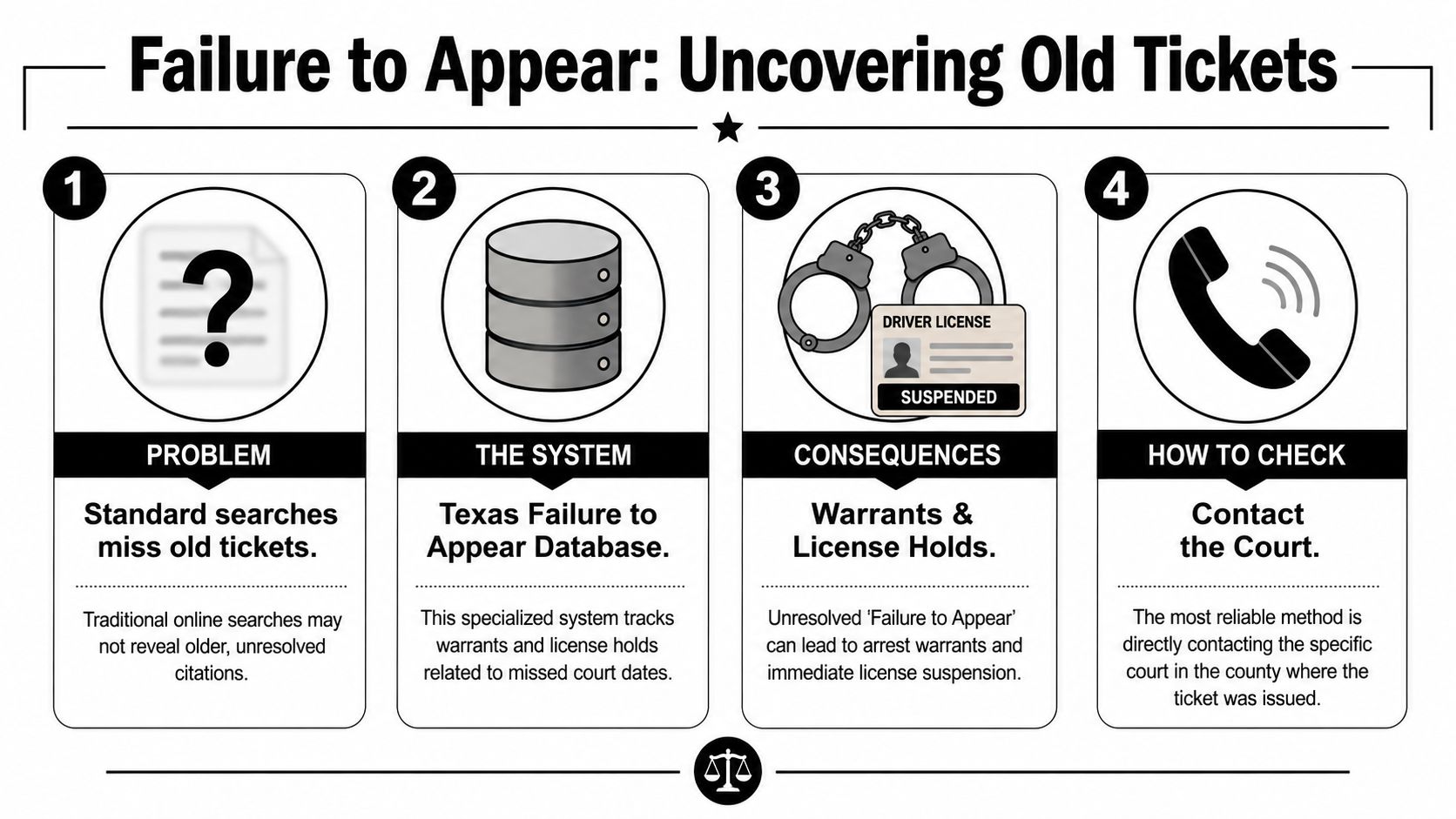
Texas Failure to Appear states that if you suspect a ticket is past due or you have an FTA record, you must search the OmniBase system using your driver's license number and date of birth, and the database provides the reporting court name and contact information needed to resolve the offense through the Texas Failure to Appear website.
Why this search matters
This database is useful because it focuses on unresolved offenses reported by courts, not just fresh citations. If multiple courts reported offenses, you may need to contact each court separately to clean things up.
Here's the practical difference:
| Search type | Best for |
|---|---|
| DPS citation search | Recent THP-issued citations |
| Local court portal | City or county tickets in the issuing court |
| OmniBase or FTA search | Past-due cases and reported failure to appear problems |
A “no citation found” result doesn't answer the FTA question. You have to ask that question separately.
Use caution if you find a record
If OmniBase shows a reporting court, take note of the court name and contact information first. Then decide how to approach it. Some people can resolve the matter directly with the court. Others should speak with a lawyer before making statements or appearing, especially if they suspect a warrant.
If you're also thinking about how records are gathered more generally, this guide to background checks for OSINT professionals gives useful context on how online public record searches work and why results often depend on the source database.
Understanding the Consequences of Unresolved Tickets
An unresolved ticket can stay small, or it can grow teeth. The primary risk usually starts when the issue turns into a missed court date, a failure to pay, or a warrant. That's why the difference between a citation search and an FTA search matters so much.

As one Texas legal guide explains, many people believe a clean online search means they have no outstanding legal obligations, but an FTA record may exist in a separate database and can lead to arrest warrants they didn't know about, as discussed in this article on checking for traffic tickets in Texas.
What can happen if the ticket is still open
The consequences depend on the court and the underlying offense, but common problems include:
- A warrant issue: A court may issue a bench-type warrant tied to a missed appearance or unpaid case.
- A driver's license problem: Some unresolved court reports can interfere with your ability to move forward cleanly.
- A more expensive resolution: Delay often means more fees, more stress, and fewer easy options.
- A bad arrest moment: People often discover the issue during a routine stop, not at a convenient time.
If you want a plain-English explanation of one common warrant category, this article on what a bench warrant is in Texas is a helpful starting point.
Why this can spill into criminal defense
A traffic case can become the doorway into a larger criminal problem. If you're arrested on an outstanding matter, the process may involve booking, an initial court appearance, bail conditions, plea bargaining, trial decisions, and sentencing consequences. In Texas, criminal charges such as theft, assault, DWI, or drug possession can raise separate issues under the Texas Penal Code.
For example, theft charges often rise or fall based on value and prior history. If your legal issue involves property allegations rather than just traffic enforcement, Theft and Property Crime Defense in Texas explains how theft charges escalate with the value of the property.
The safest assumption is simple. If the paperwork is unclear and the case may be old, don't rely on one website.
Some readers also deal with license consequences in more than one state. If you need a comparison point for reinstatement issues elsewhere, this overview of Georgia DUI Schools license reinstatement shows how another state structures that process. The rules are different, but the lesson is the same. License problems are usually administrative and court-related at the same time.
Your Next Steps and When to Call an Attorney
Once you find the ticket, you need a plan. In many cases, your choices are straightforward, but each choice carries consequences.
Your main options
- Pay the fine: This is simple, but it often means you're accepting responsibility instead of contesting the case.
- Ask about defensive driving or other court options: Some courts offer alternatives that may help protect your record, depending on the charge and your history.
- Fight the citation: If the facts are weak, the stop was questionable, or the outcome could hurt your record, contesting the case may make sense.
If your issue connects to a crash rather than just a citation, this DFox Law PLLC car accident attorney guide can help you think through when legal help becomes necessary on the civil side.
When handling it yourself stops making sense
Call a lawyer if any of these apply:
- You found a warrant or think one may exist.
- Your license may be affected.
- You have several tickets in different courts.
- The stop involved possible criminal charges, such as DWI, assault, theft, or drug possession.
- You want to protect your record, not just dispose of the case quickly.
If the matter has already crossed into criminal court, procedure matters. After arrest, a lawyer can help at arraignment, evaluate plea offers, prepare for trial when needed, and address sentencing exposure. If the case ends favorably, you may also want to ask about record relief options. In the right situation, expunction, nondisclosure, or other post-conviction relief tools may help you move forward.
For readers who want counsel on ticket defense specifically, traffic ticket lawyer options in Texas can help you understand when representation is worth considering. One option for statewide criminal defense and related record-clearing matters is Law Office of Bryan Fagan PLLC, which handles Texas criminal cases and post-case record issues.
If you've been charged with a crime in Texas, call The Law Office of Bryan Fagan, PLLC for a free and confidential consultation. Our defense team is ready to protect your rights.