Missing a court date. Forgetting about a traffic ticket. Falling behind on a payment the court ordered. That’s often how this starts.
Then your stomach drops. You wonder whether a police officer could arrest you at work, during school pickup, or on a simple drive home. If your case also touches family court, such as a protective order or child support issue, the fear can feel even worse because one problem may spill into another.
A lot of people in this position assume the worst. They think a warrant means the situation is beyond repair. It usually isn’t. Serious, yes. Hopeless, no.
The first step is understanding what is a bench warrant in texas and what it means for your life. A bench warrant is not just legal paperwork sitting in a file. It’s a court order that can interrupt your job, your parenting time, your driver’s license situation, and your ability to move forward in a criminal case.
The good news is that bench warrants can often be addressed in a controlled, strategic way. The wrong move is panic. The better move is getting clear on what happened, confirming whether a warrant exists, and taking action before law enforcement forces the issue for you.
That Sinking Feeling Discovering You Might Have a Warrant
For many Texans, this starts with a small moment that suddenly doesn’t feel small.
You search your name online after getting a strange call. You remember a court date for a DWI, assault, theft, or drug possession case that you missed because you wrote the wrong day on your calendar. Or you realize you never finished the driving safety course the court expected after a ticket. In family court, maybe you missed a support hearing or didn’t understand how serious a protective order hearing was.
That’s when the fear shows up fast. You start replaying every traffic stop, every knock at the door, every call from an unknown number.
Practical rule: If you think a warrant might exist, treat that concern as real until you confirm otherwise.
People often make two mistakes at this stage.
- They freeze: They tell themselves it’s probably nothing and hope the court forgets.
- They rush in alone: They call the court without a plan, say too much, or walk into the courthouse unprepared.
Neither approach gives you much control.
A bench warrant usually means the judge believes you didn’t follow a court order. That could be a missed appearance, unpaid fines, unfinished community service, or a probation problem. In some situations, it can also come out of a family law case and create trouble that reaches into your criminal matter.
You need facts, not guesses. Once you know what court issued the warrant, why it was issued, and what the underlying case involves, the problem becomes more manageable. The path forward may include asking the court to quash the warrant, arranging a planned surrender, appearing with counsel, or resolving the underlying violation before things get worse.
If you’re anxious right now, that reaction makes sense. But this is the moment to get organized, not defeated.
What Is a Bench Warrant in Plain English
A bench warrant is a judge’s order to arrest someone because they didn’t do what the court required.
That’s the simple version.
It authorizes immediate detention, and Texas criminal warrant guidance explains that TDCJ separately tracks bench warrant returns in its reporting, which shows these warrants matter in the system's operation.

What the judge is really saying
Think of it this way. The court told you to do something. Show up. Pay. Complete a requirement. Follow probation rules. You didn’t, or the court believes you didn’t. The judge then signs an order that says law enforcement can bring you back before the court.
This is why bench warrants are tied to court noncompliance, not usually to a brand-new criminal investigation.
Common examples include:
- Missed hearings: You had a setting in a DWI or assault case and didn’t appear.
- Unpaid obligations: You were ordered to pay fines or costs and fell behind.
- Probation violations: You missed a reporting requirement, ignored a condition, or failed to complete court-ordered service.
- Family court disobedience: You didn’t appear for a child support or contempt hearing.
The legal idea behind it
Texas law draws a line between warrants based on probable cause for a new crime and warrants based on failure to obey the court. A bench warrant fits the second category.
Texas Penal Code Section 38.10 deals with bail jumping and failure to appear. In plain English, if you were legally required to appear and didn’t, that failure can create a separate problem on top of the original case. That matters because what began as a manageable misdemeanor can become more complicated once the court believes you ignored it.
A bench warrant can also grow out of contempt issues. Courts use them to enforce their authority.
Why this scares people so much
A bench warrant doesn’t always mean officers are actively searching for you every hour of the day. But it does mean your routine can change instantly if police come across the warrant.
That’s why people often get arrested during everyday contact with law enforcement instead of during a dramatic search. The warrant sits there until something triggers it.
A bench warrant is the court’s way of saying, “You still have to answer this case, and now we may force the issue.”
If you’re asking what is a bench warrant in texas because you think one may exist in your name, the most important point is this. It does not fix itself with time and silence. It has to be addressed directly.
Bench Warrants vs Arrest Warrants in Texas
People often use the word “warrant” as if all warrants are the same. They aren’t.
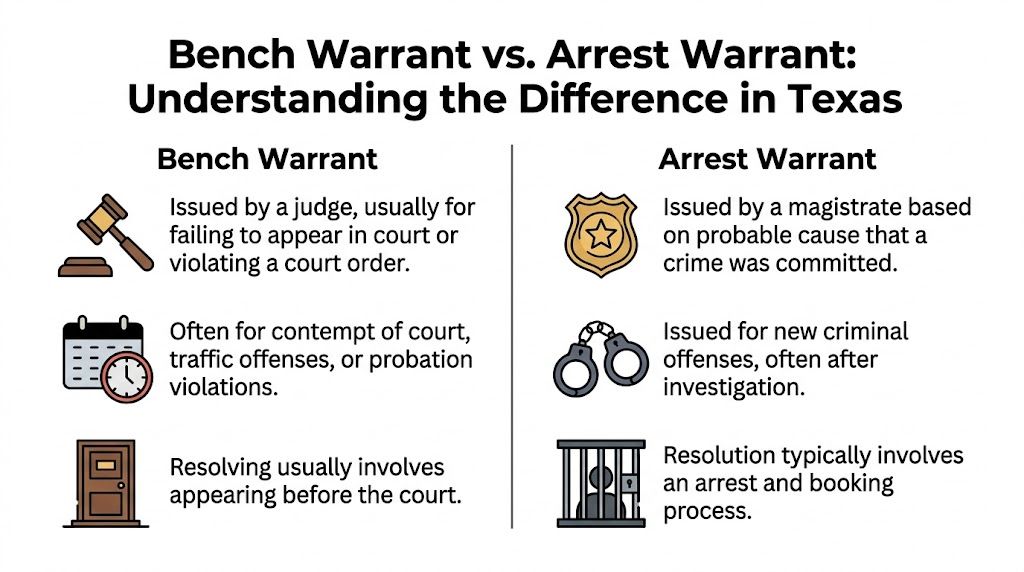
A bench warrant usually starts with disobeying the court. An arrest warrant usually starts with law enforcement claiming there is probable cause that you committed a crime. That difference affects how the warrant began, what the government wants, and how your lawyer should respond.
The easiest way to think about it
An arrest warrant says, “We think you committed an offense.”
A bench warrant says, “You ignored the court, and now the court is ordering your arrest.”
That difference sounds simple, but it matters. In many bench warrant cases, the underlying issue could have been handled much earlier with a court appearance, a payment plan, proof of compliance, or a request for more time.
Key differences at a glance
| Attribute | Bench Warrant | Arrest Warrant |
|---|---|---|
| Main trigger | Failure to follow a court order | Probable cause for a new criminal offense |
| Who drives the process | The court and the judge | Law enforcement and prosecutors |
| Typical examples | Missing court, unpaid fines, probation issues, contempt | DWI investigation, assault allegation, theft accusation, drug case |
| Main goal | Force you back before the court | Start or continue a criminal prosecution |
| How it often happens in real life | Discovered during routine contact | May follow an investigation or complaint |
| Best first move | Resolve the court noncompliance quickly | Get legal advice before speaking to police |
Why bench warrants feel sneaky
Bench warrants can sit in the background until something ordinary brings them to the surface.
According to Texas warrant information discussing failure-to-appear bench warrants, 70% to 80% of bench warrants activate opportunistically during traffic stops or other routine checks. That same source says failure-to-appear bench warrants make up roughly 25% of active warrants in major hubs like Harris and Dallas counties.
That means waiting is risky even if you haven’t had police at your door.
If your plan is “I’ll just be careful driving,” that’s not really a plan. Most people with bench warrants get caught during normal life, not dramatic raids.
What police and courts care about
With an arrest warrant, officers are usually focused on the alleged crime itself. With a bench warrant, the judge is focused on the fact that you didn’t comply with the court.
That changes the tone of the case.
If you fix a bench warrant quickly, the court may see that you’re taking the matter seriously. If you ignore it and get picked up later, the judge may be less patient about bond, scheduling, and your explanation.
Don’t confuse a bench warrant with a capias
Some Texans also hear the word capias and aren’t sure whether it means the same thing. They overlap in practice, but they’re not always used in exactly the same way across courts and case types. If you want a plain-English breakdown, this guide on a capias charge in Texas helps explain the difference.
The main point is practical, not academic. If a warrant exists in your name, the label matters less than the response. You need to know which court issued it, why it was issued, and whether you can resolve it through a motion, a scheduled appearance, or a controlled surrender.
Common Reasons a Judge Issues a Bench Warrant
Bench warrants often come from everyday mistakes that grow into court problems.
Sometimes the person knew exactly what the court required and chose not to comply. Other times, life got messy. A notice went to an old address. Work ran late. Someone didn’t understand that a family court hearing could end in arrest. The court may still issue the warrant either way.
Missed court in a criminal case
This is the most common situation people think about.
You’re charged with DWI. Or assault after an argument got out of hand. Or theft, drug possession, or another misdemeanor. The court gives you a date. You miss it. The judge may issue a bench warrant because you failed to appear.
That missed hearing can do more than delay the case. It can damage your credibility with the court and expose you to a separate failure-to-appear issue under Texas Penal Code Section 38.10.
Missed settings often happen because of:
- Bad address records: The court notice went somewhere you no longer live.
- Calendar mistakes: You wrote the wrong date or thought your lawyer would appear without you.
- Fear: You were scared of what would happen, so you stayed away.
If you’ve missed court, this resource on what to do if you miss a court date can help you understand the first steps.
Unpaid fines or unfinished court requirements
Bench warrants also show up in cases that started small.
You got a traffic citation and didn’t respond within the required time. You were allowed to take a driving safety course and never completed it. You agreed to pay fines in installments and defaulted. You were ordered to perform community service and never turned in proof.
What seems minor to you may look like defiance to the judge.
A lot of Class C cases begin this way. The original issue may not have involved jail, but ignoring the court can still put you at risk of being taken into custody.
Probation and community supervision violations
Probation is another common trigger.
The judge gave you a chance to stay out of jail if you followed conditions. Then something went wrong. Maybe you missed reporting. Maybe you failed to complete a required class. Maybe you didn’t finish community service or fell behind on fees.
When that happens, the court may respond with a bench warrant to bring you in.
Many individuals make dangerous assumptions. They think a “technical” violation won’t matter. It can matter a lot. In a felony case, probation trouble can expose you to much harsher consequences than the original deal you accepted.
A bench warrant on a probation case is a warning sign. The court is telling you your second chance is in danger.
Ignoring subpoenas or contempt orders
Some warrants have nothing to do with a new arrest or a pending criminal charge. They come from contempt.
If the court ordered you to appear, testify, produce documents, or comply with another directive and you ignored that order, a bench warrant can follow. Judges use these warrants to enforce courtroom authority and keep cases moving.
The family law overlap people miss
This is one of the most misunderstood areas.
A bench warrant can come out of a family court matter and still lead to arrest. That includes hearings involving protective orders, child support, alimony, and other contempt-related issues. The family case may be civil in form, but the consequences can become very real, very fast.
One legal discussion of Texas warrants notes that violating a protective order or failing to pay court-ordered child support can lead to a bench warrant from family court, which can then complicate related criminal matters. That same source describes a roughly 15% increase tied to post-2025 backlogs in Harris and Dallas counties as a projected trend rather than a current statewide fact, so the safer takeaway is practical instead of statistical: these overlap cases are becoming more visible and they require coordinated strategy. See the discussion at Texas Criminal Defense Group’s article on different types of warrants in Texas.
If you’re dealing with both family court and a criminal charge, one court appearance can affect the other. A protective order issue may influence bond conditions. A child support contempt case may affect your scheduling, custody concerns, or how a judge views your compliance history.
That is why these cases shouldn’t be handled in isolation.
The Hidden Consequences of an Outstanding Bench Warrant
The obvious consequence is arrest. The hidden consequences are what wear people down.
An outstanding bench warrant changes how you live. You start avoiding routine things because you know a routine police contact could become handcuffs and a jail hold. You may stop driving unless absolutely necessary. You may avoid court buildings, government offices, and any situation where your identity might get checked.
It can affect more than one case
If your warrant comes from a missed appearance in a DWI, assault, theft, or drug case, the court may treat your absence as a sign that you’re unreliable. That can hurt you when bond is discussed, when scheduling is set, and when the prosecutor evaluates plea options.
If the warrant comes from a family court issue, the damage can spread into criminal court. Judges notice patterns. A history of noncompliance in one court can shape how another court sees you.
It can interrupt work and family life
People often focus on jail time and forget the practical fallout.
A sudden arrest can mean:
- Missed work: You disappear for a day or longer and have no control over timing.
- Childcare problems: Kids still need pickup, meals, and supervision.
- Public embarrassment: Arrests during stops or at home are hard to explain away.
- Stress on your case: You lose the chance to appear organized and cooperative.
The emotional cost matters too. Living with a warrant creates constant uncertainty. Even if no officer comes looking for you today, you don’t know when the interruption will happen.
It can limit future cleanup options
If you care about expunction, nondisclosure, or rebuilding after a criminal accusation, warrant issues matter. Courts and prosecutors pay attention to compliance. Someone who handled the case responsibly often has a better position than someone who disappeared until they were arrested.
That doesn’t mean your future is ruined. It means delay usually makes cleanup harder.
A bench warrant is rarely an isolated problem. It tends to pull on everything connected to your case, your job, and your home life.
How to Find Out If You Have a Bench Warrant in Texas
If you suspect a warrant, guessing won’t help. You need confirmation.
The challenge is doing this carefully. Some people call the court and start explaining before they even know what case they’re discussing. Others rely on rumor, an old letter, or an internet search result that may be outdated. A smarter approach is organized and quiet.
Start with the court that handled your case
Think about where the original problem began.
Was it a traffic ticket in municipal court? A misdemeanor in county court? A felony or probation matter in district court? A child support or protective order issue in family court? The right court usually has the best record of whether a bench warrant was issued.
Useful places to start include the county clerk, district clerk, municipal court, or justice court involved in your matter.
Practical ways to check
You generally have a few options:
Search court records online
Some counties provide online case lookups. If you know your case number or court, this can be a useful first step.Call the clerk’s office
Ask whether a case is active and whether a warrant or failure-to-appear issue appears in the file. Keep your questions narrow. Don’t start giving explanations.Check with a lawyer
This is often the safest route, especially if you think arrest is possible or your case is tied to both criminal and family court.Review old paperwork
Look for bond papers, court notices, probation terms, or prior orders. These documents can tell you which court to contact.
Major metro areas matter
If you live in or around Houston, Dallas, Austin, or San Antonio, checking the right county system matters because your warrant is tied to the court that issued it. Harris County, Dallas County, Travis County, and Bexar County each have their own court structures and search methods. If your case crossed county lines, don’t assume only one place needs to be checked.
Why attorney review helps
Having a lawyer check on your behalf can lower the risk of making the situation worse. Counsel can identify:
- whether the warrant is active
- what court issued it
- whether bond may be available
- whether a motion to quash makes sense
- whether a walk-through or planned surrender is the safer path
The lawyer can also spot issues you may miss, such as a related probation hold, a second case in another court, or a family-law contempt matter connected to the same facts.
If you’re not sure whether your issue is criminal, family, or both, that’s another reason to avoid handling the search casually. The paper trail may be broader than you think.
You Have a Warrant What to Do Next
Once you confirm a bench warrant exists, the goal is simple. Take control before the warrant takes control of you.
The 2017 expansion of Article 45.014 also facilitated warrant issuance for fine-only misdemeanors that often lead to bench warrant trouble, as explained in this discussion of bench warrants and Texas Code of Criminal Procedure requirements.

The worst move is doing nothing
People delay because they’re afraid they’ll be arrested if they act. But in many cases, doing nothing only gives up the chance to shape the outcome.
When you move first, your lawyer may be able to contact the court, confirm the warrant basis, and ask about procedures for quashing it or arranging an appearance. In some cases, counsel can help set up a more controlled surrender instead of leaving you exposed to an unplanned arrest at work or on the roadside.
A practical response plan
Different courts handle warrants differently, but this is the framework that often works best.
Confirm the exact warrant
Get the court name, case number, underlying charge, and reason for issuance. A warrant tied to a missed misdemeanor setting is different from one tied to a felony probation issue.Stop talking about the facts of the case
If the original case involves DWI, assault, theft, or drugs, don’t use a warrant call as a chance to “explain everything.” You can hurt your defense.Evaluate whether to file a motion to quash
If there was a valid reason for missing court, such as a medical emergency or notice problem, the court may consider that. The argument has to be presented the right way.Consider a planned surrender
In some cases, it’s better to arrange a walk-through than to wait for officers to catch you unexpectedly.Address the underlying problem
If the warrant came from unpaid fines, missed classes, failed community service, or family court noncompliance, solving part of that issue can help your position.
What happens after arrest or surrender
If you’re arrested on the warrant or surrender on a planned basis, the process usually moves through familiar criminal procedure steps.
Booking and hold
You may be taken to jail, processed, and held until you can appear before a judge or magistrate. Whether release happens quickly depends on the court, the underlying case, and whether another hold exists.
Arraignment or first appearance
The court addresses the warrant and the pending matter at this stage. If you missed court, the judge may want an explanation and may set future conditions.
Plea negotiations or case reset
Many warrant cases return to the normal track of the underlying prosecution. That could mean negotiation, evidence review, motion practice, or a reset for later proceedings.
Trial and sentencing exposure
If your original charge remains unresolved, the case can still proceed toward trial or sentencing. The warrant issue doesn’t erase the underlying charge. It adds pressure to address it carefully.
This is also the stage where a defense lawyer may look ahead. If your case can be dismissed, reduced, or resolved without a conviction, future relief such as expunction, nondisclosure, or other post-conviction strategy may become part of the discussion. That’s especially important for professionals, students, and first-time offenders who are trying to protect future opportunities.
Here’s a short video that may help you think through the process in practical terms.
Going alone versus using counsel
You can walk into court alone. Sometimes people do. That doesn’t mean it’s the smart play.
A lawyer can often do more than just stand beside you. Counsel may be able to coordinate timing, reduce surprises, communicate with the court, and keep you from making admissions that hurt the underlying case. If you’re weighing that decision, it helps to understand the cost of legal advice before you assume representation is out of reach.
If you need one starting point for warrant help, the Law Office of Bryan Fagan, PLLC handles Texas criminal defense matters involving warrants, underlying charges, and cases that overlap with protective orders or family-related court issues.
You may also want to understand how a separate Texas arrest warrant differs from a bench warrant if you’re not yet sure what type of warrant is in your name.
The best outcome usually comes from showing the court you’re dealing with the problem on purpose, not because you got caught by surprise.
Take Control of Your Future Today
A bench warrant is serious, but it’s still a problem you can address.
The primary danger is delay. The longer a warrant stays active, the more likely it is to disrupt your life at the worst possible time. If your case involves DWI, assault, theft, drug possession, probation, a protective order, or child support, quick action matters even more because one issue can spill into another.
You don’t have to sort this out alone. The right strategy can protect your freedom, your record, and your next step.
If you’ve been charged with a crime in Texas, call The Law Office of Bryan Fagan, PLLC for a free and confidential consultation. Our defense team is ready to protect your rights.