Finding out you may have a travis county warrant can make your stomach drop fast. A missed court date, an old ticket, a DWI charge, or a new allegation can suddenly turn into fear about getting arrested at work, during a traffic stop, or in front of your family.
That fear is real, but panic usually makes the problem worse. A warrant is serious, yet it can often be handled in a deliberate, controlled way when you move quickly and get the right legal advice.
The Anxiety of an Outstanding Warrant in Travis County
A lot of people first learn about a possible warrant in an ordinary moment. They check a court notice they forgot about. A family member says an officer came by. They get nervous before renewing a license or going to court on another matter. Suddenly, every knock at the door feels louder.
If that's where you are right now, you're not alone. People facing warrants in Travis County often aren't hardened criminals trying to disappear. Many are working parents, students, professionals, or first-time defendants who made one bad decision, missed one date, or didn't understand what the court expected.

What matters now is control. When you know what kind of warrant you're dealing with, where it came from, and how lawyers typically resolve it, the situation becomes less mysterious and more manageable.
Practical rule: If you suspect a warrant exists, treat that suspicion as a problem to verify today, not someday.
The right response isn't hiding, guessing, or relying on a third-party website that may be wrong. The right response is to confirm the warrant, identify the court, and build a plan that protects your job, your family responsibilities, and your future record as much as possible.
What Is a Travis County Warrant
A Travis County warrant is a court order that gives law enforcement legal authority to act. In most cases, that means arresting someone. In others, it means enforcing a missed court appearance, unpaid fines, or a probation or parole issue.
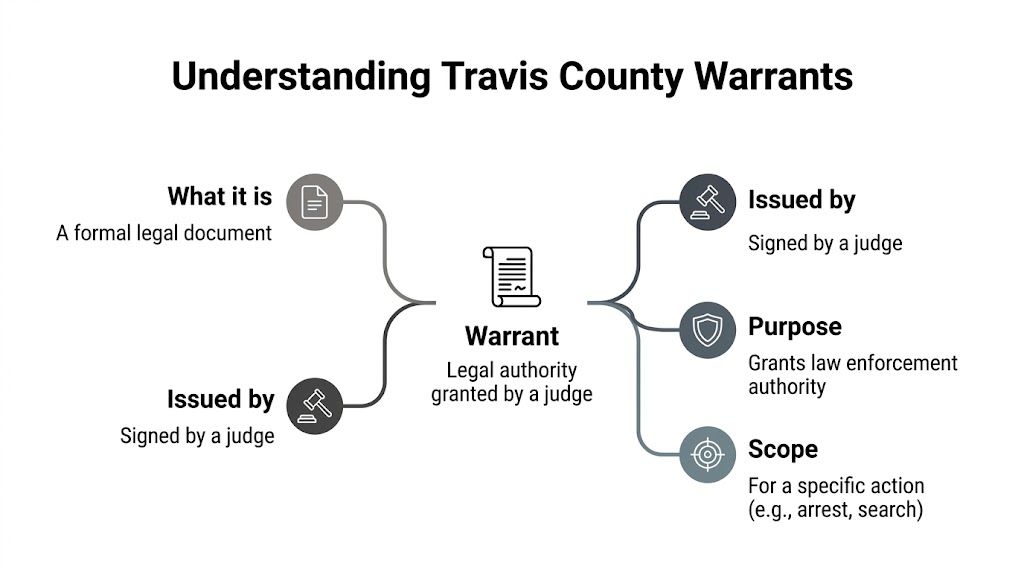
Once a warrant is signed, the problem has moved out of the warning stage. It becomes something that can affect a traffic stop, a bond decision, a background check, or an unexpected contact with police.
The main warrant types people run into
People worried about a Travis County warrant are usually dealing with one of a few categories:
- Arrest warrant: This is tied to an allegation that a criminal offense was committed. In Texas, an arrest warrant generally must be supported by probable cause. That usually means an officer or investigator submits a sworn affidavit describing facts that identify a specific person and a specific offense.
- Bench warrant or capias: This often follows a missed court date, a failure to follow a judge's order, or noncompliance in a pending case. For a plain-English explanation, see what a bench warrant means in Texas.
- Capias Pro Fine warrant: This can be issued after a person fails to pay court-ordered fines or costs in certain cases.
- Blue warrant: This usually involves an alleged parole violation through the Texas Department of Criminal Justice.
- Municipal warrant: These often grow out of city tickets, ordinance violations, or unresolved traffic matters in Austin or nearby municipalities.
The label matters because the solution changes with the warrant type. A missed court date may be resolved through a reset or recall request. A fresh felony arrest warrant often requires a different plan, including bond preparation and controlled contact with the court.
How judges decide whether to issue one
For an arrest warrant, a magistrate or judge reviews sworn facts offered by law enforcement to decide whether probable cause exists. That is a constitutional standard. It is meant to prevent arrests based on guesswork or bare suspicion.
A valid warrant also needs basic legal details. The paperwork should identify the person to be arrested, describe the alleged offense, show when it was issued, and meet Texas procedural requirements.
A signed warrant is not automatically beyond challenge. If the affidavit is weak, mistaken, or incomplete, that can become an issue for the defense later.
That said, waiting to challenge it from a jail cell is usually the worst way to start. In practice, the smarter move is often to identify the court first, assess the charge level, and decide whether a lawyer can address the warrant before an arrest happens.
Why Travis County feels confusing
Travis County does not run every warrant through one office. Felony matters, misdemeanor cases, and municipal cases can sit in different court systems, with different clerks, different procedures, and different ways of clearing a hold.
That is why two people can both say they have "a warrant" and have completely different risks. One person may need to address a county court capias for a missed misdemeanor setting. Another may be dealing with a felony arrest warrant that calls for immediate planning around surrender, bond, and statements to law enforcement.
County Courts at Law commonly handle many Class A and B misdemeanor cases. District courts handle felony matters. Municipal courts often handle city-level cases such as traffic and ordinance violations. If you identify the wrong court, you can waste time, miss a chance to fix the problem early, or walk into a setting unprepared.
Why that court structure matters to you
The court that issued the warrant affects almost every decision that follows:
| Issue | Why it matters |
|---|---|
| Type of court | It helps show whether the matter is felony, misdemeanor, municipal, or tied to compliance with a prior order. |
| Type of warrant | A failure to appear is handled differently from a new criminal accusation or a fine-only enforcement issue. |
| Available relief | Some warrants can be addressed through recall, reset, payment arrangements, or a planned surrender with counsel involved. |
| Timing | Early identification gives your lawyer more room to protect work obligations, childcare responsibilities, immigration concerns, and bond options. |
If the warrant is tied to DWI, theft, assault, drug possession, or another pending charge, knowing the exact court is the first step toward fixing the problem in a deliberate way. That is also where strategy starts. The right plan is not just about finding the warrant. It is about resolving it with the least damage possible to your record, your freedom, and your future.
Your Guide to Finding an Active Warrant
You shouldn't rely on rumor, old paperwork, or a background-check app. If you think a travis county warrant may be active, confirm it through a reliable source before making any move.

A careful search can tell you whether the issue appears to be county, district, or municipal. It can also help your attorney decide whether the next move should be a court setting, a motion, or a controlled surrender.
Where to look first
Use official or court-connected tools when possible:
Travis County Sheriff's Office warrant search
This is often the first place people check for county-level warrant information. Be ready with your name and date of birth.Odyssey and clerk record systems
If the case is already filed, court records may show case activity, settings, and related warrant entries. That can be especially useful in misdemeanor and felony matters.Austin Police Department municipal warrant search
If the problem started as a city ticket, ordinance issue, or traffic matter, municipal records may be the better place to check.
What the search result does and doesn't tell you
A search result can point you toward the court, case number, or warrant type. It doesn't always tell the full story.
For example, it may not explain whether a lawyer can ask the court to withdraw the warrant, whether bond has been discussed, or whether appearing without counsel creates unnecessary risk. That's where legal strategy matters more than the database itself.
Search results are useful for identification. They are not a substitute for legal analysis.
A short explainer can help if you're trying to understand the process before taking the next step:
The risks of searching on your own
Looking up your own case isn't illegal, but self-directed searching has practical downsides.
- You may misread the record: Court systems use abbreviations that aren't obvious if you don't work with them every day.
- You may contact the wrong office: Calling around can create confusion and panic instead of a solution.
- You may act too quickly: Some people go straight to a courthouse or station without knowing whether a lawyer could have arranged something safer first.
- You may use bad data: Third-party warrant sites are often stale, incomplete, or designed to scare you into paying for access.
When attorney-led searching is the smarter move
If the warrant may relate to a DWI, assault, theft, or drug possession case, having counsel verify the issue often puts you in a stronger position. A defense lawyer can check the record, identify the court, and start evaluating whether the issue is really a failure to appear, a filing problem, a capias, or a newly issued arrest warrant.
That kind of review often changes the plan. Instead of reacting emotionally, you respond with purpose.
Why You Cannot Ignore a Warrant
Ignoring a warrant doesn't freeze the case. It gives the system time to catch up with you when it's least convenient and most damaging.
People often hope the warrant won't be enforced because the original matter seemed minor. That's a dangerous assumption. A simple stop for speeding can turn into handcuffs, towing fees, missed work, and a rushed first appearance before you've had time to prepare anything.
Small cases can turn into bigger problems
A warrant can create a second layer of trouble on top of the original allegation. If the issue started with a missed court date, you may now be dealing with both the underlying charge and the consequences of nonappearance. If it began as unpaid fines or costs, the court may view delay as noncompliance rather than oversight.
For people charged with misdemeanor offenses, the penalties are already serious. In Travis County, a Class A misdemeanor can bring up to one year in jail and a $4,000 fine, and a Class B misdemeanor can bring up to 180 days in jail and a $2,000 fine, as explained in this overview of Travis County misdemeanor penalties.
The real-life costs usually hit first
Before sentencing is ever discussed, a warrant can damage your life in practical ways:
- Employment problems: An arrest at work or a missed shift can cost you a job.
- Family stress: Parents may scramble for childcare if someone is suddenly booked into jail.
- Transportation disruption: A traffic stop can leave your car stranded or impounded.
- Court credibility issues: Judges tend to respond better when you address a problem voluntarily.
- More pressure in negotiations: Prosecutors may be less flexible when the case has been ignored.
If your problem started because you missed court, this article on what to do after missing a court date can help you understand why immediate action matters.
A warrant is one of those legal problems that rarely stays contained. It spills into work, parenting, travel, and your ability to plan normal life.
Why waiting almost never helps
Some people wait because they're afraid of jail. Others wait because they think getting a lawyer later will be just as effective.
In practice, delay usually reduces your options. A lawyer has more room to negotiate when you act before an unexpected arrest. Once you're in custody, decisions happen faster, on the court's schedule, and under much worse conditions for you and your family.
How to Responsibly Handle a Travis County Warrant
You find out about the warrant on a Tuesday afternoon. Maybe your name came up during a background check, or a family member heard from a bondsman, or an officer called and asked you to come in. The next move matters. A rushed decision can turn a manageable case into an avoidable jail stay.

The job is to resolve the warrant in a way that protects your freedom, your record, and your ability to defend the underlying case. In my experience, that usually starts with slowing the situation down and making a plan before you hand yourself over or speak in detail to police.
Start with case control
If law enforcement contacts you, stay calm and identify yourself if required. Do not try to explain the facts of the case, apologize, or fill in gaps for the officer. Statements made in a stressed phone call often show up later in reports.
Use that first hour well. Save screenshots of any case information you can find, gather bond papers or old court notices, and write down what you know about the missed date, arrest allegation, or citation. Then get defense counsel involved. Firms such as The Law Office of Bryan Fagan, PLLC handle Texas criminal cases involving warrants, bond issues, and underlying charges, and the immediate value is having someone assess whether the warrant can be addressed without walking in blind.
A lawyer may be able to fix the warrant before you are booked
Some Travis County warrants, especially in lower-level cases, can be addressed by asking the court to recall or quash the warrant and put the case back on the docket. That is often worth trying when the problem started with a missed court date, a notice issue, or a case where the client is prepared to appear promptly.
This is a practical judgment call. Judges do not grant every request, and serious charges usually leave less room to solve the problem on paper. Still, asking first can prevent an unnecessary arrest and puts your lawyer in position to explain why you are addressing the case now instead of waiting to be picked up.
Voluntary surrender can be the safer option
If the warrant cannot be cleared in advance, a walk-through surrender may be the better route. That means your lawyer coordinates where you report, what paperwork you bring, whether bond can be addressed quickly, and who needs to be on standby for work, childcare, medications, and transportation.
Going in voluntarily often helps for one simple reason. You control the timing.
A planned surrender is usually better than being arrested during a traffic stop, outside your home, or in front of your children. It also gives your attorney a chance to prepare bond arguments, alert family members, and reduce the risk of you sitting in custody longer than necessary.
What a strategic surrender is designed to do
A managed approach focuses on specific problems that can be reduced with preparation:
- Lower the chance of surprise detention at the worst moment: You choose the day and prepare for it.
- Put bond issues in front of the court early: Work history, local ties, treatment records, or proof of compliance may help.
- Protect your job and family logistics: You can arrange coverage, transportation, and communication in advance.
- Show the court you are taking the case seriously: Voluntary action often creates a better starting point than an unexpected arrest.
If release conditions are likely to matter in your case, review how Travis County Pretrial Services can affect bond review and supervision before you surrender.
What to gather before court or surrender
Preparation affects outcomes. Bring the information your lawyer will need to make decisions quickly.
| Item | Why it matters |
|---|---|
| Photo ID | Jail and court staff need to confirm identity. |
| Case paperwork | Complaints, citations, bonds, and court notices help pinpoint what triggered the warrant. |
| Employment details | These can support bond arguments and release planning. |
| Medical information | This helps if you take medication or have treatment needs that could be affected by booking. |
| Emergency contact information | Someone should know where you are, how to reach your lawyer, and what to do if timing changes. |
Resolving the warrant is only phase one
Many clients feel relief once the warrant itself is addressed. That relief is real, but it is only the beginning. The underlying case still needs a defense strategy.
That strategy may include reviewing police reports and video, identifying witness problems, preserving favorable evidence, challenging the stop or search, negotiating for a reduction, or preparing for trial. In some cases, the immediate goal is release. In others, the better long-term decision is to focus on keeping a conviction off your record, protecting a professional license, or avoiding consequences that reach into family or immigration matters.
The first steps after a warrant often shape those later options. A careless surrender can create statements the prosecutor did not have before. A planned response can protect positions that matter months from now.
Keep the long-term record in mind
Clients under warrant stress often focus on one question: "How do I stay out of jail today?" That is a fair question. It is not the only one.
Ask a second question at the same time. "How will this case end, and what will still be fixable afterward?" Expunction, nondisclosure, and other cleanup options depend heavily on how the case is handled from the start. A good warrant strategy does more than solve the immediate crisis. It protects your future choices.
Warrants, Immigration, and Other Complex Situations
Some warrant cases involve more than one legal problem at the same time. A local case can overlap with immigration concerns, family law stress, old municipal tickets, or financial obligations tied to court costs or support orders.
For immigrant families, the fear is often bigger than the warrant itself. People worry that checking on a local case or appearing in court will automatically trigger deportation. However, the situation is more nuanced, and that nuance matters.
Judicial warrants and ICE holds are not the same thing
A judicial warrant comes from a judge or magistrate. An administrative ICE hold or detainer is different. That distinction can affect how local authorities respond and what risks exist when someone is booked into custody.
As discussed in this video on local warrant and ICE concerns, local Travis County policies limit cooperation with ICE unless a judicial warrant exists, and early attorney intervention is important for protecting clients from avoidable immigration consequences.
If immigration status could be affected, criminal defense strategy and immigration strategy need to be coordinated early, not after booking.
Why early legal help matters more in mixed-status families
A person may think the safest move is to stay hidden. In reality, unplanned contact with law enforcement is often the worst setting for making smart decisions.
When a lawyer gets involved early, the legal team can evaluate questions such as:
- What type of warrant exists
- Whether personal appearance can be managed strategically
- Whether the underlying charge creates immigration risk
- What documents should be available before any court contact
- Whether family law or protective-order issues overlap with the criminal case
If a client or family member needs language support for records, personal documents, or immigration filings connected to the case, reliable certified translation services for immigration can help avoid delays and confusion.
Other warrant situations that need a tailored plan
Not every Travis County warrant comes from a new criminal arrest. Some stem from older court obligations that were never fully resolved.
Consider these examples:
- Unpaid fines or costs: A capias pro fine warrant may require a different response than a fresh assault allegation.
- Traffic or Class C matters: Paying money sometimes helps, but payment alone isn't always enough once a warrant has issued.
- Child-support-related problems: These cases can overlap with family court issues and need careful handling.
- Older dismissed or dormant cases: What looks active to a client may require file review before anyone acts.
Why one-size-fits-all advice fails here
Online advice often treats every warrant the same. That's a mistake.
A professional facing a theft allegation has different priorities from a college student dealing with a missed municipal court setting. An undocumented parent facing a local drug possession warrant needs a plan that considers both criminal exposure and immigration risk. A person accused of assault in the middle of a custody dispute may need criminal defense and family-law coordination at the same time.
The more moving parts your case has, the less sense it makes to handle it informally.
Take Control of Your Future Today
A travis county warrant is serious, but it isn't hopeless. The worst outcomes often happen when people freeze, guess, or let fear make decisions for them.
The better path is proactive. Confirm the warrant. Learn which court issued it. Get advice before you speak to police, walk into a courthouse, or assume payment will solve everything. If the issue involves DWI, assault, theft, or drug possession, that early strategy can shape bond, negotiations, and the long-term impact on your record.
You also need to think past the immediate arrest risk. A criminal case doesn't end when the warrant is lifted. You may still face arraignment, plea discussions, trial decisions, sentencing issues, and eventually questions about expunction, nondisclosure, or other ways to protect your future.
The law gives you rights, including constitutional protections surrounding arrests and warrants. But rights have to be asserted. They don't protect you automatically if you wait for the system to make the next move first.
If you've been charged with a crime in Texas, call The Law Office of Bryan Fagan, PLLC for a free and confidential consultation. Our defense team is ready to protect your rights.
If you're dealing with a warrant, a missed court date, or a criminal charge in Texas, schedule a free and confidential consultation with Law Office of Bryan Fagan PLLC. You can get clear answers about your options, your next steps, and how to protect your future.