Getting a ticket in Texas can ruin your day fast. You're looking at the fine, wondering what it will do to your insurance, and asking the question most drivers ask right away: How do I remove a ticket from my driving record in Texas?
The short answer is that you usually aren't trying to erase a conviction after the fact. You're trying to stop the ticket from becoming a final conviction in the first place. That difference matters. If you choose the right path early, you may be able to keep the violation off your record. If you choose the wrong path, or miss a deadline, the court can enter a conviction and your options get much narrower.
At The Law Office of Bryan Fagan, PLLC, we talk to Texans every day who are dealing with traffic cases, DWI charges, assault allegations, theft cases, drug possession arrests, and the record problems that follow. A traffic ticket may sound minor next to a DWI or a Texas assault defense case, but the decision-making process is similar. You need to know the charge, the procedure, the deadlines, and the long-term consequences before you act.
A Texas Traffic Ticket Is More Than Just a Fine
A traffic ticket feels simple until you look at what's really at stake. The fine is only one part of the problem. The bigger issue is whether the case ends in a conviction that shows up on your driving history and may affect what insurers see.
If you're asking how to remove a ticket from your driving record in Texas, start with this rule: a ticket is not the same thing as a conviction. The citation is only the accusation. What affects your record is the final court outcome.
What most drivers are really trying to avoid
In most routine traffic cases, you have three practical paths:
- Driving safety course for eligible tickets and eligible drivers
- Deferred disposition, which is a form of court-ordered compliance that can lead to dismissal
- Contesting the ticket by pleading not guilty and requiring the state to prove the case
Each option has trade-offs. A driving safety course can work well when you qualify and can follow the court's instructions exactly. Deferred disposition may fit better if the court won't allow a course or if your facts make that option cleaner. Fighting the ticket can be the right move when the citation is wrong, the officer's observations are weak, or the consequences of a conviction are too serious to accept.
Practical rule: Don't focus only on the fine. Focus on the final record outcome.
Why the right choice depends on your bigger picture
One ticket doesn't exist in a vacuum. If you've had a recent citation, carry a commercial license, drive for work, or already have a pending criminal matter, the safest option may not be the fastest one.
That's also true in broader Texas criminal defense work. Under the Texas Penal Code, offenses like assault, theft, and drug possession can bring consequences that go far beyond the courtroom. After an arrest, the process may include booking, magistration or arraignment, plea discussions, trial settings, and sentencing. In those cases, you also have to think about expunction, record sealing, and post-conviction relief. The same mindset applies here. You need to think ahead, not just react.
If your traffic stop involved more than a citation, such as a DWI investigation, a drug possession allegation, or a warrant issue, you should treat the case as a criminal defense matter, not a simple ticket problem. That's where a Texas DWI attorney or Houston criminal lawyer may need to step in early.
First Check Your Official Texas Driving Record
Before you choose a strategy, get your official Texas driving record. Don't rely on memory. Don't rely on what you think happened in another county. Courts often look at the certified state record, not your personal notes.
Harris County Justice Courts require people seeking defensive driving dismissal to submit a certified driving record (Type 3A) with the course certificate, which shows how closely courts check eligibility and prior course use. That requirement is discussed in this practical guide to driving records, which is useful if you've never ordered one before.

Why the Type 3A record matters
A certified Type 3A record can show the court whether you've already used defensive driving recently and whether there are other issues that affect your eligibility. That makes it more than paperwork. It's the document that tells you whether your preferred option is even available.
If you skip this step, you can waste time asking for a remedy the court won't grant. That's one of the most common self-inflicted problems in traffic court.
What to do with the record once you have it
Use the record to answer these questions:
- Have you used defensive driving recently? If yes, that may block that route.
- Is the license status current? If not, fix that issue before the court date if possible.
- Are there old entries you didn't expect? If so, plan your strategy with the full history in mind.
Order the record first. Decide second.
For some readers, a driving record question turns into a larger record-clearing question. If your situation involves a criminal case rather than a simple citation, Expunction and Nondisclosure in Texas explains how to clear or seal a criminal record under Texas law. That won't usually erase an ordinary traffic conviction the way people hope, but it becomes important when a stop led to an arrest or prosecution.
Your Three Main Options to Keep a Ticket Off Your Record
The right answer depends on the charge, your history, and what matters most to you. Some people want the fastest path. Others care most about protecting a clean record. Others need to fight because the ticket is wrong.
Start with this visual comparison.
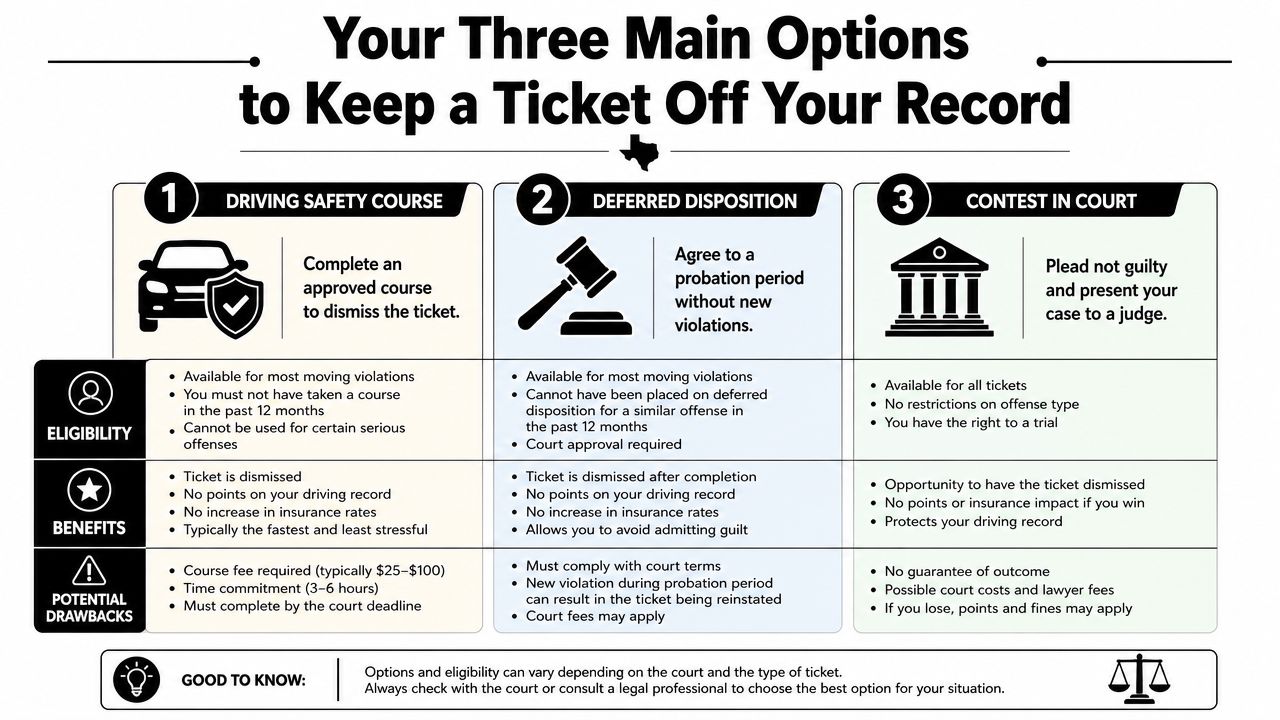
Texas law gives many eligible drivers a useful tool. Texas law allows eligible drivers to prevent certain traffic tickets from appearing on their driving record by completing a state-approved defensive driving course under Texas Transportation Code § 545.4121, which can result in dismissal of the citation. To qualify, you typically must hold a valid, non-commercial Texas driver license, have liability insurance, not have used defensive driving for dismissal within the preceding 12 months, and receive prior approval from the court that issued the ticket. The state no longer uses a points-based system; instead, the primary benefit of the course is to avoid a conviction that could raise insurance rates according to this explanation of Texas defensive driving eligibility and dismissal rules.
A separate overview on defensive driving for point reduction can also help if you're sorting through the practical differences between older “points” language and what Texas drivers are really trying to avoid today.
A short video can help if you want a quick overview before deciding.
Option one: Driving safety course
This is often the cleanest route for a first-time or low-risk traffic case. If the court approves it and you complete everything correctly, the citation can be dismissed.
Best for: eligible drivers with a qualifying ticket who want a practical, low-conflict resolution.
Main upside: dismissal without a conviction.
Main downside: strict procedural compliance. If you are sloppy with documents or deadlines, the court can deny the benefit.
Option two: Deferred disposition
Deferred disposition works more like probation for a traffic case. The court gives you conditions to complete over a set period. If you comply, the case is dismissed at the end.
Best for: drivers who don't qualify for a course, or for tickets the court prefers to handle through conditions rather than a course.
Main upside: flexible in situations where defensive driving isn't available.
Main downside: you must follow every condition exactly. A new violation or missed requirement can undo the deal.
Option three: Contest the ticket
If the facts matter, or the consequences are serious enough, fighting the case may be the right move. You can plead not guilty and require the prosecution to prove the charge.
Here's a useful firm resource on contesting a traffic citation if you're weighing whether the facts justify a court fight.
| Option | Good fit | Risk to watch |
|---|---|---|
| Driving safety course | Eligible routine ticket | Paperwork and deadline mistakes |
| Deferred disposition | You need a non-course dismissal path | Violating court conditions |
| Contest in court | Ticket is weak or stakes are high | Time, preparation, and uncertainty |
The best option isn't always the easiest one. It's the one that protects your record without creating a new problem.
Executing Your Plan A Step-by-Step Guide
A good ticket strategy can still fail on paperwork. In Texas traffic court, the difference between a dismissal and a conviction often comes down to what you filed, when you filed it, and whether you confirmed the court processed it.
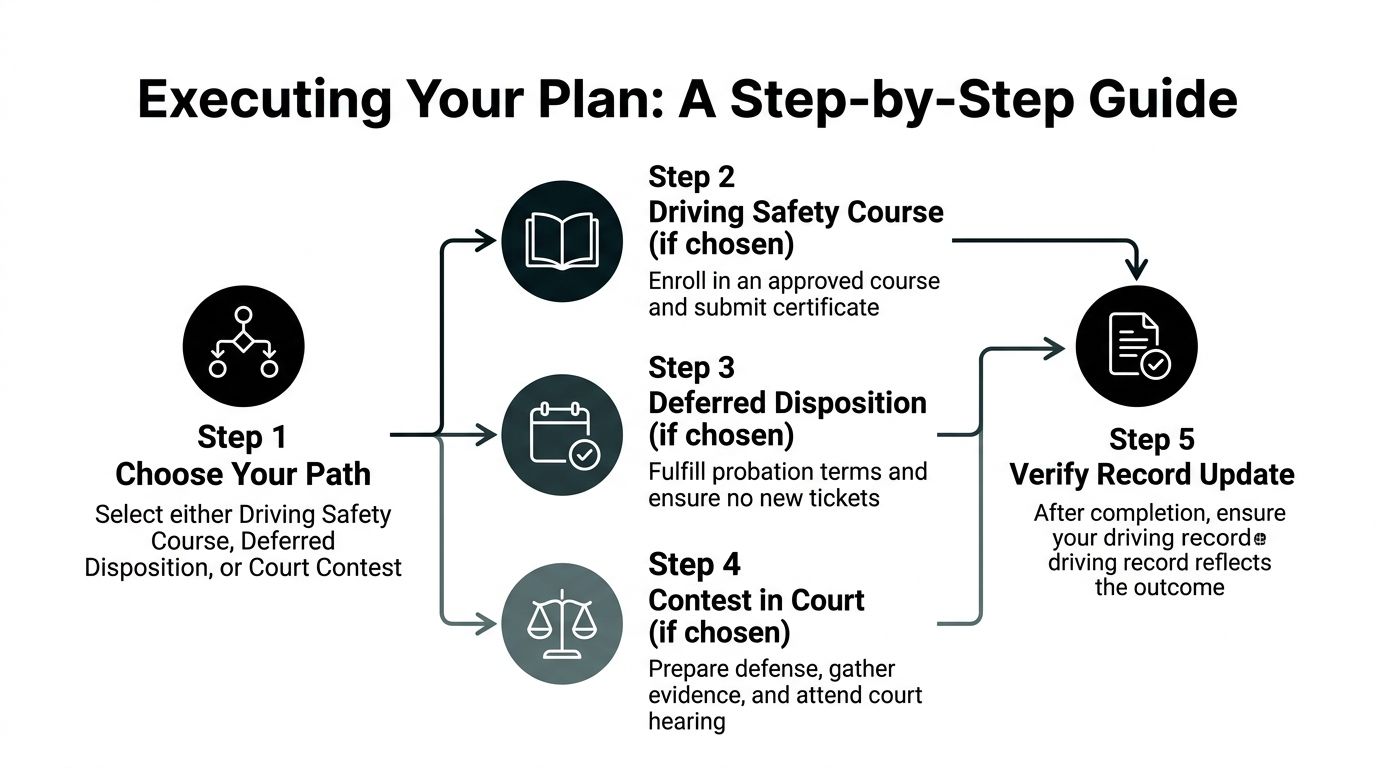
If you choose a driving safety course
Start with the court, not the classroom. Taking a course before the judge approves that option usually does not remove the ticket from your record.
Handle it in this order:
- Contact the court listed on the citation and request permission to take a driving safety course.
- Get the certified Type 3A driving record the court requires to confirm eligibility.
- Take an approved course within the deadline the court gives you.
- File the completion certificate and all required paperwork on time.
- Check the case status afterward so you know the court entered the dismissal.
This option makes sense for a routine ticket when you qualify and can stay organized. It is often the simplest path, but only if you treat the deadlines seriously. A finished course without timely proof to the court can leave you with the same conviction you were trying to avoid.
If you choose deferred disposition
Deferred disposition requires closer attention over a longer period. Instead of finishing one task, you are agreeing to conditions that may last weeks or months.
Read the order carefully. Courts may require you to avoid new violations, complete a class, pay fees, or provide proof that you met every term by a specific date. If you do what the court ordered, the case is dismissed. If you miss a condition, the judge can enter a conviction.
This path is often the better choice when a course is unavailable or when you want to preserve that course option for a different ticket later. That is a real trade-off drivers overlook.
If you decide to fight the ticket
Fighting the ticket takes more time, but it can be the right decision when the facts are on your side or the long-term cost of a conviction is too high. Insurance increases, employer concerns, and the effect of another ticket later can make a court fight worth the effort.
The process usually includes pleading not guilty, getting a court date, reviewing what the officer alleges, gathering your own evidence, and presenting your defense to the judge or jury. The key question is not whether you can argue. It is whether the case is weak enough, or the consequences serious enough, to justify the time and risk.
For drivers facing higher stakes, it helps to review what to look for in a Texas traffic ticket lawyer for a contested case. Law Office of Bryan Fagan PLLC handles Texas criminal defense matters, including cases where a traffic stop connects to a broader legal problem.
One final point matters here. A dismissal keeps the ticket from becoming a conviction on your driving record. That is different from true record removal, which usually is not how ordinary Texas traffic tickets are handled. Before you file anything, make sure your plan matches the result you want.
After the Verdict When to Call a Traffic Attorney
The case isn't finished the moment you leave court. You still need to make sure the result was processed correctly. If you earned a dismissal, verify that the record reflects that outcome. If the case ended badly, decide quickly whether there is anything left to challenge or correct.

Check the outcome, not just the courtroom result
People often assume that if the judge said “dismissed,” everything is over. Usually that's true, but you should still verify your record after the court has had time to process the case.
Look for these issues:
- The court record and state record don't match
- A dismissal was granted but not reflected as expected
- A conviction appears when you believed you completed a qualifying alternative
- Multiple tickets are stacking up and changing the risk calculation
A good outcome in court still needs a clean paper trail.
When handling it yourself stops making sense
Some traffic matters are manageable on your own. Others aren't. Call a lawyer sooner if any of these apply:
- You hold a CDL and can't afford a record mistake
- The charge is more serious than an ordinary moving violation
- You have several recent tickets
- You were stopped in a case that also involved DWI, drugs, or another criminal allegation
- You want to contest the ticket and need help preparing evidence or testimony
A lawyer can also help you spot the difference between a ticket case and a criminal case. If your stop turned into an arrest, the legal exposure changes fast. A DWI, assault, theft, or drug possession accusation may involve bond conditions, plea offers, trial strategy, sentencing concerns, and long-term record issues. Those are not situations for guesswork.
If you're trying to decide whether your case has moved beyond DIY territory, this page on hiring the best traffic ticket lawyer can help you evaluate the situation.
Frequently Asked Questions About Texas Traffic Tickets
Can a CDL holder use the same options?
Often, CDL drivers face tighter limits and much higher risk from any traffic outcome. Even when a non-commercial driver might take a routine path, a CDL holder should slow down and review the consequences before entering any plea.
Doesn't Texas use a points system?
No. Texas no longer uses the old Driver Responsibility Program points system. For most drivers, the concern now is avoiding a conviction that may affect insurance and future consequences tied to your record.
Can I remove a ticket that is already on my record as a conviction?
Usually, that is much harder than keeping it off your record from the start. In many traffic cases, the best chance to protect your record comes before the court enters a conviction. Once the conviction is final, your options are limited and very fact-specific.
If the issue is part of a broader criminal history, you may need to look at record-clearing remedies instead. This overview of expungement vs. nondisclosure in Texas explains the difference between removing a qualifying record and sealing one from public view.
What if my ticket was part of a more serious arrest?
Then you should treat it as a criminal defense issue, not just a traffic issue. After an arrest, the process may include arraignment, plea bargaining, trial, and sentencing. Depending on the charge, Texas Penal Code sections can control punishment ranges and collateral consequences. That's especially true for DWI, assault, theft, and drug possession cases. In the right case, post-conviction relief, expunction, or nondisclosure may become part of the long-term plan.
If you've been charged with a crime in Texas, call The Law Office of Bryan Fagan, PLLC for a free and confidential consultation. Our defense team is ready to protect your rights.