Skip to content
In Texas, criminal charges don't fall off your record after seven years. They stay on your record permanently unless you take legal action such as an expunction or, in some cases, an order of nondisclosure.
Being arrested in Texas can be terrifying, especially when you're lying awake wondering whether one mistake will follow you for the rest of your life. For many people in Houston, Dallas, Austin, San Antonio, and across the state, the hardest part isn't just the court case. It's the uncertainty about what comes after.
That fear is understandable. You may be dealing with a DWI arrest, an assault allegation, a theft case, or a drug possession charge. You may also be asking a question many Texans ask too late: how long do criminal charges stay on your record in Texas? The answer matters because your record can affect jobs, housing, licensing, and your reputation long after the case itself ends.
The Unsettling Truth About Your Texas Criminal Record
Texas keeps criminal records unless a court orders otherwise. According to Texas expunction guidance discussing record permanence, criminal charges in Texas, including misdemeanors and felonies, remain permanently on your record unless specific legal action removes or seals them. That same guidance explains there is no automatic seven-year expiration, even for dismissed cases or not-guilty outcomes.
That catches many people off guard. They assume a dropped case disappears on its own. It doesn't. An arrest can still leave a record. A filed charge can still leave a record. A conviction can remain visible indefinitely unless the law gives you a way to clear or limit access to it.
Practical rule: If you were arrested, don't assume time will fix your record. In Texas, time alone usually doesn't clear anything.
Many misunderstand the application of the "seven-year rule." They believe it applies universally, but it does not. That rule relates to certain consumer reporting situations, not to your full criminal history held by government agencies.
What this means for you right now
If your case involved DWI, assault, theft, or drug possession, the first question isn't whether the record will disappear on its own. The first question is whether your result makes you eligible for a future remedy.
That is why the early stages of a criminal case matter so much. What happens after arrest can shape your options later:
- After arrest: police create records that can follow you even if no conviction happens.
- At arraignment or first court appearance: you enter the court process, and decisions start affecting strategy.
- During plea bargaining: the kind of plea you accept may change whether you can later seek sealing.
- At trial: an acquittal may open the door to stronger cleanup options than a conviction.
- At sentencing: the final outcome often controls what relief, if any, becomes available later.
Texas criminal procedure can feel cold and mechanical when you're the one going through it. But you do have rights. You have the right to challenge the charge, review the evidence, contest unlawful searches, negotiate carefully, and avoid rushing into a plea that harms your future more than you realize.
Why Criminal Records in Texas Do Not Disappear
A criminal record lasts because multiple agencies create and store pieces of it. Once you're arrested, information may appear in police records, jail records, court files, and state criminal-history systems. Even when a case ends well, those records do not automatically evaporate.
Texas law doesn't provide automatic cleanup after a waiting period. If you don't ask a court for relief, the record usually stays where it is.
The seven-year myth causes real confusion
A lot of readers have heard some version of this: "A misdemeanor only stays on your record for seven years." That's not a safe rule to rely on in Texas.
The better way to understand it is this:
| Record type | What people often assume | What usually matters |
|---|---|---|
| Official criminal history | It disappears with time | It can remain unless a court clears or seals it |
| Consumer background reporting | It shows everything forever | Some non-conviction reporting is more limited |
| Conviction reporting | It fades after several years | Convictions can remain visible indefinitely |
For a closer discussion of misdemeanor record visibility, see this guide on how long a misdemeanor stays on your record in Texas.
Official records and background checks are not the same thing
This distinction is one of the most important parts of understanding how long criminal charges stay on your record in Texas.
An employer's screening report and a law enforcement database are not the same thing. A private company doing a tenant screen may be limited in what it reports in some situations. A licensing board, court, or law enforcement agency may still see a much fuller history.
Some people think, "It didn't show up on one background check, so it must be gone." That's often wrong. The legal record may still exist even if one private report leaves it out.
Why this matters in criminal defense strategy
If you're still fighting the case, your defense goal isn't only avoiding jail or fines. It may also be preserving your future ability to clear the record.
That can affect how your lawyer approaches:
- DWI defense: whether the evidence supports dismissal, reduction, or a trial strategy
- Assault defense: whether witness problems or self-defense issues can weaken the charge
- Theft defense: whether restitution or negotiation can help avoid a lasting conviction
- Drug possession defense: whether search-and-seizure issues support suppression
Texas Penal Code charges carry different facts and defenses, but the record problem is often the same. A result that sounds manageable today may be painful years later if it blocks record relief.
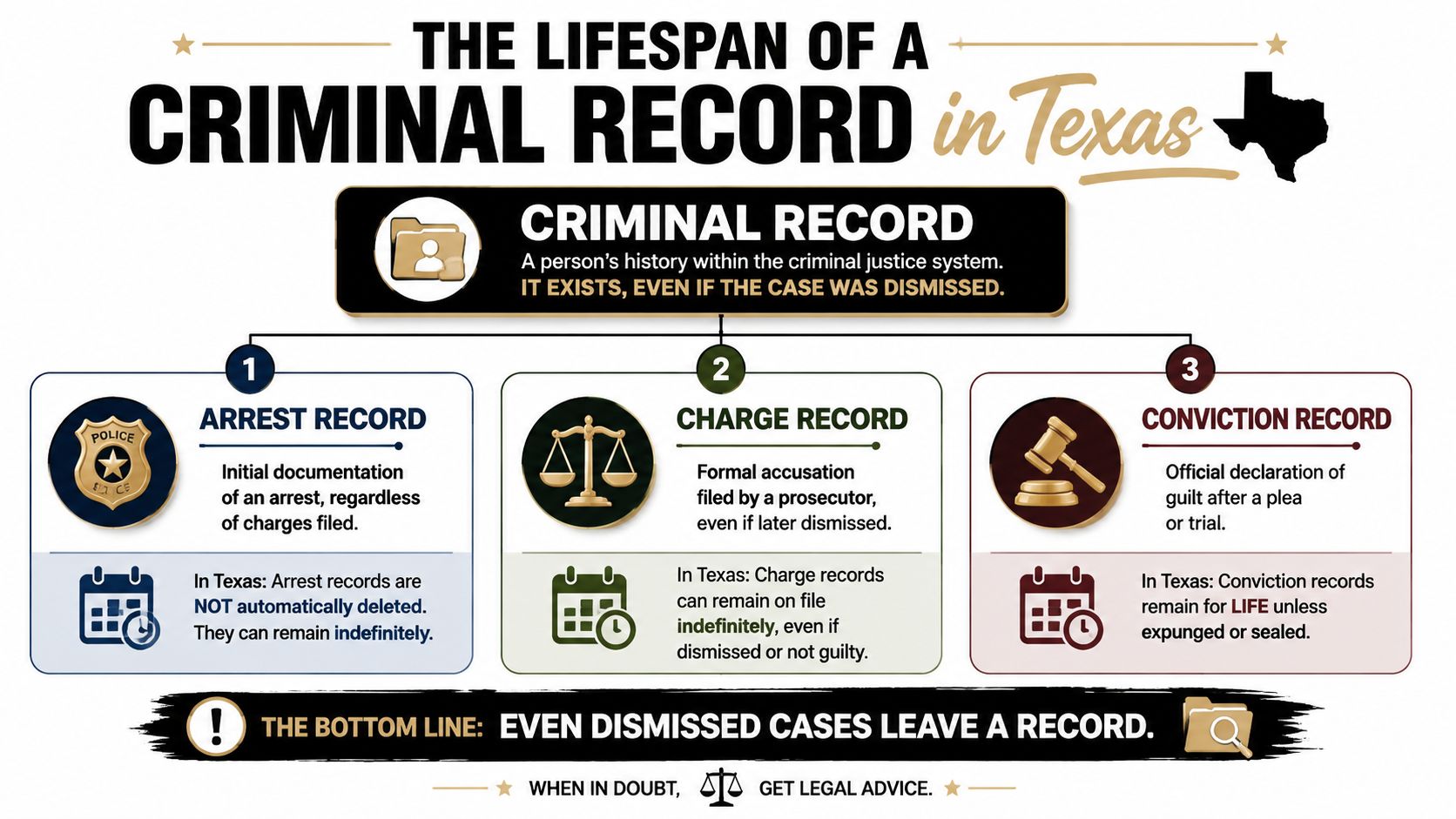
Arrest Charge and Conviction Records Explained
Many people use these words as if they mean the same thing. They don't. In real life, that confusion leads people to misunderstand what is sitting on their record.
Arrest records start first
An arrest record begins when law enforcement takes you into custody. That can happen before a prosecutor ever files a formal case.
For example, you could be arrested for suspected assault after a domestic dispute. Later, the prosecutor may reject the case. Even then, the arrest itself may still exist in the record trail unless you qualify for expunction.
Charge records show the formal accusation
A charge record appears when the prosecutor files a criminal case. This is the formal claim that you violated the law.
If you're accused of theft, drug possession, or DWI, the charge record reflects what the State says happened. Charges can later be dismissed, reduced, or resolved through a plea. But the fact that a charge was filed may still remain in the system unless you take steps to address it.
Conviction records carry the heaviest consequences
A conviction record usually follows a guilty plea, no-contest plea, or guilty verdict after trial. This is the most damaging type of record for most background checks and licensing reviews.
If you plead guilty to a misdemeanor theft offense because it seems like the fastest way to end the case, you may save time in the short term. But you may also create a record that is much harder to deal with later.
A fast plea isn't always a smart plea. Before you accept any offer, ask how it will affect your record years from now.
A simple example
Here is how three different outcomes can grow from one event:
- You are arrested for DWI. An arrest record is created.
- The prosecutor files the case. Now there is also a charge record.
- The case ends one of several ways.
- Dismissal
- Not guilty
- Deferred adjudication
- Conviction
Each result changes what remedy may be available later. That is why two people arrested on the same day for similar conduct may end up with very different long-term options.
Where readers usually get tripped up
People often say, "My case was dismissed, so I don't have a record." What they usually mean is that they weren't convicted. That's good news, but it isn't the same as having no record at all.
A dismissal can be much better than a conviction. An acquittal can be much better than a plea. Deferred adjudication can create sealing opportunities in some cases. But each leaves a different paper trail, and the legal fix depends on which trail you have.
How a Texas Criminal Record Impacts Your Future
The consequences often show up long after court ends. You may think the case is behind you, then lose a job offer, get denied for an apartment, or face questions from a licensing board.

According to this discussion of Texas background-check visibility and the FCRA, a criminal charge or conviction in Texas doesn't disappear automatically, arrests not leading to conviction are generally limited by a 7-year consumer-reporting rule, and convictions are reportable indefinitely under the FCRA. That difference matters because an old arrest may become less visible in some private screenings while the legal record still exists for other uses.
For a more detailed look at screening differences, review how background checks work in Texas criminal cases.
Employment can turn on small details
Suppose you apply for a warehouse job, office role, or health-care position. One employer may use a standard consumer background check. Another may dig deeper because the position involves money, driving, vulnerable people, or a professional license.
That means two employers may see different things.
A dismissed assault case might not appear on one report after enough time in a consumer-reporting setting. But a licensing body or government employer may still have access to the underlying official record. If you apply for work as a nurse, teacher, security guard, or commercial driver, that difference can be huge.
Housing problems often begin with old cases
Landlords don't all screen the same way. Some rely on quick commercial checks. Others review court information more closely.
A common scenario looks like this:
- Apartment application denied: the property manager sees an old arrest or charge and moves on to another applicant.
- Lease renewal becomes harder: a later check raises questions even though your case was dismissed.
- Public trust concerns grow: you feel pressure to explain a case that never led to conviction.
That can be frustrating and unfair. But it's a real part of daily life for people with records in Texas.
Even when a case ended favorably, you may still have to explain it until the record is properly addressed.
Licensing and rights issues can last
Professional licensing boards often care about criminal history. So do agencies reviewing applications involving public safety, education, finance, or health care.
If your case involves a Texas assault defense issue, a Texas DWI attorney matter, or a drug charge, the board may ask for records, court outcomes, and evidence of compliance. The practical burden falls on you.
Some convictions may also affect firearm rights or create other collateral consequences. Those consequences depend on the offense and your specific history, so they should be reviewed carefully before you decide how to resolve a case.
Why early legal advice matters
The best time to think about your record is often before the case ends. A Houston criminal lawyer or defense attorney elsewhere in Texas can look at the evidence, possible motions, plea options, and long-term cleanup paths together.
That bigger view matters. The right result isn't always the quickest one. Sometimes a harder short-term fight protects your future better.
Your Path to a Clean Slate Expunction vs Nondisclosure
You apply for a job after your case is over. On one background check, the old arrest may still appear. On another, it may be hidden. For law enforcement, the record may still exist either way. That difference is what many Texas guides skip, and it matters because the right remedy depends on what you are trying to keep out of view, and from whom.
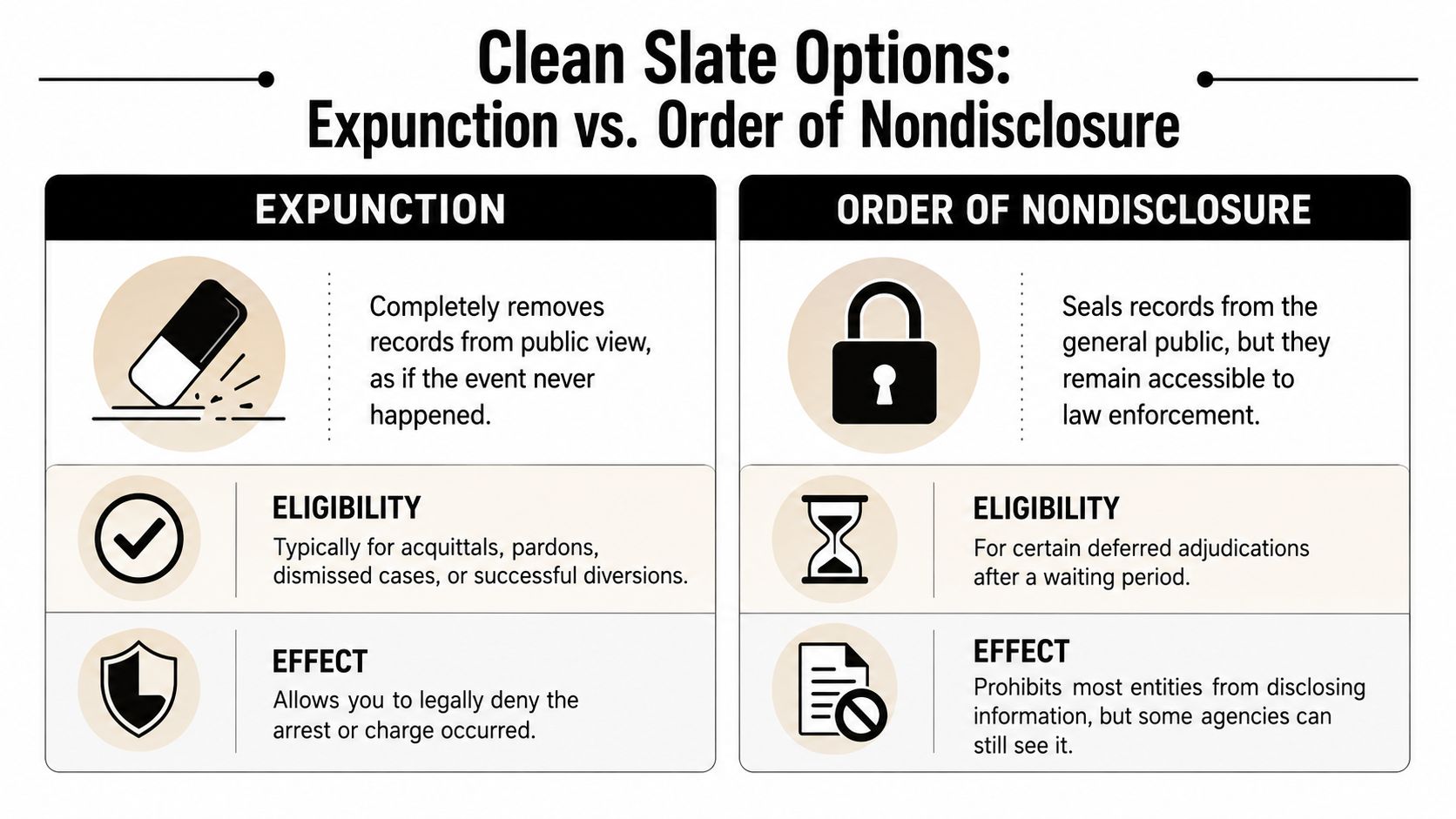
Texas offers two main forms of record clearing relief. Expunction removes qualifying records. An order of nondisclosure seals qualifying records from public disclosure.
Expunction removes the record
An expunction is the stronger remedy. If the court grants it, agencies are ordered to destroy or return the covered records, as explained by Texas Law Help's guide to expunctions and nondisclosures. In practical terms, this is the remedy people usually mean when they say they want a case "gone."
That can make a real difference on private background checks governed by the Fair Credit Reporting Act. If the record has been expunged, a consumer reporting agency generally should not be reporting that case as part of an ordinary employment or housing screening. Law enforcement access is different. Once an expunction is completed, the goal is removal of the covered record from the agencies named in the order, not merely hiding it from the public.
Expunction often fits cases that ended in dismissal, acquittal, pardon, or reversal on appeal. Timing still matters. In many situations, Texas requires a waiting period tied to the type of charge before you can file. As noted earlier from that same Texas Law Help source, the wait can track the statute of limitations.
Nondisclosure seals the record from public view
An order of nondisclosure works differently. It does not erase the case. It blocks public disclosure of qualifying criminal history, which means many employers, landlords, and private screeners will not see it in the usual background-check process.
A good way to understand nondisclosure is to picture a file moved behind a locked counter instead of thrown away. The public usually cannot pull it. Certain government bodies still can.
That is why nondisclosure helps with many FCRA-regulated background checks, but it does not make the case disappear for police, prosecutors, courts, and some licensing or regulatory agencies. If your main concern is a private employer running a standard screening report, nondisclosure may solve much of the problem. If your concern is a law enforcement agency or a sensitive licensing board, the record may still be visible to them.
This remedy commonly applies after successful deferred adjudication, not a straight conviction. Eligibility depends on the offense, how the case ended, whether you completed all court requirements, and whether any disqualifying factors apply.
Here is the practical difference:
| Remedy | What happens to the record | Who may still see it | Common fit |
|---|---|---|---|
| Expunction | Record is removed under court order | Access is far more limited once agencies comply with the order | Dismissal, acquittal, pardon, overturned case |
| Nondisclosure | Record is sealed from public disclosure | Law enforcement and certain agencies | Certain deferred adjudication outcomes |
If you want a closer comparison, this guide on expungement versus nondisclosure in Texas explains how the two remedies differ in day-to-day use.
A short video can also make the distinction easier to understand.
Waiting periods and case outcomes control your options
People often focus on the charge itself. Texas law usually focuses first on how the case ended.
For example, a dismissed charge may point toward expunction if the rest of the record and timing line up. A deferred adjudication case may point toward nondisclosure after the required wait. A straight conviction usually leaves fewer cleanup options.
The waiting period for nondisclosure also depends on the offense category. As noted earlier from the same Texas Law Help source, some cases require a waiting period after discharge and dismissal, while others do not. Filing too soon can lead to delay or denial, even when the person would have qualified later.
The Law Office of Bryan Fagan, PLLC represents Texans in criminal cases and also handles expunctions and nondisclosures, which makes it possible to evaluate both the defense strategy and the long-term record impact in one review.
Navigating the Legal Process for Clearing Your Record
You apply for a job, the interview goes well, and then the background check raises a question about an old Texas case you thought was behind you. What happens next often depends less on what you remember and more on what the records show, where they show up, and whether the right legal remedy has been entered.
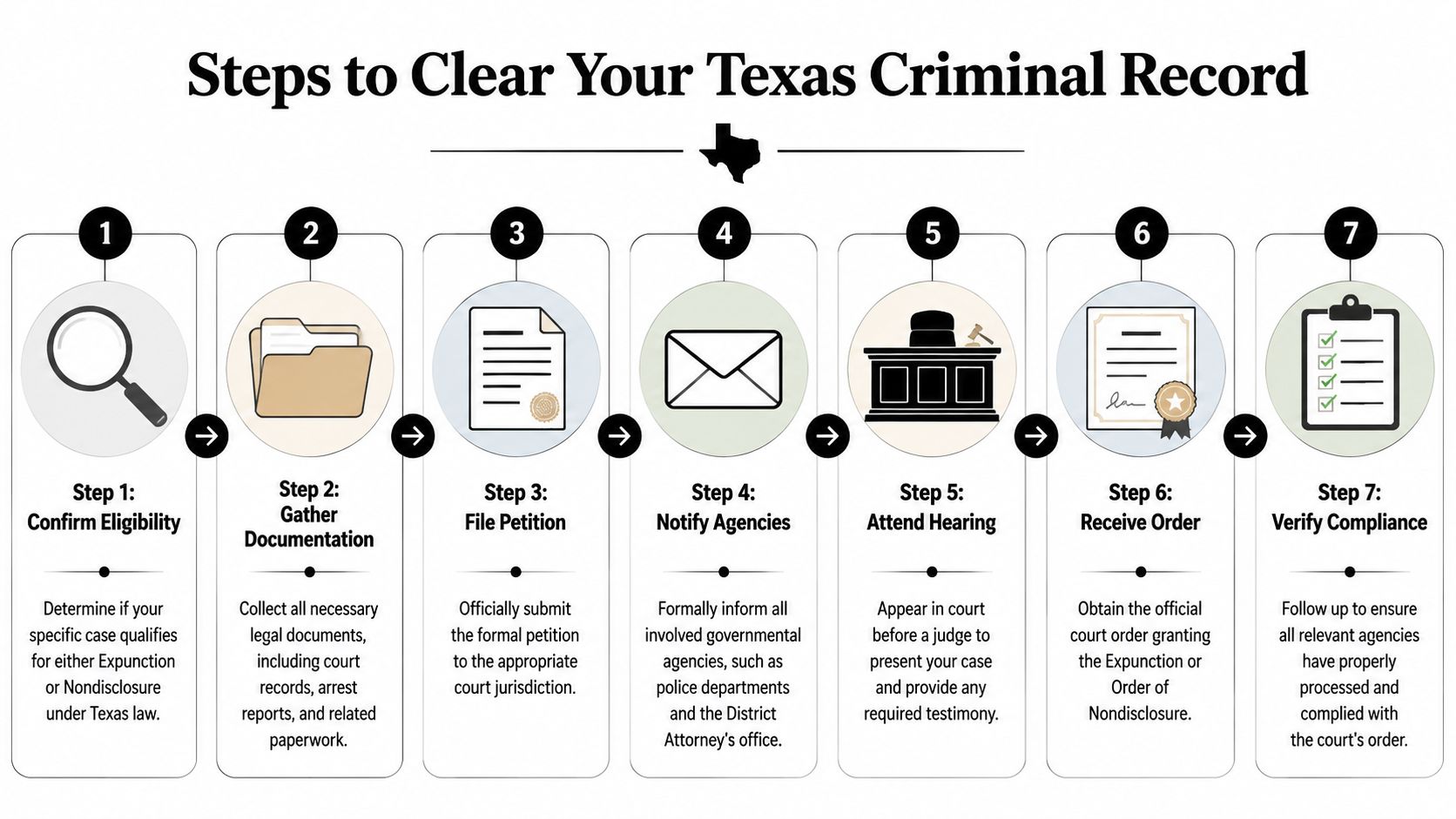
Clearing a record in Texas is a paperwork-driven court process. It also helps to understand the goal. An expunction is meant to remove qualifying records from public view and direct agencies to destroy or return records covered by the order. A nondisclosure seals qualifying records from many private background checks, but it does not erase the case for law enforcement or certain government entities. That difference matters in real life because an employer using an FCRA-regulated background check may see something very different from what a police agency can still access.
Start with the exact case outcome
The first step is getting the final paperwork from the court, not relying on memory, docket gossip, or what someone told you at the end of a hearing.
You need to confirm:
- the formal charge
- how the case ended
- whether any form of probation or deferred adjudication was involved
- the date the case was completed
- the court and cause number
- every agency that may still hold a record
This part is where confusion starts for many people. A dismissed case, a no-bill, deferred adjudication, and a conviction can sound similar in conversation, but Texas treats them very differently. The legal label controls the remedy.
Then match the remedy to what you want the record to do
A good way to look at it is this. Expunction is aimed at qualifying cases that should be removed from public record systems. Nondisclosure is aimed at limiting who can see a qualifying case, especially in ordinary private background screening.
That means the practical question is not only, "Can I clear this?" It is also, "Who will still be able to see it after the order is signed?" For many clients, that answer changes how they plan for jobs, housing, licensing, or a professional application.
As noted earlier, waiting periods and case endings control eligibility. Filing too early can delay the process or lead to denial.
The petition has to be precise
Texas courts do not clear a record through an informal request. You file a petition, and the details have to match the court file and the agencies involved.
That often includes the arresting agency, jail records, the clerk, prosecutor records, DPS systems, and other entities that received the case information. If even one agency is left out, the order may not reach every place where the record appears. A client may win the case on paper and still run into an old entry on a background check because the order did not name the right office.
Accuracy matters here for another reason. Different background check companies pull from different sources. Some rely on courthouse records, some use commercial databases, and some compare multiple reporting systems. A clean result on one screen does not always mean every reporting source has updated.
A hearing may be required
Some petitions are decided after a hearing. The judge will want to see that you qualify under the statute, filed in the right court, waited the required time, and correctly identified the agencies that should receive the order.
The role of legal analysis continues to be critical well after the criminal case ends. The court may need a clear explanation of why your dismissal qualifies for expunction, why your deferred adjudication qualifies for nondisclosure, or why a particular offense category blocks relief.
Your original defense strategy can shape your cleanup options
Record clearing starts earlier than many people realize. It often starts the day the criminal case begins.
A defense lawyer may review the stop, arrest, witness statements, search issues, body camera footage, and plea options with two goals in mind. One goal is the immediate case result. The other is what that result will look like later on a background check. In many Texas cases, the difference between a dismissal, deferred adjudication, and conviction can shape your options for years.
That is one reason the Law Office of Bryan Fagan, PLLC handles both criminal defense matters and record-clearing cases. Reviewing the original case and the later cleanup process together can help identify the most realistic path.
A practical checklist
If you are ready to address an old record, use this order:
- Get certified or complete final case documents.
- Confirm the exact disposition and completion date.
- Determine whether expunction or nondisclosure fits that outcome.
- Identify every agency that may still hold the record.
- File the petition in the correct court.
- Attend the hearing if one is set.
- Follow up after the order so you know the agencies processed it.
A Texas criminal record rarely goes away on its own. But there is often a path to improve what employers, landlords, and screeners can see. The right first move is to find out exactly what your record says now, then choose the remedy that fits that reality.