Yes, it can. A U.S. study found that even misdemeanor non-convictions were linked to a 5 percentage point lower probability of filing a W-2 or 1040 tax return five years after the charge, which shows that a pending case can affect work long before any conviction and even long after court is over.
You may be sitting at your kitchen table right now, phone in hand, wondering whether to call your boss, whether HR will run a background check, or whether one arrest just put your paycheck at risk. That fear is real. But a pending case does not always mean you'll lose your job, and it does not mean you have no options.
In Texas, the answer depends on several moving parts. Your type of job matters. Your employer's policies matter. The difference between an arrest, a formal charge, and a conviction matters. Your next few decisions matter too. If you're dealing with DWI, assault, theft, drug possession, or another charge, the right legal strategy can protect more than your court case. It can help protect your livelihood.
The Arrest Is Over But the Worry Has Just Begun
A lot of people think the hardest part is the arrest itself. In many cases, the next morning is worse.
You get home after posting bond. You look at your uniform, your laptop, your badge, or your work truck keys, and your thoughts go straight to one question. Can a pending criminal case affect your job? For many Texans, that is the first practical problem after the shock wears off.

A simple example shows how fast this starts. A warehouse worker gets arrested on a Saturday night after an argument turns into an assault allegation. By Monday, he isn't just worried about court. He's worried about clocking in, whether a background alert will hit, and whether a supervisor will ask questions in front of other people. The criminal case is pending, but the employment stress is already here.
What happens right after arrest matters
The first stage of a Texas criminal case can move quickly. After an arrest, you may deal with booking, bond, release conditions, and court settings before you've had time to think clearly. If you need a plain-language primer on the process, this guide on what to do immediately after getting arrested in Texas helps explain the first decisions that can affect the rest of your case.
If you're trying to understand the sequence of release, court dates, and early case steps in a broader way, this overview of steps after an arrest in Forsyth County is useful because the core rhythm of criminal procedure feels familiar even across jurisdictions.
The court case and the job problem often start at the same time. You need to treat both seriously from day one.
Why the anxiety gets worse after you get home
Many individuals are unaware of what their employer can see, whether they have to disclose anything, or whether an arrest alone is enough to get them fired. That uncertainty creates panic, and panic leads to mistakes. People overshare. They text coworkers about the facts. They try to explain everything to HR without legal advice. They assume honesty means telling the whole story immediately.
Usually, that does more harm than help.
In Texas, the better approach is calm, planned, and specific. First understand where you stand. Then understand what your employer can do. Then decide what to say, when to say it, and what documents you may need.
Understanding Texas At-Will Employment and Pending Charges
Texas is an at-will employment state. In plain English, that usually means an employer can end employment for almost any lawful reason, or for no stated reason at all. The big exception is that they can't fire you for an illegal reason, such as unlawful discrimination or retaliation.
That matters because a pending criminal charge can become the reason an employer uses, even when there has been no conviction.
Arrest, charge, and conviction are not the same
These words get mixed together all the time, but they mean different things.
| Term | What it means | Why it matters at work |
|---|---|---|
| Arrest | Law enforcement took you into custody | An arrest is not proof of guilt |
| Charge | The State has formally accused you of an offense | Employers often react here because the case is active |
| Conviction | You were found guilty or entered a plea that resulted in conviction | This usually creates the strongest employment impact |
A pending case usually means there is an unresolved charge, not just an arrest. In practice, employers often focus on the risk of the unresolved accusation, not the legal presumption of innocence.
At-will employment gives employers broad room
Think of at-will employment like an open door that swings both ways. You can leave the job. The employer can end the relationship too, as long as the reason isn't illegal. If you want a broader employment-law overview, this explanation of the employment-at-will doctrine gives useful background.
That doesn't mean every firing is proper. It does mean many employers in Texas don't need to wait for a conviction before acting. They may say the pending charge affects trust, attendance, insurability, licensing, or workplace safety.
The work impact can last even after court
The employment damage is not always short-term. In a U.S. study using IRS and court data, misdemeanor non-convictions were associated with a 5 percentage point lower probability of filing a W-2 or 1040 tax return five years after the charge, showing that work harm can continue even when the case does not end in conviction (IRS study on criminal records and employment).
Practical rule: Don't assume "I haven't been convicted" will end the employment problem. For many employers, the pending charge itself triggers concern.
Why this matters in Texas criminal defense
A strong defense is not only about avoiding jail, probation, or fines. It is also about reducing collateral damage. In DWI cases under Texas Penal Code and Transportation Code related offenses, theft cases under Texas Penal Code Chapter 31, assault cases under Texas Penal Code Chapter 22, and drug possession allegations under the Texas Controlled Substances Act, early case handling can affect how long the case stays open and how it looks to an employer.
That is one reason early intervention matters. A fast, organized defense may help you challenge weak allegations, fix bond conditions that interfere with work, and position the case for dismissal, reduction, or a better outcome.
Your Employer's Rights When You Have a Pending Case
When a criminal case is pending, employers usually start from one question. Does this create risk for the business?
That risk may involve customers, cash, driving, company property, confidential information, vulnerable people, or workplace safety. The law doesn't require employers to ignore those concerns. But it also doesn't let them do anything they want.
What employers often can do
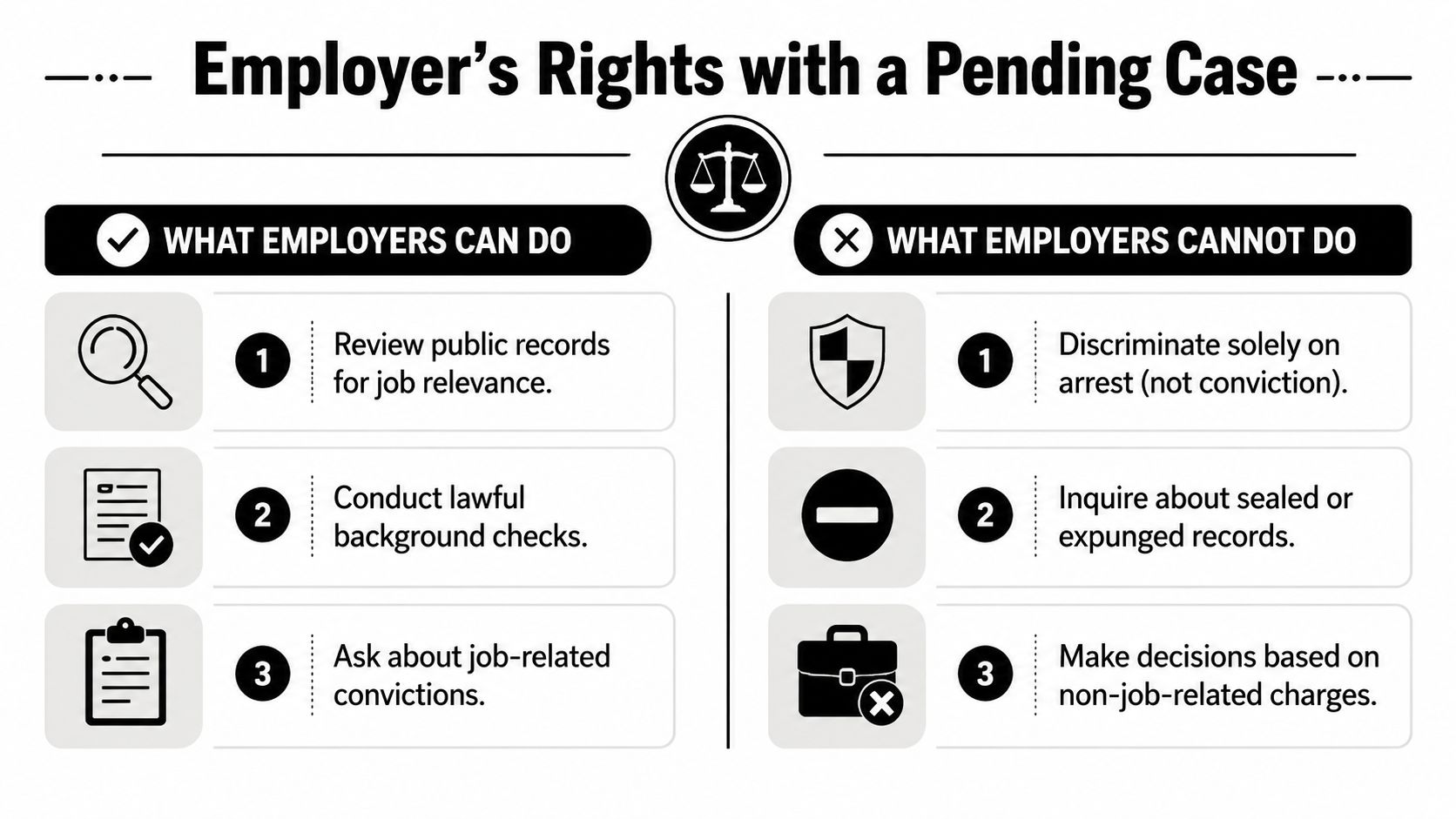
Texas employers often have room to act when a pending case may affect job duties. That can include:
- Reviewing job-related criminal information. If a position involves driving, cash handling, patient care, or security, employers may look more closely at an active case tied to those duties.
- Running lawful background checks. A pending charge may appear during screening. This is especially important for new hires and for workers in regulated fields.
- Investigating workplace impact. If the alleged conduct involves a coworker, company property, or an off-duty event that affects the workplace, employers may conduct an internal review.
If you want a practical look at screening issues, this guide on how background checks work in Texas criminal cases helps explain what may appear and when.
What employers are not supposed to do
The line is not wide open. The EEOC's guidance says employers generally cannot refuse to hire someone merely because they were arrested, and it emphasizes individualized assessment rather than broad exclusion based on criminal history concerns. The same body of guidance also stresses the relevance of the offense, the time passed, and the relationship to the job.
The Lawyers' Committee for Civil Rights has warned that employers often treat unresolved cases as high risk. Its standards note that a "pending prosecution" has a formal meaning, yet employers often blur that line and treat arrests and active charges alike, leading to application denials or pauses based on perceived liability rather than proven conduct (Lawyers' Committee best practice standards).
A pending case creates uncertainty, and many employers resolve uncertainty by protecting themselves first.
Why employers react before conviction
Employers usually aren't making a criminal-law judgment. They are making a business judgment. If the allegation involves violence, theft, fraud, drugs, or driving, they may worry about insurance, supervision, customer complaints, negligent hiring claims, or bad publicity.
That doesn't mean their decision is fair. It does explain why waiting passively and hoping the issue disappears rarely works.
Internal investigations and practical limits
An employer may ask questions. You do not have to guess your way through those conversations. Often, the smartest response is limited and factual. You may be able to confirm that a case is pending, that you are complying with court requirements, and that your lawyer has advised you not to discuss underlying facts.
If HR asks for records, be careful. Giving over police reports, witness statements, or your own written narrative without legal review can create new problems. What helps your employer understand scheduling may hurt your defense if you start explaining the allegation itself.
How Specific Charges Impact Different Jobs in Texas
The same pending charge can look very different depending on the work you do.
A charge doesn't exist in a vacuum. Employers compare the allegation to the actual duties of the job. That is why a pending DWI may hit one worker hard and matter far less to another.
Side-by-side job examples
| Pending charge | Job type | Common employer concern |
|---|---|---|
| DWI | Commercial driver, delivery driver, field technician with company vehicle | Driving safety, insurability, license status |
| Theft | Cashier, bank employee, bookkeeper, warehouse worker | Trust, money handling, inventory access |
| Assault | Teacher, nurse, security guard, supervisor | Safety, conflict management, public trust |
| Drug possession | Heavy equipment operator, healthcare worker, refinery contractor | Safety, impairment concerns, policy compliance |
A pending DWI often creates immediate pressure if driving is part of your job. If you hold a CDL or depend on a clean driving record, even the accusation can trigger employer action while the case is unresolved. For an office employee who never drives for work, the same DWI may still matter, but usually for different reasons such as attendance, reputation, or company policy.
A pending theft charge can be especially hard for jobs built on trust. Retail, banking, bookkeeping, shipping, and office administration all involve access to money, merchandise, records, or client information. Even if the allegation is weak, employers often see a theft charge as directly tied to the job.
Licensed jobs face another layer of risk
If you hold a professional license, your problem may be bigger than HR. Nurses, teachers, real estate professionals, and others may face reporting duties or board review. That review can happen while the criminal case is still open.
Many people often lose time. They focus only on the court date and ignore the licensing side until a notice arrives. If that applies to you, this guide on whether you can lose your professional license after a criminal charge in Texas is worth reading early.
Common charge-by-job patterns in Texas
- Healthcare and caregiving roles often react strongly to assault, drug, or theft allegations because the work involves patient safety, medication access, and vulnerable people.
- Oilfield, construction, and industrial jobs may focus on drug possession, DWI, or assault because of safety rules and high-risk environments.
- Office and professional roles may be more sensitive to fraud, theft, forgery, or family violence allegations when trust and judgment are central to the position.
- Public-facing jobs may respond quickly when an employer fears reputational harm, even if the charge is unrelated to the work itself.
If the alleged conduct overlaps with your daily duties, the job risk usually rises fast.
How this connects to the criminal process
What happens in the case can change the employment picture. After arrest, your case may move through first appearance, bond conditions, arraignment or first court setting, negotiations, motion practice, and possibly trial. In many Texas courts, plea bargaining begins well before trial. A dismissal, reduction, or strong pretrial challenge may help protect your work status in a way that waiting alone cannot.
Sentencing matters too. A conviction with probation may still affect employment, but in some cases it can preserve options better than jail time or a final judgment that blocks licensing. The right strategy depends on the charge, the evidence, and the work you do.
How to Talk to Your Employer About a Pending Case
Individuals often either say too much or say nothing until the problem explodes. Neither approach works well.
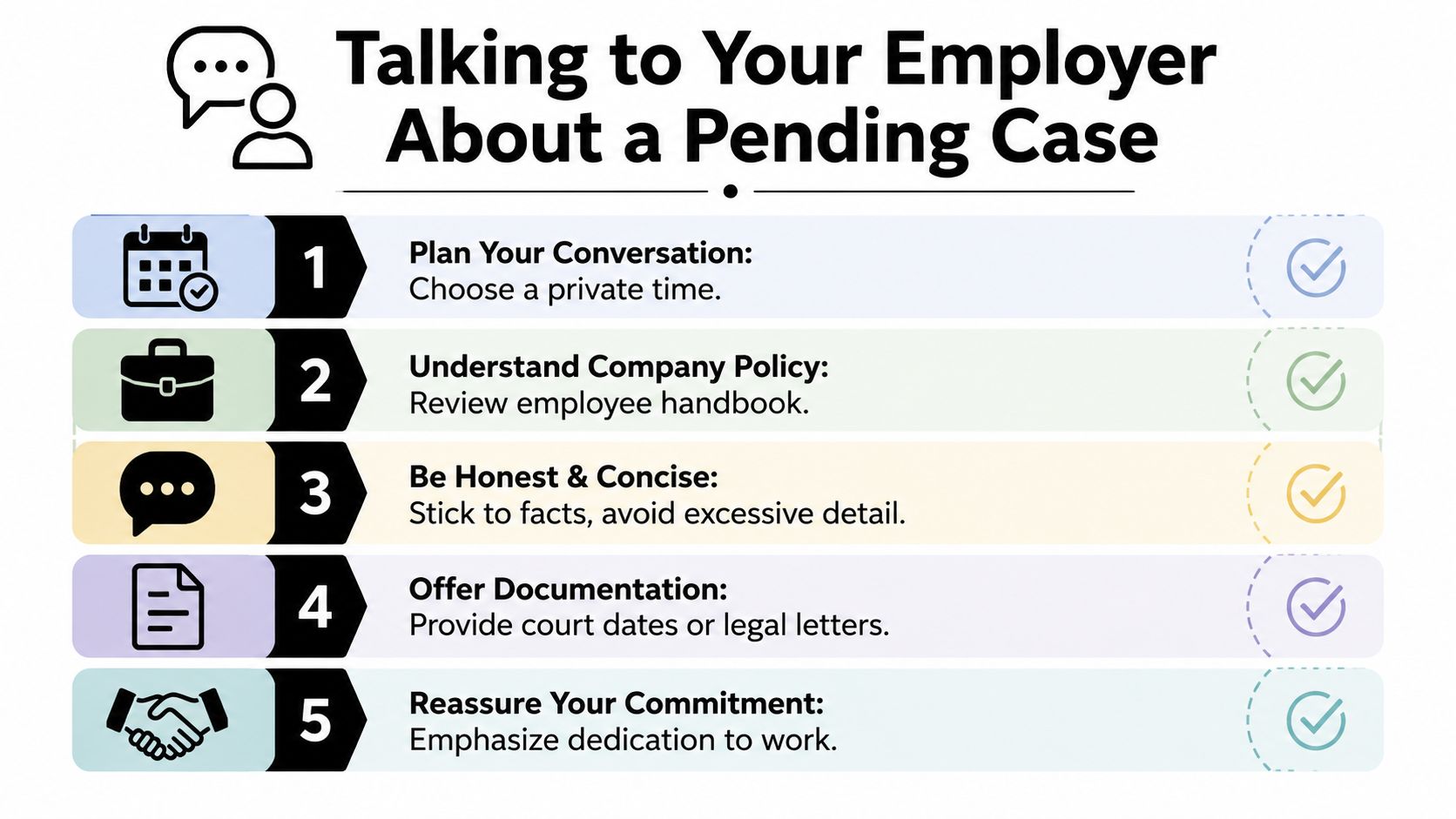
The better approach is controlled disclosure. You need to know whether you have a duty to report, what your handbook says, whether your job involves licensing or security rules, and whether a background check is about to happen anyway.
Start with policy, not panic
Before you talk, review:
- Your employee handbook
- Any employment contract
- Licensing or reporting rules tied to your profession
- Any pending background check or renewal process
EEOC guidance states employers generally cannot refuse to hire someone solely for an arrest. But pending charges often appear on background checks, which creates a critical moment in hiring, especially after a conditional offer has been made (EEOC arrest and conviction guidance).
That means silence is not always strategic. If the issue is likely to surface, a short, careful explanation may be better than letting HR feel surprised.
What to say and what not to say
A useful script sounds like this: there is a pending case, the allegation has not been resolved, you are complying with all court requirements, and your lawyer has advised you not to discuss underlying facts. Then bring the conversation back to work. Confirm attendance, scheduling, and your commitment to the job.
Don't do these things:
- Don't admit guilt at work. Even casual comments to a supervisor can come back later.
- Don't give a long emotional narrative. Long explanations often create new questions.
- Don't attack the complainant or police. That usually makes HR more nervous, not less.
- Don't promise outcomes you can't control. A court date is not a guarantee of dismissal.
Best approach: Be truthful, brief, respectful, and focused on your ability to keep doing your job.
Timing matters
For a current job, earlier is often better if your work requires reporting, a public record is likely to surface, or your case could affect scheduling, driving, or licensing. For a new job, answer application questions truthfully and carefully. Read each question exactly as written. An arrest is not the same as a conviction, and a pending charge is not the same as a closed case.
If you're speaking with a prospective employer after a conditional offer, keep your explanation narrow. Confirm the status of the case, avoid arguing the evidence, and offer limited documentation if needed, such as a court notice or a letter confirming representation.
Five Immediate Steps to Protect Your Employment
When your case is fresh, speed matters. Small early decisions can protect your job or make the situation worse.
Step 1 and Step 2
First, stop talking about the facts of the case. That includes your boss, coworkers, HR, friends at work, and group texts. Work conversations are not protected. If your words are repeated, they can damage both your defense and your employment position.
Second, hire a Texas criminal defense attorney quickly. Early representation can help with bond conditions, no-contact terms, court settings, employer strategy, and case resolution. In many cases, the strongest job protection starts with improving the criminal case itself.
Step 3 and Step 4
Third, read your work documents. Look for reporting duties, morality clauses, driving requirements, licensing language, and background screening policies. People often guess wrong about what their employer requires.
Fourth, become very easy to employ while the case is pending. Show up on time. Follow policy. Avoid attendance problems. Keep your performance steady. If an employer is deciding whether to keep you, reliability helps.
A practical checklist helps:
- Save records. Keep copies of schedules, reviews, emails, court notices, and any HR communication.
- Track dates. Write down when you told your employer something, when they responded, and what was said.
- Protect privacy. Ask for private HR meetings rather than hallway conversations.
- Watch social media. Posts, jokes, and angry replies can create new employment issues.
Step 5
Fifth, learn the charge and the process. Texas cases move through specific stages, and you should understand each one. After arrest may come bond conditions, the first court appearance, arraignment or an initial setting, plea discussions, pretrial hearings, trial preparation, and if needed, sentencing.
Knowing the sequence helps you plan around work. It also helps you avoid avoidable violations. Missing court because of a shift, or missing work because no one planned for a court setting, can create two problems at once.
The most effective employment strategy is usually boring and disciplined. Say little, document everything, and take the criminal case seriously from the start.
Your Path Forward Expunction and Nondisclosure
The best long-term answer is to keep a pending case from becoming a permanent employment problem.
For many Texans, that means fighting for a dismissal, a not guilty result, or another outcome that protects future record-clearing options. Once the case is over, you may be able to remove or limit what employers can see.
Expunction and nondisclosure are different
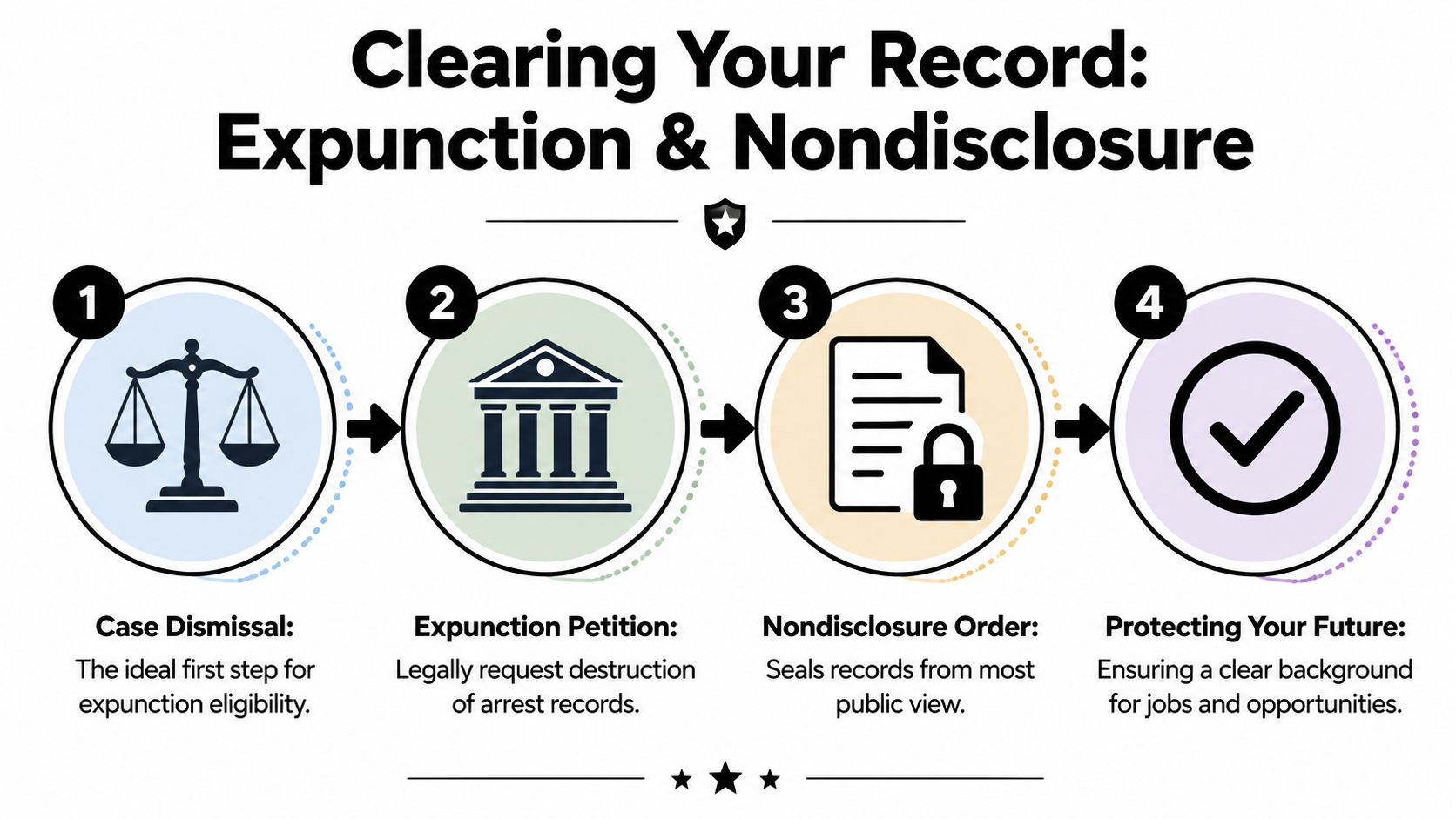
An expunction is the stronger remedy. In qualifying situations, it destroys the records of the arrest and case. When an expunction is granted, the law generally allows you to deny the occurrence of the expunged arrest in most settings.
An order of nondisclosure seals eligible records from public view. It is not the same as erasing the case, but it can keep many private employers from seeing it.
Whether you qualify depends on the charge, the final result, and the exact path the case took. Dismissals often create the cleanest expunction opportunities. Deferred adjudication may open the door to nondisclosure in some cases. A conviction usually creates more limits.
Why record relief matters for work
Even when a record becomes harder to find, employment barriers can linger. A 2024 NBER summary reported that being charged with a crime reduced employment prospects even when records were sealed or otherwise nonreportable after a non-conviction, and removing the record later did not show a noticeable average increase in traditional employment, though the researchers did find more gig-platform work (NBER digest on remediation of criminal records and job prospects).
That finding does not mean record clearing is pointless. It means you should be realistic. Expunction and nondisclosure are powerful, but they work best as part of a broader strategy that starts with handling the case well from the beginning.
Individualized review still matters
Federal guidance also matters on the back end. The EEOC requires employers to conduct individualized assessments before denying a job based on criminal history, considering the nature of the offense, the time passed, and job relevance. A blanket policy against pending charges may be discriminatory and can sometimes be challenged (EEOC standards under 29 CFR 1607.1).
That gives some applicants room to push back, especially when a charge has little to do with the actual work.
A realistic but hopeful outlook
If your case is still pending, your immediate goal is damage control. If your case ends favorably, your next goal is clearing or sealing what the law allows. Both matter.
For many people, the path forward looks like this:
- Fight the pending case early
- Protect your job while the case is open
- Pursue expunction or nondisclosure when eligible
- Correct background check errors if they appear later
A pending charge can disrupt your work life. It doesn't have to define the rest of it.
If you've been charged with a crime in Texas, call Law Office of Bryan Fagan PLLC for a free and confidential consultation. Our defense team is ready to protect your rights.