Skip to content
Being arrested in Texas can be terrifying. If an officer asked for a blood test and you said no, you may be sitting at home right now wondering whether you made things better, worse, or both.
The honest answer is that refusing a blood test in Texas usually starts two separate legal problems at the same time. One involves your license. The other involves the criminal DWI case. They move on different tracks, and each one matters.
Texas DWI law can feel confusing fast. Officers talk quickly, paperwork piles up, and the deadlines don't wait for you to catch your breath. The good news is that a refusal does not mean you have no defense. It also does not mean the state automatically wins.
Pulled Over in Texas and Asked for a Blood Test?
A traffic stop can go from routine to overwhelming in minutes. You see lights in the mirror, answer a few questions, and then the officer says they want a blood sample. Few individuals have planned for that moment. You're tired, scared, embarrassed, and trying to make a legal decision on the side of the road or in a station hallway.
In Texas, this issue grows out of implied consent. In plain English, that means the state treats driving on Texas roads as agreement to chemical testing after a lawful DWI arrest. But implied consent doesn't mean the situation is simple. People still refuse. Officers still react. And the consequences often arrive before you even know what paperwork you were handed.
If you're trying to understand the difference between chemical testing and other roadside requests, this guide on whether you can refuse a breathalyzer test in Texas can help sort out part of that confusion. The answer often depends on what test was requested, when it was requested, and whether you were already under arrest.
Why blood testing creates more anxiety
Blood testing feels more invasive than blowing into a machine. That's one reason people hesitate. Another is uncertainty about what police are looking for. Alcohol is only part of the picture in some DWI investigations. Officers may also suspect drug impairment, and that issue is getting more attention as testing methods evolve. If you want broader context, these insights into drug impairment testing from Zoe Behavioral Health show why chemical testing questions keep expanding beyond traditional alcohol cases.
A refusal is not the end of the story. It's the start of a more complicated one.
What matters now is not whether the stop felt unfair or whether the officer sounded certain. What matters is understanding what happens next, what can still be challenged, and what deadlines you cannot miss.
Understanding the Two Battles You Face After a Refusal
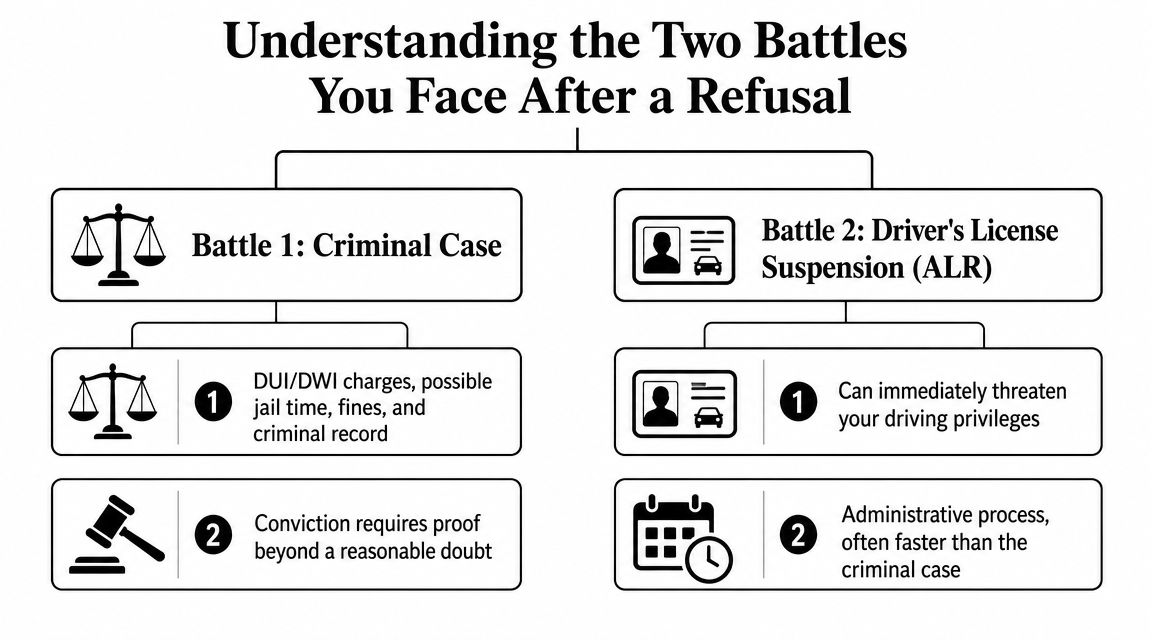
Refusing a blood test doesn't create one case. It creates two.
One battle is with the State over your driver's license. The other is with the prosecutor over the DWI charge. They may grow out of the same arrest, but they are not the same proceeding, they do not use the same standards, and they do not always end the same way.
Battle one is administrative
The license case is an Administrative License Revocation, often called an ALR matter. This is handled through the Texas Department of Public Safety, not the criminal trial court. It moves fast and can affect your ability to drive long before the criminal case is resolved.
Battle two is criminal
The DWI case is the criminal prosecution. That is where the State tries to prove you were intoxicated while operating a motor vehicle. That case can involve court settings, motions, plea discussions, trial preparation, and sentencing issues if there is a conviction.
A lot of people assume these cases rise and fall together. They don't. You can have a good argument in one and still face trouble in the other. That is why a Texas DWI attorney has to think on two fronts from the start.
Practical rule: Treat the refusal like a fork in the road. One path threatens your license right away. The other shapes what evidence the prosecutor may try to use later.
Texas is not unusual in handling refusals this way. The National Highway Traffic Safety Administration reports that all states except Wyoming impose separate penalties for BAC test refusal, usually through administrative revocation or suspension, as explained in NHTSA's discussion of refusal penalties and licensing consequences.
Why this matters to your defense
A refusal case often turns on details people overlook in the first week after arrest:
- The stop itself: Did the officer have a legal reason to pull you over?
- The arrest decision: Was there probable cause to believe you were intoxicated?
- The paperwork: Did the officer properly trigger the administrative process?
- The evidence path: Did police rely on observations, a warrant, or both?
That dual-track framework is the clearest way to understand what happens if you refuse a blood test in Texas. If you only focus on the criminal charge and ignore the license side, you can lose important rights before your first serious court date.
The Immediate Consequence Your Driver's License Suspension
The first serious consequence after a refusal is often not jail, trial, or a plea offer. It's your license.

In Texas, refusing a breath or blood test after a DWI stop can trigger an automatic license suspension under the Administrative License Revocation process. The standard suspension is 180 days for a first refusal, and it can rise to two years for drivers with prior refusals. You also have only 15 days from arrest to request an ALR hearing, as described in this explanation of Texas refusal suspensions and ALR deadlines.
The deadline that catches people off guard
That 15-day window is one of the most important deadlines in a Texas DWI case. Miss it, and your suspension can move forward without you getting the hearing that might have let you challenge the basis for it.
For many people, this deadline passes because they are focused on getting out of jail, arranging a ride to work, or waiting for the criminal court date in the mail. The license case does not wait for any of that.
If you want a county-level look at how this process works, this Harris County ALR hearing guide is a useful starting point.
What an ALR hearing can do
An ALR hearing is not a criminal trial. It is an administrative proceeding about your driving privilege. Still, it can matter a great deal.
A hearing can give your lawyer a chance to examine issues such as:
- Whether the officer had grounds to stop you
- Whether the arrest was lawful
- Whether the refusal was properly documented
- Whether DPS can meet its burden for suspension
This video gives a practical overview of the process many drivers face after arrest:
What usually works and what doesn't
What helps is acting fast, keeping every paper you received, and getting legal help before the deadline runs out. What does not help is assuming the criminal case will somehow fix the license issue later.
If your license matters for work, school, medical care, or your family, the ALR case deserves immediate attention. It is not a side issue.
If you've already passed a few days since the arrest, count carefully. In these cases, time is one of the most important facts.
How Police Can Obtain a Warrant for Your Blood
A lot of drivers believe refusal blocks the police from getting a blood sample. In many cases, it doesn't.
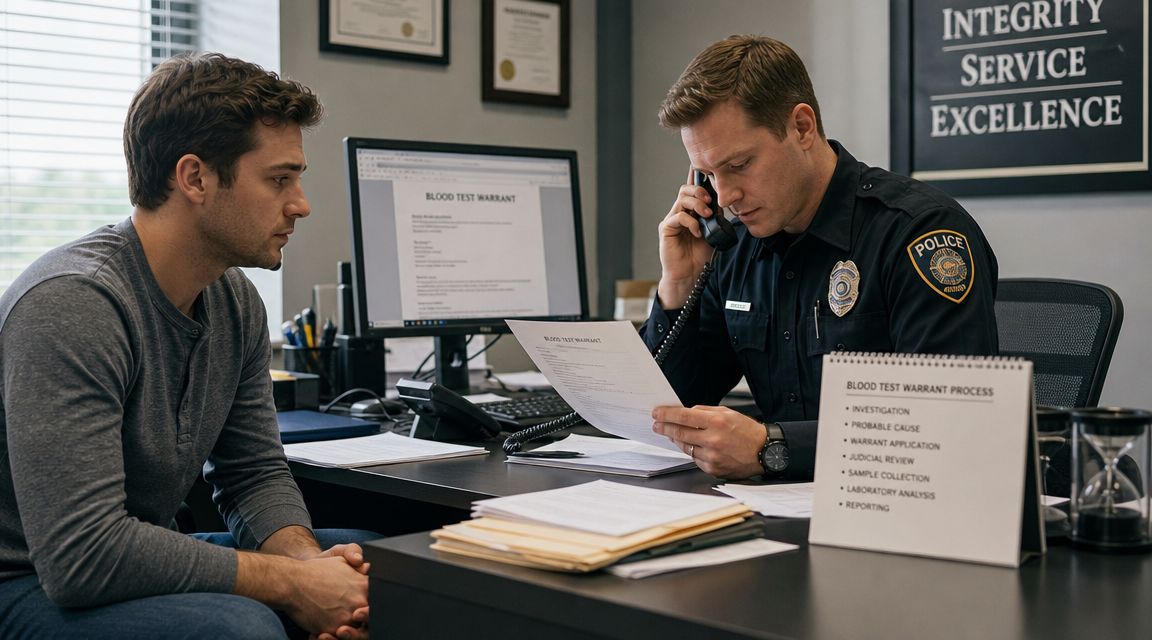
In Texas, a refusal does not reliably prevent chemical testing because officers can seek a search warrant for a blood draw. Once a warrant is issued, the blood sample can still be taken and used to measure BAC, and the refusal itself may also be introduced in court as evidence of consciousness of guilt, as discussed in this overview of Texas blood-draw warrants after refusal.
What that looks like in real life
The process often moves quickly. An officer writes an affidavit, presents it to a judge or magistrate, and asks for judicial approval to draw blood. If the warrant is signed, medical personnel may take the sample at a hospital, clinic, or other approved setting.
That means refusal often changes the route to evidence, not the result. Instead of a voluntary sample, police pursue a court-authorized one.
Why warrant review matters
A warrant is not untouchable. Defense lawyers look closely at:
- Probable cause in the affidavit
- Whether facts were misstated or omitted
- How the warrant was executed
- How the blood was drawn, handled, and preserved
Those issues can affect whether the evidence comes in and how persuasive it is. But the key point for a worried driver is simple. Saying no does not guarantee there will be no blood evidence in the case.
For some people, the consequences go beyond an ordinary driver's license. Commercial drivers can face separate fallout that affects their ability to keep working. That is one reason refusal decisions can hit harder than people expect.
How a Refusal Affects Your Criminal DWI Case
In the criminal case, refusal creates a trade-off.
On one hand, if the State never gets a usable chemical result, the prosecutor loses a clean BAC number to show a judge or jury. That can matter. Many DWI prosecutions become easier for the State when they can point to a lab result and build the case around it.
On the other hand, refusal gives the prosecutor a story to tell. The State may argue that you refused because you knew the result would hurt you. That is the consciousness of guilt argument. It is not automatic proof of intoxication, but it is a theme prosecutors often use.
How the prosecution frames it
In court, the State may try to connect the refusal to other evidence, such as:
- The officer's description of your driving
- Statements made during the stop
- Field sobriety test performance
- Body camera or dash camera footage
- Your appearance, speech, or balance
When that happens, the refusal becomes one piece of a larger narrative. The prosecutor wants the jury to think the refusal was an admission without words.
How the defense answers it
A good defense does not just say, "my client refused." It explains why refusal is not the same as intoxication.
A person may refuse because blood testing feels invasive. Someone may distrust the process, panic after arrest, misunderstand what is being requested, or freeze in a high-pressure situation. Jurors often understand that real people do not make calm, lawyer-like decisions when handcuffed on a DWI arrest.
The prosecutor's version of a refusal is simple. A strong defense gives the jury the full human context.
The criminal case also raises legal questions that have nothing to do with the refusal itself. If the stop was unlawful, if the arrest lacked probable cause, or if the warrant process was flawed, the State can face major problems even when it starts the case sounding confident.
Where Penal Code issues fit in
Texas DWI charges are commonly prosecuted under Texas Penal Code Section 49.04 for driving while intoxicated. The refusal itself is not the DWI charge. It is a separate fact that may affect evidence, license consequences, and trial strategy.
If the case continues, the criminal process usually includes several stages:
- Arrest and booking
- First court appearance or arraignment-type setting
- Evidence review and motions
- Plea bargaining, if appropriate
- Trial, if the case is not resolved
- Sentencing, if there is a conviction
Later, depending on the outcome, some people may ask about nondisclosure, record sealing, expunction, or other post-conviction relief. Those options depend on the charge, the result, and your record.
Refusal vs Failure Which Path Has Harsher Consequences
People often ask a blunt question. Is it better to refuse, or is it better to take the test and risk failing?
There isn't one answer for every case. It depends on your history, whether police can get a warrant anyway, what the video shows, whether you hold a CDL, and how strong the rest of the evidence is. But the trade-offs become easier to understand when you compare them side by side.
Consequences of Refusing vs. Failing a DWI Chemical Test in Texas (First Offense)
| Consequence | Test Refusal | Test Failure |
|---|---|---|
| Driver's license risk | Refusal can trigger an ALR suspension and an immediate need to protect your driving privileges | License consequences can still follow, but the State's focus often includes the chemical result itself |
| Time pressure after arrest | You face a fast administrative deadline tied to the refusal | You still need to act quickly, but the refusal-specific pressure is not the issue |
| Evidence in the criminal case | The State may have no voluntary BAC number, but may argue refusal shows consciousness of guilt | The State may rely heavily on the chemical test result as direct evidence |
| Chance police still get blood | Possible if officers obtain a warrant | Not the central issue because testing already occurred |
| Jury impact | Prosecutor may argue you refused because you knew you were intoxicated | Prosecutor may point to a scientific result and present it as objective proof |
| Defense focus | Challenge the stop, arrest, refusal procedure, warrant process, and officer credibility | Challenge the stop, test reliability, testing procedure, and officer credibility |
| Commercial driver's license concerns | Refusal can create serious employment problems for CDL holders | CDL exposure remains serious and fact-specific |
| Everyday practical effect | You may feel the license problem before the criminal case moves far | You may be fighting the criminal evidence more directly from the start |
What usually matters most
For many first-time drivers, refusal can help in one sense and hurt in another. It may reduce the State's immediate chemical evidence, but it can trigger fast administrative consequences and still leave room for a later blood draw.
For other drivers, especially those with prior history or job-related license concerns, the calculus changes. There is no universal safe choice once the arrest has happened. The better question is not "which path is always better?" It is "what evidence does the State have, and where are the weak points now?"
That is where a Houston criminal lawyer or Texas DWI attorney earns their value. The answer lies in the facts, not in slogans.
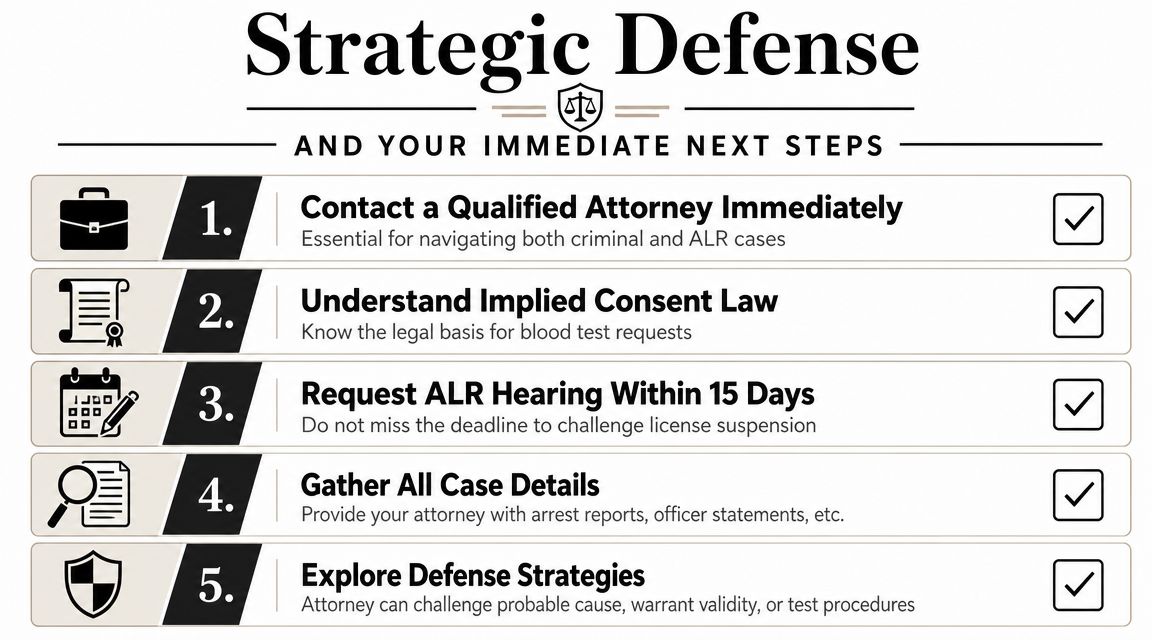
Strategic Defense and Your Immediate Next Steps
The most important move after a refusal is not arguing with the officer, replaying the stop in your head, or searching message boards for a magic answer. It is getting organized fast.
What defense strategy can look like
A refusal case can still be defended from multiple angles. Depending on the facts, your lawyer may examine:
- The traffic stop: Was there a lawful reason to pull you over?
- The arrest decision: Did the officer have probable cause?
- The refusal process: Were warnings given correctly and documented properly?
- Any warrant: Was the affidavit strong enough, and was the warrant valid?
- The blood procedure: If blood was taken, was the process handled correctly?
- Video evidence: Does the footage match the report, or does it undercut it?
That kind of review needs to start early. Waiting rarely improves a DWI case.
The steps you should take now
Call a lawyer immediately. You need someone who handles both the ALR side and the criminal side. One option is the DWI and license defense support available here, which addresses both fronts of the case.
Track your deadline. If you were arrested recently, count the days carefully. The ALR hearing request window is short.
Save every document. Keep the notice of suspension, bond papers, tow papers, booking records, and anything else you received.
Write down what happened. Do it while your memory is fresh. Include where you were stopped, what the officer said, whether there was body cam or dash cam, and whether a warrant was mentioned.
Stay quiet about the facts. Don't try to explain your side to police or post about the arrest online.
The strongest early move in a DWI case is often simple. Preserve the facts before they get blurry.
What happens after that
Once a lawyer is involved, the work often includes requesting the ALR hearing, gathering reports, reviewing video, evaluating warrant issues, and planning for court settings. In some cases, plea bargaining may be the right path. In others, trial preparation makes more sense. If there is a conviction or a qualifying dismissal later, rehabilitation-focused options such as record sealing, nondisclosure, expunction, or post-conviction relief may become part of the conversation.
The Law Office of Bryan Fagan, PLLC handles criminal defense matters across Texas, including DWI cases where license issues and criminal charges are moving at the same time. In a refusal case, that kind of coordinated approach matters because the paperwork, timing, and defense decisions overlap even when the proceedings do not.
If you're still asking what happens if you refuse a blood test in Texas, the shortest answer is this: you still have rights, but you need to use them quickly.
If you've been charged with a crime in Texas, call Law Office of Bryan Fagan PLLC for a free and confidential consultation. Our defense team is ready to protect your rights.