Being arrested in Texas can be terrifying. You may be out on bond, still in jail waiting to see a judge, or at home trying to figure out what your first court date means for your job, your family, and your future.
Many individuals in that position fear the worst. They assume the arraignment is where the judge decides guilt, hands down punishment, or expects them to explain everything that happened. That's not what this hearing is.
An arraignment is the formal start of your court case. It matters a great deal, but not for the reason many assume. The important decisions usually involve protecting your rights, choosing the right plea, and fighting for workable bond conditions so you can defend your case from the strongest position possible.
If you're trying to understand what to expect at a texas arraignment hearing, the goal is simple. Know what the court is doing, know what you should and should not say, and know where strategy matters from the first minute.
An Arrest Is Just the Beginning Your First Day in Court
A common scene looks like this. You were arrested for DWI after a traffic stop, or after an argument that led to an assault charge, or after officers found drugs during a search. You spent the night replaying every detail in your head. Then someone tells you that your arraignment is coming up, and suddenly you're worried that one wrong answer will ruin the case.
That fear is understandable, but it helps to reset what this day is. Your first court appearance is usually not the day the court decides whether you're innocent or guilty. It's the day the court starts putting the case into formal legal shape.
For some people, the biggest concern is getting out of jail. For others, it's whether a charge like theft or assault will affect a professional license, child custody case, or a pending protective order. Those concerns are real. They also mean the arraignment should be treated as a strategic moment, not a simple formality.
Practical rule: The less you improvise at arraignment, the better. Preparation protects you more than explanations do.
If you want a broader overview of that first appearance, this guide on your first court appearance in Texas criminal court is a useful starting point.
What helps most is understanding that the arraignment is one manageable step. You don't have to solve the whole case that day. You do need to avoid early mistakes that make the rest of the case harder.
Demystifying the Arraignment Its Purpose and Timeline
Think of an arraignment as the court's formal kick-off meeting for your criminal case. The judge is not hearing witnesses, weighing trial evidence, or deciding punishment. The court is making sure the case starts the right way.
In Texas, arraignment hearings typically occur within 48 to 72 hours after an arrest, and for the vast majority of the 1.4 million criminal cases processed in Texas in FY 2023, this is the first formal appearance where charges are read and bail is set. Dismissals at this stage are extremely rare, at less than 1% according to the Texas Judiciary Annual Statistical Report.
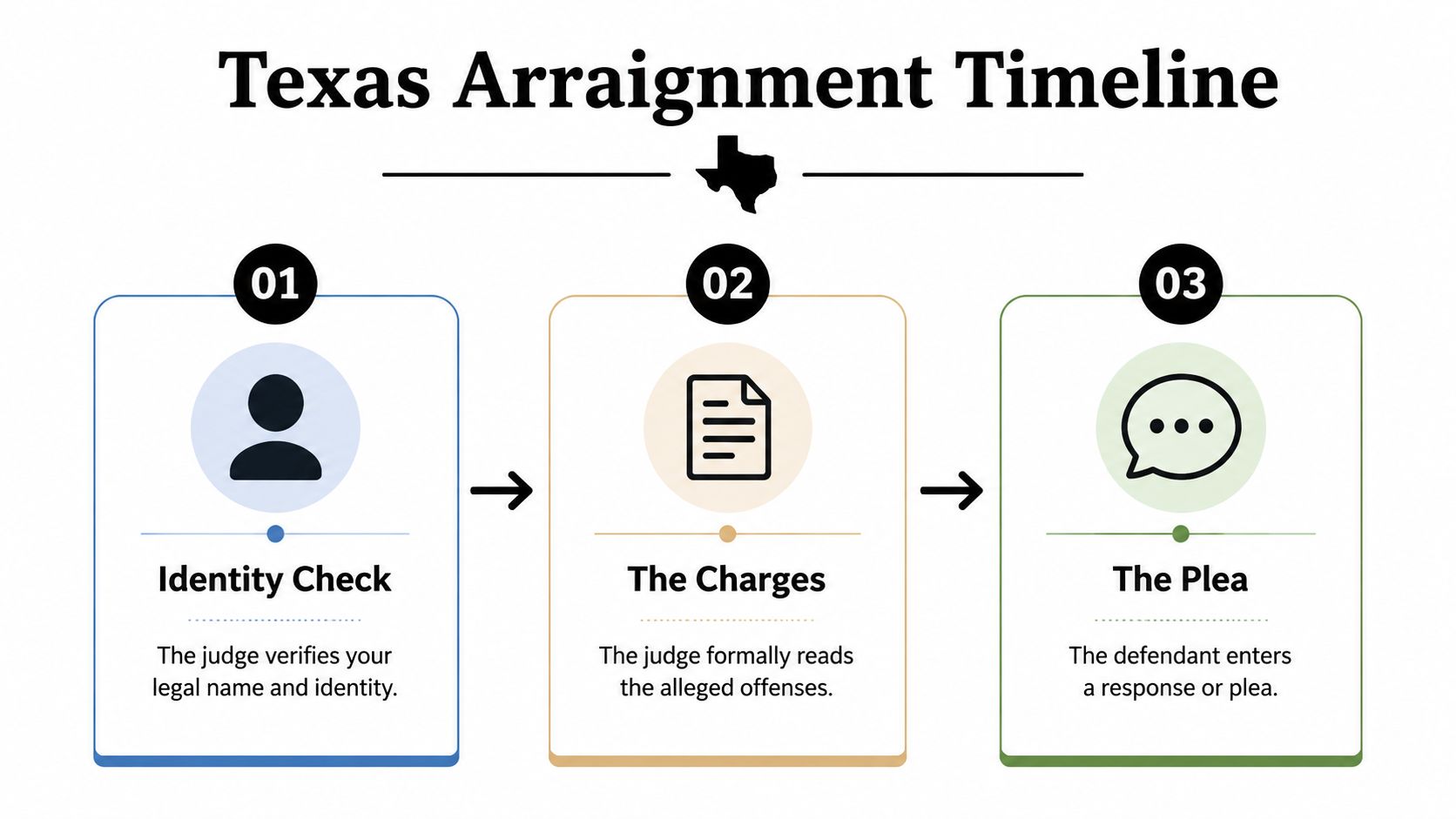
What the judge is doing
The hearing usually centers on three basic tasks:
Confirming who you are
The court identifies the defendant on the case. That sounds simple, but it matters. The court record has to match the right person.Telling you the charge
The judge states the offense the State says you committed. In plain English, that means the court puts the accusation on the record. That could involve a DWI allegation under Texas Penal Code Section 49.04, an assault allegation under Texas Penal Code Section 22.01, or a theft allegation under Texas Penal Code Section 31.03.Addressing rights and release
The judge advises you of basic rights and may deal with bail or bond conditions if that issue is still open.
What an arraignment is not
People often expect a chance to tell their side of the story. That's usually a mistake.
An arraignment is not:
- A trial
- A sentencing hearing
- A full evidence review
- The right time to argue facts on your own
The court is not asking for your life story at arraignment. It is setting the legal framework for what comes next.
Why the timeline matters
That short window after arrest is why quick legal advice matters. If your case involves family violence allegations, for example, the criminal case may immediately affect where you can go, who you can contact, and whether a protective order is likely. If your case involves DWI or drug possession, early decisions can shape bond conditions and how quickly your attorney can start pushing for evidence.
The key point is simple. Arraignment is procedural, but its outcomes are significant. What happens there often affects your freedom, your deadlines, and your negotiating position going forward.
Pleading Not Guilty The Smartest First Move
The most important choice at arraignment is usually your plea. Many people think pleading not guilty means they are denying reality or being dishonest. In criminal court, that's not what it means.
At this stage, a not guilty plea is usually the smart legal move because it preserves your options. It keeps the burden on the State, gives your attorney room to investigate, and prevents you from giving up rights before you've seen the evidence.
Under Article 26.03 of the Texas Code of Criminal Procedure, an arraignment can't happen until at least two full days after the indictment is served, which gives the defense time to prepare. Also, over 95% of defendants enter a not guilty plea at this stage to preserve discovery rights under Article 39.14, which requires prosecutors to disclose exculpatory evidence. Pleading guilty too early waives those protections, as reflected in Article 26 of the Texas Code of Criminal Procedure.
Your three basic plea options
Here's the practical difference.
| Plea | What it means | Usual effect |
|---|---|---|
| Not guilty | You require the State to prove the charge | Preserves defense options and discovery |
| Guilty | You admit the offense | Moves the case toward punishment |
| No contest | You don't contest the charge | Usually treated like guilty in criminal court |
For a first-time defendant, the temptation is often to “get it over with.” That instinct causes damage.
Why guilty pleas at arraignment usually backfire
In a DWI case, the video may not match the police report. In an assault case, witness statements may conflict. In a drug possession case, the legality of the stop or search may be the central issue. If you plead guilty before your lawyer reviews those things, you can lose an advantage that may have changed the outcome.
That's why experienced defense lawyers are careful here. A not guilty plea does not close the door on a later plea agreement. It keeps the defense alive while your attorney reviews police reports, video, lab work, and witness problems.
A not guilty plea at arraignment is usually a strategy choice, not a public speech about the facts.
What works and what doesn't
What works:
- Entering not guilty early
- Letting your attorney handle the talking
- Waiting to evaluate the evidence before making final decisions
What doesn't:
- Pleading guilty out of panic
- Trying to “explain” the case to the judge
- Assuming a minor charge doesn't need a defense plan
If you're charged with DWI, assault, theft, or drug possession, this first plea decision can shape everything that follows.
Getting Out of Jail Understanding Bail and Bond
For many people, the most urgent part of arraignment is not the plea. It's whether they can go home.
Texas judges set bail under Article 17.15 of the Code of Criminal Procedure. The court looks at factors such as the seriousness of the charge and your criminal history. In practice, the judge is asking whether you'll return to court and whether release conditions can reasonably manage the case.
The main kinds of bond
Not every release works the same way.
Personal recognizance bond
You are released based on your promise to appear. For Class C misdemeanors, an 85% PR bond rate is common according to this discussion of Texas arraignment and bond practice.Cash bond
The full amount is paid directly to the court.Surety bond
A bail bond company posts the bond for you under its own financial arrangements and requirements.
For more detail on how judges and lawyers handle that process, this article on what happens at a bond hearing can help.
What the judge cares about
A judge usually wants grounded facts, not promises. Strong bond arguments often focus on:
- Stable work and proof of employment
- A fixed address and long-term community ties
- Family responsibilities
- A clean or limited record
- A history of appearing in court
In felony cases, bond can become expensive fast. The same source notes that felonies such as burglary can see bonds over $50,000 in some cases, and a Nebbit Affidavit supported by employment records and community ties can reduce bond amounts by 30% to 50% in a majority of cases.
That kind of paperwork matters because judges don't lower bonds based on general sympathy. They respond to documents, details, and a clear release plan.
The trade-offs people miss
A low bond with harsh conditions may still disrupt your life. Some defendants are released but placed under strict monitoring, travel limits, no-contact orders, or alcohol testing. In family violence cases, that can affect where you live, whether you can return home, and how you see your children.
That's one reason to look at bond strategically. A defense lawyer should be thinking about release amount and release conditions together. If you have cross-border family concerns or want a comparative look at bail advocacy approaches, Badesha Law legal support in Brampton offers a useful example of how lawyers frame release issues around stability, supervision, and court compliance.
The practical goal is not only getting out. It's getting out under terms you can follow.
How to Prepare for Your Texas Arraignment Hearing
Good preparation lowers stress and helps you avoid small mistakes that make a bad day worse. You do not need to give a polished speech. You do need to show up ready, respectful, and organized.
If you want a separate checklist before court, this guide on how to prepare for a court hearing is a practical companion.
What to wear and bring
Dress like you're taking the matter seriously. Business casual is usually the safest choice. Clean, plain, and conservative works better than flashy or overly casual.
Bring:
- Photo ID
- Any court paperwork
- Bond paperwork if you have it
- A list of medications or important needs if custody issues are involved
- Your lawyer's contact information
If your case involves a protective order, child custody dispute, or a no-contact condition, bring copies of any related orders so your attorney can keep the court records straight.
What the courtroom may sound like
Arraignments are often brief. The exchange can be short and formal.
Judge: State your name for the record.
Defendant: [Name].
Judge: You are charged with [offense]. Do you understand the charge?
Attorney: We do, Your Honor. We enter a plea of not guilty.
That is normal. Court is not theater. Short, direct answers are usually best.
Arraignment Hearing Do's and Don'ts
| Do | Don't |
|---|---|
| Arrive early so you have time to find the courtroom and speak with your lawyer | Don't be late and assume the court will excuse it |
| Dress neatly and show respect for the setting | Don't wear clothing with offensive language, hats, or anything distracting |
| Let your lawyer speak when possible | Don't interrupt the judge, prosecutor, or court staff |
| Listen carefully for conditions of bond and the next court date | Don't guess if you missed something important |
| Stay calm even if the charge sounds unfair | Don't argue facts directly with the judge at arraignment |
| Ask your lawyer about no-contact terms or travel limits | Don't assume you can go home, call someone, or return to work without checking bond conditions |
A few habits that help
Turn your phone off before court. Stand when the judge addresses you unless your lawyer says otherwise. Call the judge “Your Honor.” If you don't understand something, discreetly inform your lawyer rather than trying to fix it yourself in open court.
The best-prepared clients are rarely the ones who talk the most. They are the ones who follow instructions.
After Arraignment The Road Ahead in Your Case
You leave the courtroom thinking the hard part was the hearing. In many cases, the hearing was only the point where the defense finally got room to make careful decisions that can shape the rest of the case.
After arraignment, the work becomes less visible and more strategic. The court has heard the charge and the plea. Now the defense starts measuring the State's proof, spotting pressure points, and deciding what should be challenged early instead of saved for trial. A rushed decision here can diminish strategic advantage later.
For many clients, that means a close review of police reports, body camera footage, witness statements, lab work, and the legality of the stop, search, arrest, or identification procedure. In a DWI case, I look at the basis for the stop, the video, field sobriety issues, and breath or blood testing problems. In an assault case, the timeline matters, along with injuries, prior statements, self-defense facts, and whether anyone is trying to use the criminal case to gain an advantage in a custody or divorce dispute.

What usually happens next
After arraignment, cases usually continue through several steps:
Discovery review
Your attorney studies the evidence the State provides and looks for weaknesses, omissions, and constitutional issues.Pretrial hearings
The court tracks deadlines, checks compliance with bond conditions, and addresses legal disputes that need rulings before trial.Motion practice
Your lawyer may file motions to suppress evidence, challenge statements, request records, or limit what the jury is allowed to hear.Negotiation
Productive negotiations usually happen after the evidence is reviewed, not before. Sometimes the right result is a reduction or dismissal. Sometimes the right choice is to reject an offer that sounds convenient but creates long-term problems.Trial preparation
If the State will not offer a fair resolution, the defense prepares witnesses, themes, exhibits, and cross-examination for trial.
New bail rules and virtual hearings
Procedure after arraignment can also be affected by changes in how courts handle release and appearances. According to this discussion of Texas arraignment changes and pretrial reform, House Bill 3471, effective September 2025, is described as shifting the bail process for some non-violent offenses toward more monitoring and less reliance on high cash bonds. The same discussion reports that virtual arraignments have increased by 40% in counties like Harris in its summary of those local practice trends.
Those changes matter because release conditions often become part of the defense strategy. Electronic monitoring, travel limits, testing requirements, and no-contact terms can affect work, parenting time, and how a case is negotiated. Virtual appearances can save time, but they also make it easier to miss a condition, mishear a date, or answer a judge too quickly without counsel beside you.
If your case involves both criminal court and family court, bond conditions can start affecting daily life immediately. No-contact terms, firearm restrictions, and protective orders often create a second legal problem before the criminal case is resolved.
The family law overlap many people don't expect
This comes up often in family violence cases, stalking allegations, and cases with an emergency protective order. A bond condition can keep you out of your home, limit contact with your spouse or dating partner, and complicate exchanges involving children. Even when the criminal case is still in its early stages, those orders can influence temporary family court decisions in practical ways.
That is why I treat arraignment and bond terms as more than short-term paperwork. If a no-contact condition is entered without clear exceptions, a parent can accidentally violate it by trying to coordinate school pickup or ask about a child's medication. If a protective order is being considered, the criminal defense has to account for that risk early. The Law Office of Bryan Fagan PLLC handles criminal defense matters as well as related protective order and family-law-adjacent issues, which can matter when one court's order starts affecting another part of your life.
Looking beyond the charge
A good defense after arraignment keeps one eye on the next court date and one eye on the final outcome. The goal is not only to answer the current accusation. The goal is to protect your record, your job, your license, your immigration position if that applies, and your ability to live at home and care for your family.
Some cases end in dismissal. Some end in a negotiated result that limits damage. Some need trial. And if a case does end with a qualifying resolution, relief such as expunction or nondisclosure may matter later. The right choices after arraignment usually come from patience, evidence review, and discipline, not panic.
Your Arraignment Questions Answered
Can my case be dismissed at arraignment
It can happen, but it's unusual. As noted earlier, dismissals at this stage are rare because arraignment is mainly a procedural hearing. If a case falls apart that early, it is usually because there is a serious legal defect, not because the judge heard a full defense story on the spot.
What happens if I miss my arraignment date
The court can issue a warrant for your arrest. Missing court can also hurt your bond situation and make the judge less willing to trust future requests. If there is any risk you cannot appear, contact your lawyer immediately and have the issue addressed before the hearing date passes.
Do I really need a lawyer for a misdemeanor arraignment
In most cases, yes. Even a misdemeanor can affect your record, job, immigration status, professional license, housing, and family situation. A misdemeanor assault case can trigger no-contact rules. A DWI can affect driving and employment. A theft charge can create long-term record problems.
Should I talk to the judge and explain what really happened
Usually, no. Arraignment is not the right setting for a free-form explanation. You can accidentally say something that locks the defense into a bad position before your attorney reviews the evidence.
What if my case involves a spouse, dating partner, or protective order
Tell your lawyer immediately. Family violence accusations often carry release conditions that affect housing, contact, and parenting. Those conditions can matter as much as the charge itself in the short term, so they need immediate attention.
If you've been charged with a crime in Texas, call Law Office of Bryan Fagan PLLC for a free and confidential consultation. Our defense team is ready to protect your rights.