Being threatened or facing violence, especially from someone you know, can be terrifying and isolating. But you don’t have to face it alone. You have powerful legal options in Texas to protect yourself and your family. This guide is designed to walk you through the process of getting a protective order, a court order created to stop family violence and restore your peace of mind.
The process hinges on one core requirement: you must show a judge that family violence has occurred and is likely to happen again. This involves filing an application and telling your story at a court hearing. Let's walk through how it works, step-by-step.
Your First Step Toward Safety

Feeling unsafe in your own home is an overwhelming experience. Taking the first step to seek legal help can feel daunting, but a Texas Protective Order is an accessible tool designed to give you back your peace of mind.
This isn't just a piece of paper. It's a legally enforceable court order that draws a clear line in the sand. Violating it comes with serious criminal consequences, including arrest, and that's what gives it real power.
The entire point of a Protective Order is to stop violence before it escalates. A judge issues it after hearing evidence that family violence has already occurred. You must convince the court of two things: that an act of family violence took place, and that there's a real risk it could happen again. Our goal is to demystify this process and show you that seeking protection is a manageable—and empowering—step to take.
What Can a Protective Order Actually Do?
A Texas Protective Order is more than just a command to "stay away." It's a flexible legal tool that a judge can customize to fit the specific dangers of your situation.
Depending on what you need, a protective order can:
- Order the abuser not to come within a certain distance of your home, your job, or your children's school or daycare.
- Forbid the abuser from communicating with you or your family in any way—that includes texts, social media messages, or passing messages through others.
- Require the abuser to move out of a home you share.
- Prohibit the abuser from possessing a firearm.
These orders are not suggestions. As mentioned, breaking a Protective Order is a criminal offense in Texas, which can lead to arrest, fines, and jail time. This legal backbone is what makes the order an effective shield.
Understanding Where You Stand Legally
Texas law is very specific about these orders. While you might hear about "Extreme Risk Protection Orders" (ERPOs) in other states, Texas law focuses squarely on Family Violence Protective Orders. This isn't a niche legal tool; it's a vital part of our state's crisis intervention system.
In fact, Texas courts grant over 50,000 of these orders every single year. That number alone should tell you how accessible and necessary they are for survivors across the state. This is a well-traveled path to safety.
What's the Difference Between a Protective Order and a Restraining Order?
People use these terms interchangeably, but in a Texas courtroom, they mean very different things. Getting this right is crucial for your safety.
A Protective Order is specifically for victims of family violence, sexual assault, stalking, or human trafficking. It's a tool rooted in the criminal justice system, designed to provide safety from physical harm or credible threats. Violating it is a crime.
A Temporary Restraining Order (TRO), on the other hand, is a civil court tool, most often seen in divorce cases. A TRO's job is typically to protect property, such as stopping a spouse from selling marital assets or clearing out a joint bank account. While it can include rules about contact, violating it does not carry the same criminal penalties as violating a Protective Order.
Key Takeaway: If you fear for your physical safety due to violence or threats from a family member, dating partner, or ex, the legal tool you need is a Protective Order.
Understanding this distinction is the first step toward getting the right kind of help. While the road ahead can feel complicated, you don't have to figure it all out by yourself. For immediate safety planning, it's wise to connect with local support systems. You can learn more in our guide to locating domestic violence shelters near you.
Do You Qualify for a Protective Order in Texas?
Before you can get a protective order, you must be sure your situation fits the legal requirements. The law is very specific about who gets this kind of protection. Knowing where you stand from the beginning is the first step toward getting the safety you deserve.
At its core, a Texas Protective Order hinges on one key concept: family violence. The judge needs to believe that family violence has already happened and is likely to happen again. Let's break down what the court is actually looking for in plain English.
Defining Family Violence Under Texas Law
Many people hear "violence" and immediately think of physical blows. But the Texas Family Code’s definition is much broader, which is a critical detail. You might be eligible for protection even if you’ve never been physically struck.
According to Texas Family Code § 71.004, "family violence" includes:
- An act against a family member intended to cause physical harm, injury, assault, or sexual assault.
- A threat that puts a family member in fear of imminent physical harm, injury, assault, or sexual assault.
That second point is huge. A credible threat that genuinely makes you fear for your safety is considered family violence in the eyes of a Texas court. You do not have to wait to be physically hurt before you can ask for legal help.
Who Qualifies as a Family Member?
The next piece of the puzzle is your relationship with the person you need protection from. The term "family member" is defined broadly to cover a wide range of domestic situations.
You can seek a protective order against:
- Your current or former spouse
- Someone you have a child with
- A relative by blood or marriage (like a parent, sibling, or in-law)
- A current or former dating partner
- A member of your household or a former household member
That last category often surprises people. It means that under the right circumstances, even a roommate could be subject to a protective order if family violence has occurred. The eligibility criteria are often wider than most people realize. For a closer look, you can review our full guide on the specific requirements for restraining orders in Texas.
Beyond Family Violence: Other Qualifying Situations
While family violence is the most common reason for a protective order, it isn't the only one. Texas law also extends this powerful protection to victims of other serious crimes, even when the offender isn't a "family member."
You can also seek a protective order if you are a victim of:
- Stalking: This isn't a one-time event. Stalking is a pattern of harassing behavior that makes you feel threatened, fearful, or unsafe.
- Sexual Assault or Abuse: If you have been the victim of these crimes, you can get a protective order against the person who harmed you, regardless of your relationship.
- Human Trafficking: Victims of trafficking are also able to use protective orders to create a legal barrier between themselves and their traffickers.
This legal framework isn't unique to Texas; it's a reflection of a global understanding of these issues. For example, recent data shows a significant rise in the enforcement of similar orders worldwide. In 2026, Finland saw a 14.7% increase in restraining orders, with 92% of them issued against men. These figures highlight a common pattern where these orders serve as a vital first step for survivors seeking safety without waiting for an arrest. You can discover more insights about these global trends on stat.fi.
A Real-World Scenario: Imagine your ex repeatedly shows up at your job unannounced. They send you dozens of texts a day, some of which say they are "watching you." Even if they haven't laid a hand on you, this pattern of behavior could easily be classified as stalking. Because it places you in fear of imminent harm, it could make you eligible for a protective order.
Figuring out if you qualify is the first major step toward safety. If your situation falls into one of these categories, you have a legal path to demand protection. The law is on your side, and our team at The Law Office of Bryan Fagan, PLLC, is here to help you use it.
A Practical Guide to Filing Your Protective Order
Knowing you need a protective order is one thing; actually filing the paperwork is another. Facing the legal system is intimidating, especially when you're already under a mountain of stress. Our goal is to cut through the confusion and give you a practical, step-by-step guide.
Think of this as your roadmap. You have the strength to get this done, and we'll take it one step at a time.
Finding and Filling Out the Right Forms
The entire process begins with one crucial document: the Application for Protective Order. This is where you officially tell the court what’s been happening and formally ask for its help.
You can usually download this form from your county's district clerk website or pick up a copy at the courthouse. When you fill it out, be as detailed and honest as possible. Describe the specific acts of family violence, stalking, or other threatening behavior. Include dates, times, and a clear account of what happened. The more specific you are, the stronger your application will be.
Where to File Your Application
Once the application is complete, where do you take it? In Texas, you have a couple of options for filing:
- File in the county where you live.
- File in the county where the other person lives.
You'll file the paperwork with either the district clerk or the county clerk's office—it depends on your county's local rules. Don't be afraid to ask for directions at the courthouse. The clerks are there to point you to the right window. For a closer look at how this works on the ground, our guide on the Dallas County protective order process provides a great county-specific example.
Understanding Filing Fees and Fee Waivers
Filing court documents almost always comes with a fee. But your safety should never depend on your ability to pay.
If you can't afford the fees, you can ask the court to waive them by filing a "Statement of Inability to Afford Payment of Court Costs." This is a straightforward form where you detail your income and expenses. If the judge agrees, all your court costs will be waived, and you can move forward with your case for free.
To get a broader sense of how the legal system handles these cases, it can be helpful to understand the different types of restraining orders and filing procedures. Having that context can make the process feel less mysterious.
The flowchart below breaks down the main reasons a judge will grant a protective order in Texas.
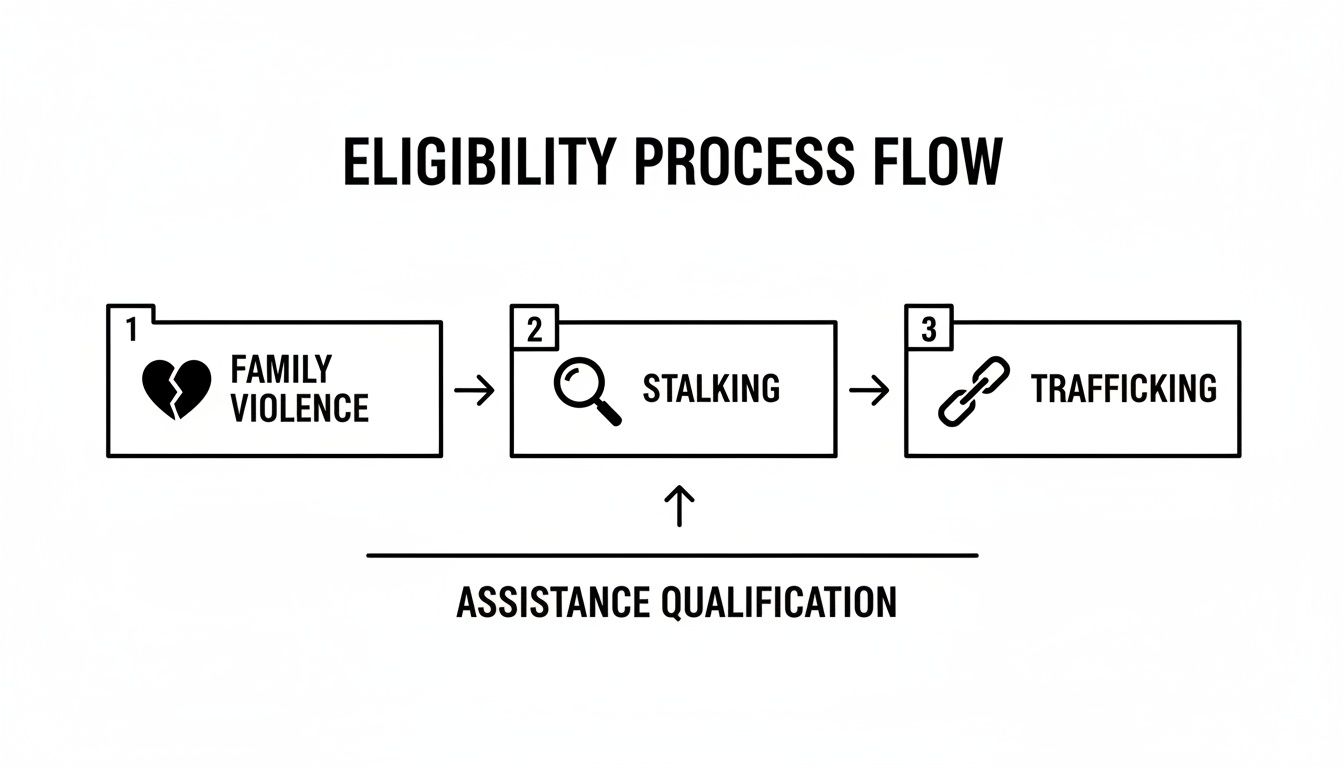
As you can see, the core grounds are typically Family Violence, Stalking, and Trafficking, which is what makes a person eligible to seek protection.
What Is "Service" and Why Does It Matter?
After you file your application, the next step is absolutely critical. It’s called service. "Service" is the formal, legal notification to the other person (the respondent) that you’ve filed a case against them. You cannot do this yourself; it must be handled by an authorized officer.
Key Takeaway: Proper service is a constitutional requirement. The other person has a right to know they've been named in a lawsuit and be given a chance to appear in court. Your case cannot move forward to a final hearing until service is complete and proven to the judge.
A sheriff's deputy or a private process server will hand-deliver a copy of your application and a notice of the court date to the respondent. Once they are officially served, the clock starts ticking toward your day in court.
How to Build a Strong Case for the Court
Walking into a courtroom to ask for protection takes incredible courage. But to get a protective order, you need to back up your story with hard proof. The judge’s decision will hinge on one thing: can you show that family violence has occurred and is likely to happen again?
This isn’t about mastering complex legal arguments. It’s about building a clear, factual timeline that leaves no doubt about the danger you’re in. Let's talk about the specific proof that makes a judge take notice.
The Most Powerful Types of Evidence
Think of your evidence as the building blocks of your case. Each piece adds credibility, making your story undeniable. Judges are trained to spot the difference between a simple argument and a documented pattern of abuse.
Start gathering anything you have from this list:
- Police Reports: If you’ve ever called 911 or filed a police report, get a copy. These official documents create an unbiased, third-party record of the conflict.
- Medical Records: Did you go to an urgent care, ER, or your family doctor for injuries? Those records are critical. They create a medical timeline that can link an injury to a specific incident.
- Photos and Videos: In 2026, visual evidence is king. A picture is worth a thousand words. Take clear photos of any injuries, damaged property like a broken door or smashed phone, or even video of the abuser violating a no-contact agreement.
- Threatening Communications: This is often the easiest evidence to get and one of the most persuasive. Save everything. That includes threatening texts, unhinged emails, harassing social media messages, and angry voicemails. Do not delete anything.
Organizing Your Evidence for the Judge
Having a mountain of evidence is useless if it’s a chaotic mess. You can’t just hand the judge your phone or a stack of random papers. A disorganized presentation can signal to the judge that your case is weak, even if it’s not. Your goal is to make it easy for the judge to see the truth.
Use a simple binder with dividers, and label each section clearly:
- One section for printed photos, with the date and a one-sentence description.
- Another section for text messages, printed out and organized by date.
- A separate section for official documents like police reports or medical bills.
This system keeps you focused and tells the judge you are prepared, serious, and credible.
Pro Tip: When you print threatening text messages, print the entire conversation, not just one bad message. This stops the other side from claiming a message was “taken out of context.” Context is everything.
Preparing to Tell Your Story in Court
Your own testimony ties all the evidence together. This is your chance to look the judge in the eye and explain, in your own words, why you are afraid and why you need the court’s help. Preparation is your best defense against fear.
When you take the stand, remember these rules:
- Stick to the Facts: The judge needs facts, not just feelings. Avoid generalizations like, "He's always angry." Instead, be specific: "On Monday, May 10th, he threw a coffee mug against the kitchen wall and screamed at me." Give dates, times, and locations.
- Speak Clearly and Calmly: It’s okay to be nervous. Take a deep breath before answering any question. Speak slowly. If you need a moment, ask for it.
- Be Honest: Your credibility is your most valuable asset. Answer every question truthfully. If you don’t know something, the right answer is, "I don't know" or "I don't recall." Guessing can destroy your case.
Think of yourself as the narrator. The photos, texts, and police reports are the illustrations. Your testimony is the story that connects all the dots for the judge, creating a clear picture of what happened.
What to Expect at Your Protective Order Hearing

Walking into a courtroom can be intimidating. That feeling is completely normal. The key to getting through it is knowing what’s coming. Our goal is to pull back the curtain on the entire process, so you can focus on the one thing that matters: clearly and safely telling your story.
Immediate Protection with a Temporary Ex Parte Order
In dangerous situations, you don't have to wait weeks for a full hearing. Texas law provides a tool called a Temporary Ex Parte Protective Order (TPO). "Ex parte" means the order is granted based on your side of the story alone, without the other person (the respondent) present.
To get one, you must convince a judge there is a clear and present danger of family violence. This is reserved for urgent, high-risk scenarios. If the judge agrees, the TPO is issued immediately and becomes legally binding the moment the respondent is served. This temporary order stays in place until the full hearing, which is typically scheduled within 20 days.
The Main Hearing: Your Day in Court
The full hearing is where the judge hears from both sides. This is your opportunity to present your evidence and explain—under oath—why you need a final protective order. It’s also the respondent’s chance to argue against it.
The hearing follows a predictable path. First, you (the petitioner) will be called to testify. Your attorney will guide you with questions, helping you describe the family violence and explain why you fear it will happen again.
After you speak, the respondent’s attorney gets to question you. This is called cross-examination. The key is to stay calm, listen to the question, and answer truthfully.
Next, the respondent will have their turn to present their case. Your attorney will then have the chance to cross-examine them. Finally, both lawyers will make a short closing argument, summarizing the evidence for the judge.
Pro Tip: The entire hearing is governed by the Texas Rules of Evidence. An experienced criminal defense attorney knows these rules inside and out. They can make timely objections to stop improper questions or prevent inadmissible evidence from being used against you. This is a massive advantage you don’t have when representing yourself.
The Judge's Final Decision
Once the judge has heard from both sides, they will make a final decision, usually right then and there.
-
The Protective Order is Granted: If the judge finds that family violence has occurred and is likely to happen again, they will grant a Final Protective Order. This order can last for up to two years. The judge will state the specific rules the respondent must follow.
-
The Protective Order is Denied: If the judge doesn't believe you met the legal burden of proof, they will deny your request. If you had a temporary order, it expires immediately.
No matter the outcome, the judge's ruling is a formal court order. Understanding this process from start to finish strips away the element of surprise, allowing you to walk into that courtroom feeling prepared and confident.
Common Questions About Texas Protective Orders
Going through the legal system, especially when your safety is on the line, is bound to bring up questions. Here are some straightforward answers to the concerns we hear most often from everyday Texans.
What Happens if Someone Violates a Protective Order?
A protective order is a direct command from a judge, and violating it is a criminal offense.
If the person named in the order contacts you, comes near your home or work, or does anything else the judge forbade, you should act immediately. Call 911 and report the violation. Police have the authority to arrest the person for this crime, which is typically a Class A misdemeanor. If they've done it before, the charge can be elevated to a felony.
Key Insight: Don’t second-guess what counts as a violation. A single text message, a comment on your social media, or showing up at your grocery store are all potential breaches. Report every incident to create a documented history of their behavior.
What Is the Difference Between a Protective Order and a Restraining Order?
This is one of the most common points of confusion. In the eyes of Texas law, they are completely different tools.
- Protective Orders: These are about physical safety. They are for cases involving family violence, stalking, or sexual assault. Because they are meant to prevent harm, violating one carries criminal penalties, including arrest.
- Restraining Orders (TROs): These are a tool for civil disputes, most often used during a divorce. A TRO is meant to protect property and keep things stable. Violating a TRO usually leads to civil contempt of court, not an immediate trip to jail.
Why Should I Hire an Attorney for a Protective Order?
While you technically can file for a protective order on your own, walking into court without a lawyer is a huge risk. An experienced attorney knows the Texas Rules of Evidence, understands local court procedures, and can build a case that a judge will find persuasive.
Your attorney's job is to gather your evidence, prepare you for testimony, and make the powerful legal arguments you need to win. They can also shield you from improper questions from the other side. Your safety is too important to leave to chance.
For more in-depth answers, including how military protective orders affect housing and family life, it's always wise to consult reliable resources. Having a knowledgeable guide ensures you understand every angle of what you're facing.
If you’ve been charged with a crime in Texas, call The Law Office of Bryan Fagan, PLLC for a free and confidential consultation. Our defense team is ready to protect your rights. Visit us at https://texascriminallawyer.net.