You may be sitting in a parking lot, staring at a citation or bond paperwork, wondering how your life got turned upside down so fast. Maybe the accusation came after a misunderstanding, an argument, a mental health episode, a bad joke, or an accidental exposure that someone else reported as criminal. Now you're worried about jail, your job, your family, and whether this means you'll be labeled a sex offender forever.
That fear is real. So is the shame. But panic won't help you, and neither will internet advice that treats every indecent exposure case like it's the same.
Texas law is more specific than commonly understood. The prosecution has to prove particular facts. Intent matters. Context matters. Your words matter. What you do in the first days after arrest can shape the rest of the case. If you're dealing with indecent exposure in Texas, you need a clear plan and a defense built around the exact legal elements, not assumptions.
An Indecent Exposure Charge Can Be Terrifying but You Are Not Alone
A lot of people charged with indecent exposure don't look anything like the stereotype in their head. They may have no criminal record. They may have been drinking, changing clothes in a car, dealing with a medical issue, or caught in an ugly dispute where someone called police first. By the time they realize how serious the accusation sounds, they're already in handcuffs or standing before a magistrate.
I've seen the same reaction again and again. First comes embarrassment. Then comes the worst question: "Is my life over?"
It isn't. But you need to take this seriously right now.
What most people get wrong in the first 24 hours
People often make three mistakes early:
- They try to explain everything to police: That usually gives the state more statements to use against you.
- They assume it will blow over: Even a misdemeanor accusation can create long-term damage if you mishandle it.
- They underestimate the stigma: This kind of charge can affect work, housing, family relationships, and reputation long before a case is resolved.
Practical rule: If police want your side of the story, stay respectful, give identifying information if required, and say you want a lawyer before answering questions.
What you should focus on instead
Start with control. Save paperwork. Write down what happened while your memory is fresh. Identify witnesses. Preserve texts, location history, receipts, photos, and anything that shows the full context.
If you're also facing another allegation such as DWI, assault, theft, or drug possession, don't treat those charges as separate life problems. They often affect bond conditions, plea negotiations, and how a prosecutor sees your case. A defense lawyer should look at the whole picture, not just the headline accusation.
The path forward is usually less mysterious once someone explains it in plain English. That's what matters now. Not shame. Not internet rumors. Facts, strategy, and your next move.
Understanding Indecent Exposure Under Texas Law
Texas Penal Code §21.08 doesn't criminalize every exposed body part or every awkward moment. The state must prove a specific combination of acts and intent. If one piece is missing, the case gets weaker.
Consider a three-part lock. Prosecutors have to open all three parts, not just one.
The three things the state tries to prove
For an indecent exposure case, the state must show:
- Exposure: You exposed your anus or genitals.
- Sexual intent: You did it with the specific intent to arouse or gratify sexual desire.
- Recklessness about who might be offended: You were reckless about whether another person was present who would be offended.
That second part matters more than many people realize. Public urination, changing clothes, or a medical incident can be embarrassing. But embarrassment alone isn't the same as criminal sexual intent.
The reckless standard is a major defense issue
The most overlooked issue in many indecent exposure Texas cases is the mental state. Broden & Mickelsen notes that prosecutors must prove you were reckless about whether someone would be offended, while many other crimes use a knowing standard. That distinction is a real defense issue, especially when the exposure was accidental or happened in a context where criminal intent is disputed, as explained in Broden & Mickelsen's discussion of Texas indecent exposure defenses.
That means the state doesn't get to win just by saying, "Someone saw something." They still have to prove the right kind of intent and the right kind of awareness.
A bad fact pattern is not the same thing as proof beyond a reasonable doubt.
Why plain-English classification matters
Indecent exposure is generally charged as a misdemeanor, and understanding where it fits in the broader system helps you judge risk, plea options, and long-term consequences. A simple overview of Felony vs. Misdemeanor Charges in Texas can help you see how Texas classifies offenses and the penalty range for each level.
Here is the plain-English takeaway. The prosecutor doesn't just need an offended witness. The prosecutor needs evidence of what was exposed, why it was exposed, and your mental state about who might see it. If your case involved confusion, intoxication, changing clothes, poor visibility, conflicting witness accounts, or a rushed police report, those details can matter a lot.
Potential Charges and Penalties in Texas
The penalty structure for indecent exposure in Texas is straightforward on paper. In real life, the consequences can feel anything but straightforward.
Under Texas Penal Code §21.08, a first offense is a Class B misdemeanor, punishable by a maximum fine of $2,000 and up to 180 days in county jail, and the prosecution generally has a two-year limitation period from the date of the alleged offense, as summarized by Saputo Law's explanation of Texas indecent exposure penalties. That same source explains that a second conviction becomes a Class A misdemeanor, with up to one year in jail, a fine of up to $4,000, and a 10-year sex offender registration requirement.
Texas indecent exposure penalties at a glance
| Offense | Classification | Maximum Jail Time | Maximum Fine | Sex Offender Registration |
|---|---|---|---|---|
| First offense | Class B misdemeanor | 180 days in county jail | $2,000 | Not typically required for the initial conviction |
| Second conviction | Class A misdemeanor | 1 year in jail | $4,000 | 10-year registration |
What this means in practical terms
A first offense is still a misdemeanor. Don't minimize it. A misdemeanor sex-related accusation can affect your employment, school status, professional licensing, child custody disputes, and public reputation.
A second conviction changes the risk dramatically. The jump isn't just about more jail exposure. It's about a label and reporting obligation that can follow you for years.
The two-year issue matters
The limitation period can matter when an accusation surfaces late or after a personal conflict. Police reports, witness memory, texts, and surveillance often get worse with time. That's one reason quick defense work matters even if the allegation didn't lead to an immediate arrest.
If police have contacted you but no formal charge has been filed, don't treat that as good news. It may only mean the case is still being reviewed.
Bottom line: The first goal is to avoid a conviction if possible. The second goal is to avoid outcomes that create long-term reporting and record problems.
Strategic Defenses to an Indecent Exposure Allegation
These cases are often defendable because the law requires proof of more than exposure alone. A smart defense attacks the weak point in the state's evidence. Sometimes that's intent. Sometimes it's identity. Sometimes it's context. Often, it's all three.
Lack of sexual intent
The state has to prove the exposure happened with intent to arouse or gratify sexual desire. If your conduct happened during a non-sexual event, that matters.
Examples can include:
- Changing clothes quickly: A person changing after the gym, at the beach, or in a vehicle may have acted carelessly, but not with sexual intent.
- Medical distress: A health emergency, confusion, intoxication-related disorientation, or urgent bodily need may explain behavior without proving a sexual motive.
- Public urination allegations: These cases sometimes get overcharged when the underlying conduct wasn't sexual.
Lack of recklessness about an offended person
This is where details become powerful. If you were in a secluded place, believed no one was around, or had reason to think privacy existed, the state may struggle to prove recklessness.
That doesn't automatically end the case, but it creates room to fight.
False accusation and bad identification
Some accusations come out of anger, fear, or simple mistake. Lighting is poor. The witness sees only part of an event. The report gets written after the fact. One person's assumption turns into a criminal complaint.
Your lawyer should test every piece of proof. Witness statements, body camera footage, dispatch records, video, and physical layout all matter. If you want to understand that process better, read how evidence is challenged in Texas criminal cases.
Defense strategy should fit the facts
A good defense usually includes several moves at once:
- Attack the elements: Force the state to prove each legal requirement.
- Build innocent context: Show what was happening before, during, and after the allegation.
- Control your statements: Don't hand prosecutors extra admissions they couldn't prove on their own.
- Look for alternatives to conviction: In some cases, the best outcome comes through negotiation tied to evidentiary weakness.
If you need legal help, one available option is Law Office of Bryan Fagan PLLC, a Texas criminal defense firm that handles misdemeanor and felony allegations, including related charges such as assault, DWI, theft, and drug possession.
What to Expect After an Arrest The Criminal Process Step by Step
The court system scares people because it feels unfamiliar. Once you know the sequence, you can make better decisions and avoid expensive mistakes.
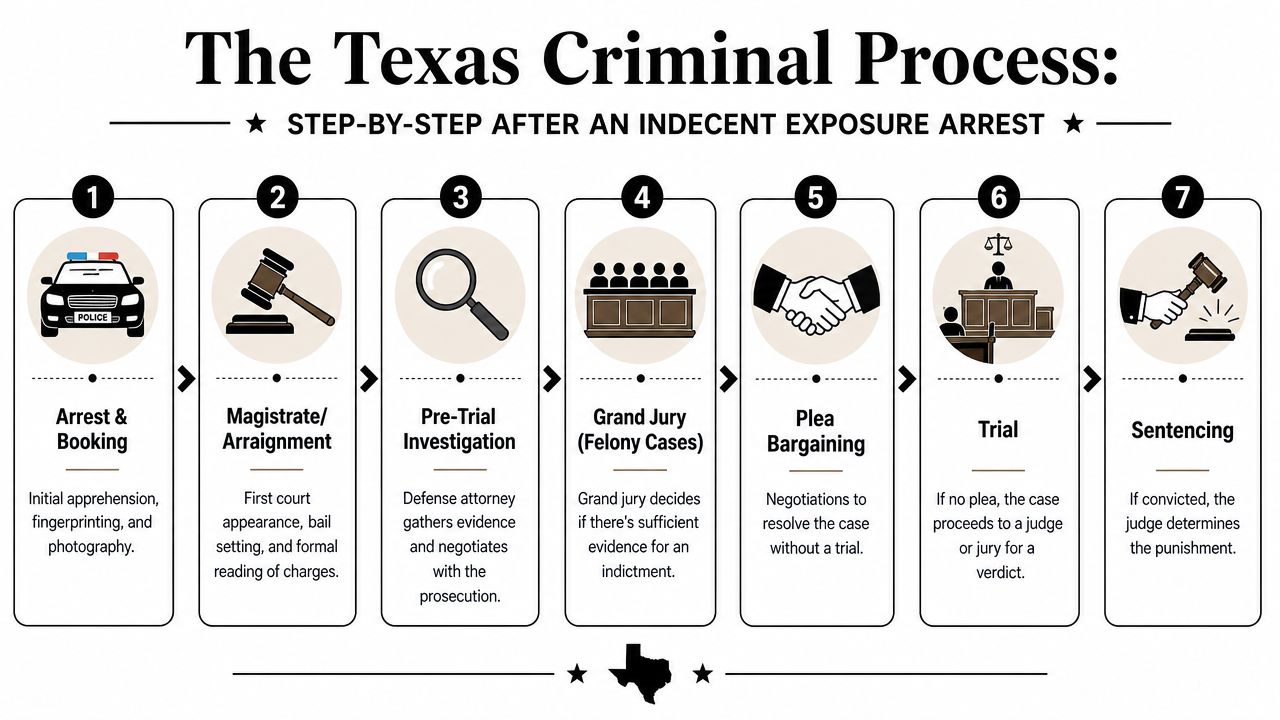
Arrest and booking
After arrest, officers usually take you to jail for fingerprinting, photographs, and basic intake. Personal property gets logged. You may be held until you see a magistrate or until bond is set.
This is not the time to argue facts with officers or try to talk your way out of it. Keep calm. Ask for a lawyer. Say as little as possible about the allegation itself.
If you need immediate triage advice, review what to do immediately after getting arrested in Texas.
Magistrate or arraignment appearance
Your first court appearance is usually where the charge is formally addressed and bond conditions may be discussed. You may hear legal terms that sound more complicated than they are.
A few key ones:
- Arraignment: The court tells you the charge and asks for a plea.
- Bond conditions: Rules you must follow while the case is pending.
- Counsel setting: The court addresses whether you have a lawyer or need one appointed.
Pre-trial work is where many cases are won
Trial is often envisioned first. That's backwards. The actual work usually happens before trial.
Your attorney investigates the facts, requests records, reviews video, interviews witnesses, studies the complaint, and looks for legal weaknesses. In other criminal matters like Texas DWI attorney work, Texas assault defense, or drug possession cases, this stage is just as important because the prosecutor's file is rarely the whole story.
The police report is a starting point, not the final truth.
Plea negotiations and possible dismissal routes
Many cases resolve without a trial. That can happen through dismissal, a reduction, deferred adjudication, or another negotiated outcome. A plea bargain is an agreement to resolve the case on stated terms.
That doesn't mean you should rush into one. Some plea offers are better than others. Some are traps that solve today's stress but create years of future damage.
Trial and sentencing
If the case doesn't resolve, it goes to trial before a judge or jury. The prosecution presents witnesses and evidence. Your lawyer cross-examines those witnesses, presents your side, and argues that the state failed to prove the charge.
If there's a conviction, the court moves to sentencing. That's where punishment is imposed and where the long-term consequences can become very real.
The main point is this. The process has stages. Each stage creates choices. Good defense work means making the right choice at the right time, not reacting out of fear.
The Hidden Costs Collateral Consequences of a Conviction
The courtroom penalty is only part of the danger. The harder damage often starts after the case appears to be over.
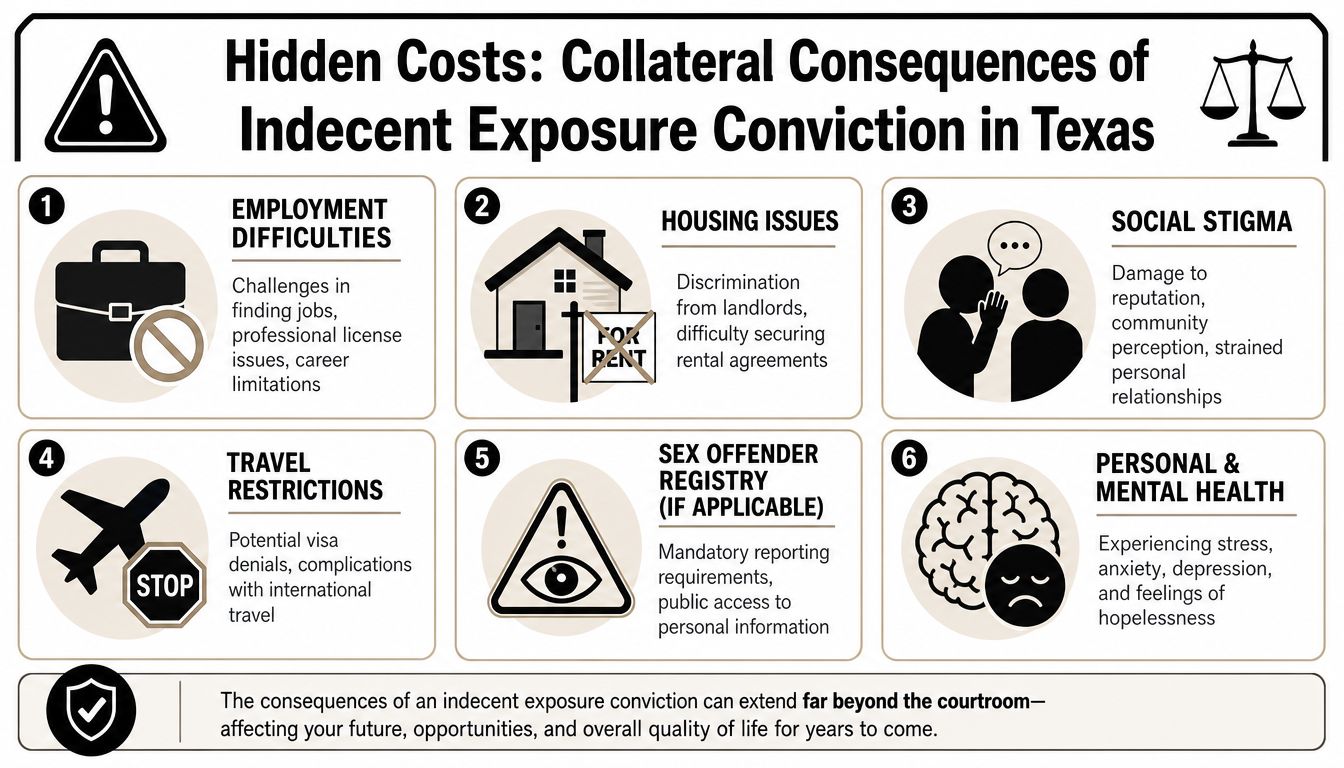
Daily life can get harder fast
A conviction can follow you into parts of life that have nothing to do with the courtroom:
- Employment problems: Employers may hesitate when they see a sex-related offense on a background check.
- Housing trouble: Landlords often reject applicants they view as risky.
- Professional fallout: Licensing boards and employers may ask questions that are hard to answer cleanly.
- Family and social strain: Reputation damage can affect relationships long before you have a chance to explain what happened.
- Travel and immigration concerns: Some people face added scrutiny or restrictions depending on their status and destination.
Those consequences can hit professionals, students, parents, and business owners especially hard. A nurse, teacher, contractor, engineer, rideshare driver, or office employee may all face very different forms of fallout from the same charge.
Deferred adjudication can change everything
Here's the point most generic articles miss. A conviction is not the only outcome.
Under Texas law, successfully completing deferred adjudication for even a second indecent exposure offense does not require sex offender registration because of an exception in Texas Penal Code Section 62.005(5)(F), as noted by BHW Law Firm's discussion of deferred adjudication and indecent exposure registration.
That doesn't mean deferred adjudication is automatic. It isn't. It also doesn't mean it's the right result in every case. But if you're eligible, it can be a critical path for avoiding one of the most feared long-term consequences.
Why this should shape your defense early
Too many people focus only on avoiding jail. That's shortsighted. You should evaluate every option through the lens of your future record, work life, family life, and reporting obligations.
A plea that looks easy in the moment can be a bad deal if it creates a conviction when a different outcome could have protected you better.
Local Legal Landscapes Houston Dallas Austin and San Antonio
Texas law applies statewide, but court culture is local. That's not theory. It's daily practice.
A case in Houston may move differently than a similar case in Dallas. Austin prosecutors may view background facts, mitigation, or diversion discussions differently than prosecutors in San Antonio. Judges also vary. Some focus tightly on paperwork and procedure. Others pay close attention to personal history, treatment efforts, counseling, employment, or how the accusation arose.
Why county-level experience matters
Local knowledge helps in ways clients don't always see:
- Charging habits: Some offices file aggressively. Others scrutinize weak complaints more closely.
- Negotiation patterns: Plea terms and alternatives can vary by courthouse and prosecutor.
- Scheduling and motion practice: Deadlines, hearing expectations, and courtroom habits matter.
- Judicial preferences: The way a judge handles bond conditions or contested hearings can shape strategy.
If your case is in Harris County, Dallas County, Travis County, or Bexar County, you want a lawyer who understands the courthouse, not just the penal code. That's also true in other criminal matters. A Houston criminal lawyer handling assault or theft, or a lawyer defending drug possession in a surrounding county, needs more than textbook knowledge. Local practice shapes outcomes.
You don't need a lawyer who promises magic. You need one who knows the road map where your case is pending.
Clearing Your Name A Path Forward with Expunction and Nondisclosure
A criminal case doesn't always define the rest of your life. Texas law gives some people a real chance to clean up their record.
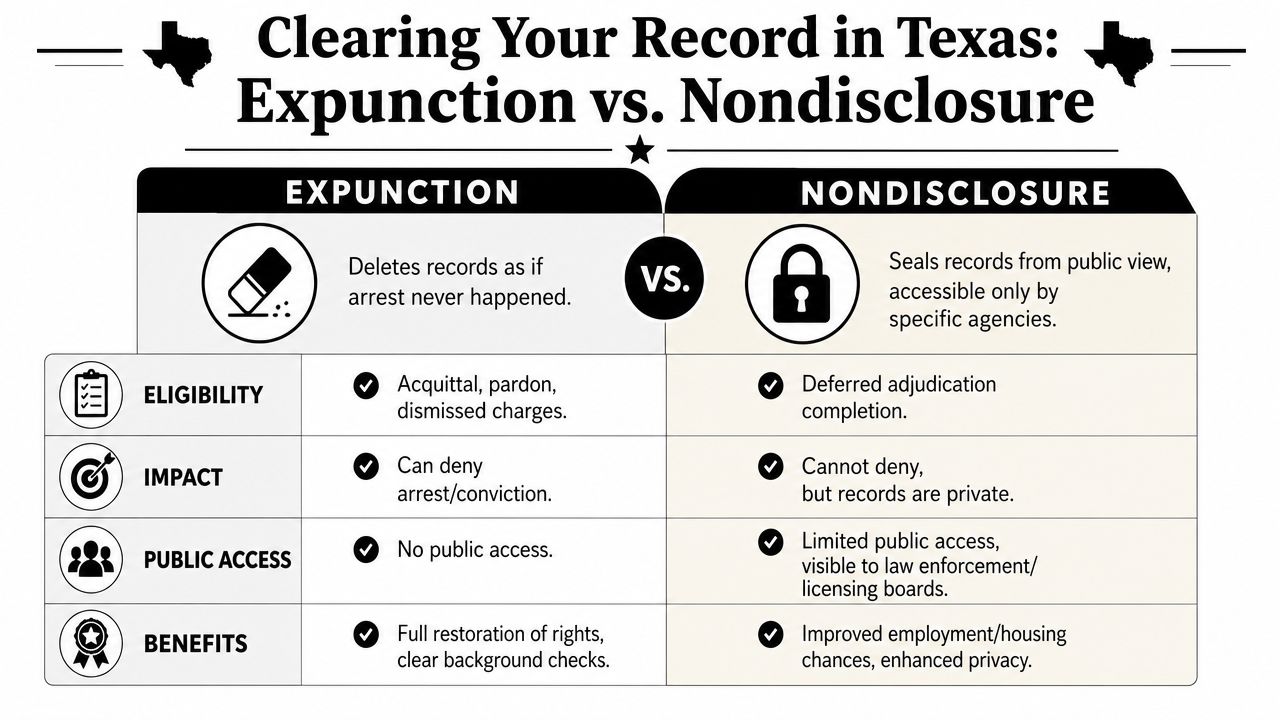
Expunction and nondisclosure are not the same thing
Expunction deletes qualifying records. In the right case, it's as close as the law gets to wiping the slate clean.
Nondisclosure seals qualifying records from public view, though certain agencies can still access them. If your case ends through deferred adjudication, this may be the tool that matters most.
Common paths forward
Here is the simple version:
- Expunction may apply: If the charge was dismissed, you were acquitted, or the case otherwise qualifies.
- Nondisclosure may apply: If you successfully completed deferred adjudication and meet the legal requirements.
- Timing matters: You usually can't file the same day your case ends. A lawyer should review when you become eligible.
If you want a closer look at sealing options, read about a Texas order of nondisclosure.
Clearing a record doesn't undo the stress you went through, but it can make it easier to get hired, rent housing, and move forward without the same public baggage.
The right post-case strategy matters just as much as the defense itself. If your goal is rehabilitation, privacy, and a fair chance at work and housing, record clearing should be part of the plan from the start.
If you've been charged with a crime in Texas, call The Law Office of Bryan Fagan, PLLC for a free and confidential consultation. Our defense team is ready to protect your rights.