Being arrested in Texas can be terrifying. One minute you're driving home, arguing with a partner, or walking out of a store. The next, you're in handcuffs, your phone is in an evidence bag, and you're trying to figure out whether your life just changed for good.
A criminal charge feels personal, but the case itself comes down to proof. The prosecutor doesn't win because an officer wrote a report or because someone accused you of something. The state has to build a case with evidence, and that evidence can be challenged at nearly every stage.
That matters whether you're facing DWI, assault, drug possession, theft, or a more serious felony. In Texas, a charge is not a conviction. A defense starts by examining how police got the evidence, whether the prosecution turned everything over, whether the testing was reliable, and whether a jury should believe the witnesses at all.
You've Been Charged with a Crime in Texas What Now
You get out of jail late at night, holding bond paperwork and a court date, and by morning the case already feels decided. In that moment, many people assume the officer's report is accurate, the testing will hold up, and the prosecutor is already several steps ahead.
That is not how a Texas criminal case should be approached.
The first job is to slow the case down and identify where the state's proof can be challenged. In a Houston DWI, that may mean examining whether the traffic stop had a lawful basis and whether the video matches the officer's written account. In a Dallas assault case, it may mean comparing witness statements, 911 audio, injury photos, and any delay in reporting. In an Austin or San Antonio drug case, it often starts with the reason for the stop, the scope of the search, and whether police tied the substance to you in a way a jury would accept.
Those issues matter early. They shape bond conditions, plea discussions, motion practice, and trial strategy.
What your defense usually focuses on first
A practical defense usually starts with three questions:
- What evidence does the state claim it has? That includes video, reports, recordings, lab paperwork, photos, phone data, witness statements, and anything seized.
- How did law enforcement get it? If the stop, detention, search, arrest, or interview violated the law, the defense may be able to file a motion to suppress illegally obtained evidence in Texas.
- Will the evidence hold up in court? The prosecution still has to show the evidence is relevant, properly authenticated, and reliable enough for a judge or jury to trust.
Early action can make a real difference. Surveillance footage gets erased. Body camera issues show up. Witnesses change their accounts. People also damage their own cases by trying to explain everything to police, pretrial services, or complaining witnesses before a lawyer has reviewed the file.
Where local courts change the strategy
Texas procedure is statewide, but court practice is not uniform. Houston courts often move differently than Dallas courts. Austin and San Antonio have their own habits on scheduling, plea settings, evidentiary hearings, and how quickly contested motions get heard.
That affects defense decisions. A DWI in Harris County may call for aggressive work on video, blood records, and officer credibility early because those cases often turn on technical details. An assault case in Dallas may require fast witness work and careful handling of protective-order issues that can influence how the case develops. Drug cases in Bexar and Travis County often rise or fall on search issues, possession theories, and whether prosecutors can connect the contraband to the right person instead of just the right location.
Good defense work accounts for the county, the court, and the kind of charge you are facing. Treating every Texas case the same is a mistake.
The First Line of Defense Demanding the State's Evidence
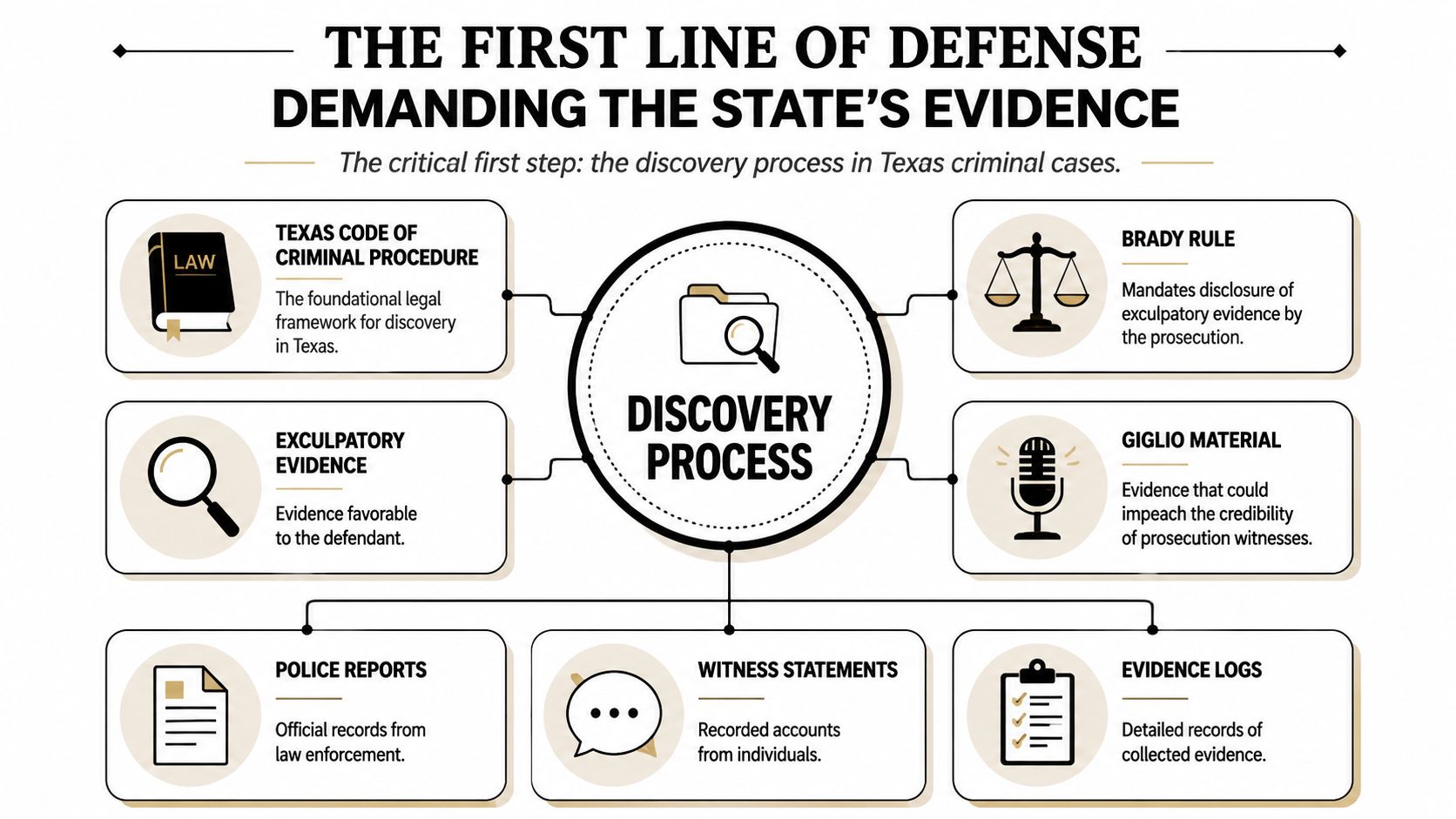
Before anyone can fight a case, the defense needs the file. In Texas, that starts with discovery. Discovery is akin to a poker game where the prosecutor isn't allowed to keep key cards hidden in a sleeve.
Under Article 39.14 of the Texas Code of Criminal Procedure, the state must disclose not only broadly material evidence, but also information that tends to negate guilt or reduce punishment. The defense may inspect, duplicate, and photograph discoverable materials, and courts can impose exclusionary remedies or other sanctions when disclosure is delayed or withheld, as discussed in this summary of Texas discovery obligations under Article 39.14.
What we ask for in real cases
Discovery isn't just a police offense report. In a DWI case, it may include dash cam, body cam, dispatch audio, field sobriety records, breath or blood paperwork, and maintenance logs tied to testing. In an assault case, it may include 911 calls, witness interviews, injury photos, medical records the state plans to use, and any prior inconsistent statements. In a drug case, it often includes search warrant materials, lab submissions, property logs, and chain-of-custody paperwork.
The value isn't only in what appears. It's also in what doesn't.
A missing body-cam segment can matter. Notes that don't match the final report can matter. A witness who told one version at the scene and another version later can matter even more.
Why missing evidence can help you
Prosecutors sometimes present a case as if every detail fits neatly together. Discovery often shows something else. A stop may have started for one reason and shifted to another in later paperwork. A witness may have been uncertain at first and certain only after talking to police again. Lab paperwork may leave questions about timing or handling.
Those problems don't automatically end the case, but they offer strategic advantage. They can support cross-examination, a suppression motion, a request for sanctions, or a better plea offer.
For many clients, this is the first point where the case starts to feel less hopeless. Once the state has to turn over the file, the defense can compare what happened to what the government says happened. If you want to understand one of the most important tools that follows discovery, this overview of a motion to suppress evidence in Texas is a helpful next step.
Pre-Trial Motions Challenging Illegal Searches and Seizures
A lot of criminal cases rise or fall on one issue. Did police get the evidence legally?
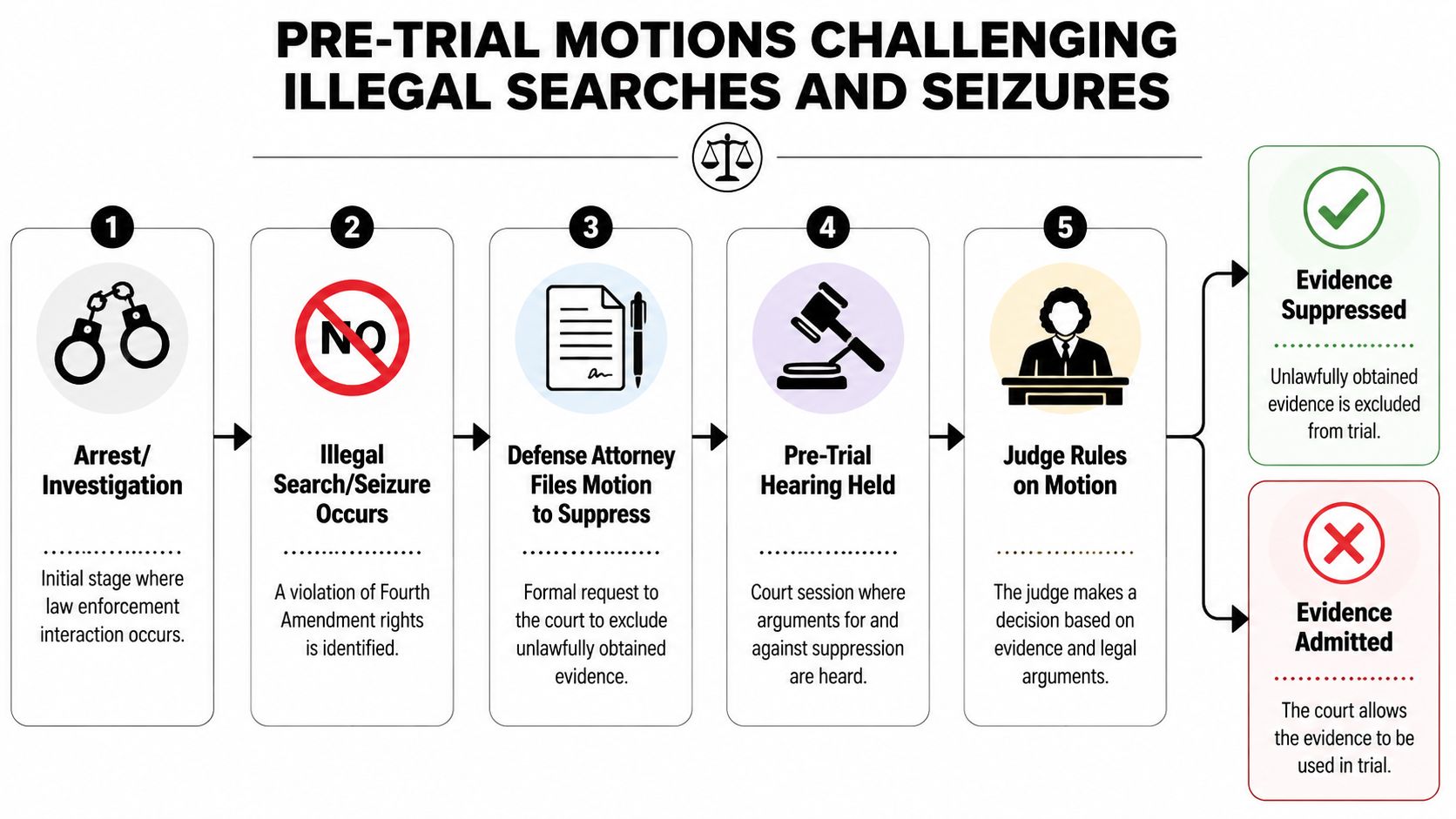
The Fourth Amendment protects you against unreasonable searches and seizures. In plain English, officers can't stop, search, or seize you just because they have a hunch. They need a lawful reason. When they don't, the defense can ask the judge to suppress the evidence, which means the prosecutor can't use it at trial.
Early in the process, it helps to understand how a suppression issue moves through court.
Common examples in Texas cases
Here are the situations that come up often:
- DWI traffic stops. If an officer lacked a valid reason to pull you over, everything that followed may be vulnerable, including observations, field sobriety testing, and later chemical evidence.
- Vehicle drug searches. An officer may claim to smell marijuana, claim consent was given, or extend a stop beyond what the law allows. Those details matter.
- Home entry cases. In assault, domestic violence, or gun cases, a warrantless entry into a home can become a major fight.
- Phone searches. Police may seize a phone, but searching its contents raises separate legal questions.
One unlawful step can infect later evidence. Lawyers often describe that as the fruit of the poisonous tree. If the tree is illegal, the fruit from it may be excluded too.
If police crossed the line to get the evidence, the court can stop the state from using that evidence against you.
How a motion to suppress actually works
A suppression motion isn't just a form with legal buzzwords. It usually requires careful comparison of reports, video, dispatch timing, warrant language, and officer testimony. At the hearing, the judge may listen to testimony, watch footage, and decide whether the government met its burden.
The best suppression issues are usually factual, not theatrical. Small details carry weight. When did the officer say you were free to leave. What exact words did you use when consent was requested. Did the warrant cover the place searched. Did police exceed the scope of a traffic stop.
For a plain-English look at these issues, this guide on what makes a search illegal in Texas criminal law is useful background.
Later in the case, a second kind of weakness can appear. Even when officers collected something, the proof may still be too thin to move the case forward. The Texas State Auditor's Office reported major obstacles in reported sexual-assault cases, including difficulty collecting evidence and delays from forensic testing, which shows how evidentiary weakness can prevent a case from ever reaching trial in the first place, according to the State Auditor's report on sexual-assault case processing.
Video can help you see how these constitutional fights are framed in practice.
Questioning Evidence Admissibility and Reliability
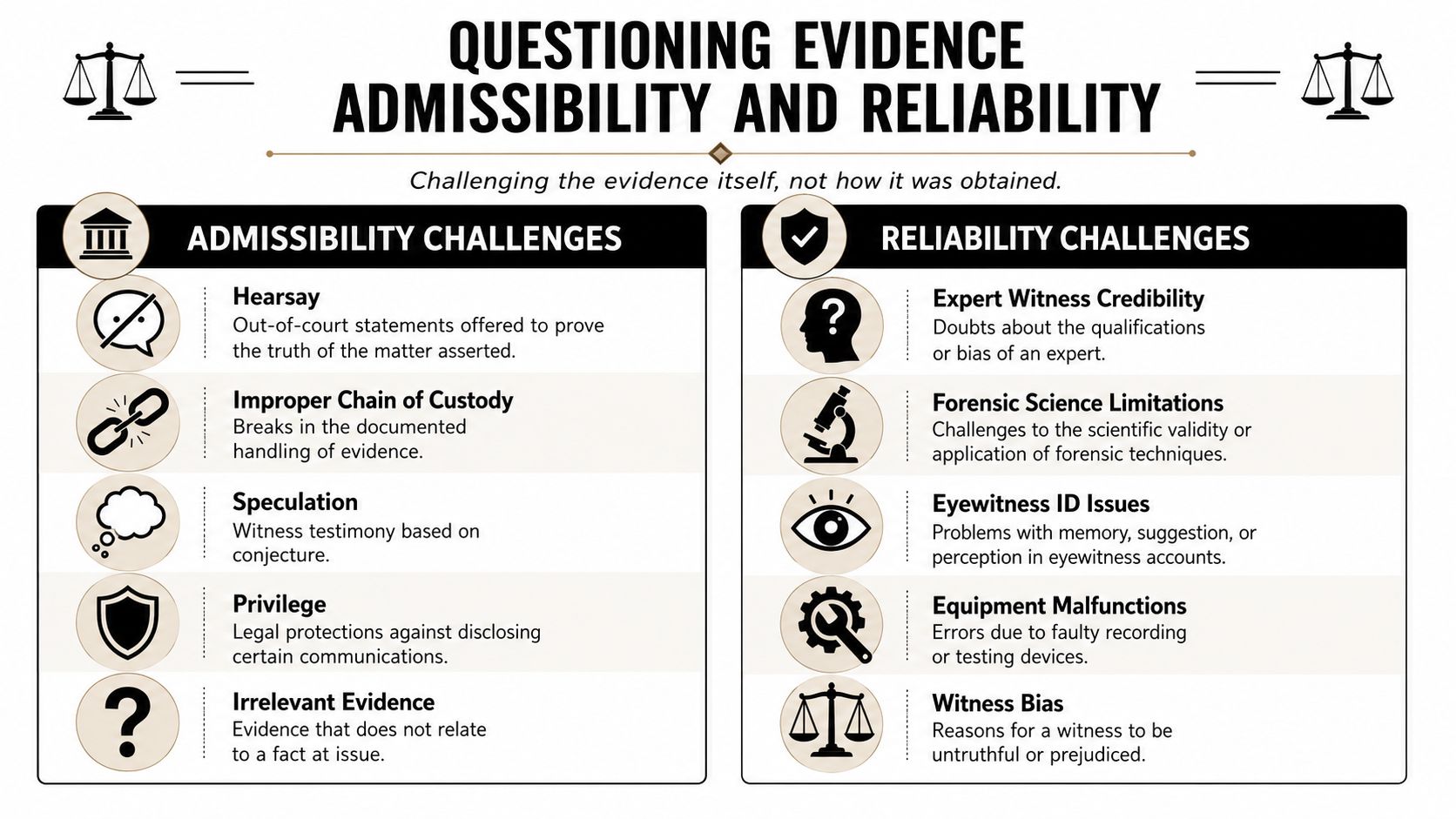
Even if police obtained evidence legally, that doesn't mean the jury will hear it. Courts still apply the Texas Rules of Evidence. Those rules let judges exclude even relevant evidence when its probative value is substantially outweighed by unfair prejudice, confusion, or misleading the jury. Evidence also has to be relevant, authentic, and not privileged, as reflected in the Texas Rules of Evidence.
Authentication and chain of custody
Authentication means the state has to show an item is what they claim it is. A screenshot of a text message doesn't prove itself. Someone has to connect it to a phone, an account, a device, or a person in a way the judge accepts. In assault and harassment cases, this issue comes up all the time with texts, social media posts, call logs, and videos clipped out of context.
Chain of custody is more like package tracking. If the state wants to use suspected drugs, blood, clothing, or a firearm swab, the record should show who collected it, who stored it, who transferred it, and who tested it. If those links are weak, the jury may wonder whether the item was altered, mixed up, contaminated, or mishandled.
For people who want a practical visual of how professional agencies think about preserving physical evidence, Material Handling USA's storage room designs show why controlled storage, logging, and access restrictions matter. In criminal court, those same handling details can become part of the defense attack.
Hearsay and unfair prejudice
Some evidence is challenged because of what it asks the jury to accept. Hearsay usually means an out-of-court statement offered to prove the truth of what it says. There are exceptions, but plenty of statements still draw valid objections.
A simple example is the schoolyard rumor problem. One person says, "I heard he admitted it." If that speaker didn't personally hear the event and the actual declarant isn't available for proper examination, the defense may challenge the statement.
Other evidence may be authentic but still unfairly damaging. A graphic photo, unrelated bad-act allegation, or confusing stack of records can create more heat than light. In those situations, the fight isn't only about truth. It's about whether the jury can fairly evaluate the case.
Key point: Some of the strongest evidence challenges don't claim the item is fake. They argue the item is too unreliable, too incomplete, or too unfair to put in front of a jury.
If you're looking into how Texas courts treat evidence that should be kept out after a legal violation, this explanation of the Texas exclusionary rule provides added context.
Contesting Expert Witness and Forensic Science
Jurors often give extra weight to a witness with a lab coat, a technical title, or a confident presentation. That's understandable. It can also be dangerous.
An expert's opinion isn't automatically correct just because the prosecutor calls it science. In Texas criminal practice, the defense can challenge whether the expert is qualified, whether the method is reliable, and whether the conclusion fits the facts of your case. Judges act as gatekeepers. If the foundation is weak, the opinion can be limited or excluded.
Where these fights show up most often
DWI cases are a common example. The state may rely on a breath test, blood result, or retrograde explanation of what your level supposedly was earlier. The defense looks at maintenance records, collection procedures, analyst notes, and whether the opinion jumps too far beyond the known facts.
Drug and violent felony cases raise similar issues. A lab analyst may identify a substance, but the defense can still examine handling, contamination risk, report language, and whether the analyst can really support every claim the state wants to make. Medical testimony in assault or homicide cases can also be narrower than prosecutors suggest.
What actually works
The strongest expert challenges are usually focused and technical. A broad complaint that "science isn't perfect" won't move a judge very far. A targeted challenge often will.
Useful lines of attack include:
- Qualifications. Does the witness have the training needed for this exact opinion?
- Methodology. Was the testing approach reliable, and was it applied correctly here?
- Documentation. Do the records support the conclusion, or are key steps missing?
- Scope creep. Is the expert trying to say more than the data allows?
For readers who want a broader background on expert witness forensic science for Texas, that overview can help you understand the kinds of issues lawyers examine when medical or scientific opinions become central to a case.
In day-to-day defense work, careful preparation beats drama. A calm cross-examination with the right records can reduce a powerful-sounding expert opinion to a much smaller point.
Using the State's Evidence Against Them at Trial
Some cases aren't won by keeping evidence out. They're won by showing the jury why the state's own evidence doesn't hold up.
Trial is where reports, videos, witness statements, and courtroom testimony collide. That's where cross-examination and impeachment matter most. Cross-examination tests the witness. Impeachment shows the jury why that witness may be mistaken, inconsistent, biased, or not believable.
How this looks in real cases
In a DWI trial, an officer may testify that you were swaying, slurring, or confused. Then the jury watches body-cam footage showing you standing steady, answering clearly, and following directions. The defense doesn't need to overstate the point. The contradiction speaks for itself.
In an assault case, the complaining witness may tell a polished story at trial that sounds stronger than the first 911 call or the first written statement. If the details changed on key facts, a defense lawyer can walk through those changes line by line.
In a drug case, an officer may sound certain about where contraband was found or who controlled it. Then property photos, vehicle layout, or another officer's report show things weren't so clear.
Why tone matters with juries
Jurors usually don't like bullying. They do respond to precision. Good cross-examination is controlled. It uses short questions, prior statements, timestamps, photos, and video clips to make a narrow point the jury can trust.
A few common impeachment themes are:
- Changed stories. The witness said one thing first and another thing later.
- Poor opportunity to observe. It was dark, chaotic, fast-moving, or obstructed.
- Bias or motive. The witness had a reason to shift blame, protect someone, or gain an advantage.
- Memory problems. The witness is filling in gaps rather than recalling actual details.
A trial isn't just the prosecutor presenting proof. It's a contest over whether that proof deserves belief.
When people ask how evidence is challenged in Texas criminal cases, this is a big part of the answer. Sometimes the evidence comes in, but it loses force once the jury sees the omissions, contradictions, and overstatements surrounding it.
Timelines and Next Steps in Your Texas Case
You get out on bond after a Friday night DWI arrest in Houston. By Monday, the questions start. Will the video help or hurt. When do we get the police report. Should you talk to the prosecutor at the first setting. How long will this take.
The answer in Texas is usually the same. It depends on the charge, the court, and how quickly the defense can get the State's evidence and force key issues into the open.
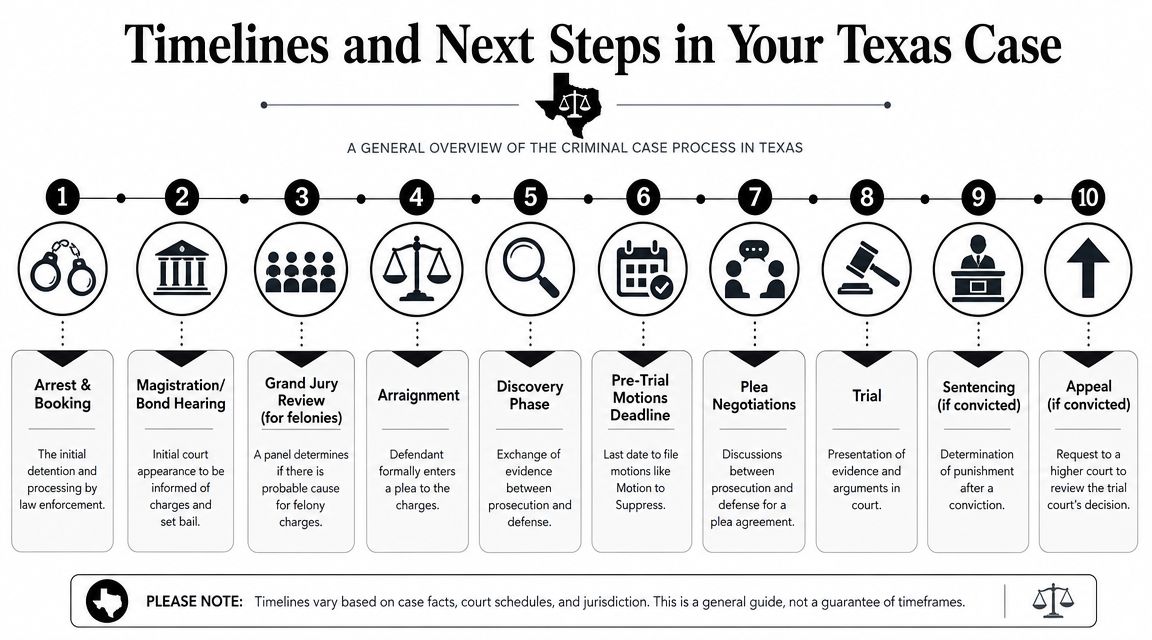
The usual timeline after an arrest
Texas cases follow a familiar sequence, but the pace can change a lot from court to court.
-
Arrest and booking
Law enforcement processes the arrest, takes fingerprints and photographs, and decides whether you stay in custody until bond is set. -
Magistration and bond
A magistrate advises you of the accusation and can set bond conditions that affect travel, firearms, alcohol use, or contact with another person. -
Charging decision or grand jury review
In misdemeanor cases, the prosecutor may file charges quickly. In felony cases, the State often seeks an indictment before the case fully moves forward. -
First settings and arraignment
The court begins tracking the case, appoints counsel if needed, and sets the early schedule. -
Discovery and defense investigation
This is when the defense requests offense reports, body camera footage, lab records, dispatch records, medical records, and witness statements. In a DWI case, that may mean video, breath-test records, and maintenance logs. In an assault case, it often means 911 audio, photographs, and prior statements. In a drug case, it usually includes lab paperwork, chain-of-custody records, and search-related reports. -
Pre-trial litigation
Motions to suppress, motions to exclude unreliable evidence, and requests for hearings are filed here. If a search was questionable or a statement was taken in violation of the rules, this stage can change the entire case. -
Negotiation or trial setting
Some cases resolve after the defense exposes a weakness the prosecutor cannot fix. Others need a contested hearing or a jury trial before the pressure shifts. -
Sentencing, appeal, or post-conviction relief
If the result is favorable, the next question may be clearing the record. If the result is not favorable, the focus turns to preserving error and evaluating appeal options.
Why local practice changes your options
Local practice matters more than people expect.
A DWI in Harris County may move on a different timetable than a DWI in Dallas County. A felony drug case in Bexar County may get a quicker push toward indictment than a similar case in Travis County. Assault cases also vary depending on how the assigned court handles reset requests, evidentiary hearings, and trial settings.
That affects defense strategy. In Houston, an early setting may be used to press for missing video or officer notes before making any recommendation about a plea. In Dallas, backlog and scheduling pressure can shape how aggressively each side pushes the case early. In Austin, some courts expect lawyers to identify legal issues fast and set hearings with a clear purpose. In San Antonio, local practice in the assigned court often determines whether a suppression issue gets real attention early or closer to trial.
From the defense side, timing is a trade-off. Filing a motion too early can show the State exactly how to repair a weak spot. Waiting too long can give up momentum, delay a hearing, or leave the client stuck under bond conditions longer than necessary. Good case planning is not just about knowing the law. It is about knowing when to force the issue.
What you should do while the case is pending
Clients help their cases most by staying disciplined.
Go to every court date. Follow bond conditions exactly. Save texts, call logs, receipts, social media posts, location history, and any other records that could matter later. Write down your own timeline while the events are still fresh. Do not contact complaining witnesses, and do not try to explain the case to police or prosecutors without your lawyer.
Those steps matter in every case type. In a DWI, they can help preserve timeline issues and identify witnesses who saw the stop or your condition before arrest. In an assault case, they can preserve messages, photos, and context that never make it into the police report. In a drug case, they can help show who had access to the vehicle, home, or property where the substance was found.
Looking beyond the charge
A criminal case may not be over when the court date ends. If the case is dismissed, refused, or resolved in a qualifying way, you may be able to pursue expunction or record sealing through an order of nondisclosure. If there is a conviction, post-conviction options may still need review based on the charge, the sentence, and what happened in the trial court.
The Law Office of Bryan Fagan, PLLC handles Texas criminal defense matters involving DWI, assault, drug possession, theft, and post-case record relief across major Texas metros and surrounding counties.
If you have been charged, the next step is simple. Get counsel involved early, preserve what can help you, and make decisions based on the actual evidence rather than the accusation.
If you've been charged with a crime in Texas, call The Law Office of Bryan Fagan, PLLC for a free and confidential consultation. Our defense team is ready to protect your rights.