Skip to content
Being arrested after a heated argument can feel unreal. A few angry words, a text message, or a comment online can suddenly turn into a charge for a terroristic threat in Texas. You may be wondering whether this is really a felony, whether the other person had to feel scared, and what happens next.
If that's where you are right now, take a breath. A charge is serious, but it isn't the same as a conviction. You still have rights, and the details matter a lot in these cases.
An Empathetic Introduction to Terroristic Threat Charges
Many people charged with a terroristic threat say the same thing at first: "I didn't mean it like that." Often, the accusation starts in a real-life moment people recognize. An argument with a spouse gets out of control. A disagreement at school or work turns hostile. Someone says something impulsive, and the police treat it as a threat of violence.
That shift is frightening. One minute you're upset. The next, you're dealing with booking, bond, court dates, and the fear that your job, family life, or reputation could be damaged.
Practical rule: If you've been accused of making a threat, don't try to explain it away to police, the alleged victim, or on social media. Early statements often make a hard case harder.
What makes this charge especially confusing is the name. People hear "terroristic threat" and assume it only applies to extreme or highly public acts. Under Texas law, that's not how it works. The charge can apply in much more ordinary settings, including private arguments, family disputes, and statements made in public places.
You may also be carrying a lot of shame or panic right now. That's normal. But you don't need to guess your way through the process.
What most people need to know right away
- The words used matter. So does the setting, who heard them, and what prosecutors say you intended.
- The charge level can change fast. Some cases stay misdemeanors. Others rise into felony territory because of where the statement was made or who was involved.
- Your next steps matter immediately. Silence, compliance with bond conditions, and early legal advice can protect you from avoidable mistakes.
If you're also dealing with related allegations such as assault, harassment, theft, DWI, or drug possession, the same basic advice applies. Stay off social media, don't discuss the facts casually, and get clear legal guidance before making decisions. That's true whether you're looking for a Houston criminal lawyer, a Texas assault defense attorney, or a Texas DWI attorney after a different kind of arrest.
Defining a Terroristic Threat Under Texas Law
A terroristic threat under Texas Penal Code § 22.07 is not limited to situations where someone plans to carry out violence. The key legal issue is usually intent.
According to Texas terroristic threat law under Penal Code 22.07, a conviction does not require the defendant to intend to carry out the violence. The law focuses on the intent to cause fear, disrupt public services, or influence government activities through the threat itself.
The idea of intent
Readers often get tripped up here.
You might think, "I never meant I was really going to do it." That may be true. But the legal question may be different. Prosecutors often look at whether they believe you intended your words to make someone fear imminent serious bodily injury, or to create disruption in one of the ways listed in the statute.
A simple way to think about it is this:
- Intent to act means planning to follow through.
- Intent to threaten means saying something with the purpose of causing fear or disruption.
Texas law can punish the second one even if the first one never existed.
The state may focus less on whether you had a real plan and more on what your words were meant to do in that moment.
Why context matters so much
The same sentence can look very different depending on context. A prosecutor may point to:
- Who heard the statement
- Where it happened
- Whether it was face to face, by text, or online
- What happened right before and after
- Whether the statement involved schools, public spaces, or public services
That context is why these cases often overlap with other charges. A single event can lead police to consider assault-related conduct, harassment, or even allegations similar to deadly conduct in Texas, depending on the facts.
In some situations, the underlying investigation also includes unrelated allegations. For example, if police searched a vehicle or home during the same incident, a person may also need help with Drug Crime Defense in Texas, which covers possession, distribution, and trafficking charges.
What the prosecutor usually tries to prove
In plain English, the state often tries to show these points:
- A threat of violence was made against a person or property.
- The statement was made with a prohibited intent under the statute.
- The circumstances support that interpretation of what you meant.
That third point is often where the fight is. Angry language, sarcasm, vague statements, and emotional outbursts don't all mean the same thing. A defense lawyer's job is to separate a criminal allegation from a human moment that may have been misunderstood, exaggerated, or reported unfairly.
Real-World Examples and Related Texas Charges
These charges don't only come from dramatic public incidents. They often start in private, emotional, ordinary places.
A parent in a custody dispute sends a message that's read as threatening. A boyfriend says something reckless during a breakup. A student makes a comment that school staff takes seriously. A worker blows up after a confrontation and says something that leads to an arrest. In each example, the legal risk depends on the exact words, the audience, and the setting.
Family and dating situations
Family cases are a major area of confusion. A threat made during a domestic argument can be treated more seriously than many people expect.
According to this explanation of terroristic threats involving family violence, a terroristic threat that qualifies as domestic or family violence under Texas Penal Code § 22.07 is classified as a Class A misdemeanor when committed against a family member, household member, or person in a dating relationship.
That matters beyond the criminal case itself. In real life, a family violence label can affect protective order issues, parenting disputes, and the way judges view later requests involving children or contact.
Online statements and overlapping charges
People also underestimate how often online speech becomes criminal evidence. A post, direct message, voice note, or comment thread can become the center of the case. Online language is easy to screenshot, easy to replay, and easy to strip from its original tone.
If your case involves texts, apps, or social media, this discussion of online threats and assault charges in Texas may help you understand how prosecutors frame digital communications.
Other charges may appear alongside a terroristic threat allegation, such as:
- Assault-related allegations if there was physical contact or claimed attempted violence
- Harassment if repeated communications are involved
- Protective order issues if the accusation comes from a spouse, ex, or dating partner
- Interference-related allegations if the event happened at school, work, or in a public setting
A single outburst can produce more than one case problem. The criminal charge is only part of what you may need to manage.
Why examples can be misleading
Friends often compare your situation to something they've seen online and say it "doesn't sound serious." That's risky advice. Two cases can sound similar at first and still be treated very differently once police reports, witness statements, school involvement, or family violence allegations enter the picture.
When considering Texas assault defense, Houston criminal lawyer, or terroristic threat Texas, clarity is often prioritized over reassurance. That's the right instinct. You need a careful reading of your facts, not a generic answer based on somebody else's story.
Understanding the Penalties for a Terroristic Threat
The punishment range for a terroristic threat in Texas can vary sharply. Some cases are misdemeanors. Others are felonies with prison exposure.
According to Texas Penal Code 22.07 penalty levels summarized here, a terroristic threat is a Class B misdemeanor punishable by up to 180 days in jail and a maximum fine of $2,000 when the intent is to place a person in fear of imminent serious bodily injury. That same source explains that the charge can rise to a Class A misdemeanor with up to 1 year in jail and a fine of up to $4,000 if it involves a family member or public servant, to a State Jail Felony with up to 2 years in state jail and a $10,000 fine if it causes interruption of public utilities, transportation, or communications systems, and to a Third-Degree Felony with 2 to 10 years in prison and a maximum fine of $10,000 when it places a substantial group of the public in fear, influences government action, or causes fear at places such as schools, churches, or government buildings.
Texas Terroristic Threat Penalties Penal Code 22.07
| Classification | Maximum Jail/Prison Time | Maximum Fine | Common Triggers |
|---|---|---|---|
| Class B misdemeanor | Up to 180 days in jail | $2,000 | Intent to place a person in fear of imminent serious bodily injury |
| Class A misdemeanor | Up to 1 year in jail | $4,000 | Threat against a family member or public servant, or certain evacuation-related situations |
| State Jail Felony | Up to 2 years in state jail | $10,000 | Impairment or interruption of public utilities, transportation, or communications systems |
| Third-Degree Felony | 2 to 10 years in prison | $10,000 | Widespread public fear, influence on government action, or fear at public places such as schools, churches, or government buildings |
Why school and public service cases get underestimated
Many people fall into a dangerous trap. They assume the charge is "just a misdemeanor" because no one got hurt.
That assumption can be badly wrong. Threats tied to schools, public places, or public service disruption can move into felony territory. Families are often shocked to learn that a school-related allegation may be treated far more harshly than a private one.
What the charge level means in everyday life
The formal penalty is only part of the picture. Even before a case ends, you may face:
- Bond restrictions that limit contact or movement
- School or work consequences while the case is pending
- Professional licensing concerns if your job requires a clean record
- Family court complications when children or household members are involved
A misdemeanor and a felony also feel very different in court strategy. Felony cases may involve more aggressive charging decisions, higher stakes in plea negotiations, and greater long-term impact if you don't address the case carefully from the start.
What to Expect After a Terroristic Threat Arrest
The court process feels less overwhelming when you know the sequence. In Texas, these cases usually move through a set of familiar stages.
This timeline can help you see the road ahead.
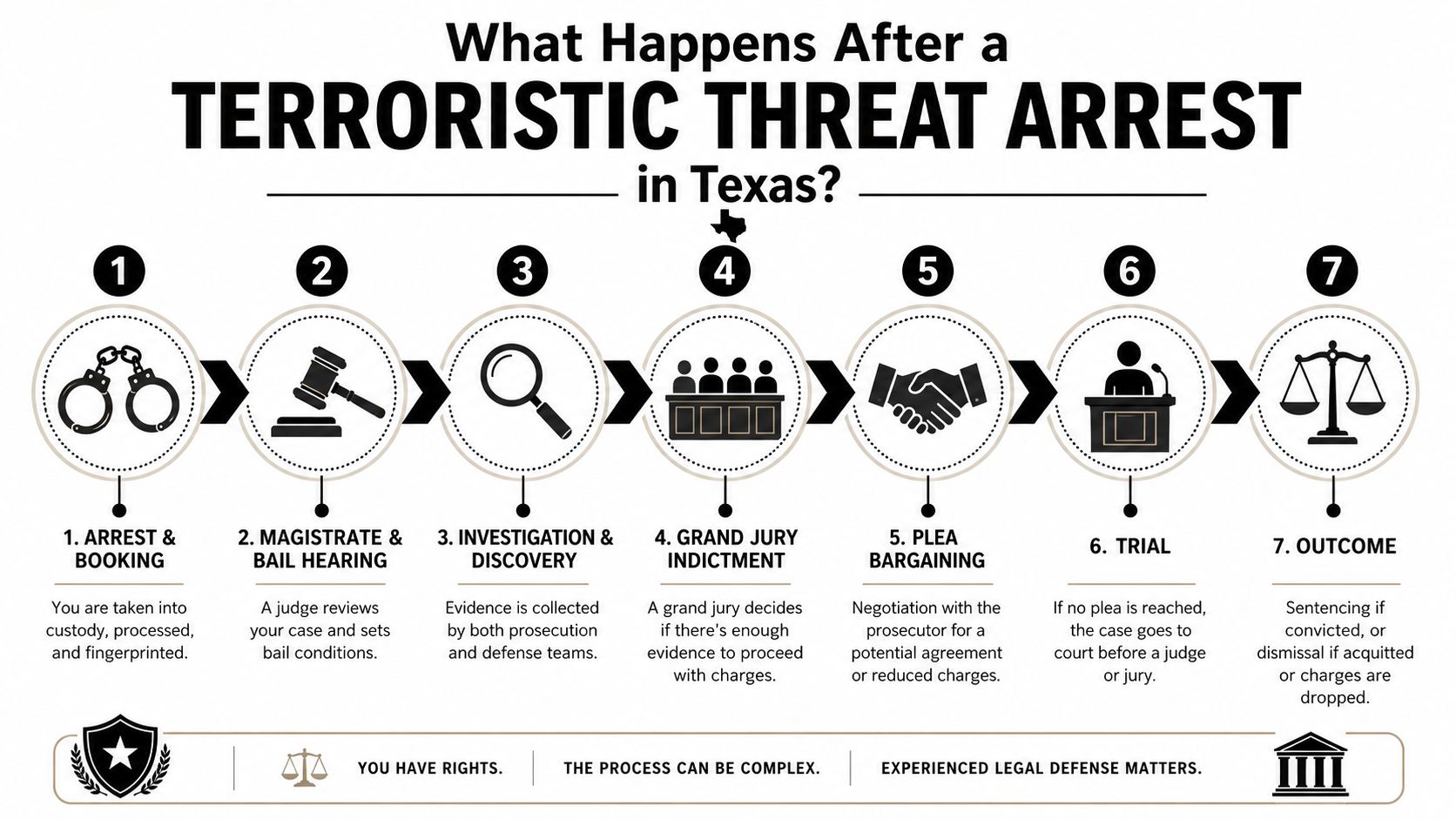
According to this overview of the legal process in terroristic threat cases, the defendant appears before a magistrate within 48 hours after arrest for bond setting, followed by a charging decision by the District Attorney that may involve a grand jury review for felony cases.
The early stages after arrest
Arrest and booking
Police take you into custody, gather identifying information, and enter the allegation into the system.Magistrate and bond setting
A judge reviews the case for initial release conditions. This stage can include no-contact rules, location limits, or other restrictions.Charging decision
The prosecutor reviews reports and evidence. An arrest doesn't force the state to pursue the highest charge possible, but it does begin that review.
Early advice: Follow every bond condition exactly as written. Even a small violation can create a new problem and weaken your defense position.
How felony review and court appearances work
If the case is filed as a felony, a grand jury may become part of the process. The grand jury reviews whether there is enough evidence for the felony case to move forward.
Later, you'll have an arraignment or first formal court appearance where you enter a plea. After that, your lawyer and the prosecutor typically move into discovery and negotiation.
To see a visual explanation of court movement in criminal cases, watch this short overview:
What usually happens before trial
Most cases don't jump straight from arrest to trial. There are usually several steps in between:
- Discovery review means your attorney examines the evidence, including reports, recordings, texts, witness accounts, and digital material.
- Investigation by the defense may include gathering context, preserving messages, identifying favorable witnesses, and checking whether police followed proper procedures.
- Plea discussions may happen if there is room to reduce the charge, resolve the case on better terms, or challenge weak parts of the state's proof.
If no fair resolution is reached, the case may proceed to trial. That's why preparation matters early. A prosecutor negotiates differently when defense counsel is ready to challenge intent, context, and proof in court.
For broader help with misdemeanor and felony allegations across the state, some readers also look for a Texas Criminal Defense Lawyer when comparing legal options.
Common Defenses Against Terroristic Threat Allegations
An accusation doesn't decide the case. Terroristic threat prosecutions often turn on interpretation, context, and credibility. That means there may be real room to challenge what the state claims your words meant.

Challenging intent and meaning
Because intent is often the center of the case, one common defense is that the statement was not made with criminal intent at all. The defense may argue that the words were:
- Spoken in transitory anger during a heated moment
- Vague or exaggerated
- Taken out of context
- Not directed in a way that meets the statute
Another issue is immediacy. If the statement doesn't communicate a real threat of imminent serious bodily injury in the way the state claims, that gap can matter.
Some of the strongest defenses begin with a simple question: what exactly was said, to whom, and in what setting?
Challenging evidence and witness accounts
These cases often depend on human recollection, screenshots, and selective reporting. A defense lawyer may examine whether:
- Messages are incomplete
- A recording starts too late
- A witness had a motive to exaggerate
- The allegation appeared during a custody fight, breakup, or workplace dispute
- Police omitted facts that support the defense
False or inflated allegations can happen, especially when emotions are already running high. That doesn't mean every accusation is false. It does mean the state's version should be tested carefully.
Constitutional and practical defenses
Some cases also raise issues about how evidence was gathered or how police questioned the accused. If officers ignored legal limits during a search or interrogation, that may affect what evidence can be used.
Good defense work is often methodical, not dramatic. It includes preserving favorable texts, identifying context witnesses, avoiding harmful admissions, and forcing the state to prove each required element instead of relying on assumptions.
If you're facing this charge along with DWI, assault, theft, or drug possession allegations, the same principle applies. Every charge has elements the state must prove. Your defense starts by slowing the case down and examining each one.
Life After a Case Expunctions and Nondisclosures
Even when the case ends, the stress often doesn't. People worry about job applications, apartment screenings, school opportunities, and what a background check might show.
Texas law may offer ways to limit or remove the impact of a criminal case, depending on how the case ended. Two terms come up often: expunction and order of nondisclosure.
The difference between expunction and nondisclosure
An expunction is the stronger remedy. In general terms, it is used to remove eligible records from public view when the law allows it.
An order of nondisclosure is different. It seals certain records from public access, but it isn't the same as erasing the case completely. For a closer look at how sealing works, see this guide to an order of nondisclosure in Texas.
When post-case relief may matter
These options often become important in situations like:
- Dismissed cases where a person wants to move on from an arrest record
- Deferred outcomes where sealing may become part of long-term planning
- Rehabilitation-focused cases where a clean slate supports employment and stability
- Older convictions where someone is trying to rebuild after a difficult period
The details depend on the actual outcome of your case. That's why post-conviction relief should be part of the conversation early, not only after everything is over.
Clearing or sealing a record isn't automatic. You usually have to ask for it through a separate legal process.
Practical next steps across Texas
Local practice can vary from county to county. A case in Houston may move differently from one in Dallas, Austin, or San Antonio, even when the law is the same. Court scheduling, prosecutor discretion, and filing habits all affect what a realistic strategy looks like.
For some readers, that strategy may include a plea discussion with future record-sealing goals in mind. For others, the right path is pushing for dismissal and then seeking expunction if eligible. Either way, your future should be part of the defense plan from the beginning, especially if you hold a professional license, work in education, or support a family.
If you've been charged with a crime in Texas, call Law Office of Bryan Fagan PLLC for a free and confidential consultation. Our defense team is ready to protect your rights.