Skip to content
Being arrested for a gun charge in Texas can turn an ordinary day into panic fast. You may be wondering whether the police got it wrong, whether a gun in your house or car counts as “possession,” or whether following Texas law was supposed to protect you.
When understanding unlawful possession of a firearm in Texas, you probably need more than a legal definition. You need a clear explanation of what the charge means, what happens next, and what you can do right now to protect yourself.
Facing a Gun Charge in Texas Can Be Terrifying
A weapons case can feel different from other criminal charges. Police, prosecutors, and judges often treat firearm allegations as serious from the start. That can affect bail, plea negotiations, and how aggressively the state investigates your case.
You might also be dealing with more than one problem at once. A firearm charge can show up after a traffic stop, a domestic dispute, a probation issue, or an arrest tied to another allegation like DWI, assault, theft, or drug possession. That matters because the gun charge may not stand alone. It can change how the entire case is handled.
What usually worries people most
Often, the fear comes in layers:
- Jail exposure: You want to know if you're facing a misdemeanor or felony.
- A permanent record: You may be thinking about your job, housing, and your family.
- Confusing gun laws: Texas law and federal law don't always match.
- What to say now: One bad statement to police can make defense harder.
Practical rule: If officers or investigators want to “clear things up,” don't try to explain the case yourself. You have the right to remain silent and ask for a lawyer.
A criminal case also follows a process, and knowing that process helps reduce panic. After an arrest, you may face booking, bail, arraignment, court settings, plea discussions, possible motions to suppress evidence, trial, and sentencing if there's a conviction. In some cases, post-conviction options may matter too, including appeals, record-related relief, or other rehabilitation-focused steps.
If your case overlaps with other charges, the strategy may also overlap. A Texas DWI attorney, Houston criminal lawyer, or Texas assault defense team often has to look at the whole picture, not just the weapon allegation in isolation.
You still have options
A charge is not a conviction. The state still has to prove possession, prove you were a prohibited person if that applies, and prove that police got the evidence legally. In many cases, the facts are more complicated than the arrest report makes them sound.
What Counts as Unlawful Possession of a Firearm
A lot of people hear the word "possession" and assume the case is simple. It usually is not. In Texas, unlawful possession cases often turn on two separate questions: Were you legally prohibited from having a gun at all, and can the state prove the gun was in your care, custody, control, or management?
Texas Penal Code §46.04 is the state law that usually drives this charge. For a person with a felony conviction, Texas generally bars firearm possession anywhere until five years have passed after release from confinement, parole, community supervision, or mandatory supervision, whichever happens last. After that, Texas law may allow possession only at the person's home, as summarized in this Texas Penal Code discussion.
That home-only rule is where many people get blindsided. A person can believe they are following Texas law and still face a serious federal problem later. State permission does not automatically erase the federal ban, and that conflict matters long before a case reaches federal court.
Who can be prohibited
Felony history is the category that gets the most attention, but it is not the only one prosecutors examine. They also look closely at family-violence convictions, active protective orders, fugitive status, and other legal restrictions that can block firearm possession under state or federal law.
The timing matters too. A prior case from years ago may still matter. A protective order that seems temporary can matter right now. A conviction that was handled in one court can create consequences in another.
This is why I tell clients to picture the case like a lock with more than one keyhole. The prosecutor does not just ask, "Was there a gun?" The prosecutor asks, "Who is this person under the law, what orders or convictions apply, and where was the firearm found?"
What “possession” really means
Ownership is only part of the story, and sometimes it does not matter much at all.
The state can try to prove possession by arguing you had actual care, custody, control, or management of the firearm. That can include a gun under a driver's seat, inside a closet in a room you control, in a backpack beside you, or in a home where officers believe you decide what stays and what goes.
But being close to a gun is not the same as possessing it. In a shared car, shared bedroom, or shared house, the core struggle is often over control. Who could access it? Who knew it was there? Who used that space? Who made statements to police?
In many firearm cases, the strongest defense issue is not whether a gun existed. It is whether the state can tie control of that gun to you.
If you are comparing this charge to other weapons offenses, Texas unlawful carrying of weapons covers a separate crime that people often confuse with unlawful possession. They are related, but they are not the same allegation.
Paperwork can create a different kind of risk. Ship Restrict's ATF Form 4473 insights explain how dealer purchase forms and screening issues can lead to separate legal exposure apart from a possession charge itself.
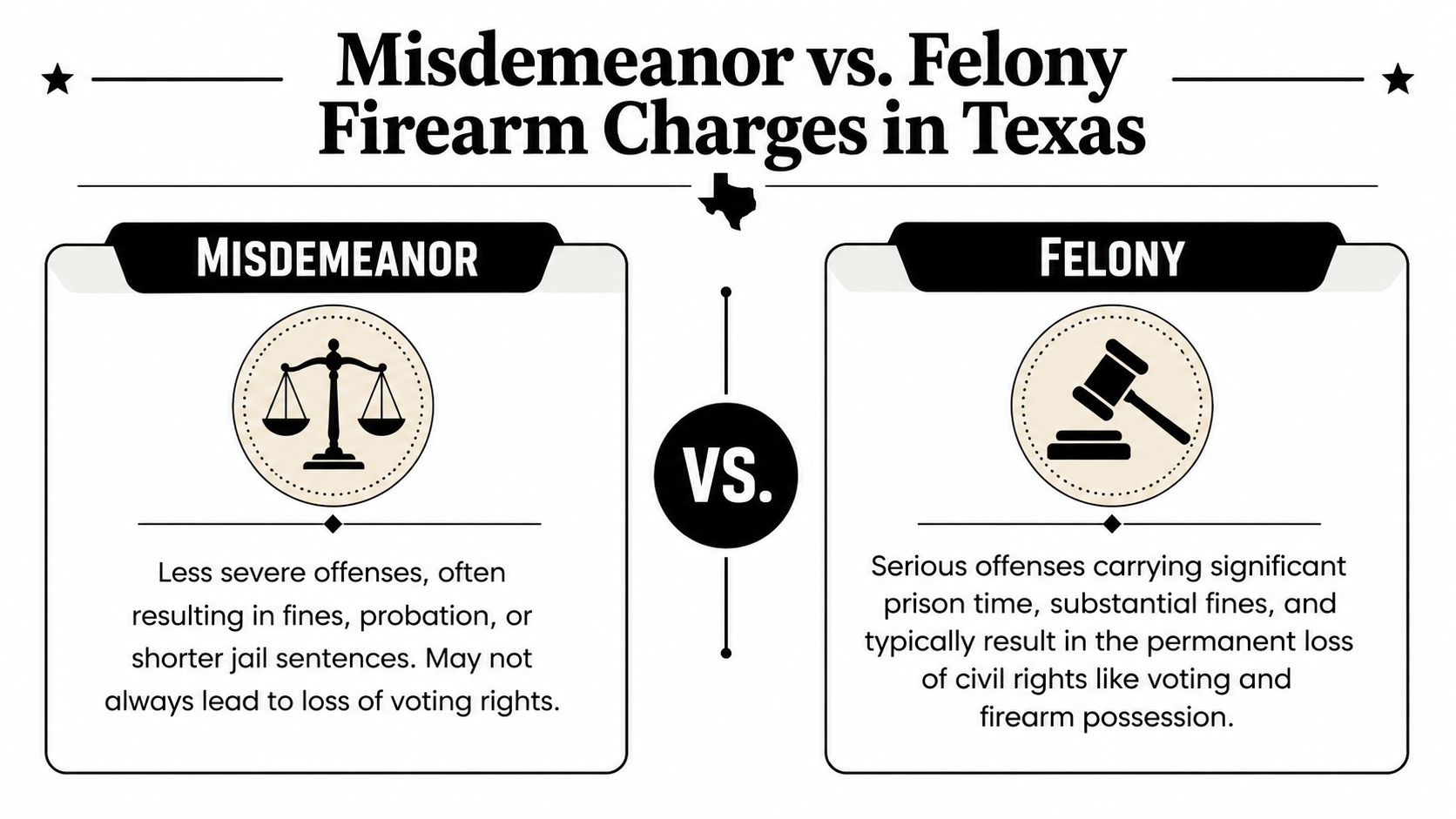
Misdemeanor vs Felony Firearm Charges
The difference between a misdemeanor and a felony gun charge is not just a label. It changes the stakes, the court process, and often the pressure you feel from the first hearing forward.
When the case is a felony
For many people, the felony version of this charge involves a prior felony conviction and an allegation that the person possessed a firearm in a way Texas law forbids. Under Texas Penal Code §46.04, that allegation is commonly filed as a third-degree felony.
That matters immediately. A felony case usually brings higher punishment exposure, stricter bond conditions, and more serious collateral damage outside the courtroom. Employers, licensing boards, landlords, and immigration authorities often react very differently to a felony accusation than to a misdemeanor one.
A simple way to view it is this. The same firearm can lead to very different consequences depending on the person's prior record and the legal reason the state says possession was prohibited.
When the case is a misdemeanor
Some unlawful possession cases are filed as Class A misdemeanors instead. A common example involves a person with a qualifying Class A misdemeanor family violence conviction within the restricted time period.
People sometimes hear "misdemeanor" and assume the danger is limited. It is not. A Class A misdemeanor can still mean jail, a lasting record, trouble in family law disputes, and added complications if a later arrest happens.
Quick comparison
| Situation | Likely charge level | Possible punishment |
|---|---|---|
| Person with a felony conviction possesses a firearm in violation of Texas law | Third-degree felony | Prison time and felony consequences |
| Person with a qualifying Class A misdemeanor family violence conviction within the past five years possesses a firearm | Class A misdemeanor | County jail exposure, a fine, and a permanent criminal record |
Why charge level matters so early
Charge level affects the whole strategy of the case. Felony prosecutors often approach negotiations differently. Judges may set different bond terms. The risk of pleading too quickly is also different, because the long-term effect of a felony conviction can follow you for years.
This is also where many people miss a second layer of danger. A case that looks limited under Texas law can still raise federal issues, especially for someone with a prior felony who believes state law gave them permission to keep a gun at home. If your facts even hint at that problem, it helps to understand how to choose a Texas federal defense lawyer for a gun case before you make statements or decisions that are hard to undo.
If you're also trying to understand the broader difference between offense levels, this guide on Felony vs. Misdemeanor Charges in Texas helps explain how Texas classifies crimes and punishment ranges.
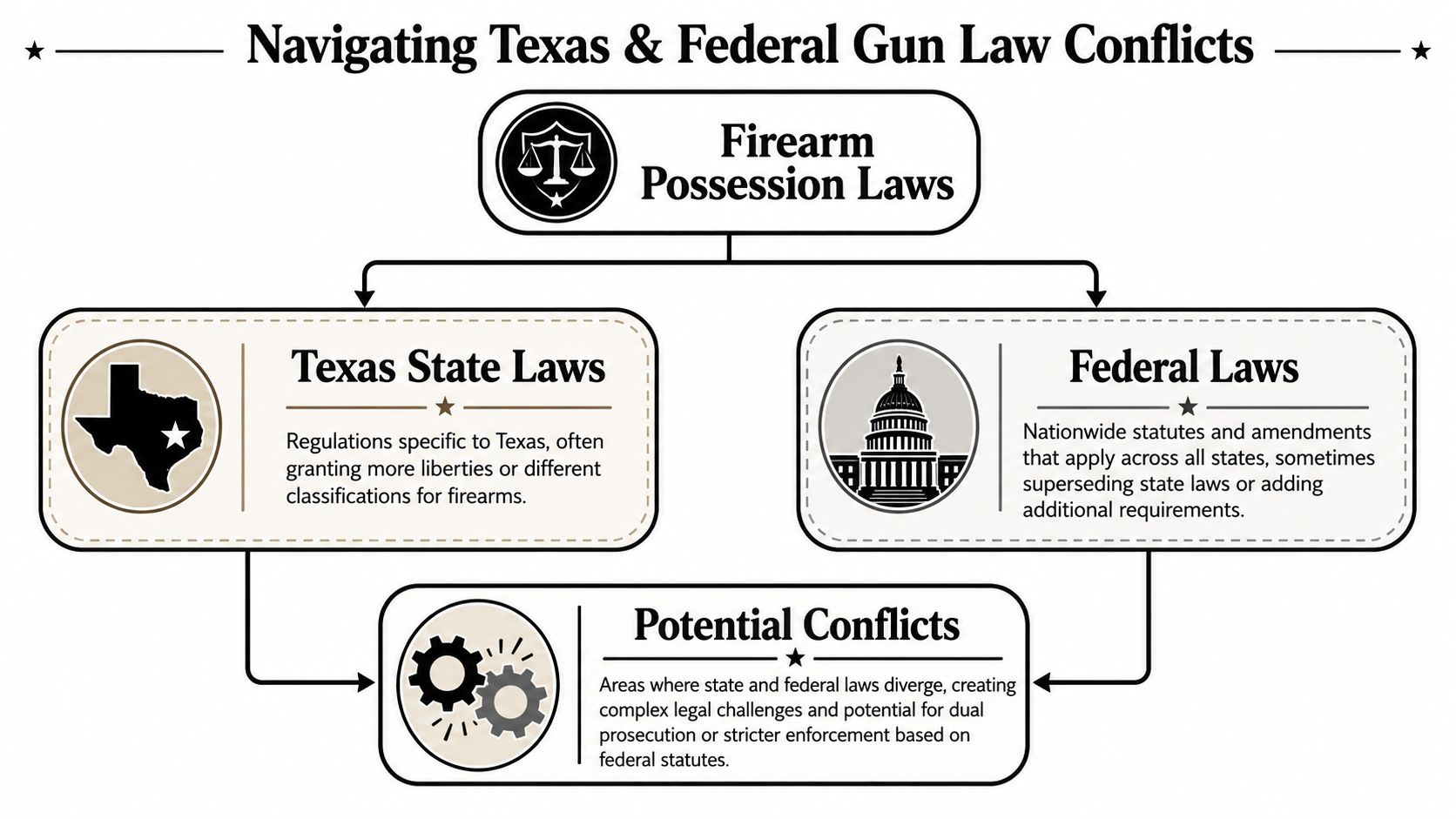
The Critical Conflict Between Texas and Federal Gun Laws
A lot of people believe that if Texas law allows something, they are safe. In gun cases, that assumption can be dangerous.
The Texas rule people rely on
Texas gives some convicted felons a narrow path after enough time has passed. After the waiting period ends, state law permits firearm possession only at the person's residential premises.
That sounds straightforward. Many people stop there and assume their rights have come back.
The federal rule that changes everything
Federal law does not follow that Texas exception. The unresolved conflict between Texas's 5-year home exception for felons and the lifetime federal ban under 18 U.S.C. §922(g) means possessing a firearm in your Texas home after five years remains a federal crime, leaving many Texans vulnerable to federal prosecution despite believing they are compliant with state law, as explained in this analysis of the Texas and federal conflict.
That is the trap. A person may think, “Texas says I can keep a gun at home now,” while federal law says, “No, you can't possess it at all.”
If you're a felon and you're relying only on Texas's five-year home exception, you may still be exposing yourself to federal prosecution.
Why this catches people off guard
The confusion usually comes from three things:
- State and federal laws use different rules.
- People hear part of the law and miss the federal side.
- A home possession exception sounds broader than it is.
This issue becomes even more serious when a case starts in state court and later draws federal attention. A traffic stop, domestic call, search warrant, or probation contact can uncover a firearm and lead to consequences far beyond what the person expected.
If your case may involve federal exposure, this guide on how to choose the best federal defense lawyer can help you understand what to look for in counsel.
Penalties and Lifelong Consequences
A gun charge can change the course of your life long after the court date ends. For many people, the hardest part is not only the risk of jail or prison. It is the way one case can keep showing up in jobs, housing, licensing, and future criminal matters.

The direct criminal penalties
In Texas, unlawful possession by a felon is usually charged as a third-degree felony. That can mean 2 to 10 years in prison and up to $10,000 in fines under Texas Penal Code § 46.04. If the allegation involves a person subject to a family violence protective order, the charge and punishment can look different, but the consequences are still serious.
Federal punishment can be severe too. The U.S. Sentencing Commission quick facts on felon in possession cases reported an average federal sentence of 64 months in the cases it studied.
That matters because the same firearm can create more than one kind of exposure. A person may believe they are following Texas law by keeping a gun only at home after the five-year period, yet still face a federal case if the facts fit the lifetime federal ban. State compliance does not automatically protect you from federal consequences.
The long-term effects outside the courtroom
A conviction follows you into parts of life that have nothing to do with a traffic stop or an arrest report. It can work like a permanent flag that appears whenever someone checks your background.
Common problems include:
- Employment barriers: Employers may pass over applicants with weapons or felony records.
- Housing denials: Landlords often screen for criminal history.
- Professional license trouble: Nursing, security, commercial driving, and other licensed fields may become harder to enter or keep.
- Family court problems: Gun allegations can affect custody disputes, protective orders, and how a judge views safety concerns.
- Higher stakes later: If you are arrested again, prosecutors often treat a prior weapons case as a sign that the new case deserves more attention.
One conviction can also shut the door on lawful firearm possession for years, and sometimes for life, unless your rights are restored in a way the law recognizes.
Why the state-federal conflict makes the consequences worse
This is the part many Texans do not see coming. Texas law may appear to give limited room for firearm possession in the home after five years for some felons. Federal law can still treat that same possession as a felony.
That mismatch creates a trap. A person can avoid one problem under state law and still face a much larger one under federal law. If you are trying to understand what relief may exist after a conviction, this guide to firearm rights restoration in Texas explains why restoration is more complicated than many people expect.
Record relief may exist, but it depends on how the case ends
Some outcomes leave more options than others. A dismissal, no-bill, acquittal, deferred disposition, or conviction all lead to different rules about what can be cleared, sealed, or limited.
That is why the final result matters so much.
Depending on the exact charge and disposition, a person may later look at expunction, nondisclosure, or other post-case remedies. Those options are narrow, fact-specific, and often unavailable after a conviction. Before you make decisions about a plea, it helps to ask not only, “What happens this month?” but also, “What will still be affecting me five years from now?”
Building Your Defense Against a Weapons Charge
A gun charge can feel overwhelming because the accusation often sounds simpler than the law is. Prosecutors still have to prove specific facts, and in many cases the fight starts with one basic question: did you legally "possess" the firearm?

Under Texas law, possession usually means actual care, custody, control, or management. That matters because being near a gun is not automatically the same as possessing it. If a firearm is found in a shared home, a borrowed car, or a backpack that several people could access, the state may have a harder time proving the gun was yours under the law.
This part confuses many people. The law works a bit like a set of house keys on a kitchen counter. If several adults live there, the fact that the keys are in the room does not tell us who controls them. A defense lawyer looks for the same problem in a gun case. Who owned it? Who could reach it? Who exercised control over it?
Common defense angles
A strong defense depends on the facts, but these are some of the issues lawyers examine closely:
- Lack of control: The gun was in a place used by other people, and the evidence does not clearly show it was under your control.
- Illegal search or seizure: Police may have found the firearm through a stop, frisk, car search, or home search that violated your rights.
- Assumptions instead of proof: Officers may treat presence as possession, but the state still has to prove more than suspicion.
- Timing errors: In status-based cases, the date a sentence ended, parole ended, or supervision ended can change how the law applies.
- Wrong legal framework: A person may appear to comply with Texas law at home after five years and still face a federal possession problem. That state-federal conflict can become part of the defense analysis because the exact charge, court, and prior record all matter.
- Weak evidence: The prosecution may not be able to connect you to the gun with reliable testimony, physical evidence, or a lawful statement.
Some defenses attack the evidence itself. Others challenge how police got the evidence in the first place.
What a defense lawyer does at each stage
A Houston criminal lawyer handling a weapons case usually starts by pulling the case apart piece by piece. That means reviewing the police reports, body camera footage, search warrant paperwork, witness statements, prior judgments, and the timeline of any earlier conviction or supervision. In a felon-in-possession case, your lawyer should also check whether prosecutors are looking only at Texas law, or whether federal exposure is lurking in the background.
That last point is often overlooked. Someone may hear, "Texas lets me have a firearm at home after five years," and assume the analysis is over. It is not. A careful defense has to account for both systems, because staying inside one set of rules does not always protect you from the other.
The process often looks like this:
- After arrest: Your lawyer reviews the claimed basis for the arrest, the reports, and any bond conditions.
- Early court settings: The defense identifies legal issues, requests evidence, and begins checking whether the state can prove possession.
- Pretrial motions: If officers stopped, searched, or questioned you unlawfully, your lawyer may ask the court to exclude that evidence.
- Negotiation or dismissal review: The defense uses gaps in proof, timing problems, and legal errors to push for reduction or dismissal.
- Trial preparation: If the case does not resolve fairly, the defense prepares to make the state prove every element beyond a reasonable doubt.
- Post-case review: A lawyer can also evaluate the long-term record consequences and whether any state result could still leave federal firearm risk.
This video gives a helpful general overview of how defense strategy can matter in criminal cases:
Getting legal help early matters
Early legal help gives your defense more room to work. Witnesses are easier to find, surveillance footage is less likely to disappear, and search issues are easier to examine before the case hardens around the police version of events.
One option for readers facing a Texas criminal case is Law Office of Bryan Fagan PLLC, a Texas-based firm that handles misdemeanor, felony, and criminal allegations including weapons cases, DWI, assault, theft, drug charges, record sealing, and post-conviction relief.
What to Do Immediately If You Are Charged
The first few hours after a gun arrest matter. What you say and do can either protect your case or make the prosecution's job easier.
Follow these steps right away
- Stay silent about the facts. Give your name and basic identifying information if required, but don't try to explain where the gun came from or why it was there.
- Don't consent to searches. If police ask to search your home, car, phone, or belongings, you can refuse consent.
- Ask for a lawyer clearly. Say you want an attorney, then stop answering substantive questions.
- Preserve details. As soon as you can, write down what happened, who was present, where the firearm was found, and what officers said.
- Keep away from new allegations. Follow bond conditions carefully and avoid contact that could trigger new charges or violations.
Ask for a lawyer in plain words, then stay quiet. That protects you better than trying to talk your way out of the case.
What happens after the arrest
Your case may move through several stages. First comes booking and bond. After that, you'll have an arraignment or initial court appearance, then later court settings where prosecutors and defense counsel exchange information and discuss possible resolutions.
Some cases resolve through plea bargaining. Others require motions hearings, especially if the defense is challenging a stop, search, or statement. If the case doesn't resolve, it can go to trial. If there's a conviction, sentencing follows, and in some situations your lawyer can advise you about post-conviction relief, expunction, or record sealing options when the law allows it.
If your gun charge came with another allegation such as DWI, assault, theft, or drug possession, your defense has to account for both cases together. A smart strategy looks at the whole record, not just one count on the complaint.
If you've been charged with a crime in Texas, call The Law Office of Bryan Fagan, PLLC for a free and confidential consultation. Our defense team is ready to protect your rights.