Skip to content
A detective calls. Then a parent sends an angry message. Then your phone starts lighting up with questions you don’t know how to answer.
If you’re searching what's the legal age of consent in texas, you’re probably not reading out of curiosity. You’re trying to figure out whether your life is about to change, whether an age gap matters, and whether one mistake, one accusation, or one misunderstanding can turn into a felony case.
It can feel isolating fast. People around you may give confident advice that’s completely wrong. Some will say “if it was consensual, you’re fine.” Others will tell you the Romeo and Juliet rule protects everything. Neither is a safe assumption in Texas.
The law is more exact than generally understood. It’s also less forgiving.
Facing an Age of Consent Accusation in Texas
A lot of these cases begin before an arrest. You may get a call from law enforcement asking if you’ll “come in and clear things up.” You may hear that a parent found text messages. You may learn that screenshots, photos, or social media posts are already being passed around.

That moment matters. What you do in the first day often affects everything that comes after. A rushed explanation to police, an apology text, or a deleted message can create problems that are much harder to fix later.
Why people get this wrong
These cases often appear to turn on simple questions like:
- Did the younger person agree
- Did they lie about their age
- Did they look older
- Were both people in a real relationship
Those facts may matter to context, negotiation, or defense strategy. But they don’t always control whether charges can be filed. That’s where people get trapped.
Practical rule: If police contact you about an age-related accusation, treat it like a felony investigation from the start.
What usually helps and what usually hurts
Some responses protect you. Others make the case easier for the State.
| Response | Likely effect |
|---|---|
| Staying silent until you have counsel | Protects you from filling gaps in the State’s case |
| Preserving texts, call logs, and app messages | Keeps context your attorney may need |
| Contacting the accuser or family to “fix it” | Often creates new evidence against you |
| Deleting screenshots or posts | Can look like concealment |
| Posting online about your side | Can damage credibility and invite more scrutiny |
A charge is not a conviction. But this is not the kind of accusation to handle casually. Clear legal advice, early, is often the difference between controlled damage and a case that gets away from you.
The Core Rule What Is the Legal Age of Consent in Texas
The short answer is straightforward. In Texas, the legal age of consent is 17. Under Texas age of consent rules and Penal Code § 22.011(a)(2), sexual intercourse with a person younger than 17 can be charged as sexual assault, a second-degree felony punishable by 2 to 20 years in prison.
That’s the black-letter rule. It doesn’t depend on whether the younger person said yes.
What strict liability means in real life
Texas treats these cases as strict liability in many situations. That means the prosecution generally does not have to prove you knew the person was under 17. It also means common explanations usually don’t work as legal defenses.
If the younger person lied about age, used a fake ID, had an adult-looking dating profile, or appeared older in person, those facts are generally not enough by themselves.
In a limited sense, this is like a speeding ticket. The law focuses on the act, not your personal belief about it. You may not have meant to break the rule, but that doesn’t stop enforcement.
For a broader discussion of how Texas treats consent in criminal cases, this guide on understanding consent in Texas law is a useful starting point.
Age of consent is not the same as adulthood
Another source of confusion is the difference between age of consent and age of majority.
A person can be old enough to legally consent to sexual activity under one statute, while still being a minor for many other legal purposes. In Texas, those are not the same thing. That gap matters because families, schools, and police often treat these situations through more than one legal lens at once.
What the State has to prove
In a typical allegation under this rule, the focus usually falls on a few practical points:
- Age: Whether the younger person was under 17 at the relevant time
- Conduct: What specific sexual conduct is being alleged
- Evidence: Messages, photos, statements, app records, and witness accounts
- Timing: When the relationship or contact began
Notice what’s missing from that list. Whether you thought the person was older usually is not the center of the legal fight.
People often come in believing the case will end once police hear “they told me they were 18.” In Texas, that usually doesn’t end the case.
What doesn’t work well
These arguments are common, but they usually don’t solve the legal problem on their own:
- “They looked grown.” Appearance is not a reliable defense.
- “Their dating profile said 18.” Online profiles are not a shield.
- “Their friends said they were older.” Hearsay from others rarely fixes the issue.
- “Their parent approved of the relationship.” Parental views don’t override the statute.
The practical takeaway is simple. If you’re asking what’s the legal age of consent in texas because law enforcement has contacted you, do not assume your explanation will clear things up. These cases are built around age, statute, and evidence. Once you understand that, you can start making smarter decisions.
Understanding the 'Romeo and Juliet' Exception
Texas does recognize that not every age-gap case involves predatory behavior. That’s where people hear about the Romeo and Juliet exception. But a lot of bad internet advice often begins with this topic.
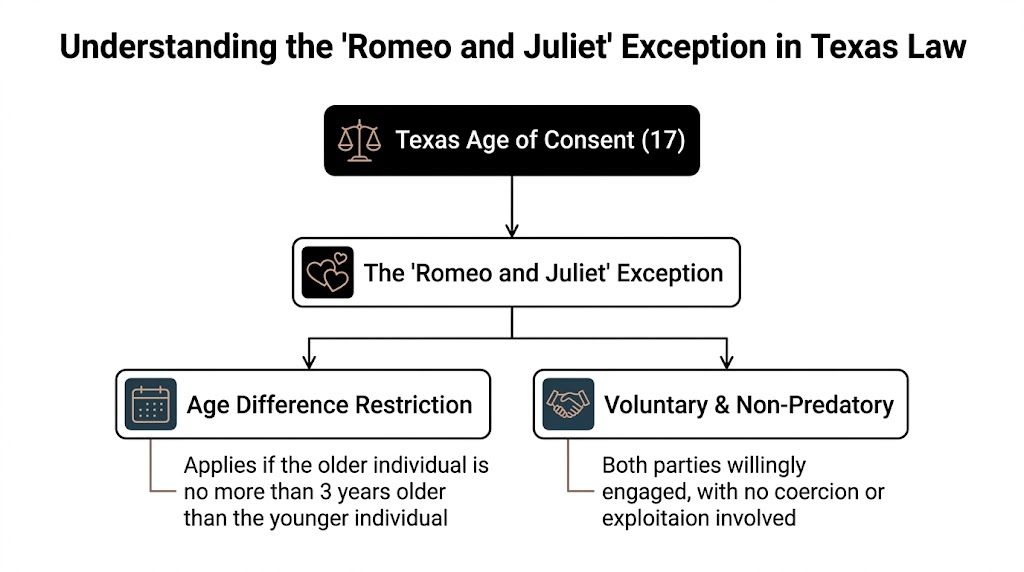
The key point is that this is not a free pass. It is an affirmative defense under Texas Penal Code § 21.11 in certain situations.
The three conditions that matter
Under Texas Romeo and Juliet exception rules in Penal Code § 21.11, the defense applies when the younger person is at least 14, the older person is not more than three years older, and the conduct was consensual. That same discussion notes Texas DPS data from 2023 showing 72% felony convictions for age gaps over 3 years, versus 18% for cases compliant with the exception.
That tells you something important. The line is narrow, and crossing it changes the case.
The easiest way to understand the line
Here’s the practical comparison:
| Situation | Likely issue |
|---|---|
| 19-year-old and 16-year-old | May fit the close-in-age defense, depending on the charge and facts |
| 20-year-old and 16-year-old | Age gap likely exceeds the defense |
| 16-year-old and 13-year-old | Younger person is below the minimum age for the defense |
That middle example is where many families are shocked. They assume one extra year can’t matter much. Under the statute, it can matter a lot.
Why “affirmative defense” matters
An affirmative defense is not the same as saying no crime was charged. It means your defense has to raise it and support it properly. You don’t want to assume police, prosecutors, or even court staff will sort that out for you automatically.
That usually means your attorney has to gather proof about:
- Exact birth dates
- The nature of the relationship
- Whether the conduct was voluntary
- Which statute the State filed under
A close-in-age relationship can still produce an arrest, a booking record, and serious disruption before the defense is ever recognized.
What this exception does not mean
People often use “Romeo and Juliet law” as if it covers every fact pattern involving teenagers or young adults. It doesn’t.
It does not mean:
- every consensual relationship is protected
- every prosecutor will decline charges immediately
- every related offense disappears
- every record vanishes if the case is resolved favorably
That last point is especially important. Even when the defense applies, the process itself can still cause damage. That includes time in jail, loss of privacy, school discipline, strained family relations, and a record that may need to be addressed later through legal cleanup.
The useful way to think about this rule is not as a loophole. Think of it as a very specific tool. It can be powerful when it fits. It can be useless when it doesn’t.
Related Charges Beyond Sexual Assault
An age-of-consent accusation rarely stays neatly inside one statute. A single relationship can produce several different allegations, especially when phones, images, or social media are involved.
That’s why a lot of people get blindsided. They look up the age of consent, decide they understand the risk, and then find out the case is also about photos, chats, or file sharing.
Why one set of facts can lead to different charges
The biggest trap is assuming the close-in-age rule works the same way across every offense. It doesn’t.
The Texas State Law Library’s age of consent guidance explains that the Romeo and Juliet defense is not a universal shield. It may apply to indecency with a child charges under Texas Penal Code § 21.11 with a 3-year age gap, but other statutes such as Sexual Performance of a Child under Texas Penal Code § 43.25 can define a minor as under 18 and may only allow a 2-year age gap defense.
That means a 19-year-old with a 16-year-old partner could face felony charges depending on the specific conduct alleged.
A real-world example of the gap
Take a dating relationship between two people who believe they are in a consensual situation.
If the allegation is one kind of physical conduct, the defense analysis may focus on the close-in-age rule you just read about. But if the case involves explicit images, saved videos, forwarded files, or screenshots from Snapchat, prosecutors may look at a different statute entirely.
Same relationship. Different legal path.
That’s why “but the age of consent is 17” is an incomplete answer. It may explain one rule while missing another one that creates separate criminal exposure.
Charges that often complicate these cases
Common issues can include:
- Explicit images: Photos or videos can trigger charges outside the core sexual assault statute.
- Saved chats and cloud backups: A person may think something disappeared, but the record may still exist on a device or account.
- Forwarding or showing content to others: Sharing can create a second layer of legal risk.
- Interstate communication: If travel or cross-state messaging enters the picture, the risk analysis gets more serious.
The legal question is often not “Was there a relationship?” It’s “What exact conduct does the State claim happened, and which statute are they using?”
Why statute-by-statute analysis matters
Defense strategy in these cases starts with careful sorting. Your lawyer has to identify each possible charge, match it to the right statute, and test whether any defense fits that statute.
That’s more important than is often realized. A family may think they’ve found relief after reading about Romeo and Juliet protections, when the accusation on the table is really about digital content governed by a different rule.
This is one reason online self-help goes wrong. General articles often answer the question “what's the legal age of consent in texas” as if that ends the analysis. In practice, the answer often opens the door to a more detailed review.
Potential Penalties and Long-Term Consequences
The legal penalty is serious enough on its own. Under the rule discussed earlier, sexual intercourse with a person younger than 17 can be charged as a second-degree felony punishable by 2 to 20 years in prison and fines up to $10,000 under Texas sexual assault penalties and related law.

But the penalty chart is only part of the story. In real life, people often feel the damage much earlier.
The arrest can hurt you before court does
According to this discussion of collateral consequences after an age-of-consent arrest in Texas, even with a successful close-in-age defense, an arrest record can appear on background checks and jeopardize college admissions, employment, professional licensing, and housing applications. Those consequences can hit before any conviction or acquittal, which is why quick action toward dismissal and later expungement matters.
That practical point gets overlooked in a lot of articles. People focus on whether they can beat the charge. They should. But they also need to think about the months in between.
What collateral damage looks like
The fallout may include:
- Work problems: Employers may place you on leave, decline hiring, or ask questions you aren’t ready to answer.
- School pressure: Colleges, graduate programs, and student organizations may react to the arrest itself.
- Licensing issues: Nurses, teachers, real estate professionals, and other license holders can face reporting concerns.
- Housing barriers: Landlords and property managers may flag an arrest even without a conviction.
These problems don’t wait for a jury verdict. They can start with a booking entry and an online record.
Here’s a short overview that helps explain why these cases carry so much weight:
Conviction is not the only outcome you need to care about
A strong defense aims at more than avoiding prison. It also tries to reduce the spread of damage.
That may include protecting your job, managing how and when information is disclosed, avoiding statements that make expunction harder later, and pursuing record-clearing relief if the case ends favorably. If there is a conviction, post-conviction relief may still matter. If there is a dismissal, you may still need formal action to clean up the record.
The case may end in court. The consequences often continue in the background unless someone actively addresses them.
Why timing matters
People sometimes wait because they hope the accusation will fade or the complainant’s family will calm down. That delay can be expensive. Once records circulate, employers search, and agencies ask questions, the problem becomes harder to contain.
The most practical defense posture is early and organized. Protect the criminal case, yes. Also protect the future version of your life that will have to answer for this incident on applications, interviews, and licensing forms if the record isn’t handled correctly.
Building a Defense Strategy for Your Case
If you’re under investigation, passivity is dangerous. These cases often involve digital evidence, emotional witnesses, and fast-moving assumptions. Once law enforcement starts collecting statements and device data, the case can build quickly.
That’s one reason early defense work matters so much. A Texas age-of-consent defense discussion notes that conviction rates for sexual assault exceed 90% in some Texas counties, and that a proactive defense should focus on challenging probable cause, scrutinizing digital evidence, and using procedural motions to push for a reduction or dismissal before trial.
What a real defense starts with
A defense lawyer doesn’t just show up on a court date and react. Good early work usually includes:
- Stopping client mistakes: No more direct contact, no more casual explanations, no more damaging texts.
- Reviewing the timeline: Ages, dates, travel, messages, and who knew what, when.
- Testing the digital record: Phones, screenshots, app logs, cloud storage, and whether context is missing.
- Looking at how evidence was obtained: Warrants, consent searches, interviews, and device access all need scrutiny.
For many clients, the digital side is the most misunderstood part of the case. Files often carry hidden information about date, time, edits, and location. If you’re gathering records for your lawyer, it can help to understand how to remove metadata from PDF copies you plan to share outside your defense team, especially when you want to limit unnecessary exposure of personal details. You should still preserve original files for your attorney.
The stages where strategy matters
These cases are shaped at several points, not just at trial.
Investigation stage
The most self-inflicted damage occurs when people agree to interviews, surrender context-free explanations, and assume honesty alone will protect them.
Usually, your lawyer wants to control communication and learn what law enforcement already has before you give them anything new.
First court appearance and arraignment
This stage can feel procedural, but it matters. Conditions of release, bond restrictions, and no-contact orders can affect your work, school, family life, and your ability to gather evidence.
Plea negotiations
A lot of cases are resolved before trial. That doesn’t mean you should rush into a deal. It means your lawyer needs an advantage. This advantage comes from weak evidence, legal issues, factual context, and a clear understanding of what the State can prove.
For readers exploring defense options in more detail, this page on a Texas sexual assault defense attorney and your legal options gives a useful overview.
Trial and sentencing
If the case doesn’t resolve earlier, the defense has to be ready to challenge witnesses, confront the State’s timeline, and present any affirmative defense clearly. If sentencing becomes necessary, mitigation still matters. Facts that don’t defeat guilt can still matter to outcome.
What tends to work and what tends not to
What works is disciplined, early, fact-heavy lawyering. What doesn’t work is hoping the issue will disappear, trusting police to “understand,” or assuming a relationship history solves a statutory problem.
In these cases, speed helps when it is organized. Panic helps no one.
Your Next Steps After an Accusation or Arrest
If you’ve been accused, keep your next moves simple and controlled.
Step one is silence
Don’t explain your side to police without a lawyer present. Don’t agree to a “quick interview.” Don’t try to talk your way out of it. If officers contact you, identify yourself if required, then clearly say you want an attorney and you’re exercising your right to remain silent.
Step two is no contact
Stop all contact with the accuser, their family, and potential witnesses. That includes calls, texts, DMs, comments, and messages sent through friends. Even a message meant to apologize or calm things down can be used against you.
Step three is preserve evidence
Save texts, emails, social media messages, call logs, photos, and app records. Do not edit them. Do not delete anything. Preserve the full context and let your lawyer decide what matters.
Step four is prepare for procedure
If there’s an arrest, the case may move through booking, bond, court settings, plea discussions, and possibly trial. Some cases also create later questions about expunction, record sealing, or other post-case relief. Those issues should be part of your legal plan early, not an afterthought.
Step five is get legal help now
The most important move is getting a Texas criminal defense attorney involved before you make the case harder. Early intervention can protect your rights, help manage contact with law enforcement, and position the case for the best possible result.
If you’ve been charged with a crime in Texas, call Law Office of Bryan Fagan PLLC for a free and confidential consultation. Our defense team is ready to protect your rights.