Being arrested in Texas can be terrifying. A court date on a sheet of paper can make it feel like your life is already spinning out of control.
Individuals often walk into this moment with the same fears. Am I going to jail today? Do I have to explain myself to the judge? Should I just plead guilty and get it over with? Those are normal questions. They're also the wrong place to make fast decisions.
What happens at your first court appearance in texas criminal court is usually much less dramatic than people expect. It's a procedural hearing. That matters because the smart work often starts before you ever stand in front of the judge.
Answering the Call to Court A Guide for Texans Facing Criminal Charges
If you've been given a court setting after an arrest for DWI, assault, theft, drug possession, or another charge, your first job is simple. Don't panic, and don't treat the hearing like your one chance to tell your whole story.
Typically, that first date is the beginning of the case, not the end of it. The court wants to identify you, make sure you know what you're charged with, address counsel, and move the case into the next stage. That's why preparation matters more than courtroom speeches.

A good lawyer uses the time before court to get organized, protect your bond position, and avoid early mistakes that can follow you for the rest of the case. If you're still deciding who should represent you, this practical guide on choosing the right attorney for your case gives a useful starting point for evaluating fit, experience, and communication style.
What you should expect right now
You should expect a process. Not a quick fix.
That process usually includes a first appearance, later court settings, evidence review, plea discussions if appropriate, motion practice, and sometimes trial. In some cases, the focus later turns to probation options, deferred adjudication, sentencing issues, or cleanup tools like expunction and nondisclosure if the law allows them.
Practical rule: The biggest mistake at the start of a criminal case is trying to solve it before you understand it.
If you're anxious, that's understandable. But anxiety doesn't have to control the next step. Knowledge helps. So does having a plan before your name is called.
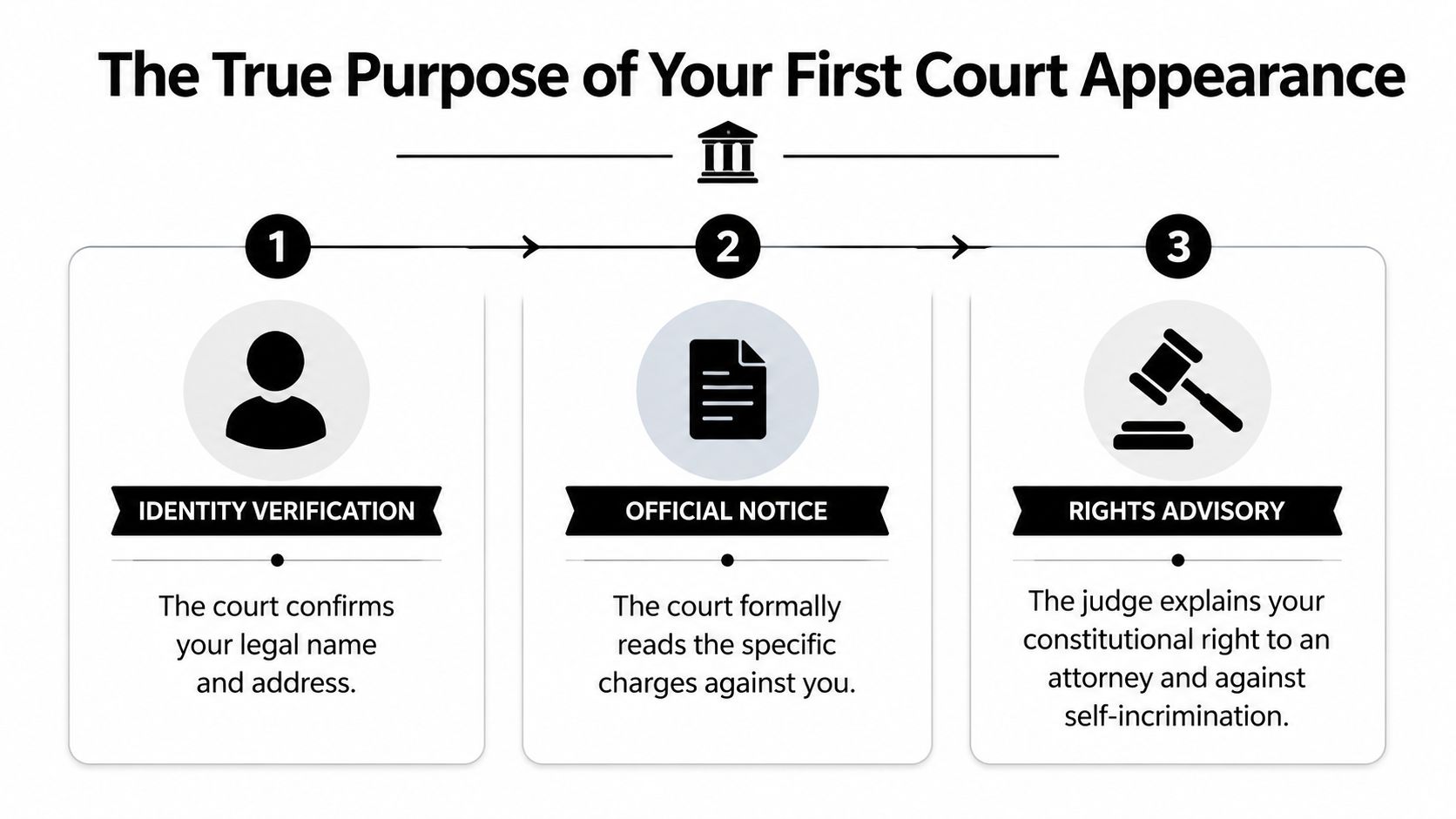
The True Purpose of Your First Court Appearance
Your first court appearance is often called an arraignment, initial appearance, or first setting. The label can change by court, but the function is usually the same. It is mainly an administrative hearing.
This appearance serves as the kickoff meeting for a major project. Nobody is finishing the project that day. The court is setting the ground rules, confirming who is involved, and deciding what happens next.
What the judge is usually doing
At this stage, the judge is usually focused on a few core tasks:
- Confirming your identity so the court knows the right person is present
- Making sure you know the charge that has been filed
- Addressing representation so it's clear whether you have counsel or need appointed counsel
- Handling scheduling and case management so the case moves to the next setting
- Addressing release issues if bond, restrictions, or compliance questions are still active
Research from Texas criminal defense analytics shows that over 80% of first appearances in county criminal courts result in the formal entry of a not guilty plea and the resetting of the case for later hearings, not a conviction or sentencing on the same day according to this explanation of Texas first criminal court appearances.
That should take some pressure off your shoulders. In Houston, Dallas, Austin, San Antonio, and courts across Texas, this hearing is usually not where guilt is decided.
What this hearing is not
It is not usually the moment to present witnesses. It is not usually the moment to argue every fact in the police report. It is not usually your one shot to tell the judge why the arrest was unfair.
Those issues may matter later. They just usually don't get decided here.
Most first appearances feel brief because they are built to move the case forward, not to finish it.
That's why calm preparation works better than emotional reaction. A defendant who shows up on time, says little, and has counsel ready often starts from a much stronger position than someone who tries to argue the whole case at the opening setting.
Understanding Your Constitutional Rights in Court
Your rights are not technical details. They are the guardrails that protect you from making a bad situation worse.
One of the most important things that happens early is the court's duty to advise you of core rights. Under Texas Code of Criminal Procedure Article 15.03, a magistrate must hold an initial appearance within 1 working day in larger counties or 3 working days in smaller counties, and at that appearance the magistrate must inform you of the charges, determine probable cause, and advise you of your right to counsel, as shown in the Texas courts' felony caseflow materials.
Your right to a lawyer
If you can hire a lawyer, do it as early as possible. If you can't afford one and you qualify, you can ask for court-appointed counsel.
This matters in every type of case. A Texas DWI attorney may focus on the traffic stop, testing issues, and bond conditions like ignition interlock. A Texas assault defense lawyer may focus on witness credibility, self-defense, and no-contact orders. A lawyer in a theft or drug possession case may start by examining search issues, statements, or chain-of-custody problems.
The right to counsel is not a formality. It protects you from walking blind into a system that moves on deadlines, procedures, and records.
Your right to remain silent
People often confuse the courtroom right to remain silent with Miranda warnings. They are related, but they're not the same thing.
Miranda warnings usually come up during custodial interrogation. Your courtroom right to remain silent is broader in practical effect. You do not need to explain your case in open court. You do not need to talk your way into mercy. In many cases, speaking freely at the wrong time only gives the prosecution more to work with.
If you want a clearer explanation of suppression issues and police questioning, this discussion of Miranda rights violations in Texas cases is a helpful reference.
What smart defendants do with these rights
They use them.
- Ask for counsel instead of guessing
- Keep answers short when the court asks basic procedural questions
- Don't discuss facts of the case in the hallway, courtroom, or with anyone except your lawyer
- Treat the hearing seriously even if it feels quick
A judge won't punish you for using your rights. A prosecutor won't dismiss a case because you sounded sincere. Rights exist so your defense has room to work.
Navigating Bond Bail and Conditions of Release
For many people, the most urgent issue is getting out of jail or staying out while the case is pending. That's where bail and bond come in.
In plain English, bail is the amount or condition set for release. Bond is the mechanism used to secure that release. People often use the words interchangeably, and in everyday conversation that's fine. What matters is understanding what the court is deciding and what you must do to stay compliant.
Common forms of release
You may hear about several kinds of bond:
- Personal bond or PR bond means you are released based on your promise to appear and follow conditions
- Cash bond means money is posted directly with the court
- Surety bond means a bail bond company posts the bond for a fee
The court also looks at practical concerns when setting terms. In real life, judges often care about the nature of the allegation, whether you're likely to return to court, and whether there are public safety concerns.
Conditions that can change daily life
Release is not always simple freedom. It can come with strict rules.
In a family violence or assault case, the court may enter a no-contact order. That can affect where you live, who you can call, and whether you can return home. In a DWI case, the court may require an ignition interlock device, alcohol monitoring, or restrictions on driving. In a drug case, testing or treatment conditions may follow.
For a closer look at how courts handle these issues, this article on what happens at a bond hearing in Texas gives useful detail.
If the judge releases you with conditions, treat every one of them like a direct court order. Because that's exactly what they are.
Where preparation helps most
A lawyer can often do more for bond issues before the first setting than people realize. The court is more likely to listen to organized information than to panic.
Helpful preparation often includes:
- Stable residence proof such as a lease, utility bill, or family confirmation
- Work information showing you have a job, schedule, or business responsibilities
- Medical or family needs that support release or modified conditions
- Clean compliance after arrest including showing up, testing if required, and avoiding new trouble
Here's a short video that helps frame bond and release concerns in practical terms:
The wrong move is assuming bond conditions are negotiable on your own. The better move is to have counsel present a clear, credible reason for the court to reduce restrictions or lower the burden of release.
How to Handle Your Plea at Arraignment
For most defendants, the safest and smartest plea at the first appearance is Not Guilty.
That answer scares people because they think it means they are denying reality. It doesn't. In criminal court, a not guilty plea is usually a procedural move that preserves your rights and gives your lawyer time to examine the government's evidence before you make life-changing decisions.
Why not guilty is usually the correct first move
In Texas, most first appearances are reset for discovery, which allows the defense to review evidence under CCP Article 39.14 before any formal plea is entered, and entering Not Guilty is the standard procedure used to trigger that review process, as described in this discussion of the Texas first court appearance process.
That matters because police reports do not always tell the full story. Videos may help you, hurt you, or contradict the narrative. Witnesses change. Search issues surface. Lab work can matter in a drug possession case. A theft allegation may involve consent, ownership disputes, or lack of intent. An assault accusation may involve self-defense or mutual combat. A DWI file may raise stop, field test, or blood draw issues.
What the other pleas can mean
A Guilty plea is exactly what it sounds like. You are admitting the offense.
A No Contest plea means you are not contesting the charge. In practice, it often leads to the same criminal result as a guilty plea in court. Either one can carry serious consequences for your record, your job, professional licensing, immigration status, and your ability to seek later relief.
That's why quick pleas often backfire. People plead early because they want relief from stress. But relief bought too fast can create a conviction that follows you long after the court date is over.
Don't plead for peace of mind. Plead only after your lawyer has enough facts to give real advice.
If you want a state-by-state comparison, this Georgia arraignment hearing process guide shows how arraignment works outside Texas. But Texas procedure has its own rhythm, and local practice matters.
You can also review this overview of what happens at arraignment hearing in Texas for a more Texas-specific breakdown.
Misdemeanor vs Felony First Appearances in Texas
Not every first appearance looks the same. The level of the charge affects the court, the pace, and what may happen next.
A misdemeanor usually moves through county-level courts. A felony usually moves through district court and carries more exposure, more formal process, and more long-term consequences. That doesn't mean your first hearing becomes a trial. It means the stakes and future path are different.
The basic comparison
| Aspect | Misdemeanor (Class A/B) | Felony |
|---|---|---|
| Typical court | County Court or County Court at Law | District Court |
| Examples | DWI, assault causing bodily injury, theft, drug possession in lower amounts | Higher-level drug possession, aggravated assault, robbery, burglary, white-collar allegations |
| First appearance focus | Advisements, scheduling, counsel status, bond issues | Advisements, counsel, bond issues, and positioning for the charging process |
| Case pace | Often faster to early negotiation | Often requires more investigation and formal litigation |
| Practical stakes | Jail exposure, fines, probation, record impact | Prison exposure, stricter bond concerns, felony record consequences |
What about Class C cases
Class C misdemeanors are different. These include many ticket-level and fine-only allegations handled in municipal courts or justice courts.
According to the Texas first appearance guide from Ticket Help Texas, 70 to 75% of first appearances for Class C misdemeanors are resolved through pleas, deferrals, or administrative resets without a full trial. That's one reason traffic-style first appearances can feel much more direct than county or district criminal court.
Why this distinction matters to you
A Class B DWI and a felony drug possession case may both begin with anxiety, but they won't move the same way. Felony cases usually demand more patience, more document review, and tighter control over what you say and do.
For misdemeanor defendants, the risk is often underestimating the case because it seems smaller. That's a mistake. Even a misdemeanor can affect work, housing, insurance, firearm rights in some situations, and future enhancement exposure.
For felony defendants, the common mistake is hopelessness. A felony accusation is serious, but the first setting is still just the beginning. Your defense is built through investigation, motion practice, negotiation, and if needed, trial preparation.
What to Do Before and After Your Court Date
The night before court, many clients are focused on one question: “What do I say when my case is called?” A better question is, “What can I do before I walk into that courtroom?” In many cases, the work done before the first setting affects bond terms, prevents avoidable mistakes, and gives your lawyer a head start on the facts.
Good preparation can change the tone of the case early. If a lawyer has time to review your paperwork, identify bond problems, collect favorable records, and contact the prosecutor when appropriate, your first appearance is less likely to be wasted on confusion and damage control. This early stage also gives you time to read practical guidance on what to expect during a Texas criminal case.
What to do before court
Start by getting organized.
- Hire counsel as early as you can. Early representation gives your lawyer time to review the complaint, bond conditions, notice settings, and possible pressure points before the hearing.
- Collect every paper tied to the case. That includes your citation, bond paperwork, charging documents, court notices, jail release papers, and any conditions of release.
- Write out a private timeline for your lawyer. Include what happened before police arrived, what officers said, who was present, what was searched or seized, and whether any video, texts, or medical records exist.
- Bring proof of stability. Pay stubs, school enrollment, proof of residence, treatment records, and family responsibilities can help when bond terms or court compliance are being discussed.
- Dress neatly and arrive early. You do not need to impress anyone. You do need to show the court that you take the process seriously.
One more point. Do not wait until the parking lot to ask basic questions about where to stand, whether to speak, or whether your case may be reset. Those are the kinds of issues your lawyer should help you sort out beforehand.
What helps and what hurts
Certain habits put defendants in a better position right away:
- Talk about the facts only with your lawyer
- Follow every bond condition exactly
- Save documents, screenshots, receipts, and contact information for witnesses
- Tell your lawyer promptly if your phone number, address, or job changes
Other choices create problems fast:
- Contacting an alleged victim despite a no-contact order
- Posting about the arrest, police, or witnesses online
- Missing testing, classes, reporting, or check-ins
- Treating a reset like a dismissal
A reset usually means the case is still being worked. Sometimes that extra time helps the defense. Sometimes it gives the State more time too. The result depends on how that time is used.
What to do after court
After the hearing, keep the paperwork. Read any bond conditions again the same day. I tell clients to calendar every court date before they leave the courthouse and to send questions early, not after a problem has already started.
Stay in contact with your lawyer. Ask before you travel. Ask before you contact anyone connected to the case. If the court orders classes, testing, treatment, ignition interlock, or reporting, complete each requirement exactly as written and keep proof.
If your case is resolved favorably later, ask whether expunction, nondisclosure, record sealing, or another form of relief may be available. For many people, clearing the record is part of the actual finish line.