Realizing you missed a criminal court date in Texas can make your stomach drop. You may be thinking about your job, your family, your bond, and whether the police can arrest you today.
That fear is understandable. Missing court is serious, but it's also a problem that can often be managed if you move fast and make smart decisions. If you're searching for what happens if you miss a court date in texas criminal case, the most important thing to know is this: don't ignore it, don't guess, and don't wait to see what happens.
Your Heart Sinks You Just Missed Your Court Date
Most people don't miss court because they wanted to defy a judge. They miss it because life got messy. A date was written down wrong. A notice went to an old address. A child got sick. A car broke down. A work shift ran long. Then the realization hits, and panic takes over.
At that point, people usually make one of two mistakes. They freeze and hope the court will reset the date on its own. Or they call the court themselves without any plan and say things that make the problem worse. Neither approach helps.
A missed court date creates a chain reaction in a Texas criminal case. The court may issue a warrant, your bond may be affected, and prosecutors may treat your original charge more aggressively. But this is still a fixable moment in many cases, especially when you respond quickly and present the right information the right way.
Practical rule: The first hours after a missed setting matter. Calm action works better than panic.
What helps is a clear recovery plan. You need to find out what the court did, whether a warrant is active, whether your bond was revoked, and what your lawyer can do to get you back in front of the judge with the least damage possible.
That plan looks different for a Class C ticket, a DWI, an assault case, a theft charge, or a felony drug case. But the basic goal stays the same. Get ahead of the warrant, control the surrender or recall process, and protect the original case before the situation grows.
An Arrest Warrant Is Now Active Against You
When you miss a required criminal court date in Texas, the court can issue a bench warrant, also called a capias. In plain English, that means the judge has ordered law enforcement to arrest you and bring you before the court.
Under Texas criminal court procedures for a missed appearance, missing a court date triggers an automatic issuance of a bench warrant under Article 23.01, and clerks can enter that warrant into NCIC databases within hours. That's why a routine traffic stop or ID check can suddenly turn into handcuffs and jail.
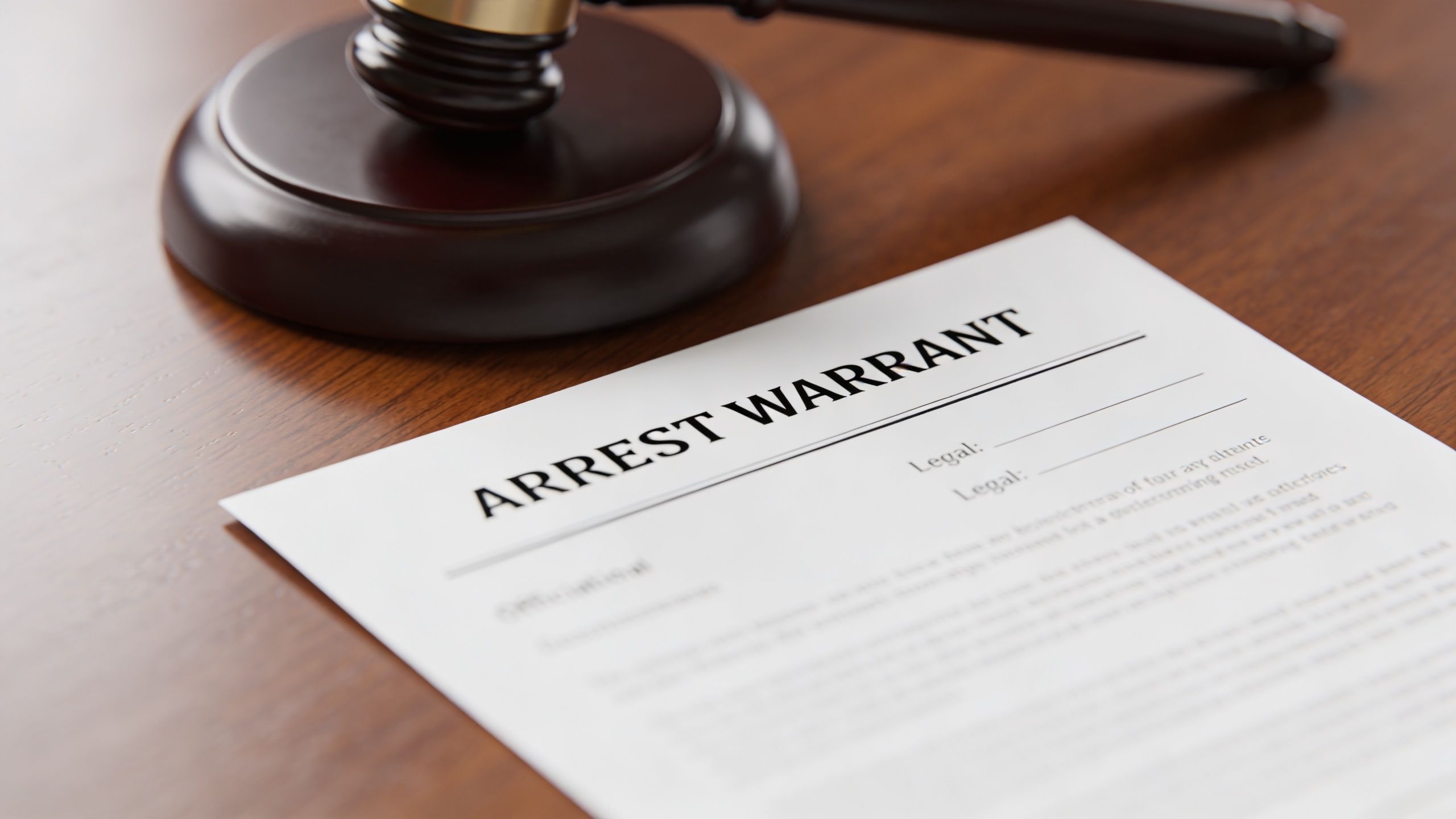
What a capias means in daily life
A capias isn't something that sits in a file. It follows you around. If an officer runs your name during a traffic stop, a roadside accident investigation, or another police contact, the warrant can appear immediately.
That's why “I'll just stay careful for a while” is not a strategy. People get picked up while driving to work, returning home, or dealing with an unrelated issue.
If you want a plain-English breakdown of the term itself, this guide on what a bench warrant means in Texas is a helpful starting point.
What usually doesn't work
Some people think calling the clerk and saying, “I forgot,” will automatically fix it. Usually it won't. Clerks don't decide whether to withdraw a warrant. Judges do.
Others assume they should wait until the next court notice arrives. That can be risky because the warrant may already be active before any new notice shows up.
A few people try to walk into court alone without checking whether they'll be taken into custody. Sometimes that works out. Sometimes it leads to an immediate arrest in the hallway. You need a plan before you physically show up.
Once the warrant is active, the question usually isn't whether law enforcement can arrest you. It's whether you can get in front of the problem before they do.
The practical takeaway
Treat the warrant as live unless a lawyer confirms otherwise. Don't test it by driving around and hoping for the best. Don't assume a small original charge means the court won't care. Texas courts take missed criminal settings seriously, including in busy counties where judges see non-appearances every day.
You Now Face a New Criminal Charge for Failure to Appear
A warrant is only part of the problem. Texas law can also turn the missed court date into a new criminal offense called Failure to Appear, often shortened to FTA.
Under Texas Penal Code 38.10 and missed court penalties, FTA is a separate offense. That means the state can prosecute the original case and the missed appearance.
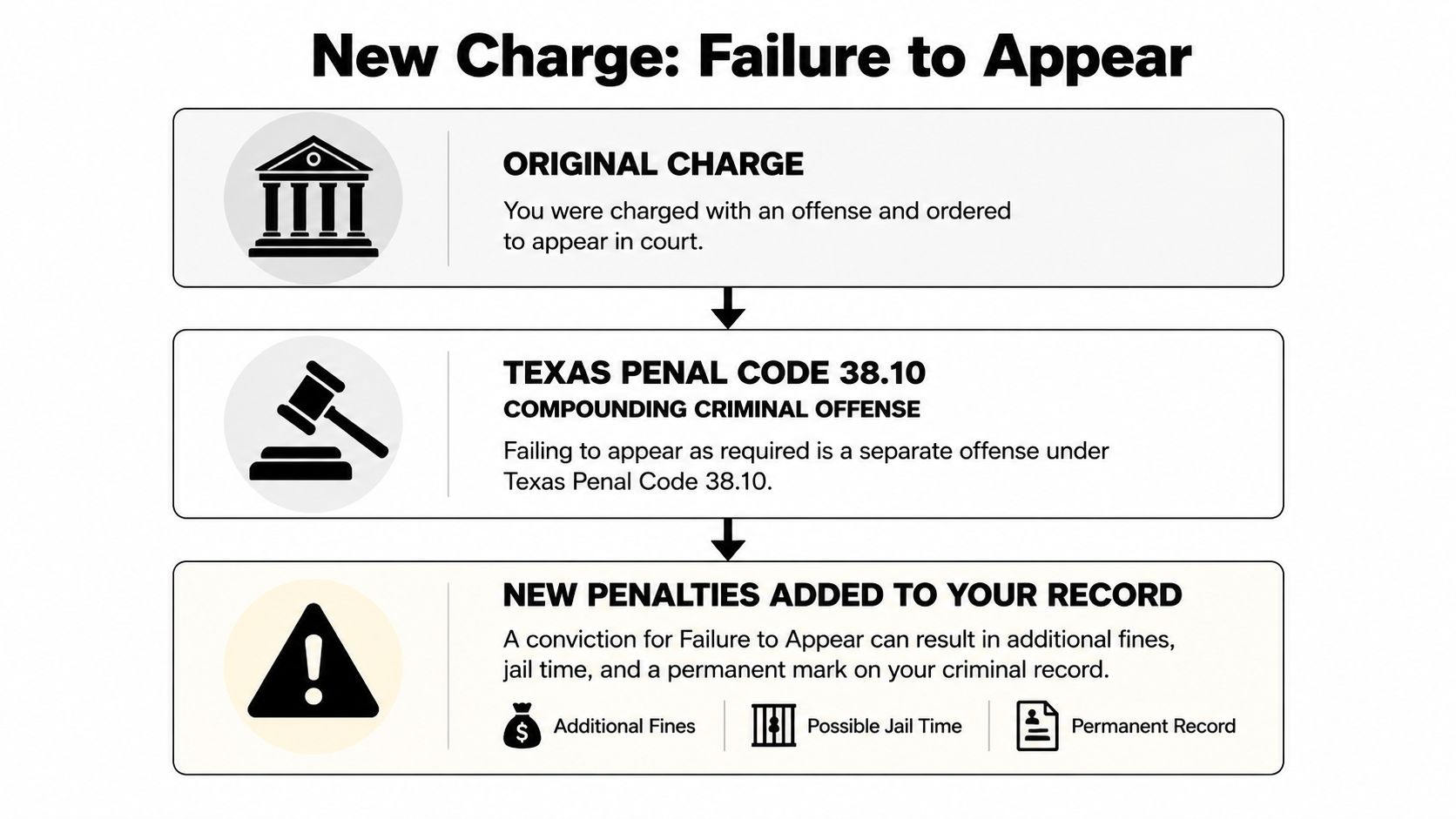
How the new charge is graded
The severity of the FTA charge depends on the seriousness of the original charge.
| Original charge | FTA classification | Maximum penalty |
|---|---|---|
| Class C misdemeanor | Class C misdemeanor | Fine up to $500 |
| Class A or B misdemeanor | Class A misdemeanor | Up to 1 year in county jail and fine up to $4,000 |
| Felony | Third-degree felony | 2 to 10 years in prison and fine up to $10,000 |
That matters a lot in real life.
If you missed court on a Class A or B misdemeanor, such as certain DWI, assault, or theft charges, the FTA can itself be a Class A misdemeanor. If you missed court on a felony, the FTA can become a third-degree felony with 2 to 10 years in prison and a $10,000 fine.
Why this catches people off guard
Many defendants think missing court is only a scheduling issue. It isn't. The state may treat it as a new crime because you were released on the condition that you return.
That's why a missed setting in a drug possession case, burglary case, robbery case, or aggravated assault case can sharply increase your exposure. Even if the original defense had strong issues to work with, the new FTA charge creates another problem to solve.
Key point: The missed date doesn't replace the original case. It adds another layer to it.
What this means for your defense strategy
The right response depends on timing and proof. If you act quickly and present a legitimate explanation in a proper way, you may be able to improve your position before prosecutors decide how hard to push the FTA issue. If you ignore the problem, you hand the state a stronger argument that the non-appearance was intentional.
For anyone facing DWI, assault, theft, or felony allegations, legal advice matters most. The same missed date can be a manageable setback in one case and a major escalation in another.
How a Missed Court Date Damages Your Original Case
Even before the separate FTA charge is resolved, a missed appearance can hurt the case you already had. Judges and prosecutors often see the missed date as a sign that you may not follow court orders going forward. That affects bond, negotiations, and credibility.
In high-volume counties, the reaction can be fast. According to Harris County court information on failure to appear, judges in major counties like Harris and Tarrant immediately issue warrants and revoke bonds upon a single missed appearance, and defense attorneys observe that new bond amounts often increase by 20 to 50% and additional FTA charges are filed in over 80% of cases.

Bond problems start quickly
If you posted bond, the court may treat your missed date as a violation of release conditions. That can mean bond forfeiture, bond revocation, or a harder road to getting released again.
When a judge thinks you might not return, the next bond usually comes with less trust and more restrictions. That can affect where you live, how you travel, and whether you can stay at work while the case is pending.
If you want more context on what happens after release conditions are set, this article on what happens after being released on bond in Texas gives a useful overview.
Plea deals often get worse
A missed court date can also change the tone of the case. A prosecutor who was open to a reasonable plea bargain before may take a tougher line after an FTA. Judges may also become less flexible about resetting hearings or approving favorable terms.
This is especially important in cases where the defense was building trust through compliance. If you were showing up, testing clean, attending classes, or working toward a dismissal path, one missed date can interrupt that progress.
Here are the trade-offs in plain terms:
- If you act quickly: Your lawyer may be able to show the court that this was a real mistake, not a refusal to appear.
- If you wait: The court has more time to treat you as a flight risk.
- If you surrender strategically: You may have a better chance of controlling when and how custody happens.
- If you get arrested unexpectedly: You lose control of timing, preparation, and often your advantage.
Evidence can help if your absence had a real cause
If you missed court because of an emergency, proof matters. Medical paperwork, repair records, screenshots of court notices, and phone logs can all matter depending on the facts. If your explanation involves texts with a bondsman, family member, employer, or court staff, learn how to preserve text messages for court so that useful evidence isn't lost or altered.
Judges hear excuses every day. Documents carry more weight than apologies.
A Strategic Plan to Address Your Warrant and FTA Charge
The worst move after a missed court date is doing nothing. The best move is a deliberate, controlled response. In many Texas criminal cases, there are two main paths: try to get the warrant recalled before arrest, or arrange a planned surrender that avoids unnecessary chaos.

Under Texas guidance on recalling a missed-court warrant, a proactive approach is critical. A lawyer can file a Motion to Recall Warrant under Article 23.13, and a sworn affidavit describing a legitimate emergency can significantly improve the chances of recall without arrest and may even prevent the prosecutor from filing the separate FTA charge.
Step one is not calling the court blindly
Your first move should usually be speaking with a criminal defense lawyer who handles Texas warrants and missed court settings. A lawyer can confirm the court, the warrant status, the bond posture, and whether the judge is likely to consider a recall request before requiring surrender.
Different courts respond in unique ways. A district court managing a felony case might require a more formal procedure than a lower-level court. Some judges demand written evidence before they will consider leniency. Others might require a physical appearance regardless of the circumstances.
For more background on the process itself, this page on an arrest warrant in Texas can help you understand the bigger picture.
When a motion to recall may be the better option
A Motion to Recall Warrant asks the judge to withdraw the capias and put the case back on track. This approach is often strongest when the missed appearance happened because of a documented and credible problem.
Good examples may include:
- A medical emergency: Hospital records, discharge papers, or urgent care paperwork can support the explanation.
- A notice problem: Proof that the court notice went to the wrong address or that you never received the setting can matter.
- A serious family crisis: Courts may consider death, severe illness, or another documented emergency in the immediate family.
- A verified mistake with supporting records: A screenshot alone may not be enough, but a full paper trail can help.
Poor explanations usually sound vague, unsupported, or careless. Saying you were busy, forgot, overslept, or assumed your lawyer would handle it without proof won't usually put you in the strongest position.
How to frame the mistake to the court
The court usually wants to know three things:
- Why you missed the date
- Why the court should believe it won't happen again
- Why you should be trusted with release or a reset
That means your explanation should be direct and responsible. Not dramatic. Not evasive. Not blaming everyone else.
A strong presentation usually does three things at once:
- admits the missed appearance happened
- provides documents, not just a story
- shows immediate corrective action
A judge is more likely to listen when you take responsibility and show proof.
Here's a useful mindset: you are not trying to win sympathy alone. You are trying to restore credibility.
A short video can help clarify how lawyers approach warrant issues in practice.
When a walk-through surrender makes more sense
Sometimes recall isn't realistic. The warrant may already be fully active, the judge may want you in custody first, or the case may be serious enough that the court expects a formal surrender.
In that situation, lawyers often arrange a walk-through surrender. That means you don't wait to get arrested during a traffic stop or at work. Instead, your attorney coordinates the timing, location, bond preparation, and paperwork so the process is controlled as much as possible.
A walk-through surrender can help because it may allow you to:
- Choose timing: You can avoid being arrested at the worst possible moment.
- Prepare bond logistics: Your lawyer and bondsman can often coordinate in advance.
- Bring the right documents: Identification, medications, court paperwork, and emergency contacts matter.
- Reduce confusion for family: People know where you are and what the next steps look like.
That doesn't mean surrender is easy. It means it's often better than being surprised by an arrest when you're unprepared.
What to do in the next few hours
If you missed court today or recently, focus on these actions:
- Stop driving around unnecessarily: If the warrant is active, even a minor stop can end in jail.
- Gather records now: Save notices, emails, medical papers, phone logs, and messages.
- Write down the timeline: Put the date, time, and reason for the missed appearance in order while it's fresh.
- Avoid social media posts about the case: Complaints and jokes can become problems later.
- Get legal advice before appearing in person: Walking in without a plan can hand control to the court.
If your original charge involves DWI, assault, theft, or drug possession, the stakes are too high to treat this like a clerical inconvenience. This is a legal problem that needs a legal strategy.
Long-Term Consequences for Your Record and Freedom
A missed court date doesn't only affect the next hearing. It can echo through the rest of your case and beyond it.
If you're already on probation or deferred adjudication in another matter, a missed court date in a new case can trigger closer scrutiny and possibly a motion to revoke or modify your supervision. Courts pay attention to patterns of noncompliance. Even when the new case is still pending, the allegation that you failed to appear can make you look unstable or unreliable.
Family court and related cases can be affected
Criminal and family law often overlap. If you're dealing with custody, visitation, or a protective order issue, an outstanding warrant can create immediate pressure. The other side may argue that missed court and an active warrant show poor judgment, instability, or a failure to follow rules.
That doesn't automatically decide a family case, but it can make your life harder. A problem that started in criminal court can spill into parenting time, court credibility, and settlement discussions elsewhere.
Record clearing can become harder
People often ask about expunction, nondisclosure, and other forms of post-conviction or post-case relief. Those options depend heavily on how the case ends. An FTA allegation or conviction can complicate the path to clearing your record, even if the original charge later improves.
That's one reason quick action matters. The better the missed court issue is handled now, the better your position may be later if you want to seal records, seek relief after conviction, or rebuild after an arrest.
It can change sentencing risk
Judges make decisions about bond, plea terms, and sentencing based partly on whether they believe you'll follow court orders. A missed appearance can cut against you at every stage:
- At arraignment or reset hearings: The court may tighten release conditions.
- During plea bargaining: The prosecutor may offer less favorable terms.
- At trial: The state may use your conduct to argue you ignored the process.
- At sentencing: The judge may see the missed date as a sign of poor compliance.
That doesn't mean the case is hopeless. It means your defense has to address credibility as well as the underlying charge.
Cleaning up a missed court date early protects more than one hearing. It protects your future options.
Call a Lawyer Today to Protect Your Future
Missing court in a Texas criminal case can lead to a warrant, a separate failure to appear charge, bond trouble, and a weaker position in your original case. But panic won't help. A smart, fast response often will.
If you've missed a court date, don't wait to be arrested on someone else's schedule. Get advice, gather proof, and build a plan that fits your court, your charge, and your explanation.
If you've been charged with a crime in Texas, call Law Office of Bryan Fagan PLLC for a free and confidential consultation. Our defense team is ready to protect your rights.