Skip to content
Being arrested in Texas can be terrifying, especially when someone tells you the charge is a felony but not the kind you've heard about on television. You may be sitting in jail after a drug possession arrest, a theft allegation, or a DWI-related case, trying to figure out whether this means prison, probation, or a permanent record that follows you for years.
A state jail felony is often misunderstood. People hear “lowest level felony” and assume it works like a misdemeanor with a scary name. It doesn't. One of the biggest surprises is that a straight state jail sentence is generally served day-for-day, with no parole eligibility and no early release through good conduct credits unless the judge grants community supervision at sentencing.
Introduction to State Jail Felony in Texas
If you're asking what is a state jail felony in Texas, you're probably not reading out of curiosity. You may have been arrested, a family member may be in custody, or you may have found out that a pending case was filed as a felony instead of a misdemeanor. That's a hard place to be.
State jail felonies matter because they sit at a critical line in Texas criminal law. They are the lowest felony level, but they still carry the weight of a felony accusation. That means more than possible jail time. It can affect your job, your housing, your professional future, and how prosecutors handle your case from the first court date forward.
You also need a clear roadmap, not legal jargon. After an arrest, your case usually moves through bond conditions, arraignment or first appearances, plea negotiations, possible pretrial motions, trial settings, and sentencing. At each stage, your decisions matter.
Practical rule: The earlier you understand the charge, the better chance you have to protect your record, challenge the evidence, and avoid choices that hurt your case later.
Understanding State Jail Felony in Texas
You get booked into jail expecting to hear about a misdemeanor, then someone says the case is a state jail felony. That label catches people off guard. It sounds like the least serious kind of felony, and in one sense it is. But it still puts you inside the felony system, with felony court, felony consequences, and a punishment structure that works differently from what many people assume.
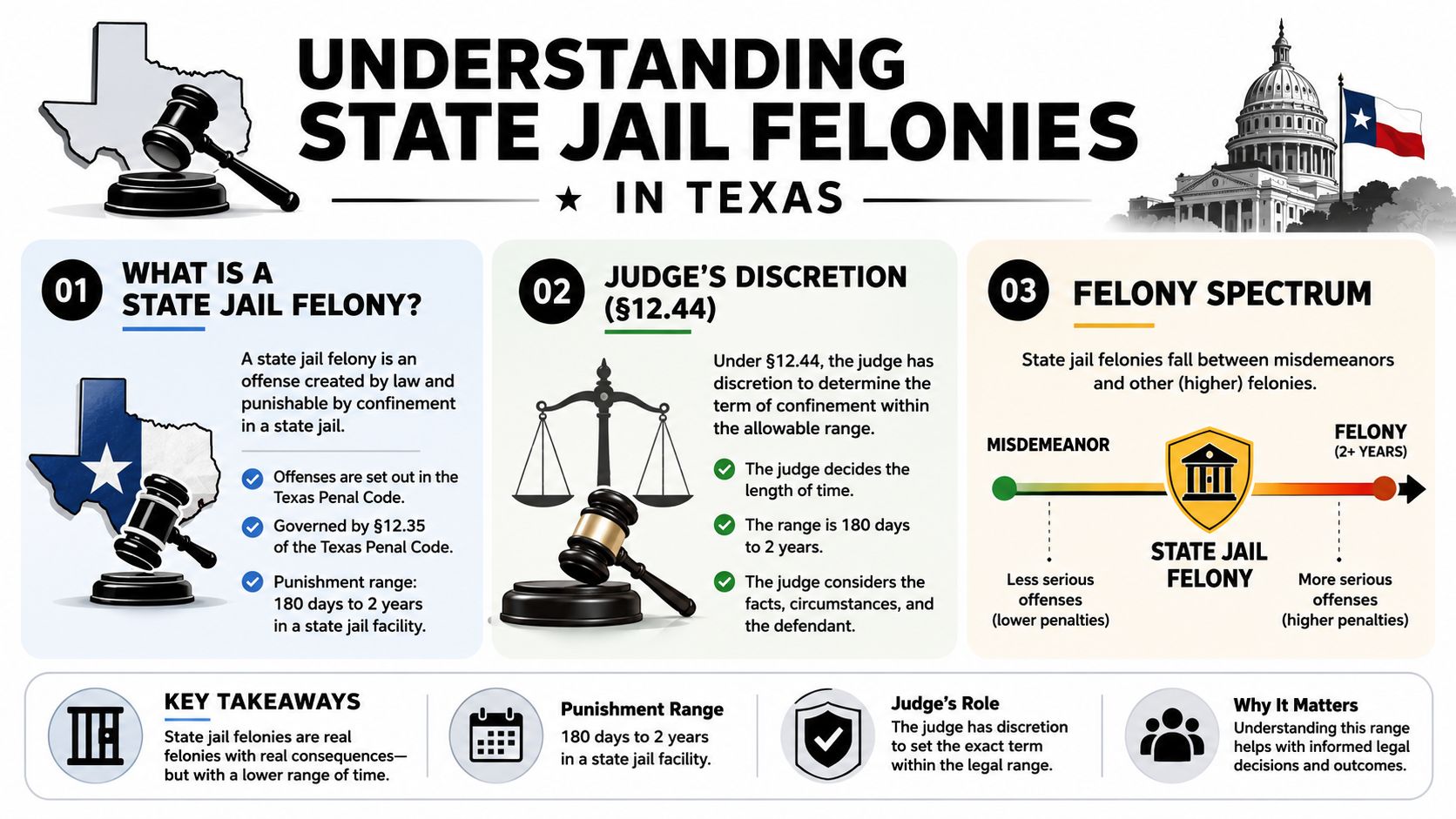
A state jail felony is the lowest felony level in Texas. The usual punishment range is confinement in a state jail facility for 180 days to 2 years, and the court may also assess a fine of up to $10,000. The part many people miss is the time-credit issue. State jail cases often involve day-for-day time, with far fewer opportunities to shorten the sentence through parole-style release than people expect. For many families, that reality does not become clear until late in the case.
Where it fits in the felony system
State jail felonies sit at the bottom of the felony ladder, below third-degree felonies but above misdemeanors. That placement matters because the case is still prosecuted as a felony from the start. You may face indictment, district court proceedings, stricter bond conditions, and long-term record problems even if the punishment range is shorter than other felony levels.
A useful way to look at it is this. A misdemeanor usually stays in the county-jail world. A state jail felony enters the felony world, even though it is the lowest rung. If you want a wider view of how this charge fits into the full grading system, this guide on what a felony means in Texas gives that bigger-picture context.
For a side-by-side view of offense levels and prison exposure, Texas Felony Defense: State Jail to First Degree lays out what each felony level means in practical terms.
Why this category surprises people
The name causes some of the confusion. “State jail felony” refers to a punishment category, not one single crime. Texas uses it for many different offenses, and the case can start with conduct that does not sound serious enough to many people to be called a felony.
The overlooked problem is how the sentence can be served. People hear “lowest felony” and assume early release works the same way it does in other cases. Often it does not. In practical terms, state jail time can be much more literal. If you are evaluating plea options, that detail can matter as much as the number of months on paper.
What judges and prosecutors can do under Section 12.44
Texas law gives the court and the prosecutor a narrow tool that can change the outcome in the right case. Under Penal Code Section 12.44, some state jail felony cases can be punished as Class A misdemeanors instead.
That matters for a simple reason. The label on the charge may stay serious, but the punishment exposure can shift in a way that affects jail risk, plea strategy, and future record consequences.
Keep these points in mind:
- A state jail felony is still a felony accusation from day one.
- The punishment structure can be harsher in practice than people expect because parole-style relief is limited.
- A misdemeanor-style punishment under Section 12.44 is possible in some cases, but it is not automatic.
- Early case decisions matter. The facts, your criminal history, bond compliance, and the prosecutor's position often affect whether a reduction is realistic.
That is why people charged with state jail felonies need to look at the whole path of the case, not just the offense title. The right question is not only “How bad is this charge?” The better question is “What happens next, and where can this case be improved before the punishment terms harden into place?”
Required Elements of a State Jail Felony Charge
The prosecutor can't convict you just by labeling the case a state jail felony. The State still has to prove every required element beyond a reasonable doubt. The exact elements depend on the offense.
The charge depends on the underlying crime
“State jail felony” is a punishment category, not a single offense. That means the prosecutor must first prove the elements of the underlying allegation, such as theft, burglary of a building, unauthorized use of a motor vehicle, or possession of a controlled substance.
For example, in a drug case involving less than one gram of a controlled substance, the State usually has to prove that you knowingly possessed the substance and that the amount falls within that charged range. In a theft case, the State must prove unlawful appropriation and that the value falls within the charged range.
Common points prosecutors must establish
Here are the kinds of issues that often decide these cases:
- Identity. The State must show that you were the person who committed the act.
- Mental state. In many cases, prosecutors must prove you acted knowingly, intentionally, or unlawfully.
- Quantity or value. In some charges, the felony level depends on the amount of drugs or the value of property.
- Possession or control. In drug and vehicle cases, the State often has to prove more than mere presence.
- Prior-conviction or enhancement facts. Some cases become more serious if the State proves a qualifying prior conviction or another enhancing fact.
A strong defense often begins with a basic question: can the State actually prove that the item, vehicle, substance, or property was connected to you in the way the law requires?
Why the elements matter early
This affects every stage of your case. After arrest, your lawyer may review police reports, body camera footage, lab records, witness statements, and value evidence. At arraignment or early court settings, plea talks often turn on whether the prosecutor's proof has weak spots. If the case goes to trial, the jury must decide whether each legal element was proved beyond a reasonable doubt.
That's true whether you're dealing with a drug possession case, a theft allegation, or a fact pattern that overlaps with a Texas assault defense or DWI-related enhancement issue.
Typical Examples of State Jail Felony Offenses
Many people don't realize how ordinary life situations can lead to a state jail felony charge. These cases aren't limited to dramatic accusations. They often come from traffic stops, store investigations, domestic incidents, or searches after an arrest.
Common examples include:
- Possession of less than one gram of certain controlled substances. Texas treats some low-quantity possession cases as state jail felonies rather than misdemeanors.
- Theft of property valued between $2,500 and $30,000. Value can become a major fight in these cases, especially when police rely on store estimates or rough replacement figures.
- Burglary of a building. Entering a building without consent and with the required criminal intent can fall into this category.
- Unauthorized use of a motor vehicle. This charge often appears in cases involving borrowed cars, disputed permission, or family and relationship conflicts.
- DWI with a child passenger. A DWI-related arrest can become much more serious when a child is alleged to have been in the vehicle.
- Certain repeat DWI situations under specific circumstances. Depending on the facts and charging theory, some alcohol-related cases can move into felony territory.
Alcohol can also play a role in how police, prosecutors, and courts view risk and decision-making. If you're trying to understand that broader connection, Casa Recovery has a useful article on the link between alcohol and crime.
Why these examples confuse people
Some of these offenses sound like misdemeanors. A small amount of drugs, shoplifting allegations, or using someone else's car may not feel like felony conduct to the person accused. But Texas law classifies some of these cases as felonies based on the offense type, the value involved, or the surrounding facts.
That's one reason early legal advice matters. A charge that looks minor on paper may carry felony-level consequences in court.
Sentencing and Probation for State Jail Felonies
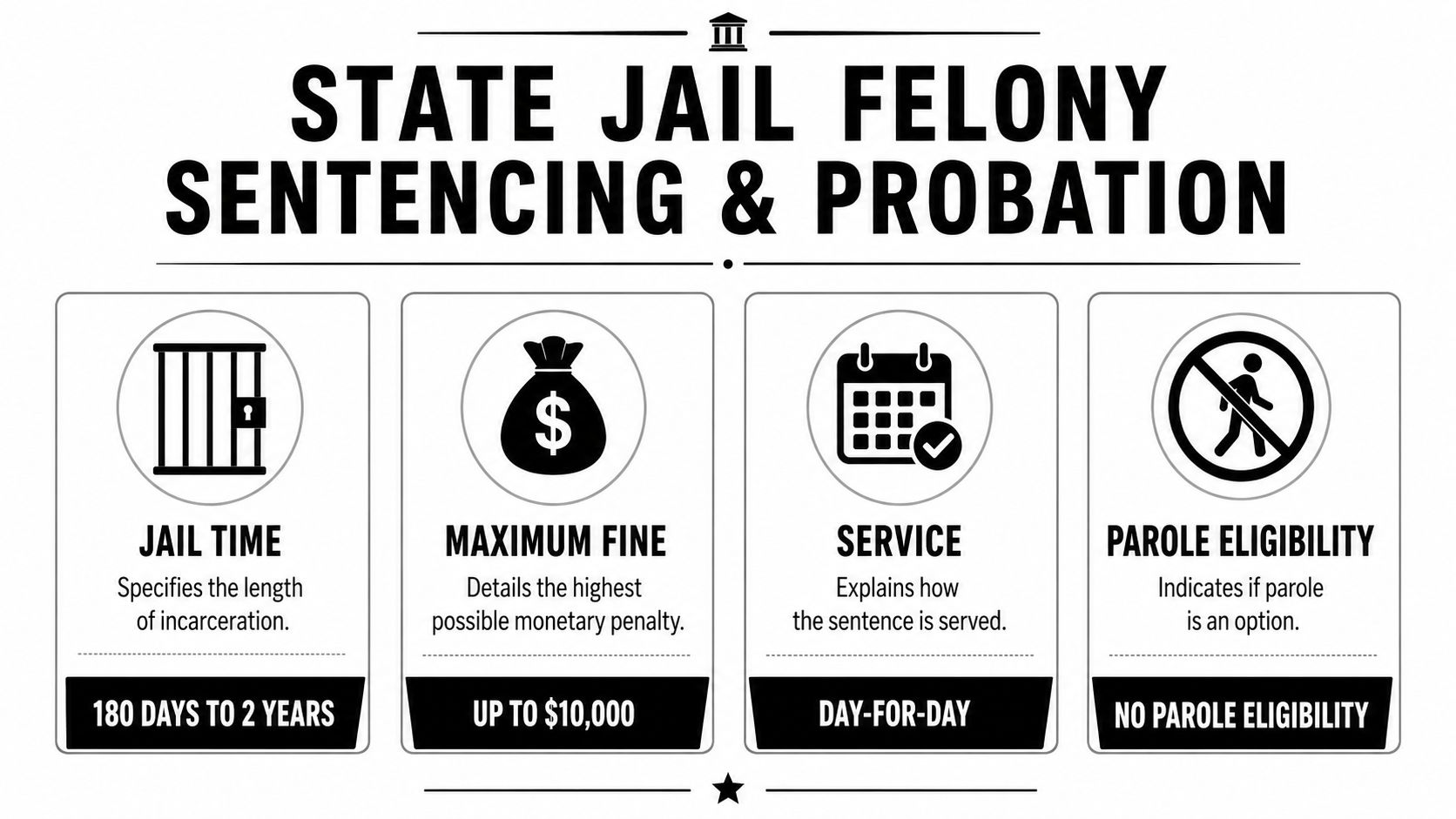
A lot of people hear "state jail felony" and assume they will be out early with parole if things go badly. That assumption causes real damage in plea negotiations. Under Texas Penal Code §12.35, the punishment range is 180 days to 2 years in a state jail facility, plus a possible fine of up to $10,000.
The day-for-day rule
The part people often miss is the release rule. A straight state jail sentence is generally served day-for-day. In plain English, if a judge gives you a year in state jail, you should not expect parole to cut that year down.
State jail works differently from the prison system many people have in mind when they hear the word felony. A prison sentence may involve parole eligibility at some point. A state jail sentence usually does not. That makes even a shorter sentence on paper more serious than it first sounds.
FindLaw's summary of Texas Penal Code §12.35 gives a helpful overview of that punishment structure.
If someone tells you, “It's only state jail,” slow down. In many cases, “only” still means serving every day the judge orders.
This video gives a quick visual explanation of how Texas felony punishment issues can unfold in practice:
How probation and deferred outcomes fit in
A straight sentence is not the only possible outcome. In some cases, the court can place a defendant on community supervision instead of sending that person to a state jail facility. That option can change the entire case because it may preserve work, parenting time, treatment options, and a much better position for future record relief.
Still, probation is never automatic. Judges usually look closely at the facts of the offense, criminal history, bond compliance, drug or alcohol concerns, restitution issues, and whether the person appears likely to follow rules in the community. Prosecutors also have a say in how negotiations develop, even though the final decision may rest with the court.
Some defendants may also qualify for deferred adjudication. That is a different result from a final conviction, and the difference matters later if you are trying to limit damage to your record. This guide to deferred adjudication in Texas explains how that option works.
What happens from arrest to sentencing
The path from arrest to punishment usually unfolds in a series of steps, and each step affects the next one. A state jail felony case works a lot like a chain. If one link is weak, the defense may be able to challenge the case or improve the outcome.
- Arrest and booking. Police make the arrest, take fingerprints and photos, and the court addresses bond.
- Early court settings. The judge sets basic ground rules, including bond conditions and future court dates.
- Case review. Your lawyer gathers reports, videos, witness statements, lab results, and other evidence to test the State's proof.
- Negotiation or contested hearings. The defense may challenge a search, seizure, statement, identification, or valuation issue. Plea discussions often happen at the same time.
- Trial or plea. You either accept a negotiated resolution or ask a judge or jury to decide guilt.
- Sentencing. If there is a conviction, the court decides whether the result will be straight time, community supervision, fines, treatment conditions, restitution, or another lawful term.
That sequence matters because good decisions early in the case can protect options later. In state jail felony cases, the biggest practical question is often simple: how do you avoid a day-for-day sentence if the evidence is strong enough that some resolution is likely?
Comparing Felony Levels in Texas
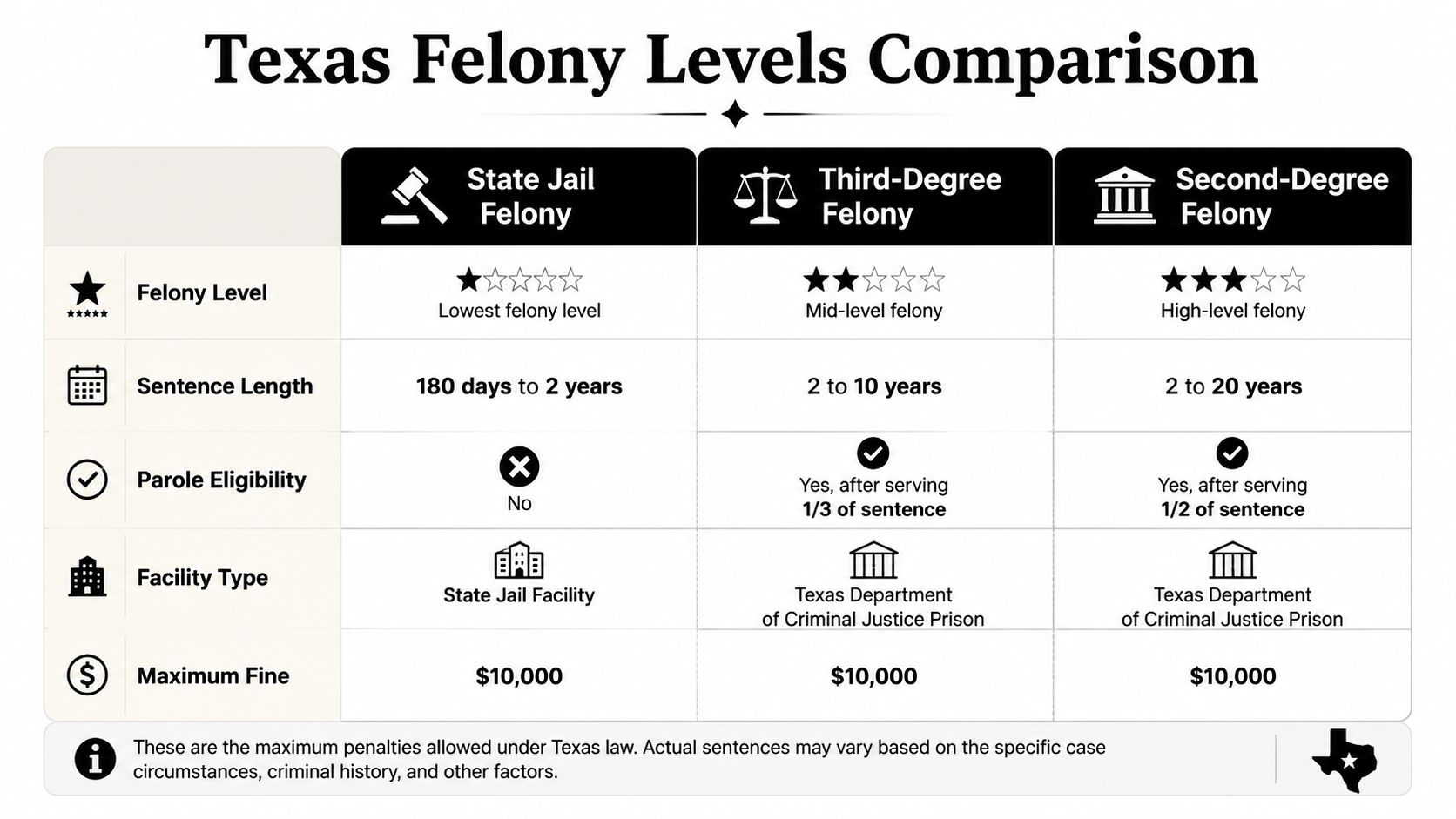
A state jail felony is a felony, but it does not work like a third-degree or second-degree felony. The punishment range, facility type, and release rules are different. That difference matters when you're weighing plea offers or trying to understand your real exposure.
Felony Level Comparison
| Felony Level | Sentence Length | Parole Eligibility | Facility Type |
|---|---|---|---|
| State Jail Felony | 180 days to 2 years | No | State jail facility |
| Third-Degree Felony | 2 to 10 years | Generally available within the prison system | Prison within TDCJ |
| Second-Degree Felony | More severe than third-degree felony and punished within the prison system | Generally associated with prison sentencing rather than state jail sentencing | Prison |
Why the comparison matters
The biggest practical difference is release structure. A third-degree felony can carry a longer sentence, but state jail punishment has its own harsh feature because the sentence is generally served day-for-day in a separate type of facility.
There's also an enhancement issue. Some state jail felony cases can be bumped up to a third-degree felony if the State proves additional facts, such as certain prior convictions or the presence of a deadly weapon, according to this discussion of Texas state jail felony enhancement and consequences.
That means a charge that starts at the lowest felony level can become much more serious depending on the facts.
Common Defenses Against State Jail Felony Charges
A state jail felony case often turns on something much earlier than punishment. It turns on whether the police acted lawfully, whether the evidence proves the charge, and whether the prosecutor can connect each fact in the chain. If one link breaks, the case can weaken fast.

Search and seizure challenges
Many state jail felony cases start with a traffic stop, a pat-down, a car search, or officers entering a home. The first question is simple. Did law enforcement have a legal reason for each step?
If the stop was unlawful, if consent was not voluntary, or if officers searched beyond what the law allowed, the defense can ask the judge to suppress the evidence. Suppression means the State may lose the very item it needs to prove the case, such as drugs, allegedly stolen property, or statements made after an illegal detention.
This matters more than people expect. A possession case without the seized item is like a house missing its foundation.
Weak proof on possession, value, or intent
The State also has to prove the right facts, not just present suspicion.
In a drug case, prosecutors must usually show more than your presence near a substance. If several people had access to the car, room, or bag, the key issue becomes control and knowledge. The law does not automatically treat proximity as possession.
In a theft case, value can change the charge level. If the State overstates what property was worth, a defense lawyer may challenge receipts, replacement estimates, condition, ownership records, or the method used to calculate value.
Intent is another common pressure point. In burglary and property cases, the dispute is often about what the person meant to do. A bad decision, confusion over permission, or being in the wrong place at the wrong time does not always prove criminal intent beyond a reasonable doubt.
Problems with witnesses, lab work, and police reports
Paperwork can look neat and still be wrong.
Witnesses may give inconsistent accounts. Officers may leave out facts that body camera video later shows. Lab testing can raise chain-of-custody questions, especially if the defense cannot tell clearly who handled the evidence and when. In some cases, the offense report reads stronger than the actual proof.
That is why a careful defense review usually starts with the timeline. What happened before the stop, during the arrest, and after booking? For someone facing a charge that can mean day-for-day time in a state jail facility, those details are not technicalities. They can decide whether the case holds up at all.
Case resolution strategy
A strong defense is not limited to trial. Sometimes the best outcome comes from using legal weaknesses to improve negotiations, seek a reduction, press for community supervision if available, or avoid a conviction that follows you long after the case ends.
The right strategy depends on the whole roadmap of the case, from arrest through any plea decision and later record consequences. An experienced Texas criminal defense firm can evaluate whether suppression issues, proof problems, witness credibility concerns, or sentencing risks should drive the next move.
Defense focus: Do not assume the arrest report is the final version of events. Video, dispatch records, lab documents, witness statements, and the legal basis for the stop can all change the direction of a state jail felony case.
Post-Conviction Options and Next Steps
You finish court, hear the word "convicted," and assume the only question left is how much time you will serve. In a state jail felony case, that assumption can cost you. The punishment structure is different from other felonies, and one of the most overlooked parts is the day-for-day reality of state jail time. In plain terms, many people sentenced to a state jail facility do not receive parole credit the way they expect. That makes every decision before sentencing, at sentencing, and after judgment matter.
Misdemeanor punishment under Section 12.44
Texas law gives courts and prosecutors a narrow tool that can change the outcome in a meaningful way: Penal Code Section 12.44. This section matters because it can allow a state jail felony to be punished like a Class A misdemeanor.
There are two paths. Under Section 12.44(a), the judge may sentence a defendant as if the offense were a Class A misdemeanor if the judge decides that result serves justice. Under Section 12.44(b), the prosecutor may agree to a plea in which the offense is treated as a Class A misdemeanor for punishment purposes.
That distinction confuses people, so here is the practical version. Section 12.44 is not automatic, and it is not available in every case. It is a form of relief that must be raised, negotiated, or requested with a clear reason why it fits the facts, the person's background, and the goals of the case. If you want a practical explanation of how lawyers pursue that result, this guide on reducing a felony to a misdemeanor is a helpful next read.
A simple way to understand 12.44 is this: the charge may start as a state jail felony, but the punishment outcome may sometimes be pulled down into misdemeanor territory. For someone facing day-for-day confinement, that can be a major difference.
Expunction and record sealing
People often get bad information from friends, social media, or even well-meaning court staff. A conviction for a state jail felony usually does not disappear just because the sentence ends.
Expunction and nondisclosure are different tools. They do different jobs.
- Expunction destroys qualifying records.
- Nondisclosure seals qualifying records from public view, but not from all government agencies.
- A conviction usually limits both options.
In many cases, a final conviction for a state jail felony cannot be expunged. Record sealing may be available only in limited circumstances, and eligibility turns on the exact outcome of the case, the wording of the judgment, the type of supervision imposed, and whether the person completed all requirements. The paperwork matters here. So does the sequence of events from plea to discharge.
Practical next steps after conviction or pending sentencing
Treat the period right after conviction or right before sentencing like the final miles of a long road. Small mistakes can still change where you end up.
Start with the file. Get copies of the complaint, indictment, bond conditions, plea papers, judgment, sentencing orders, and any community supervision terms. If you later need to ask about appellate deadlines, a 12.44 issue, record relief, or a licensing problem, those documents are the map.
Then focus on timing. Post-judgment deadlines come fast. So do reporting dates, class requirements, drug testing, payment schedules, and surrender dates. Missing one condition can create a new problem that is harder to fix than the original one.
Ask direct questions, especially if sentencing has not happened yet:
- Will this end as a final felony conviction, or is a 12.44 result still possible?
- Will I serve time in a state jail facility, and if so, am I facing day-for-day time?
- Is community supervision legally available in my case?
- What happens to my record after I complete the sentence?
- Will this affect immigration status, professional licensing, housing, or firearm rights?
Those are not side issues. For many people, they shape the personal cost of the case more than the courtroom sentence itself.
If you have already been sentenced, keep proof of everything you complete. Save payment receipts, class certificates, discharge paperwork, and correspondence with supervision officers or the court. If a future employer, board, or lawyer needs to review your history, complete records can prevent expensive confusion.
If you've been charged with a crime in Texas, call The Law Office of Bryan Fagan, PLLC for a free and confidential consultation. Our defense team is ready to protect your rights.