Deferred adjudication in Texas is a special kind of probation that can keep a conviction off your record if you complete everything the judge orders. The maximum term is 2 years for a misdemeanor and 10 years for a felony under Texas deferred adjudication rules, and if you finish successfully, the court dismisses the charge instead of entering a conviction.
Being arrested in Texas can be terrifying, but you don't have to face it alone. You may be lying awake wondering whether one mistake is about to follow you for the rest of your life, whether you'll lose your job, or whether a DWI, assault, theft, or drug possession case means a permanent criminal record.
For many first-time offenders, deferred adjudication can offer a second chance. But people often misunderstand what it does and what it doesn't do. A dismissal is not the same as a clean slate. That's where confusion starts, and it's also where smart legal guidance matters most.
Your Guide Through the Texas Legal System After an Arrest
A lot of people first hear the words "deferred adjudication" while standing in a courtroom, talking to family after bond, or searching online in a panic after an arrest. Maybe you were arrested after a traffic stop that turned into a DWI investigation. Maybe an argument led to an assault charge. Maybe a theft or drug possession accusation caught you off guard. However it happened, the first feeling is usually the same. Fear.
Texas criminal cases move through a process, and that process matters. After an arrest, you're usually dealing with booking, bond, court settings, and early decisions that can shape the rest of the case. If treatment or counseling becomes part of the discussion, it helps to understand the broader laws around court-mandated treatment because judges often look at rehabilitation as part of supervision decisions.
If you've just been arrested, practical steps matter right away. This guide on what to do immediately after getting arrested in Texas can help you avoid common mistakes in those first critical days.
What usually happens after an arrest
A criminal case often follows a path like this:
- Arrest and booking: Police take you into custody, collect basic information, and process the charge.
- Bond and release: A judge may set conditions for release.
- Arraignment or first court appearance: You learn the charge and your rights.
- Negotiations and case review: Your lawyer reviews evidence, challenges weak spots, and talks with the prosecutor.
- Possible plea bargain, trial, or dismissal: Some cases resolve through negotiated outcomes. Others go to trial.
Practical rule: The earlier your defense lawyer starts reviewing the case, the more options you may have.
Where deferred adjudication fits
Deferred adjudication is one possible outcome during the plea bargaining stage. It isn't available in every case, and it isn't always the right choice. But when it fits, it can mean the difference between carrying a conviction and moving forward without one.
That matters because criminal procedure isn't just about what happened at the arrest. It's about what result ends up on your record.
Defining Deferred Adjudication Under Texas Law
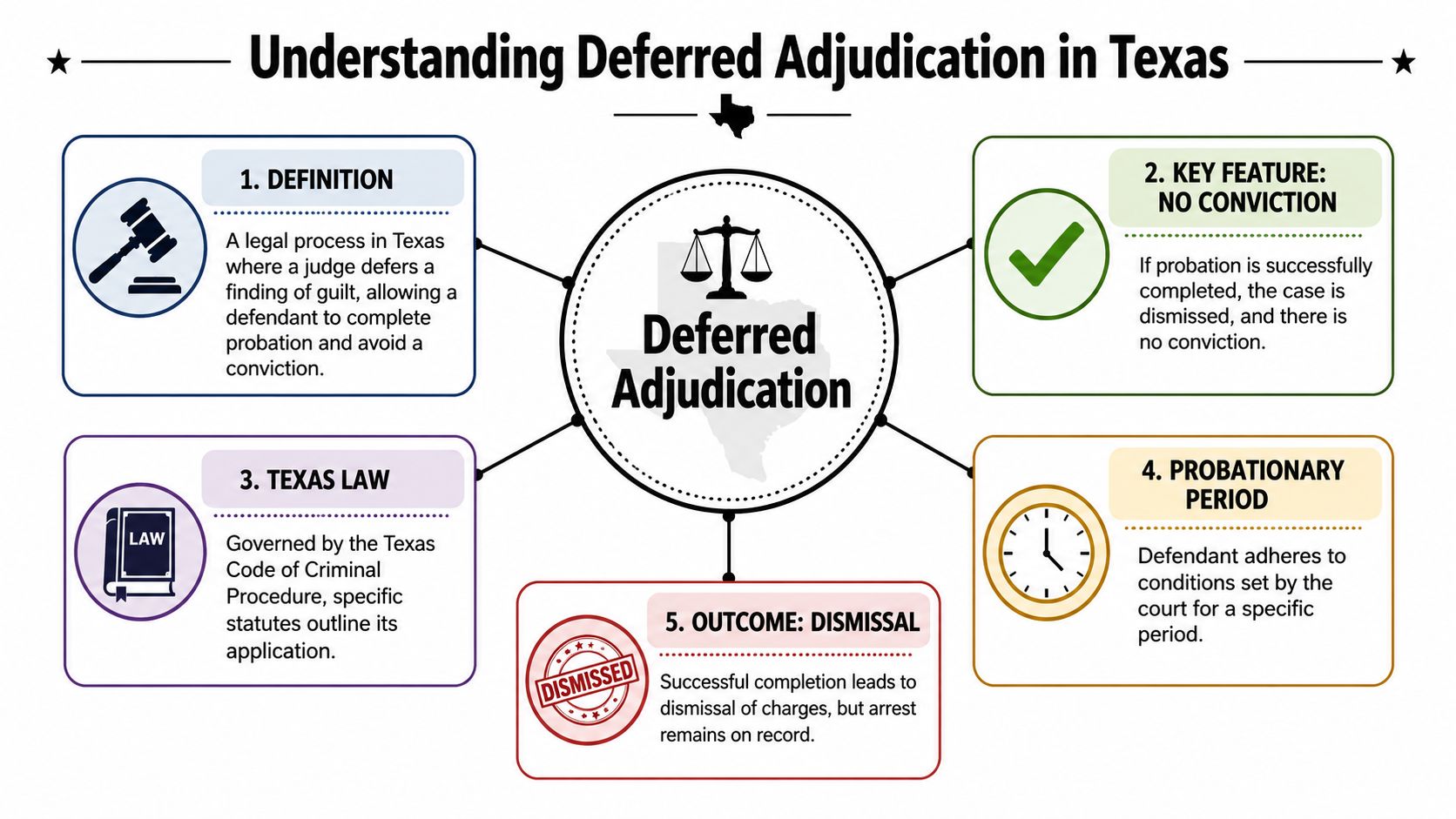
Under Texas law, deferred adjudication is a form of judge-ordered community supervision. In plain English, that means a judge puts your case on hold while you complete probation-like conditions. If you do what the court requires, the case is dismissed without a final conviction.
Texas law describes it this way under Texas Code of Criminal Procedure Article 42.12, Section 5: deferred adjudication is a specialized form of judge-ordered community supervision where the finding of guilt is deferred even though there is enough evidence to convict, so no final conviction is entered if all conditions are completed successfully, as explained in this discussion of deferred adjudication in Texas.
A simple way to think about it
Think of deferred adjudication like a legal probationary period for your record.
You still have to answer the charge. You still have to go before a judge. You still have rules to follow. But the judge holds back the final finding of guilt. If you complete the terms, the court dismisses the case instead of entering a conviction.
That last part is why people ask, "What is deferred adjudication in Texas?" They're usually really asking something deeper: "Can I avoid a conviction?" In many cases, deferred adjudication is the path that makes that possible.
What you have to do to get it
Deferred adjudication doesn't happen after a not guilty verdict. It usually requires you to plead guilty or no contest and waive a jury trial, because the judge, not a jury, has the authority to defer a finding of guilt.
That makes this decision very serious. You're not merely asking for leniency. You're making a legal choice with long-term consequences.
Here are the basics:
- Judge decides: A jury can't place you on deferred adjudication.
- Plea is required: You generally plead guilty or no contest.
- Conditions apply: The court can order drug testing, classes, counseling, community service, fines, and other supervision terms.
- Dismissal is possible: If you finish successfully, the charge is dismissed.
If you're unsure how Texas classifies the charge you're facing, Felony vs. Misdemeanor Charges in Texas explains how Texas groups offenses and the penalty range for each level.
Deferred adjudication isn't an eraser. It's a legal opportunity. If you handle it correctly, it can keep a conviction off your record.
The Deferred Adjudication Process Step by Step
The process feels less intimidating when you break it into stages. The idea of probation isn't typically a source of confusion. Instead, questions often arise concerning when deferred adjudication is offered, who approves it, and what happens at the end.
Early in the case, your defense lawyer reviews the evidence, identifies legal issues, and negotiates with the prosecutor. In many misdemeanor and felony cases, that negotiation is where deferred adjudication enters the conversation. It's one of the reasons early case strategy matters so much in DWI, assault, theft, and drug possession cases.
The court path from plea to supervision
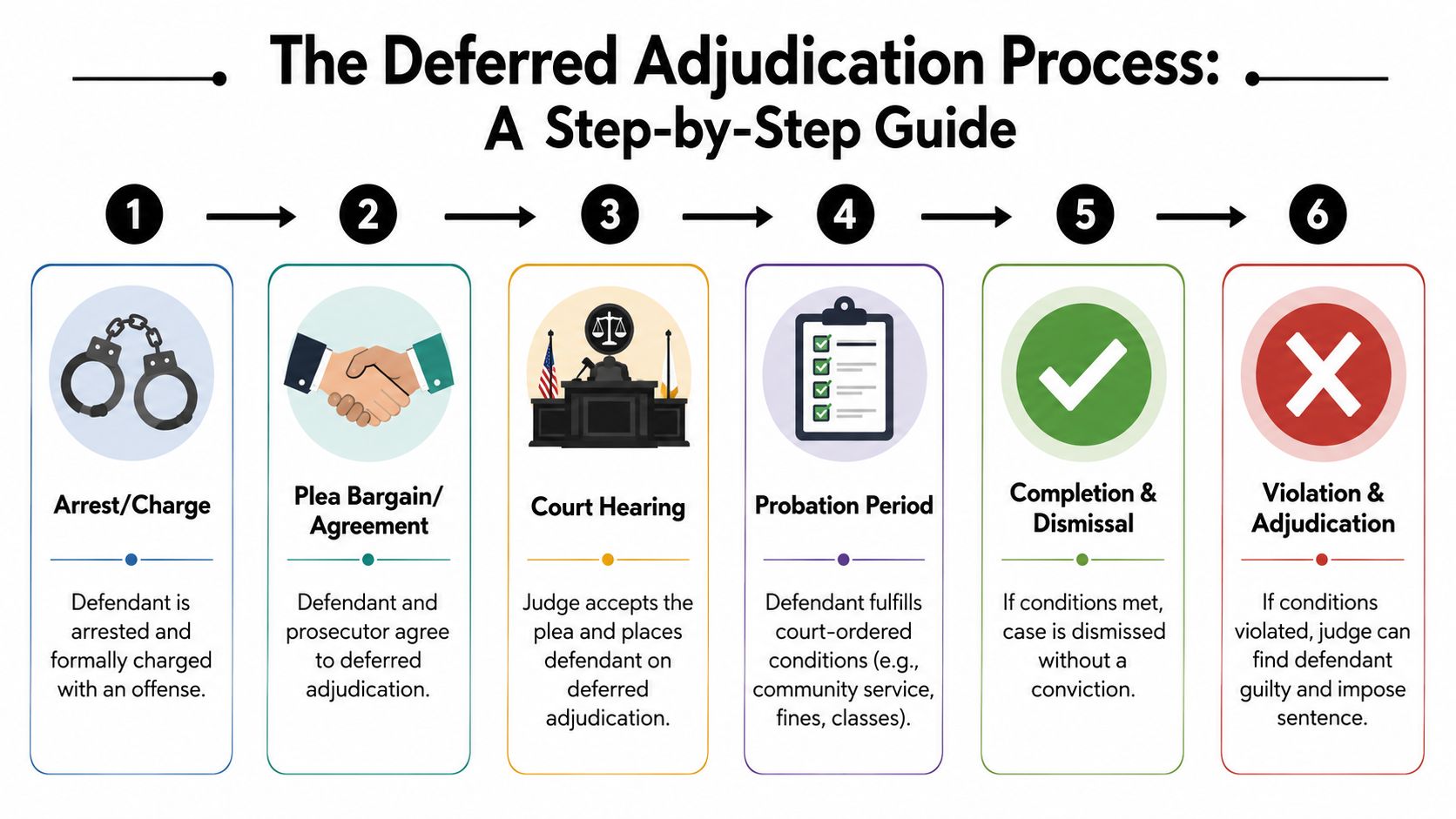
Here is the usual sequence:
Arrest and charge
Police file the charge, and your case enters the criminal system.Case review and plea bargaining
Your attorney looks at reports, video, witnesses, and legal defenses. Then your lawyer may negotiate for deferred adjudication rather than a conviction.Court hearing before the judge
If an agreement is reached, you appear in court. The judge decides whether to accept the plea and place you on deferred adjudication.
A short video can help if you want a visual overview of how deferred works in real court practice.
What supervision usually looks like
Once the judge grants deferred adjudication, you're placed on community supervision. The terms often look a lot like standard probation.
You may have to:
- Report as ordered: Meet with a supervision officer or comply with reporting rules.
- Complete programs: Attend counseling, education classes, or treatment.
- Pay court-ordered amounts: Fines, costs, and fees may be part of the order.
- Perform service work: Community service is common.
- Stay out of trouble: New arrests can create major problems.
How the case ends
In Texas, the maximum probation term for a felony deferred adjudication case is 10 years, and the maximum for a misdemeanor is 2 years, according to this overview of Texas deferred adjudication rules. The same source notes that in the 2024 fiscal year, deferred adjudication accounted for 10% of statewide dispositions, showing how often Texas courts use it as an alternative to a conviction.
If you complete every condition, the judge dismisses the charge. If you violate the terms, the judge can move forward with a finding of guilt and sentence you within the full punishment range for the original offense.
That risk is why you shouldn't treat supervision casually. Missing a class, failing a drug test, or falling behind on requirements can snowball fast.
Deferred Adjudication vs Straight Probation and Conviction
People often use the word "probation" to mean several different things. In court, the differences matter. A deferred case, a straight probation case, and a conviction can all sound similar in conversation, but they lead to very different outcomes.
A straight probation case usually means the court enters a conviction and then suspends some or all of the jail or prison time while you serve community supervision. A standard conviction means guilt is formally entered, and the conviction stays with you unless later relief applies. Deferred adjudication is different because the judge postpones the finding of guilt.
Side by side comparison
| Factor | Deferred Adjudication | Straight Probation | Conviction |
|---|---|---|---|
| Final finding of guilt | Delayed and not entered if completed successfully | Entered | Entered |
| End result if completed | Case dismissed | Conviction remains | Conviction remains |
| Community supervision | Yes | Yes, in many cases | Sometimes no supervision, depending on sentence |
| Record sealing possibility | May be possible in some cases after waiting periods and eligibility review | More limited and depends on the case | Depends on the offense and relief available |
| Background check impact | Arrest and case history may still appear unless sealed | Conviction appears | Conviction appears |
| Risk if terms are violated | Judge can adjudicate guilt and sentence on original charge | Judge can revoke probation | Sentence already tied to conviction |
Why deferred is often attractive
For many defendants, especially first-time offenders, deferred adjudication is appealing because it can avoid a final conviction. That can matter for employment, housing, professional licensing, and personal peace of mind.
It can also matter in plea negotiations. A Houston criminal lawyer or Texas DWI attorney may focus not only on reducing immediate punishment, but on avoiding the long-term damage of a conviction.
If two outcomes involve similar supervision terms, the one without a final conviction is often worth fighting for.
Why it's still not automatic
Deferred adjudication isn't always available. Some charges carry special rules, and some facts make prosecutors or judges less willing to agree. Even when it's legally possible, the better question is whether it's strategically wise.
That depends on the evidence, your history, the county, the judge, and what your lawyer may be able to win through motions, negotiation, or trial. In some cases, accepting deferred too quickly can mean giving up a stronger defense than you realized.
Your Criminal Record After Deferred Adjudication
Many people find themselves blindsided. They hear "dismissed" and assume the case disappears. It doesn't.
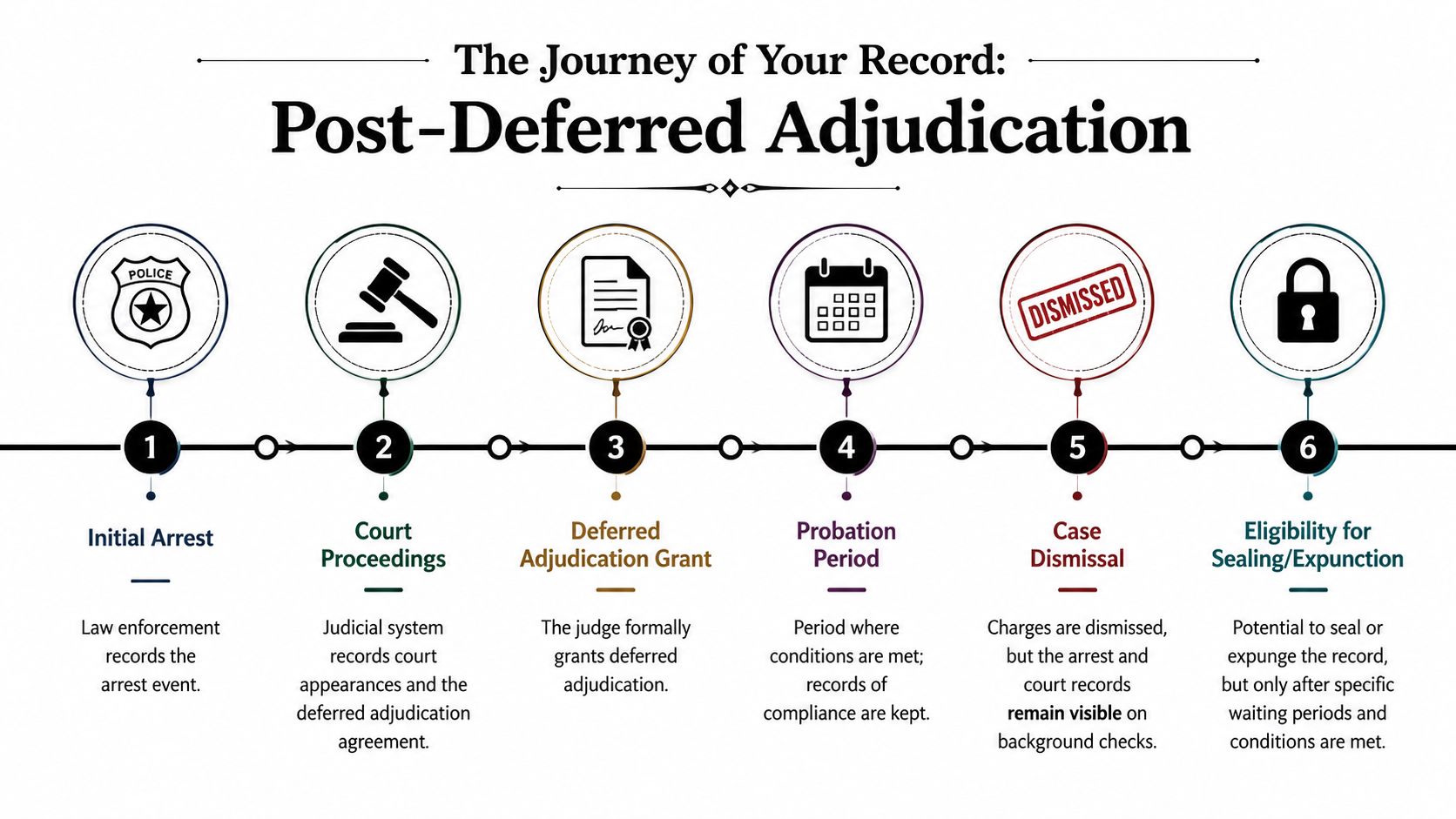
Successful completion of deferred adjudication means there is no final conviction, but the arrest record and the fact that you served deferred adjudication can still remain visible unless you take another legal step. That next step is often a Petition for Non-Disclosure, which asks the court to seal the record from public view in qualifying cases.
Dismissed doesn't mean cleared
This is the key distinction:
- Dismissed case: The court did not enter a final conviction after successful completion.
- Cleared or sealed record: The public may no longer be able to see the record, but only if the law allows that relief and you file for it.
Texas law requires a separate filing for nondisclosure. It is not automatic. For specific misdemeanors such as assault or unlawfully carrying a weapon, the waiting period is 2 years after completing probation before you can file. For felonies, the waiting period is 5 years. Crimes involving family violence are categorically ineligible for nondisclosure, as explained in this discussion of deferred adjudication and nondisclosure in Texas.
What to do after successful completion
Once you finish deferred adjudication, your job isn't always done. You should ask:
- Am I eligible for nondisclosure?
- Do I need to wait before filing?
- Does the offense type block sealing?
- What will employers still be able to see until the order is signed?
If you want a fuller look at the process, this guide to an order of nondisclosure in Texas is a helpful starting point.
Expunction and record sealing
People also confuse expunction with nondisclosure. They aren't the same. Expunction destroys or removes certain records in qualifying cases. Nondisclosure seals an eligible record from public access. Deferred adjudication often points people toward nondisclosure rather than expunction, though the exact relief depends on the case outcome and the statute involved.
If you're focused on rehabilitation and rebuilding your life, a post-case record review is just as important as the courtroom outcome.
A good result in court can lose value if you never address the record afterward.
Common Pitfalls and Hidden Consequences
Deferred adjudication can be a smart outcome. It can also create false confidence. Some people treat it like a clean reset and don't realize the record may still affect later decisions by courts, employers, licensing boards, or agencies reviewing sensitive positions.

The mistake people make most often
The biggest misunderstanding is this: "If my case gets dismissed, nobody will ever see it."
That's often wrong. Brazos County explains that deferred adjudication can still be used as evidence in sentencing for future offenses and may preclude some positions requiring bonding or security clearance, as described in its overview of deferred adjudication community supervision.
Real-world consequences beyond the courtroom
These hidden issues can matter:
- Future sentencing: A later court may consider the deferred case as evidence in sentencing.
- Security-sensitive jobs: Some employers or agencies may treat the record as disqualifying.
- Professional reputation: A background review may still raise questions until the record is sealed, if sealing is available.
- Violation risk: If you slip up while on supervision, the judge can move from deferred status to a formal finding of guilt.
For people facing Texas assault defense issues, drug possession allegations, or a first-offense DWI where deferred may be on the table, this is why the legal question isn't only "Can I avoid conviction?" It's also "What will this look like a year from now, and what can I do about it?"
Why careful planning matters
A smart defense strategy looks past the plea hearing. It asks whether the conditions are realistic, whether treatment requirements are manageable, and whether the record can later be sealed.
That approach matters because deferred adjudication is not a magic wand. It's a legal tool. Used properly, it can protect your future. Used carelessly, it can leave you with a dismissed case that still causes serious problems.
How an Experienced Attorney Can Secure Your Future
The right deferred adjudication result usually doesn't happen by accident. It takes legal judgment at every stage. Your lawyer has to evaluate the evidence after arrest, protect your rights at arraignment, negotiate during plea bargaining, and stay alert to what could happen at sentencing if the case goes off track.
An attorney can help in practical ways:
Where legal help changes the outcome
- Before any plea: Your lawyer can assess whether deferred adjudication is a good option or whether trial, dismissal efforts, or a different resolution makes more sense.
- During negotiations: The defense can push for manageable supervision terms instead of setting you up for violations.
- While you're on supervision: Good legal guidance helps you respond quickly if a reporting issue, failed test, or new allegation threatens your status.
- After completion: Counsel can review whether nondisclosure or other post-conviction relief tools may help protect your record.
If you want to understand how defense lawyers build these decisions from the ground up, this explanation of how criminal defense attorneys build a defense strategy gives a useful overview.
The bigger picture
Upon successful completion of deferred adjudication, the case is dismissed with no final conviction, which means your gun rights and voting eligibility are preserved even for felony charges, because those rights are lost by a final conviction, not a deferred one, as explained in this video discussion of Texas deferred adjudication consequences.
That's important, but it isn't the end of the analysis. You still need to think about background checks, sealing eligibility, and how to avoid mistakes during supervision.
The Law Office of Bryan Fagan PLLC represents Texans in criminal cases involving DWI, assault, theft, drug charges, record sealing, and related post-case relief. For many people, having counsel who can handle both the case itself and the next steps for the record makes the process easier to manage.
If you've been charged with a crime in Texas, call Law Office of Bryan Fagan PLLC for a free and confidential consultation. Our defense team is ready to protect your rights.