Being arrested in Texas can be terrifying, especially if you've never been through the system before. One minute you're answering questions from police. The next, you're thinking about bond, court dates, your job, your family, and whether the prosecutor already has enough to convict you.
Individuals in that spot often feel powerless. That's normal. But you're not walking into a courtroom blind. Texas criminal cases have rules, and one of the most important is discovery.
Discovery is how your lawyer finds out what the State has. It is often the first real step in taking back control. Before your attorney can advise you about a plea, a trial, a motion to suppress, or whether the case has serious weaknesses, your attorney needs to see the evidence.
Your Guide After a Texas Arrest
If you're sitting in Houston, Dallas, Austin, or San Antonio wondering what happens next, the short answer is this: your case moves through stages, and discovery affects nearly all of them.
After an arrest, you may face a magistrate hearing, bond conditions, formal charging decisions, and early court appearances. In many cases, the prosecutor already has a basic police version of events. That does not mean they have the full truth. It also does not mean their evidence is strong.
A DWI arrest may look simple on paper until bodycam footage shows confusion during roadside instructions. An assault case may sound one-sided until witness statements conflict. A drug possession case may change once the defense reviews the stop, search, and lab paperwork carefully.
Practical rule: Your case should never be judged only by the arrest report.
Why discovery matters so early
Discovery gives the defense a way to inspect what is in the State's possession. That matters because legal decisions come fast. You may need advice about whether to contest probable cause, challenge a search, negotiate pretrial terms, or prepare for trial.
The criminal process usually includes issues such as:
- Arraignment and first settings: You appear in court, hear the accusation, and begin addressing scheduling and representation.
- Plea discussions: The prosecutor may make offers before the defense has a complete picture. Good advice depends on good information.
- Trial preparation: If the case doesn't resolve, your attorney uses discovery to test witnesses, identify defenses, and prepare exhibits and cross-examination.
- Sentencing and later relief: If there is a conviction, the case may still involve punishment strategy, post-conviction issues, and later remedies such as expunctions, nondisclosures, record sealing, and post-conviction relief when the law allows.
If you've been charged with DWI, assault, theft, or drug possession, discovery often becomes the roadmap for every major decision that follows.
What Is Criminal Discovery in Texas
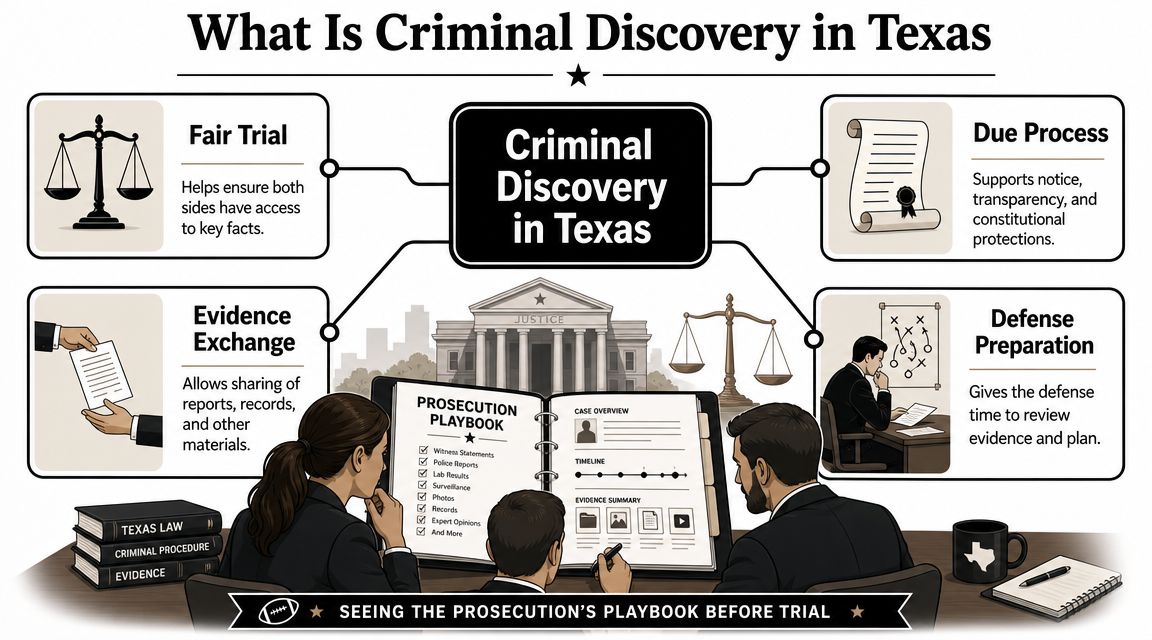
Think of discovery as being allowed to see the other side's file before the game starts. Not every note, not every strategy, but the evidence they plan to rely on and the material the law says they must disclose. Without that process, the defense would be forced to react at the last second.
In plain English, discovery in a Texas criminal case is the process that lets the defense inspect, and often duplicate, evidence in the State's possession, custody, or control. That includes things like offense reports, written or recorded statements, and tangible evidence.
The rule that controls discovery in Texas
The main rule is Article 39.14 of the Texas Code of Criminal Procedure. Texas criminal discovery changed in a major way when Article 39.14 was amended in 2013, and the new act became effective on January 1, 2014, for offenses committed on or after that date. The reform expanded what prosecutors had to share, including offense reports, written or recorded statements, and tangible evidence in the State's possession, custody, or control, as discussed in this explanation of the new Texas discovery rules.
That change matters because older ideas about criminal discovery in Texas still confuse people. Some clients think the prosecutor can keep the file closed until trial. That is not how modern Texas criminal practice is supposed to work.
Discovery is a right, not a favor
Discovery is not the prosecutor doing the defense a courtesy. It is part of a fair process. It helps prevent trial by ambush and gives your lawyer a meaningful chance to test the case.
A simple way to think about what is discovery in Texas criminal cases and how it works is this:
| Part of the process | What it means for you |
|---|---|
| Defense requests discovery | Your lawyer asks to inspect the evidence the State has |
| Prosecutor produces material | The State provides access to the evidence covered by law |
| Defense reviews and investigates | Your attorney looks for gaps, contradictions, and legal problems |
| Strategy changes as facts change | Plea talks, motions, or trial plans may shift based on what discovery shows |
Discovery is where the case stops being a rumor and starts becoming a file your lawyer can analyze.
One more procedural point matters. In Texas practice, discovery requests are made to the prosecutor, not the court. That sounds small, but it affects how your lawyer pushes the process forward and documents what has or has not been produced.
What Evidence Is Included in Discovery
Clients often ask, "What exactly do we get?" The answer depends on the facts of the case, but there are common categories that show up again and again.
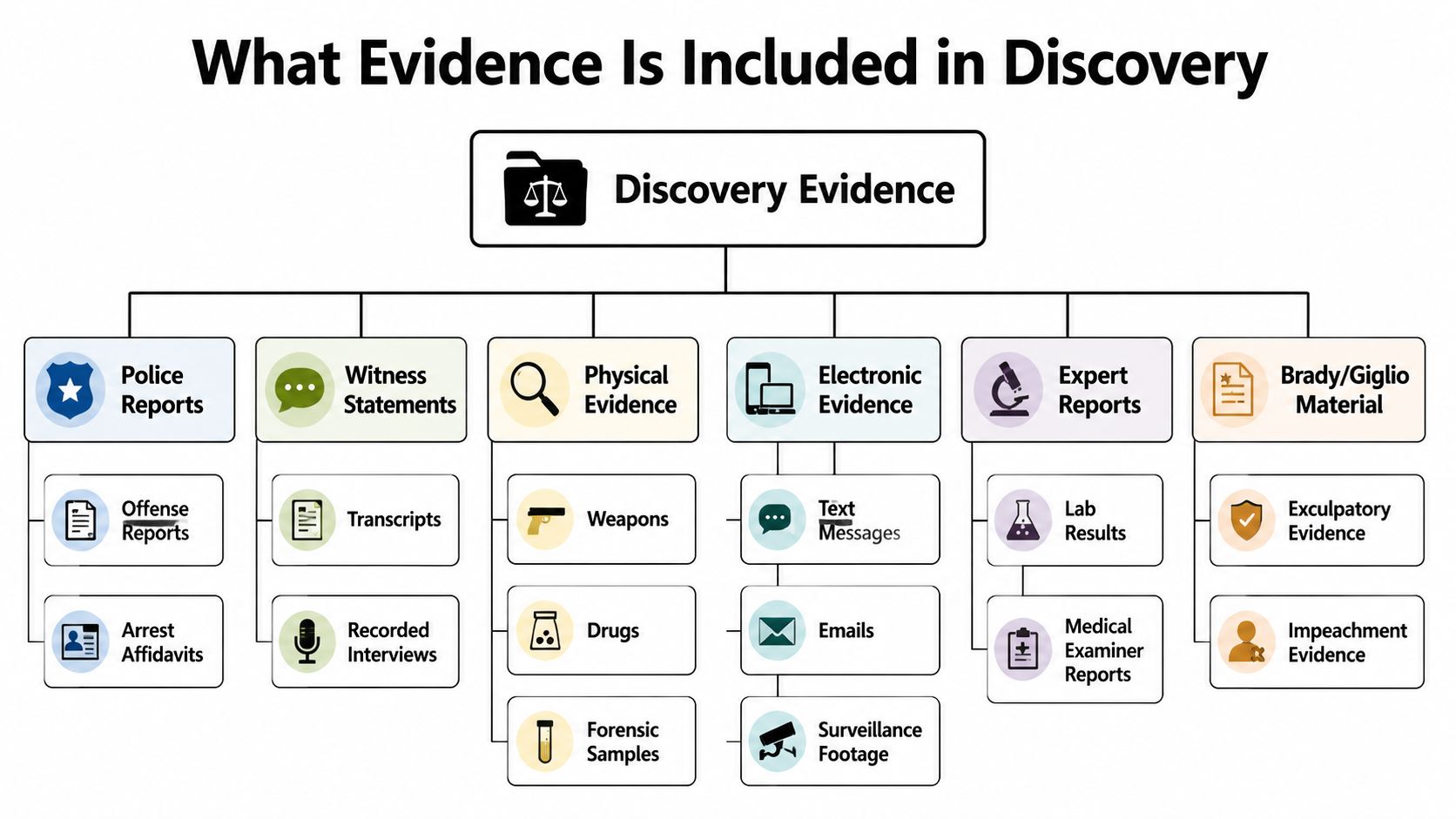
The easiest way to understand discovery is to group it by where the evidence comes from. Some materials come from police. Some come from witnesses. Some come from labs, phones, photos, or medical records. Some are especially important because they help the defense.
Police and prosecution materials
In many cases, discovery starts with the government's own paperwork and recordings.
You may see:
- Offense reports: The officer's narrative about what supposedly happened.
- Arrest affidavits: The sworn statement often used to support the arrest or filing.
- Dashcam and bodycam footage: Especially important in DWI, resisting arrest, assault, and search cases.
- 911 calls and dispatch audio: Useful when the first report differs from later testimony.
- Photographs and scene images: Property damage, injuries, locations, or seized items.
- Jail calls or booking videos: Sometimes these help the State. Sometimes they help the defense.
In a DWI case, for example, the report may say you had slurred speech and failed field sobriety tests. The video may tell a more complicated story. Maybe road conditions were poor. Maybe instructions were rushed. Maybe your statements were taken out of context.
Witness and expert evidence
Cases also turn on what other people said and what technical testing shows.
Common examples include:
- Written or recorded witness statements
- Recorded interviews
- Lab reports, such as blood or substance testing
- Medical records when injury is part of the allegation
- Forensic reports tied to fingerprints, DNA, or other testing
- Expert materials the State may use to explain scientific evidence
If your case involves a phone call or recorded conversation, details matter. Timing, clarity, and chain of custody can all affect how useful that recording is. For people trying to understand recording practices in a business setting, this guide on how to use call recording effectively is a practical example of why audio records need context, documentation, and careful handling.
Evidence that helps the defense
Readers often become confused. Discovery is not limited to evidence that hurts you.
Texas courts and prosecutors are required to turn over evidence that negates guilt or mitigates the offense. The State must also electronically record or otherwise document what it provides, and if more required material is later discovered, it must promptly disclose it. In some situations, sensitive items may only be viewed at a State facility instead of being copied to the defense file, as explained in this discussion of Texas criminal discovery obligations.
Lawyers often use terms like Brady material and Giglio material. Clients don't need the labels as much as the meaning.
- Brady material: Evidence that helps show you may not be guilty, or that the charge may be less serious than claimed.
- Giglio material: Evidence that may cast doubt on a witness's truthfulness or reliability.
Here is the practical effect. If a witness changed their story, had trouble seeing what happened, or gave a statement that conflicts with the police report, that may matter to your defense. If evidence points to self-defense, mistaken identity, lack of intent, or weaker injury proof, that also matters.
Some of the most valuable discovery isn't dramatic. It's the inconsistency, omission, or contradiction that creates reasonable doubt.
Sensitive evidence is treated differently
Not every item will be handed to you in a neat digital folder. In cases involving children, sexual allegations, family violence, or graphic images, the law may limit copying or sharing.
That can frustrate clients, but it doesn't mean your attorney can't review the material. It means the review may happen under stricter rules.
The Discovery Process and Timeline
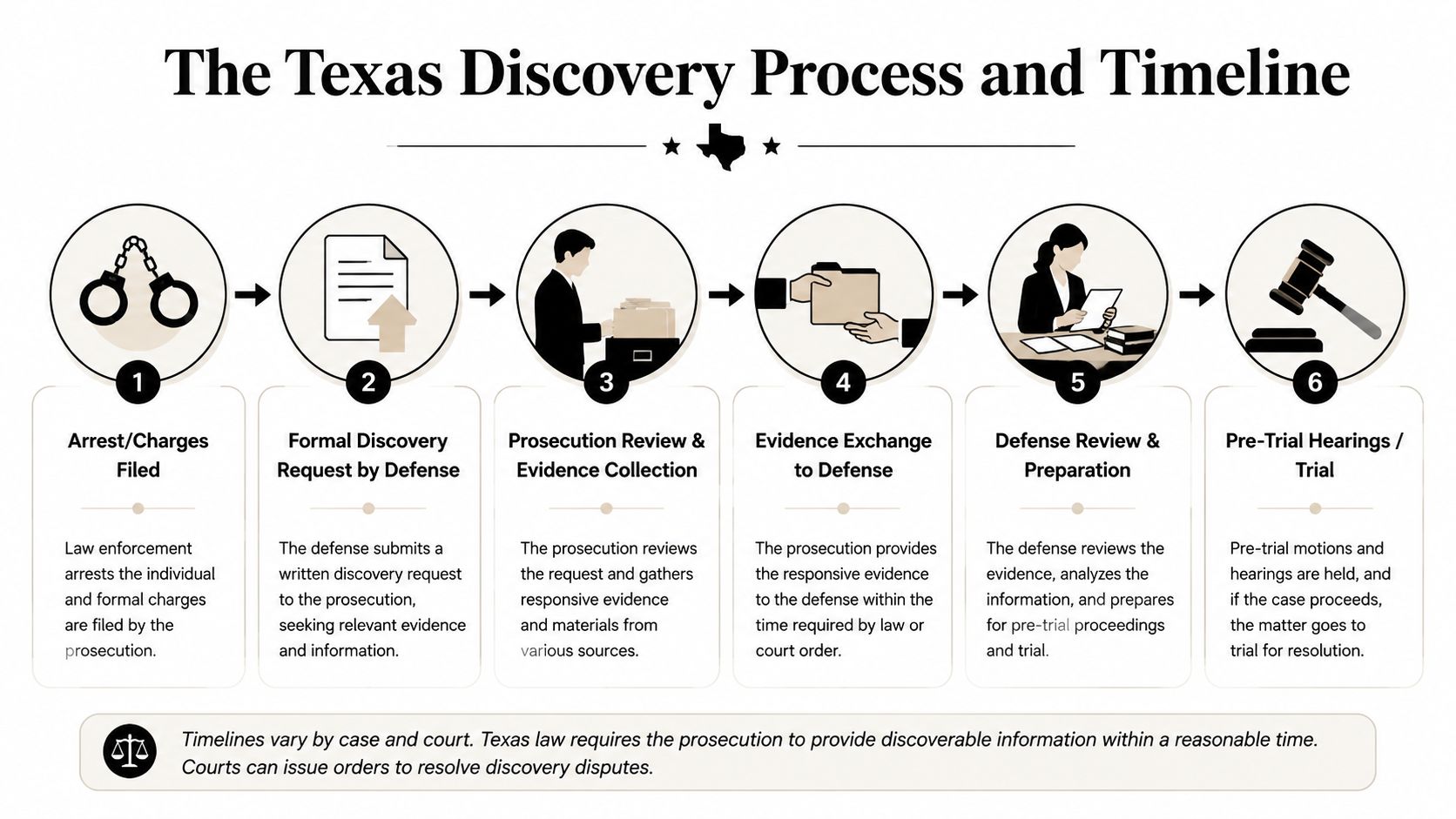
Discovery is not a single event. It is a working process that begins early and continues as the case develops.
That surprises many people. They assume the prosecutor turns over everything at one court setting, the defense reads it, and the case moves on. In reality, evidence often arrives in waves. A report may come first. Video later. Lab results later still. A late witness interview can shift the whole posture of the case.
How the process usually unfolds
A typical timeline looks something like this:
Arrest and filing
The case begins with an arrest, citation, complaint, or formal charge.Defense enters the case
Your lawyer appears, protects your rights, and starts requesting information from the prosecutor.Initial discovery production
The State provides the first set of materials. In some counties, this may happen through an electronic portal or an "open file" practice.Defense review
Your attorney studies the evidence, compares reports to recordings, identifies legal issues, and looks for missing items.Follow-up requests and hearings
If something important is missing or restricted, your lawyer may press for more production or ask the court to address disputes.Ongoing supplementation
As new evidence appears, the State may have to disclose it before trial.
Texas discovery is continuous rather than one-time. Prosecutors have an ongoing duty to disclose exculpatory, impeaching, or mitigating material, and late-produced forensic, witness, or impeachment evidence can materially change plea bargaining position and trial strategy, as the Department of Justice explains in its overview of ongoing disclosure duties in criminal discovery.
What this means in real life
In a Dallas-area DWI case, your lawyer may get the arrest paperwork quickly but wait longer for blood records or video downloads. In a Houston assault case, witness statements may arrive after the first court date. In an Austin drug case, lab analysis may become a major turning point after plea talks have already started.
For a more focused example, this guide on discovery in Texas DWI charges shows how evidence review can affect the direction of an impaired-driving defense.
This short video also gives useful background on the discovery process:
Why timing matters so much
A late-produced video can undermine an early plea recommendation. A newly disclosed impeachment issue can change how a witness will be cross-examined. A fresh lab result can strengthen the State or weaken it.
That is why experienced defense lawyers don't just request discovery once and forget it. They keep checking for supplementation through pretrial.
If the evidence changes, the defense strategy should change too.
Your Defense Lawyer's Role and Your Obligations
After discovery comes in, your lawyer starts doing the part clients usually do not see. We compare every piece of the State's story the way a mechanic checks an engine part by part. A police report may sound confident on paper, but confidence is not proof.
Your lawyer is asking practical questions that affect the defense plan. Does the body camera match the officer's written report? Did the police stop, search, arrest, or question you lawfully? Is a witness changing details? Is there a break in the handling of evidence? Do the facts fit the charge that was filed, or did the State overcharge the case?
That review is how a defense strategy gets built. Discovery is not just a stack of files to read. It is a map. In a Harris County assault case, one text thread can change whether the case looks like self-defense, mutual combat, or a credibility fight. In a Tarrant County drug case, a shaky chain of custody issue may matter more than the initial arrest report. In Bexar County or Travis County, a short body cam clip can become the center of plea talks, motion practice, or trial preparation.
What your attorney is looking for
A good discovery review usually focuses on four areas at the same time:
- Factual weak spots: Witnesses disagree, lighting was poor, timing does not line up, or identification is uncertain.
- Legal problems: Police may have made an unlawful stop, search, arrest, or interrogation.
- Strategy value: Certain facts may support dismissal, reduction, diversion, or better plea terms.
- Jury themes: The defense needs simple points a jury can follow without getting lost in police jargon.
If you want to see what happens after those weak spots are identified, this guide on how evidence is challenged in Texas criminal cases explains the next step.
What you need to do
Your job is different, but it matters more than many clients realize.
Tell your lawyer the full story early. That includes bad facts, old arguments, social media posts, text messages, photos, prior relationships with witnesses, medical or mental health issues, and anything else that might show up later. Surprises hurt cases. Hard facts that are disclosed early can usually be worked into a plan.
You should also preserve evidence. Do not delete messages, call logs, location history, videos, or app data because you think they look embarrassing. Sometimes the detail a client wants to erase is the same detail that explains context, shows consent, undercuts intent, or proves someone else started the conflict.
And do not talk about the case with friends, family, or online as a way to "clear things up." That often creates new evidence for the State.
In Texas criminal cases, the defense usually does not have the same broad duty to turn over information that people expect in civil lawsuits. Even so, some defenses and expert issues can require notice to the prosecution. That is one reason timing and preparation matter. Your lawyer has to decide what to disclose, when to disclose it, and what should stay protected as defense work product.
The same principle shows up in other high-stakes investigations. This article on how military attorneys win investigations shows how early fact development can shape the result long before a trial date is set.
One practical option for people who want help through this stage is working with a firm that handles the criminal case and related record-cleanup issues later, such as plea consequences, expunction, or nondisclosure eligibility. The Law Office of Bryan Fagan, PLLC provides criminal defense representation across Texas and also assists with post-case record relief when available.
What Happens When the State Hides Evidence
One of the biggest fears clients have is simple: what if the prosecutor does not play fair?
The law does not treat discovery as optional. Under Article 39.14, the State must permit defense inspection of evidence in its possession, custody, or control. In practical terms, discovery is a case-management rule that limits trial surprise and forces the prosecution to reveal material evidence that may affect guilt or punishment, as reflected in Article 39.14 of the Texas Code of Criminal Procedure.
Remedies when discovery rules are violated
If the State withholds evidence or turns it over too late, your lawyer can ask the court for relief. The right response depends on what was hidden, when it surfaced, and how much damage the delay caused.
Possible remedies may include:
- More time: The defense may ask for a continuance so it can investigate the late disclosure.
- Excluding evidence: A judge may limit or bar certain evidence if the violation created unfair prejudice.
- Cross-examination advantage: A late or incomplete disclosure can weaken the State's witness credibility in front of the judge or jury.
- Mistrial or post-trial relief: In serious situations, the violation may support stronger remedies.
Hidden evidence can change the defense strategy
Suppose a prosecutor discloses a new video right before trial. That may create a fresh basis to delay the case, revisit plea talks, or challenge admissibility. Suppose a witness statement was never turned over and it conflicts with trial testimony. That can become a major impeachment point.
Sometimes the proper response is not just about the evidence itself. It is about how the police obtained it. If discovery shows a search or seizure problem, your lawyer may file a motion aimed at keeping the evidence out altogether. This guide on what a motion to suppress evidence does in Texas explains that tool in plain language.
Courts can't fix every unfair moment instantly, but discovery rules give the defense a way to force the issue into the open.
Frequently Asked Questions About Texas Discovery
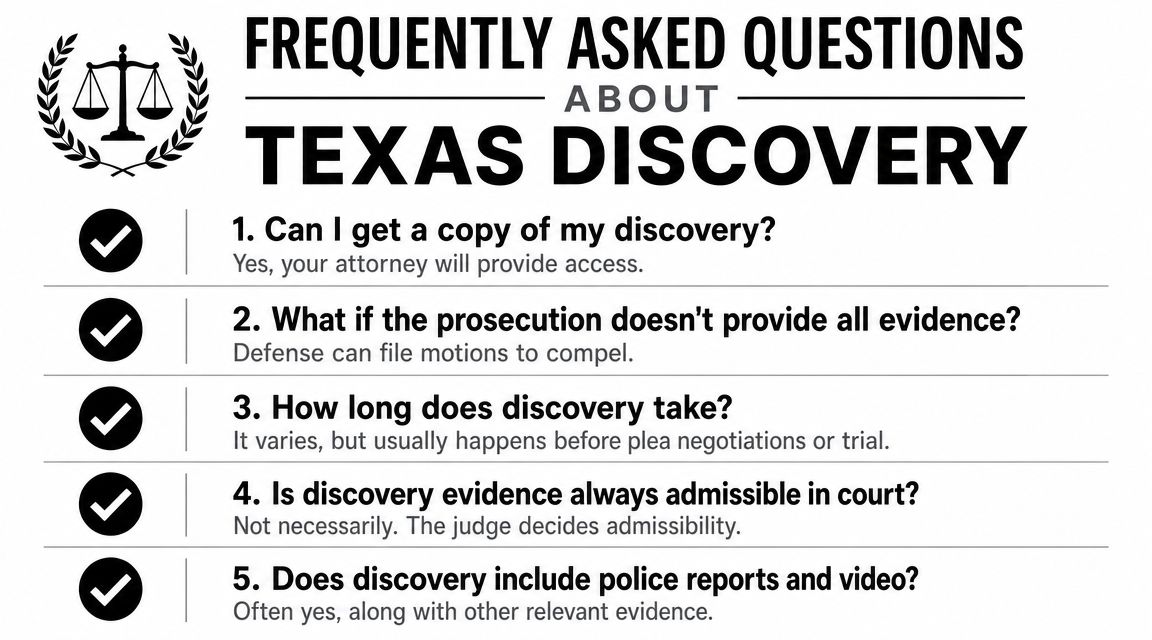
The questions below come up often because discovery feels personal. You want to know what you can see, when you can see it, and whether the prosecutor can hold things back.
What if new dashcam video appears right before my DWI trial in Dallas
That can matter a lot. Your lawyer may ask for time to review it, investigate it, and decide whether it changes plea strategy, trial preparation, or possible motions. Late evidence is not something the defense should absorb without response.
In a Houston assault case, can the prosecutor refuse to give witness statements
Discovery rules generally require the State to permit defense inspection of covered evidence in its possession, but the exact handling of materials can vary by the type of item and any court-imposed limits. If something important seems to be missing, your lawyer can press the issue through the proper channels.
Can I keep a copy of my discovery at home in San Antonio
Sometimes yes, sometimes no. In sensitive criminal cases, especially those involving family violence or sexual allegations, some discovery may only be viewed at a State facility, defense counsel may be limited in copying or recreating certain materials, and disclosure to third parties may be restricted unless a court orders otherwise for good cause, as described in this overview of limits on sensitive discovery in Texas cases.
Can my spouse, family member, or investigator look at the file
Not automatically. Restrictions on third-party sharing are real, especially with sensitive images, recordings, and protected personal information. Your attorney should tell you what can be shared, with whom, and under what conditions.
Does discovery mean the case will be dismissed
No. Discovery is information, not a result. But it often reveals weaknesses, defenses, and legal issues that can support dismissal, reduction, better negotiations, or stronger trial preparation.
Does discovery matter after the case ends
Yes. The evidence and outcome may affect later options such as sentencing arguments, appeals, post-conviction relief, expunction, or record sealing. Discovery can shape the entire life of the case, not just the trial setting.
If you've been charged with a crime in Texas, call The Law Office of Bryan Fagan, PLLC for a free and confidential consultation. Our defense team is ready to protect your rights.