Being arrested in Texas can be terrifying, especially if you're sitting in a jail cell, trying to remember what happened, and wondering whether one bad night is about to change your life. In that moment, many assume a defense starts in court. It usually doesn't.
A real defense starts early. It starts with what you say, what you preserve, what you avoid doing, and how quickly your lawyer can examine the state's version of events before it hardens into the only version anyone hears. That is a big part of how criminal defense attorneys build a defense strategy.
If you're facing a DWI, assault, theft, drug possession, or another criminal charge, you are not a bystander in that process. You have a job to do. A good Texas criminal defense lawyer has to know the law, the local courts, and the pressure points in the evidence. But you also need to help protect your own case from the first day forward.
The First 48 Hours Your Role in the Initial Case Assessment
The first two days after an arrest matter more than is generally appreciated. In many cases, your lawyer is trying to answer a few urgent questions right away. What are you charged with. What facts does law enforcement claim support the charge. What evidence may disappear if nobody acts quickly.
Under Texas law, the charge itself can tell us a lot about what the state must prove. A DWI charge often turns on driving facts, officer observations, field sobriety testing, and chemical evidence. An assault charge under Texas Penal Code Chapter 22 may depend on whether the state claims bodily injury, threats, or offensive contact. A theft case under Texas Penal Code Chapter 31 often comes down to intent, ownership, consent, and value allegations. A drug possession case under the Texas Controlled Substances Act can rise or fall on whether the state can prove you knowingly possessed the substance and whether the search was lawful.
What to bring to your first meeting
Your first consultation is not a performance. It is a working session. Your lawyer needs facts, documents, and timeline details.
Bring or send whatever you have, including:
- Release papers or bond paperwork that show your charge, court date, and bond conditions
- Any citation, complaint, or probable cause affidavit you received
- Names of witnesses who saw what happened before, during, or after the arrest
- Photos, videos, text messages, or call logs that may help your side
- A written timeline made from memory while events are still fresh
If you don't have documents yet, that's common. Start with your memory. Write down where you were, who was present, what officers said, what you said, what was searched, and whether you were questioned after you asked for a lawyer or asked to stop talking.
Practical rule: Tell your lawyer the facts that hurt you too. Surprises help the prosecution, not the defense.
What you should stop doing immediately
Anxious people often damage their own cases without meaning to. They try to explain themselves to family, post online, text witnesses, or call the complaining witness to “clear things up.” That almost never helps.
Avoid these mistakes:
- Don't talk about the case with anyone except your lawyer. Friends and family can be subpoenaed.
- Don't post on social media. Photos, comments, jokes, location tags, and deleted posts can all become evidence.
- Don't contact alleged victims or witnesses. In assault or family violence cases, that can create new legal problems fast.
- Don't assume the police report is accurate. It is one version of events, often written quickly and from one side.
If you need a more immediate checklist, read what to do immediately after getting arrested in Texas.
What your lawyer is looking for right away
Early case screening and investigation drive strategy because about 90% to 95% of criminal convictions in the United States are resolved by guilty plea rather than trial, which means strong defense work often begins before anyone picks a jury, as noted in this discussion of criminal defense strategy and early case screening.
That is why a seasoned Houston criminal lawyer or Texas assault defense attorney starts by checking the charging papers, arrest narrative, witness issues, body camera references, and any obvious search problems. In Texas, many important opportunities appear before trial. Bond conditions can be challenged. Evidence can be preserved. Witnesses can be interviewed before memories shift. Poor early decisions can weaken your position later.
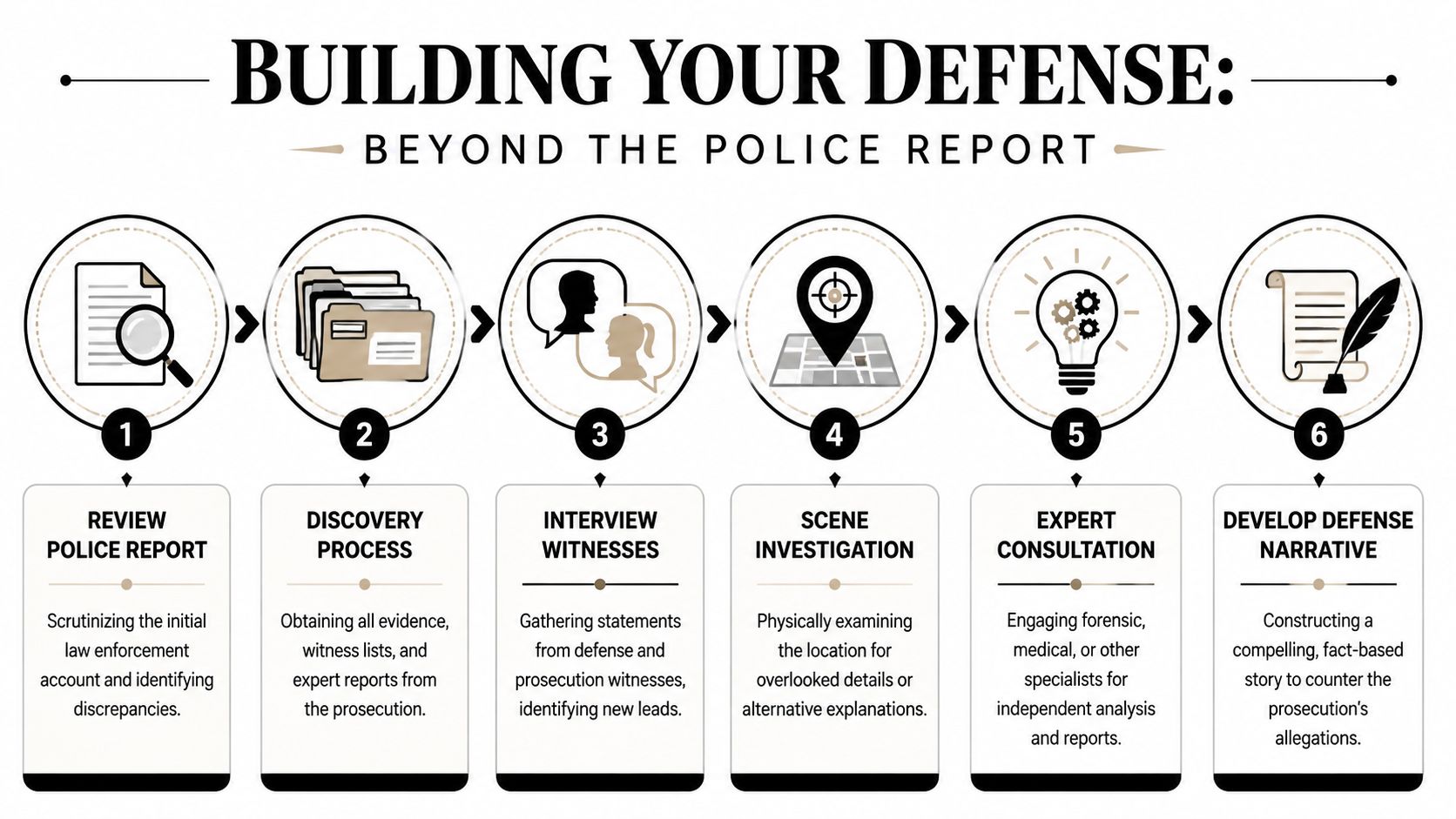
Building Your Case Beyond the Police Report
A police report is not the case. It is the state's opening draft.
In practice, many reports leave out context, miss contradictions, or summarize events in a way that sounds stronger than the actual evidence. That is why a defense investigation has to move past the report and into the raw material behind it.
A DWI example from the real world
Take a common Texas DWI case. The report may say the officer observed weaving, smelled alcohol, saw bloodshot eyes, and concluded that you failed field sobriety tests. On paper, that can look clean and complete.
Then the video arrives.
The dash camera may show a wide lane movement instead of dangerous driving. The body camera may show clear speech, steady balance, and confusing officer instructions during field sobriety testing. The dispatch audio may show that the original call described a different vehicle. A time gap may appear between the stop and the arrest. Those details matter because they can change how a prosecutor values the case and how a jury sees it.
What we request in discovery
Texas criminal defense work depends heavily on discovery. That is the process of obtaining the evidence the prosecution has or plans to use. If you're trying to understand that process better, this guide on what discovery is in Texas criminal cases and how it works is a helpful starting point.
In a DWI, assault, theft, or drug case, discovery may include:
- Body camera and dash camera footage that show the stop, arrest, and officer conduct
- 911 calls and dispatch records that may confirm or weaken the original allegation
- Witness statements from civilians, officers, and complaining witnesses
- Lab paperwork and forensic records tied to blood, breath, or seized substances
- Booking videos and jail calls if the state claims they support intoxication, intent, or admissions
A defense lawyer also looks outside formal discovery. Security video from a store, apartment complex, gas station, or nearby business may disappear quickly if nobody asks for it. Phone records, rideshare logs, medical records, and GPS history can also become important depending on the charge.
The strongest defense often comes from facts the police did not collect, not just from attacking the facts they did.
Why systems and organization matter
Criminal cases produce a surprising amount of material. Videos, photos, witness notes, hearing dates, lab packets, and motion deadlines have to stay organized. Many firms use case-management tools to track that work, and legal teams that want to discover legal software for law firms often look for systems that centralize documents, deadlines, and client communication in one place.
That kind of organization is not cosmetic. It helps your lawyer compare officer narratives to video, spot missing records, and build a defense narrative grounded in actual evidence rather than assumptions.
A practical example is a shoplifting or theft allegation. The report may describe intentional concealment. The store video may show confusion, distraction, or no clear attempt to leave without paying. The receipt may show part of the merchandise was scanned. A witness may explain that you were on the phone with a family member discussing payment. A defense is built by collecting those details before they disappear.
Finding Legal Flaws to Weaken the Prosecution's Argument
Facts matter. So does the law that controls how those facts were obtained.
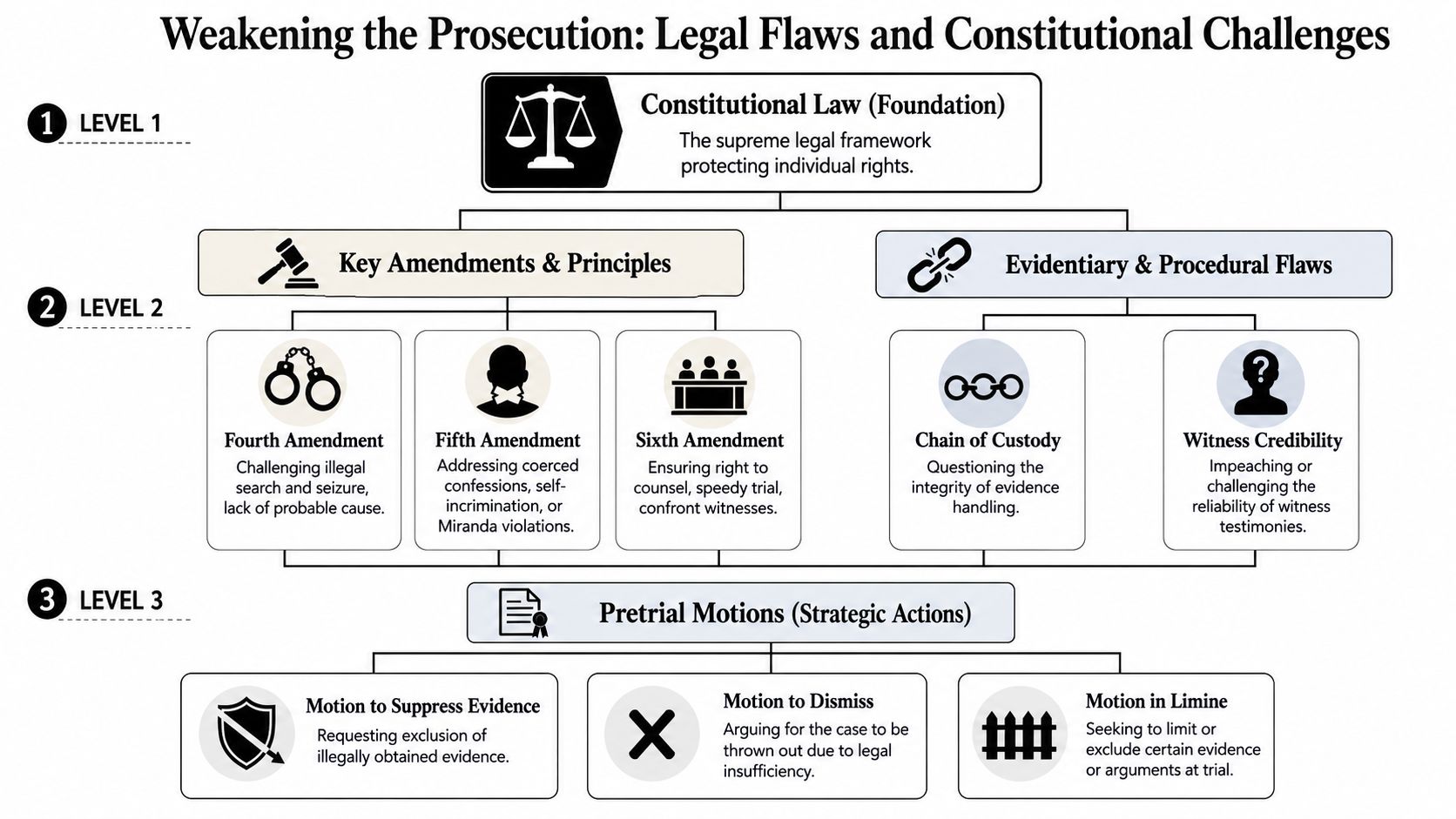
A case can look strong until you examine how police stopped you, searched you, questioned you, handled evidence, or documented the chain of events. It is at this point that legal analysis becomes strategic. A criminal defense lawyer is not just reading reports; the lawyer is comparing police conduct to constitutional rules, Texas statutes, and the Texas Code of Criminal Procedure.
What a motion to suppress really means
A motion to suppress asks the court to keep certain evidence out because police obtained it unlawfully. In plain English, it says the government broke the rules and should not benefit from that violation.
A common example is a traffic stop. Police generally need a legal reason to stop a vehicle. If the officer did not have reasonable suspicion for the stop, the defense may argue that the stop violated the Fourth Amendment. If the stop was unlawful, the court may exclude what came after it, such as statements, field sobriety tests, contraband, or other observations.
That principle can matter in a Texas DWI attorney's work, but it also appears in drug possession, firearm, and theft cases. If the search of your person, vehicle, phone, or home crossed constitutional lines, the defense may challenge the evidence directly instead of arguing only about guilt or innocence.
Where legal flaws usually appear
Some weaknesses are factual. Others are procedural. Both can change the direction of a case.
A defense lawyer may examine:
- The stop or detention to see whether officers had legal grounds to detain you
- The search to determine whether consent was valid, limited, or withdrawn
- Statements made during questioning to evaluate Miranda issues and voluntariness
- Evidence handling to see whether chain of custody problems affect reliability
- Witness identification procedures if police used suggestive methods
Texas criminal procedure gives structure to these challenges, and the timing matters. Some issues should be raised before trial through written motions and hearings. Waiting too long can weaken your position.
For a closer look at that process, review how evidence is challenged in Texas criminal cases.
What works and what doesn't
Clients sometimes think every technical mistake gets a case thrown out. That is not how criminal court works. Small errors that don't affect your rights may not change much. A judge usually wants a clear legal violation tied to real evidence and a focused argument.
What does work is discipline. Narrow issues. Strong hearing preparation. Careful use of body camera footage, dispatch records, and officer testimony. The defense should not file motions just to look aggressive. A weak motion can educate the prosecutor about your concerns without giving the judge a strong reason to rule in your favor.
A useful defense challenge is specific. It ties the law to one police action, one piece of evidence, and one remedy the court can actually grant.
This is also where your role matters again. If you remember asking whether you were free to leave, objecting to a search, or asking for a lawyer, tell your attorney. Details like that often do not appear clearly in the report.
The Two Paths Plea Negotiation Versus Trial Preparation
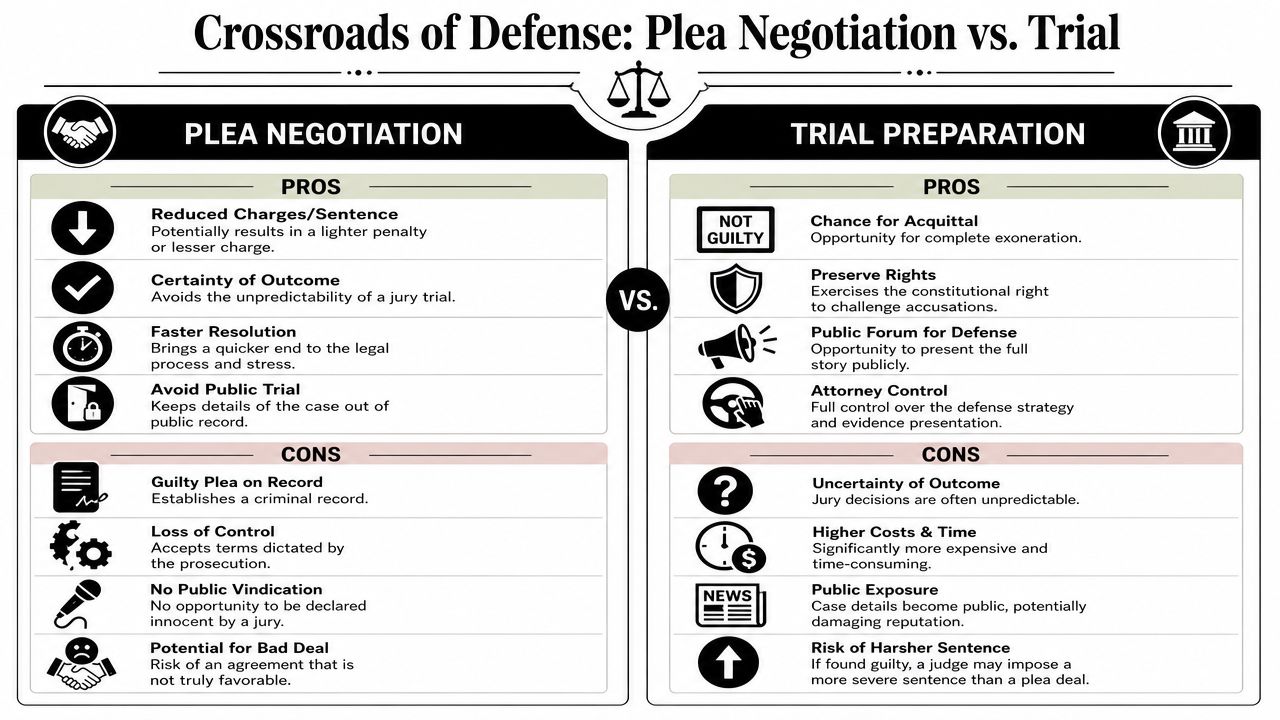
Every criminal case reaches a choice point. Either the defense works toward a negotiated resolution, or it prepares to put the case in front of a judge or jury. Often, both tracks move at the same time.
That does not mean your lawyer is undecided. It means good strategy keeps pressure on the state from both sides.
Plea negotiation from a position of strength
A plea bargain is not automatically surrender. In the right case, it is a calculated decision based on risk, evidence, sentencing exposure, collateral consequences, and your goals.
If the defense has found witness problems, search issues, missing video, or weak proof of intent, those weaknesses can present opportunities. In a drug possession case, that may support a reduction or an alternative resolution. In a theft case, it may support a lesser charge. In an assault case, it may shift the discussion toward self-defense problems, proof issues, or a less serious allegation.
Here is a practical comparison:
| Path | When it may help | Main trade-off |
|---|---|---|
| Negotiated plea | When the evidence risk is high or the offer protects your long-term interests | You may accept a criminal consequence to avoid a worse one |
| Trial | When the state has major proof problems or you need to contest the accusation fully | The result is less predictable |
The decision should never be driven by panic. It should come from a sober review of the file, the law, the court, and your priorities.
What trial preparation actually involves
Some clients hear “trial” and think only of dramatic cross-examination. Real trial work starts long before that. It includes selecting issues, preparing exhibits, reviewing prior statements, identifying jury themes, drafting questions, and deciding what story the defense wants jurors to hear.
This matters in common charges:
- DWI cases often turn on officer credibility, video, and whether intoxication was proven
- Assault allegations may involve self-defense, mutual combat, inconsistent witness accounts, or lack of intent
- Theft prosecutions can center on consent, mistake, identity, or whether the state can prove intent to deprive
- Drug possession cases often raise possession versus mere presence, search legality, and lab proof
The video below gives useful context on how these decisions can unfold in practice.
Why smart lawyers prepare for both outcomes
You want your lawyer negotiating as if trial is possible and preparing for trial as if negotiation may still resolve the case. That is how a strong position is established.
If a prosecutor knows the defense is organized, ready for hearings, and prepared to try the case, offers tend to be taken more seriously. If the state knows the defense is bluffing, negotiations become harder.
Going to trial should be a reasoned decision, not a reaction to fear, anger, or false confidence.
Arraignment, plea discussions, pretrial hearings, trial, and sentencing are all connected. The work done at the beginning shapes every later choice.
Planning for Your Future Mitigation Sentencing and Record Clearing
You may be relieved once a plea is entered or a verdict comes back. Then the next worry hits. What happens to your job, your record, your family responsibilities, and your future.
That part of the case deserves planning too.
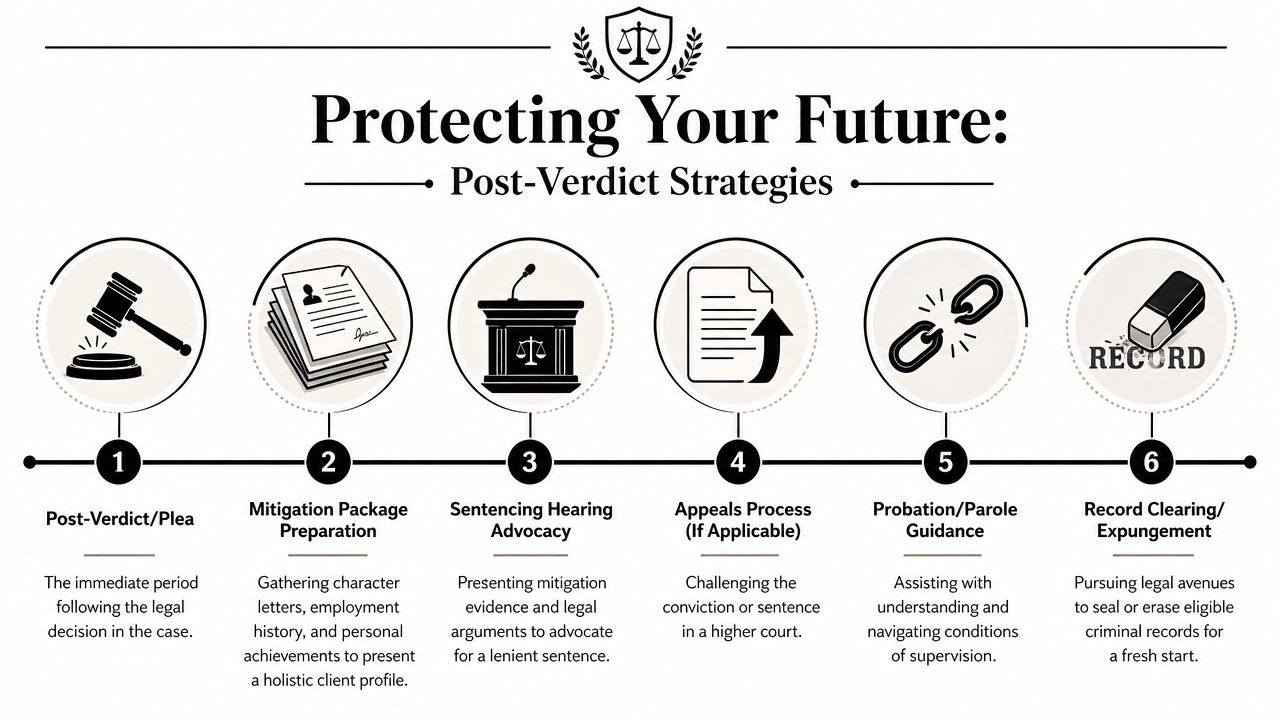
Mitigation is the work of showing the court who you are in full context. A judge should see more than the charge. The court should also see your work history, treatment efforts, family support, responsibilities, and the concrete steps you have already taken to reduce the chance of another problem.
What belongs in a mitigation packet
A useful mitigation packet is organized, specific, and credible. Judges can tell the difference between real preparation and a pile of papers gathered the night before court.
Your role matters here. Start gathering records early and give your lawyer documents that show stability, treatment, and accountability, such as:
- Employment records showing steady work, a return to work, or a supervisor willing to keep you employed
- School, GED, certification, or training records showing structure and future planning
- Counseling, rehab, or treatment records when substance use, anger, trauma, or mental health is part of the case
- Letters from family, employers, clergy, coaches, or mentors that give specific examples of your character and support system
- Proof of caregiving, volunteer work, or community involvement that shows responsibility to other people
Specificity matters. A short letter saying you are "a good person" carries less weight than a letter explaining that you show up on time, support your children, completed counseling, and followed through after the charge.
The same rule applies to classes and treatment. If alcohol played a role in a DWI case, early education or treatment can help. If anger, conflict, or substance use is part of the facts, counseling, testing, or documented compliance can help. The point is to present honest proof of what you are doing now, not a polished version of who you wish the court believed you were.
Texas options for clearing your record
After the criminal case ends, some people may qualify for record clearing. In Texas, the two remedies clients ask about most often are expunction and orders of nondisclosure.
An expunction can remove records tied to certain arrests or charges. An order of nondisclosure can seal eligible records from public view, but it does not erase the record entirely. Whether either option is available depends on the result of the case, the type of charge, your criminal history, waiting periods, and sometimes whether there was any family violence finding.
A few practical points come up often:
- A dismissal does not always mean immediate expunction
- Some deferred adjudication outcomes may later qualify for nondisclosure
- Family violence allegations or findings can limit sealing options
- Probation terms and final paperwork can affect what relief is available later
This is why clients should keep every final order, judgment, discharge notice, and receipt. If you lose the paperwork, your lawyer can still get records, but that slows things down and can make later cleanup harder than it needs to be.
Your job after the case
Many clients assume the danger has passed once court settings stop. In reality, post-case mistakes can still damage your future.
Follow every probation condition exactly. Finish classes, treatment, fees, community service, ignition interlock requirements, reporting, and testing on time. Keep copies of everything you complete. If a term is confusing, ask before you guess.
Law Office of Bryan Fagan PLLC handles criminal defense matters as well as expunctions, nondisclosures, and related post-conviction issues. That can matter if your goal is not only to resolve the charge, but also to protect your ability to work, rent housing, keep professional opportunities, and explain your record as little as possible from now on.
Your Defense Strategy Begins with a Single Conversation
A strong defense is rarely built on one dramatic courtroom moment. It is built through early honesty, careful investigation, focused legal challenges, practical negotiation, and smart planning for what comes next. Criminal defense attorneys build a defense strategy primarily with facts, timing, legal judgment, and your active help.
You do not need to know everything today. You do need to act quickly, protect your rights, and speak to counsel before avoidable mistakes make the case harder. Whether you're dealing with a Texas DWI attorney issue, a Houston criminal lawyer matter, or a Texas assault defense case, the right strategy starts with getting the full story on the table.
If you've been charged with a crime in Texas, call The Law Office of Bryan Fagan, PLLC for a free and confidential consultation. Our defense team is ready to protect your rights.
If you've been charged with a crime in Texas, contact Law Office of Bryan Fagan PLLC for a free and confidential consultation. Our defense team is ready to protect your rights.