Skip to content
Being stopped, searched, or arrested by the police can be a terrifying experience—but you don’t have to face it alone. An illegal search and seizure is a serious violation of your constitutional rights. It occurs when law enforcement invades your privacy without a valid warrant or a legitimate legal reason. In Texas, police can't just search you, your home, or your car based on a hunch. Their actions must be justified by law, and understanding what makes a search illegal is the first step toward protecting your freedom.
The Fourth Amendment: Your Personal Privacy Bubble
When you're dealing with law enforcement, it's easy to feel powerless. But the U.S. and Texas Constitutions give you powerful rights, specifically the right to be free from "unreasonable searches and seizures." The best way to think about the Fourth Amendment is as a personal privacy bubble that surrounds you, your home, your car, and your belongings.

The core idea is simple: for the government to burst that bubble, they almost always need a good reason and official permission from a judge. Let's break down what "search" and "seizure" actually mean in a way that applies to your situation.
What Counts as a Search and Seizure?
These legal terms might sound technical, but they have very real consequences. Knowing what they mean helps you understand when your rights are on the line.
A "Search": This happens any time the government intrudes on a place where you have a "reasonable expectation of privacy." It isn't just about an officer physically rummaging through your pockets. A search can include swiping through your phone, opening your glove compartment without permission, or even walking into your backyard uninvited.
A "Seizure": This is when the government takes control of your property (like confiscating your backpack) or restricts your freedom of movement. If you're pulled over for a traffic stop, you've been "seized." If you're placed in handcuffs, you have definitely been seized.
For any search or seizure to be legal, it must be reasonable. In the eyes of the law, "reasonable" usually means law enforcement obtained a search warrant based on probable cause. Any search conducted without a warrant is automatically considered unreasonable unless it falls under one of a few specific exceptions.
The entire question of whether a search and seizure was illegal boils down to one word: reasonableness. If what the officer did wasn't reasonable, any evidence they found can, and should, be thrown out of court.
Legal Search vs. Illegal Search at a Glance
In the heat of the moment, telling the difference between a lawful police action and a violation of your rights is tough. This table breaks down the key characteristics to give you a clear reference.
| Element | What Makes It Legal | What Makes It Illegal |
|---|---|---|
| Justification | Police have a valid search warrant or probable cause plus a recognized legal exception (e.g., consent, plain view). | Police act on a hunch, bias, or flimsy evidence without a warrant or a valid exception. |
| Scope | The search stays within the specific person, place, and items listed in the warrant or justified by the situation. | Police search areas beyond what the warrant allows or the situation justifies (e.g., searching a whole house during a traffic stop). |
| Consent | You give clear, voluntary, and uncoerced permission. You know you have the right to say no. | You agree to a search because of intimidation, threats, or feeling like you have no other choice. |
| Duration | A traffic stop or detention lasts only as long as needed to handle the original reason for the stop. | Police drag out a stop without new reasonable suspicion just to look for evidence of other crimes—a "fishing expedition." |
Recognizing the signs of an illegal search is the first step toward building a strong defense. If police found evidence against you during a search that just felt wrong, it’s critical to speak with a criminal defense attorney who can scrutinize every detail of the encounter.
The Power of Warrants and Probable Cause
We’ve all seen it on TV: police show up with a piece of paper and start tearing a place apart. But in the real world, that piece of paper—a search warrant—and the legal standard needed to get it, probable cause, are what stand between a lawful search and a violation of your constitutional rights. Getting a handle on how they work is a crucial step to protecting yourself.
A warrant is essentially a permission slip from a neutral judge or magistrate. It gives law enforcement specific approval to search a particular place for specific items related to a crime. It’s meant to be a critical check on police power, ensuring an independent legal mind agrees that invading your privacy is actually justified.
What Is Probable Cause?
Before any judge can sign off on a warrant, the police have to convince them they have probable cause. This is one of the most fundamental concepts in criminal law, but it’s also one of the most misunderstood.
Probable cause isn't just a hunch or a gut feeling an officer has. Think of it like a half-finished puzzle. A single piece tells you nothing, but once you connect enough pieces, a reasonable person can start to see what the final picture is supposed to be.
That’s what probable cause is—enough credible facts and circumstances to lead a reasonable person to believe that a crime was committed and that evidence of it will be found in the location they want to search.
The Flaws in the Warrant System
In a perfect world, the warrant process would be a powerful shield for your Fourth Amendment rights. But we don't live in a perfect world. In practice, the system often breaks down, and when it does, the results can be unjust and even tragic. Rushed judges and flawed police work can turn a legal document into a weapon.
This isn’t some new development. For decades, legal scholars have warned that warrants are often "rubber-stamped" by overloaded courts. A landmark analysis by Richard Van Duizend laid bare a shocking truth: observers watching 84 warrant proceedings saw 65% were approved in two-and-a-half minutes or less. You can dive deeper into these findings in the full analysis from the Harvard Law Review.
When the gatekeepers aren't watching closely, dangerous mistakes happen.
The Danger of "No-Knock" Warrants
Nowhere are the stakes higher than with "no-knock" warrants. These warrants give police the authority to smash into a home without announcing themselves. The tactic is supposed to be reserved for high-risk situations where knocking could lead to officers getting shot or evidence being destroyed.
But when these raids are based on bad information, they lead to disaster. The 2020 death of Breonna Taylor during a botched no-knock raid forced a national reckoning with these dangers. In response, many states finally took action. By April 2023, 30 states and 25 cities had restricted no-knock raids, and six states, including Florida and Virginia, had banned them altogether.
A warrant is only as good as the information used to get it. If police use false statements, stale information, or unreliable sources to obtain a warrant, any search based on it may be deemed illegal.
This is exactly where a sharp Texas defense attorney makes all the difference. We never take a warrant at face value. Our team at The Law Office of Bryan Fagan, PLLC, will dissect the affidavit—the sworn statement police gave the judge—to find every crack and every weakness.
We start by asking the tough questions:
- Was the confidential informant actually reliable? Or just someone trying to get out of their own trouble?
- Did the police conveniently leave out facts that would have made the judge think twice?
- Was the information so old that it was no longer relevant?
- Did the police go beyond the four corners of the warrant and search areas they weren't allowed to?
Challenging a warrant is a complex fight, but it's often the single most effective strategy for dismantling the prosecution's case. If you're facing charges that started with a search, you can learn more about how warrants work in Houston, TX. Finding the answers to these questions can be the key to getting evidence thrown out and reclaiming your freedom.
When Police Can Search Without a Warrant
You’d think the Fourth Amendment’s protection against unreasonable searches means police always need a warrant. The truth is, that’s not how it usually works on the streets of Texas. The vast majority of searches happen without a judge’s signature.
This is because the law has carved out several major exceptions to the warrant rule. Knowing these exceptions is one of the most powerful tools you have to protect your rights. It helps you understand when an officer is acting within the law and, just as importantly, when they might be crossing a serious legal line.
The Most Common Exceptions to the Warrant Rule
Police officers are well-versed in these exceptions and know exactly what they need to justify a search on the spot. Here are the most common situations you might run into during a traffic stop, on the street, or even at your front door.
Consent to Search
This is, by far, the most frequent reason police give for a warrantless search because it’s the easiest for them to use. If an officer asks for your permission to search your car, your pockets, or your home, and you give it, you’ve essentially handed over your Fourth Amendment rights.
For consent to be legally valid, it must be voluntary. An officer can’t use threats, intimidation, or trickery to get you to agree. But here’s the most important part: you have the absolute right to say “no.” You can and should state clearly and politely, “Officer, I do not consent to any searches.”
Plain View Doctrine
The plain view doctrine is another big one. It allows police to seize evidence without a warrant if they see it from a place where they’re legally allowed to be. For instance, if you get pulled over for a traffic violation and the officer spots what looks like a bag of cocaine on your passenger seat, they can seize it.
The key requirements are:
- The officer must be lawfully in the spot where they viewed the item.
- The illegal nature of the item must be immediately obvious.
- The officer has to have a lawful right to access the object itself.
What they can’t do is use a traffic stop as an excuse to start poking around your car, opening your trunk, or rummaging through your glove box hoping to find something "in plain view" inside. The item has to be visible from the outside.
Searches During or After an Arrest
Once you are lawfully placed under arrest, the rules for searching change dramatically. This is another area where your rights can quickly get complicated.
Search Incident to Lawful Arrest
When an officer makes a lawful arrest, they have the right to search your person and the area within your “immediate control.” The justification for this is twofold: to find any weapons that could harm the officer and to prevent you from destroying or hiding evidence.
If you’re arrested in your car, this generally includes the passenger compartment—anywhere you could reasonably reach. It typically does not, however, include a locked trunk. The scope of this kind of search is often a battleground in court, and a sharp defense lawyer will scrutinize whether the area searched was truly within your immediate reach.
This decision tree helps visualize the basic questions that determine if a search was legal.
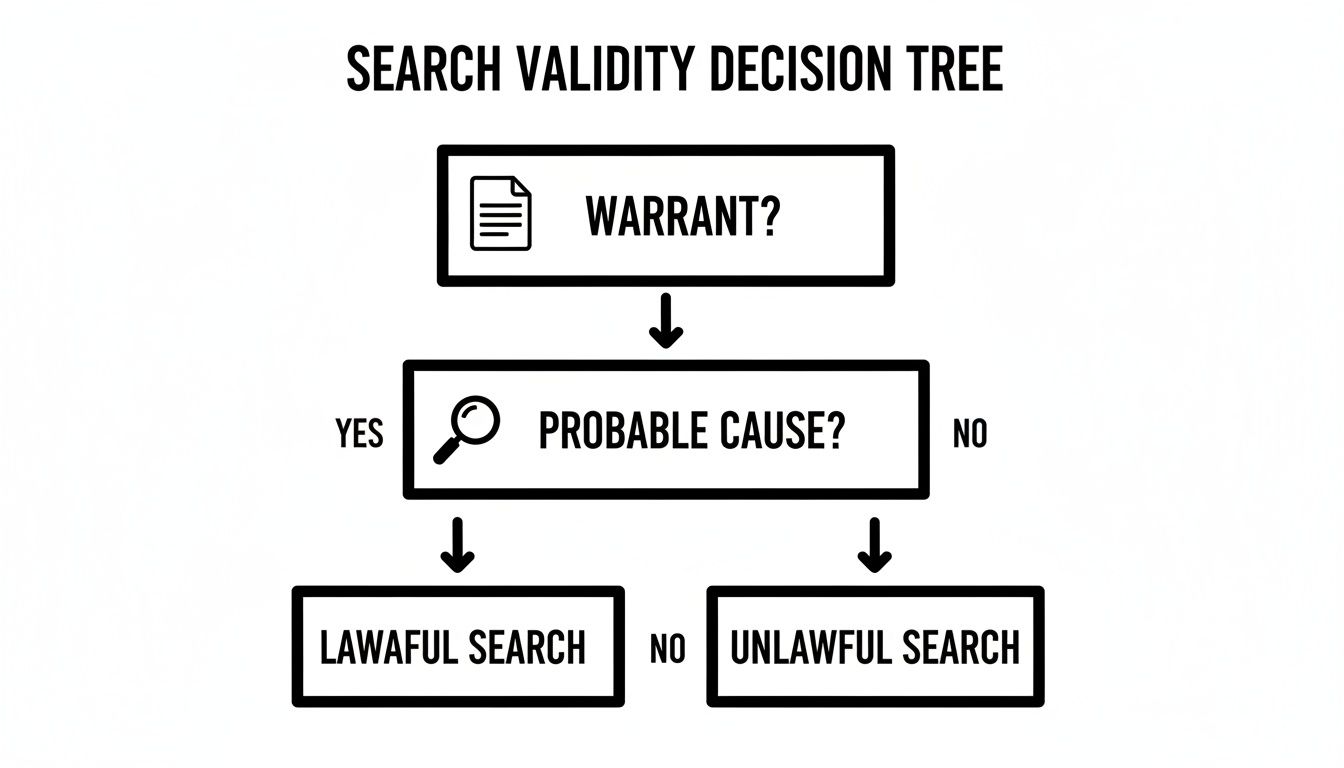
As you can see, a "No" at either step—the warrant or the probable cause—points straight to an unlawful search.
Exigent Circumstances
“Exigent circumstances” is a legal phrase that basically means “an emergency.” This exception allows police to act without a warrant if they have a good-faith belief that waiting to get one would result in:
- The destruction of critical evidence.
- The escape of a suspect.
- Immediate danger to the public or the police themselves.
For example, if police are in “hot pursuit” of a fleeing bank robber who ducks into a house, they can follow him inside without pausing to get a warrant. What they can’t do is turn a minor traffic offense into an excuse to barge into your home without a real, pressing emergency.
Figuring out if one of these exceptions genuinely applied in your case is a detailed legal question that depends entirely on the facts. An officer’s claim of “plain view” or “exigent circumstances” might sound good on the report, but it may not hold up under scrutiny in court. This is exactly why having an experienced Houston criminal lawyer examine every detail of your case is so critical.
Protecting Your Rights During Texas Traffic Stops
The flash of red and blue in your rearview mirror is a sight that makes anyone’s heart pound. A simple stop for a minor traffic violation can quickly spiral into a full-blown vehicle search, leaving you feeling confused, powerless, and wondering where things went wrong. For many Texans, this scenario is all too real.
It’s one of the most common ways people find themselves facing serious charges. That’s why understanding your rights on the road—especially when an officer wants to search your car—is one of the most important things you can do to protect yourself.

The Automobile Exception and What It Means for You
Here's the first thing to know: your car doesn't get the same Fourth Amendment protection as your home. Thanks to a legal doctrine called the "automobile exception," courts have ruled that people have a lower expectation of privacy in their vehicles because they're mobile. This gives police more freedom to search a car without a warrant.
But it’s not a free-for-all. To legally search your vehicle without a warrant, an officer still needs probable cause—a solid, reasonable belief that your car contains evidence of a crime. A simple speeding ticket isn’t enough. Probable cause has to be based on specific facts, like the distinct smell of marijuana or seeing drug paraphernalia sitting on your passenger seat.
The Stop Cannot Last Forever
A traffic stop has a mission—usually to investigate a traffic infraction and issue a ticket or a warning. A landmark Supreme Court case, Rodriguez v. United States, made it clear that police cannot drag out a stop beyond the time it takes to complete that mission just to go on a "fishing expedition" for other crimes.
What does that look like in practice? An officer can't just make you sit on the side of the road indefinitely while they wait for a drug-sniffing dog to show up. To legally detain you longer, they must develop new reasonable suspicion of criminal activity during the stop. If they unreasonably prolong the stop, it becomes an illegal seizure, and any evidence they find after that point can be thrown out of court.
This is a battleground in countless DWI and drug possession cases. A sharp criminal defense attorney will scrutinize the dashcam and bodycam footage, timing every second of the interaction to see if the officer illegally extended the stop.
A traffic stop must be limited in scope and duration. Once the purpose of the stop is complete, you should be free to go unless the officer has a new, legitimate reason to detain you further.
The reality is that many people feel their rights are violated during these stops. National data from the Bureau of Justice Statistics found that 3.5% of drivers who were pulled over had their car or person searched. Of those drivers, over 40% reported the officer never even asked for consent, and a shocking 61% felt the search was illegitimate. To see more on these numbers and the impact of the Rodriguez case, you can explore the details on driver search perceptions.
Practical Advice for Handling a Texas Traffic Stop
If you see those flashing lights, your primary goal is to remain calm while firmly protecting your rights. It’s a delicate balance, but knowing what to do ahead of time makes all the difference.
- Stay Calm and Be Polite: An aggressive or nervous attitude will only escalate the situation. Keep your hands on the steering wheel where the officer can see them and cooperate with basic commands, like providing your license and registration.
- You Can Refuse a Search: If the officer asks for permission to search your vehicle, you have the right to say no. A clear and polite, “Officer, I do not consent to a search,” is all you need to say.
- Don't Answer Fishing Questions: Officers are trained to ask vague questions to get you to incriminate yourself, like, "You don't have anything in the car I should know about, do you?" You are not obligated to answer. You can simply state, "I'm not going to answer that question."
- Ask if You Are Free to Go: Once the officer has given you a ticket or warning, you can ask, "Am I being detained, or am I free to go?" This simple question forces the officer to either end the stop or justify why they are continuing to hold you.
If an officer decides to search your car anyway despite your refusal, do not physically resist. You can’t win that fight on the side of the road. Let your lawyer win it for you in the courtroom. Your job is to remember every detail and call a defense attorney as soon as you possibly can.
Border Searches and Your Digital Privacy Rights
As a Texan, you know the border is a huge part of our state's identity. But what most people don't realize is how your constitutional rights—especially your right to privacy—can shrink the closer you get to it. This is all because of a powerful legal doctrine called the “border search exception.”
This exception gives federal agents, like those from Customs and Border Protection (CBP), sweeping authority to conduct searches without a warrant and without the probable cause that’s normally required. And here’s the kicker: this rule doesn’t just apply at the physical border crossing. It extends into a "reasonable distance" inland, which the government defines as a zone up to 100 miles from any U.S. border.
The Fourth Amendment-Free Zone
Because of the “border search exception,” many legal experts and civil rights groups have dubbed this area a “Fourth Amendment-free zone.” Within this massive stretch of land, federal agents can stop and search your vehicle, your belongings, and even you with far less justification than a local police officer would need to pull you over in downtown Houston.
Originally, the idea was to protect national security and control what comes into the country. But its use has expanded dramatically over the years, and now it poses a serious threat to your digital life.
Your Phone and Laptop Are Not Safe
One of the most alarming modern applications of the border search exception is how it’s used on electronic devices. Federal agents now claim they have the authority to search your cell phone, laptop, or tablet without a warrant—and they’ll often demand you unlock it for them.
Think about that for a second. That means they can potentially sift through your private emails, text messages, photos, social media accounts, and financial records. It’s a complete window into your personal life, handed over without a warrant.
Make no mistake: the information found on your digital devices during a border search can absolutely be used to prosecute you. Evidence of drug offenses, financial crimes, or any other illegal activity discovered on your phone can lead to serious state or federal charges, even if the search had nothing to do with immigration in the first place.
This isn't a rare occurrence, either. The use of this power has skyrocketed. Data from U.S. Customs and Border Protection shows that searches of electronic devices have jumped more than four times since 2015, hitting 46,000 in 2024 alone. While 78% of these searches involved non-citizens, that still means thousands of U.S. citizens had their digital lives picked apart without a warrant. In fact, some federal policies even allow agents to conduct these intrusive digital searches without any suspicion at all, further eroding privacy protections near the border. You can read more about this growing issue and its impact on the Fourth Amendment.
If your digital privacy is breached during a search, knowing how to collect and present that evidence in court is critical. For instance, you might need information on exporting legally admissible text messages from your iPhone for court. This kind of knowledge is essential when you're trying to build a defense against evidence taken from your personal devices. The rules at the border are complex and always changing, making it vital to have a skilled attorney who knows how to challenge this kind of evidence.
How to Fight Back After an Illegal Search
If the police found evidence against you during an illegal search, it’s easy to feel like the case is over before it even starts. But a violation of your Fourth Amendment rights isn’t just an injustice—it's a legal opening a skilled defense attorney can use to turn the tables on the prosecution. The legal system has a specific remedy for this exact situation, and it can be a true game-changer.

Our primary weapon in this fight is a powerful legal tool called a Motion to Suppress. This is a formal request your lawyer files with the court, arguing that the police broke the rules and that whatever they found should be thrown out of court.
The Exclusionary Rule and Its Impact
The legal firepower behind this motion is the Exclusionary Rule. Think of it as a penalty flag thrown on the prosecution's case. The rule says that any evidence obtained through an illegal search or seizure cannot be used against you in a criminal trial. It’s designed to deter police misconduct by taking away the very incentive to violate your rights in the first place.
But it gets even better. This powerful doctrine doesn’t just apply to the evidence found during the initial bad search. It also covers any additional evidence discovered as a direct result of that first violation. Lawyers call this the "fruit of the poisonous tree" doctrine. In short, if the tree (the initial search) is poisoned, then all of its fruit (any resulting evidence) is poisoned, too.
For example, if an illegal car search turns up a key that opens a storage unit where drugs are found, both the key and the drugs can be suppressed. The entire chain of evidence is tainted. If you'd like a deeper dive into this crucial concept, you can learn more about how the Exclusionary Rule works in Texas courts.
The Motion to Suppress Hearing
After your attorney files the Motion to Suppress, the judge schedules a special hearing. This isn't the full trial—it’s a mini-trial focused on just one thing: whether the police acted legally. During this hearing, your attorney gets to put the officer on the stand, cross-examine them about their actions, and expose any holes in their story.
A successful Motion to Suppress can completely dismantle the prosecutor's case. Without their key evidence, they may have no choice but to reduce the charges or dismiss the case entirely.
Winning a motion to suppress isn't just a long shot; it’s a core defense strategy that gets real results in all kinds of cases, including:
- DWI: If the traffic stop that led to your arrest was illegal, everything that followed—from field sobriety tests to breath or blood results—can get thrown out.
- Drug Possession: If officers found drugs during a search that violated your rights, the prosecutor could be left with nothing to present at trial.
- Theft or Fraud: When police seize computers or phones, a defense attorney can challenge the search warrant's validity. Understanding the challenges in digital forensics is key to protecting digital privacy and ensuring evidence was handled properly.
An illegal search might feel like the end of the road, but for an experienced defense team, it’s often just the beginning of a powerful fight to protect your freedom. After a case concludes, we can also help with post-conviction options like expunctions and record sealing to help you move forward with your life.
Frequently Asked Questions About Search and Seizure
Knowing the law is one thing, but facing a real-life police encounter is another. Things can get confusing fast. Below, we’ll tackle some of the most common questions we hear about search and seizure in Texas.
Can Police Search My House if My Roommate Consents but I Don’t?
This is a tricky situation, and the answer hinges on the specific facts. As a general rule, if you and your roommate are both standing at the door and you clearly refuse the search, the police can't legally enter common areas without a warrant.
But what if you aren't home? In that case, your roommate can typically give consent for officers to search shared spaces like the living room or kitchen. However, that consent does not extend to your private bedroom or personal spaces.
Police Pulled Me Over for Speeding and Then Searched My Trunk. Is That Legal?
Not without something more, no. A simple traffic stop for speeding doesn't automatically give an officer probable cause to pop your trunk.
To legally search a locked trunk, the officer needs to develop a separate and reasonable belief that it contains evidence of a crime. That might happen if they see something illegal in plain sight on your passenger seat or smell a strong odor of marijuana coming from the car. The traffic ticket itself isn't enough.
I Felt Intimidated and Said Yes to a Search. Can I Still Fight It?
Yes, you absolutely may be able to fight it. For your consent to be considered valid in court, it must be given freely and voluntarily. If you only agreed because you felt pressured, threatened, or coerced by the officer's presence or words, that consent isn't legally binding.
Proving your consent wasn’t truly voluntary can be tough, but a skilled Texas assault defense attorney knows exactly where to look. We scrutinize body camera footage, review police reports, and analyze the officer's conduct to build a strong argument. A successful challenge often leads to evidence being thrown out through a legal filing known as a Motion to Suppress.
If you’ve been charged with a crime in Texas, call The Law Office of Bryan Fagan, PLLC for a free and confidential consultation. Our defense team is ready to protect your rights. You can reach us at https://texascriminallawyer.net.