You may be reading this because a traffic stop rattled you, a missed court date is haunting you, or someone told you there might be a warrant with your name on it in San Antonio. That fear is real. People often worry about getting arrested at work, in front of family, or during something as ordinary as renewing a license.
A warrant is serious, but it isn't a mystery you have to sit with alone. In most cases, the smartest move is to slow down, verify what's real, and choose a plan before law enforcement chooses the timing for you. That matters whether the underlying issue involves DWI, assault, theft, drug possession, or a missed appearance in court.
The Fear of an Unknown Warrant in Bexar County
The hardest part of suspected bexar county warrants is often the waiting. You don't know whether the warrant is active, what level of offense is attached to it, or whether a routine stop will suddenly turn into handcuffs and booking.
Many people in this position aren't trying to run. They're trying to figure out what happens next without making things worse. That includes parents with school pickups, workers who can't miss shifts, and first-time defendants who have never dealt with the criminal courts before.
What people usually fear most
The fear usually falls into a few categories:
- Sudden arrest: You worry that a simple traffic stop could turn into jail.
- Public embarrassment: You don't want to be arrested in front of coworkers, children, or neighbors.
- The unknown charge: You may not even know whether the issue is tied to a misdemeanor, a felony, or a missed court setting.
- Collateral damage: You may already have a pending family law matter, immigration concern, or job issue that could get worse fast.
A warrant feels overwhelming because it removes predictability. The right response is to put structure back into the situation.
If you're facing possible charges for DWI, assault, shoplifting, drug possession, or a probation-related issue, the strategy isn't the same in every case. Sometimes the immediate goal is to confirm whether a warrant exists. Sometimes it's to arrange a controlled surrender. Sometimes it's to challenge the warrant itself.
Calm action beats panic
Panic leads people to make bad choices. They rely on random websites, ignore court notices, or show up unprepared at a jail facility hoping things will somehow work out. That usually creates more risk, not less.
A better approach is simple:
- Confirm the warrant safely
- Learn what kind of warrant it is
- Decide whether surrender, bond, or a legal challenge makes sense
- Prepare for the underlying criminal case
That last point matters. Clearing the warrant is only the first problem. After that, your case still moves through arraignment, plea discussions, motions, trial settings, and possibly sentencing. If the matter ends favorably, you may also want to look at expunction or record sealing options so the case doesn't follow you longer than it should.
Understanding Different Types of Bexar County Warrants
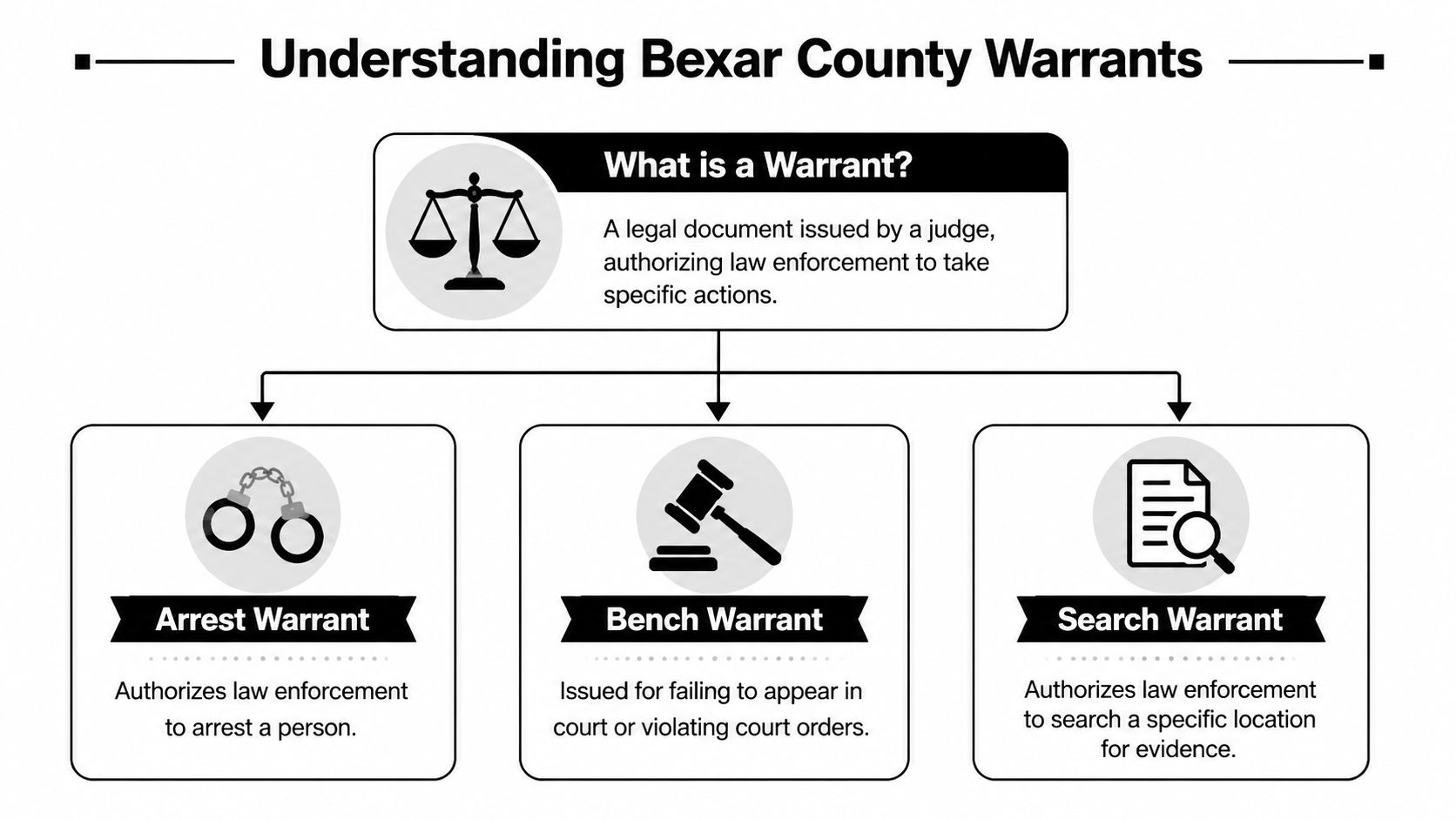
A warrant is a court-authorized order that lets law enforcement take a specific action. In plain English, it is the judge's written permission for officers to arrest someone, bring someone to court, or search a place for evidence.
Arrest warrants
An arrest warrant is the most familiar type. It usually means law enforcement asked a judge to authorize an arrest based on alleged criminal conduct. That could involve a DWI, assault, theft, robbery, drug offense, or another Penal Code or related charge.
For a person under investigation, an arrest warrant changes the practical reality of the case. The issue is no longer just whether officers are looking into an allegation. The issue becomes whether they can take you into custody immediately.
If you want a more detailed look at how this works under Texas procedure, this explanation of an arrest warrant in Texas is a useful companion.
Bench warrants
A bench warrant usually comes from the court itself, not from a fresh police investigation. Judges commonly issue bench warrants when someone fails to appear for court, violates a court order, or falls out of compliance in a pending case.
That happens more often than people expect. A person charged with DWI may miss a court date because they moved and never saw the notice. A defendant in an assault case may misunderstand a reset date. A witness or defendant may believe the lawyer handled everything, only to learn later that the court expected a personal appearance.
For a focused overview, see this article on what is a bench warrant in Texas.
Search warrants
A search warrant gives officers authority to search a specific place for particular items. In drug, firearm, or white-collar investigations, this can become a major part of the evidence fight.
Under Texas law, search warrants have to be specific. Officers aren't supposed to get broad permission to search everywhere for anything. The place and the items sought must be identified with enough detail to satisfy the statute and the Constitution.
Practical distinction: Arrest warrants focus on people. Search warrants focus on places and evidence. Bench warrants focus on court compliance.
Why the type matters
The kind of warrant shapes your next move. A bench warrant may sometimes be resolved through a motion and a new court setting. An arrest warrant may call for a managed surrender and bond plan. A search warrant often leads to a suppression issue if officers or the affidavit failed to follow the law.
That difference affects everything after arrest too. The path may include magistration, bond review, plea bargaining, trial preparation, sentencing exposure, and later efforts to clear your record if the case qualifies for expunction or nondisclosure.
The Truth About Checking for Warrants in Bexar County
A lot of people start with a search engine. They type in "free warrant search" and hope for an instant answer. That's understandable, but it's also where many people get misled.

The biggest myth is that there is a free, public online felony warrant lookup for Bexar County. There isn't. According to a discussion of Bexar County warrant procedures, the county's active felony warrants map requires a "bexarusername" login, so public users can't search it from home, and active warrants are treated as confidential until executed under the Texas Public Information Act. That same resource notes that the public generally must rely on calls to the Sheriff's office at 210-335-6030 or 210-335-6050 for verification or work through counsel using attorney channels, as explained in this overview of Bexar County warrant checks.
What doesn't work well
Many commercial search sites recycle old court data, scrape incomplete records, or mix civil, traffic, and criminal information together. That can produce false comfort or false panic.
Common problems include:
- Old information: A case may appear active even though it was resolved.
- Incomplete information: A website may show a case filing but not whether a warrant was recalled.
- Wrong person matches: Similar names can create dangerous confusion.
- No confidentiality: You may end up entering personal data into a site that has no official role in the case.
Safer ways to check
The better options are more boring, but they are more reliable.
| Method | What it can do | Trade-off |
|---|---|---|
| Sheriff's office phone call | Can help verify whether a warrant exists | Limited hours and limited detail |
| Court record review | May show a case, filing, or missed setting connected to a warrant | Not the same as live warrant confirmation |
| Attorney-assisted check | Adds confidentiality and strategy before you act | Requires legal help up front |
If your concerns overlap with travel or federal screening issues, this guide on resources for immigration warrant enforcement can help you think through airport and immigration-related risk in broader terms.
Practical rule: If you think a warrant may exist, don't rely on a pop-up website that promises instant answers. Use a direct county contact or a lawyer who can verify status and plan the next move.
Why confidentiality matters
The reason people get into trouble isn't always the warrant itself. It's the way they respond to it. Calling the right office or asking counsel to verify the situation lets you make decisions in the right order.
That order matters. First, confirm whether the warrant is real. Second, identify the court and charge. Third, decide whether a recall, self-surrender, or bond plan makes the most sense. Once that piece is under control, attention turns back to defending the underlying allegation and protecting future options like a dismissal, a reduction, or post-case record relief.
Legal Consequences of an Outstanding Warrant
Ignoring a warrant rarely improves anything. It usually narrows your options and lets the timing fall into someone else's hands.
One of the clearest points in Bexar County practice is that warrants do not expire. According to the Bexar County Warrant Division, they remain active until they are resolved or recalled, and a person can be arrested years later during a routine law enforcement contact.
Where arrests often happen
People sometimes assume officers will only serve a warrant if they come looking at home. In reality, arrests often happen during ordinary events:
- Traffic stops: An officer checks your information and sees the warrant.
- Booking on another matter: A minor issue turns into a bigger detention problem.
- Routine law enforcement contact: Any lawful identification check can expose the warrant.
- Court appearances on another case: The warrant can affect bond or detention decisions.
That can be especially damaging if you already have another pending case. A new arrest may affect bond conditions, credibility with the court, and influence in plea discussions.
The ripple effect on your life
An outstanding warrant can create pressure in areas far beyond criminal court. Employers may not tolerate missed work after an unexpected jail stay. Family law disputes can become harder when the other side argues that you are unstable or noncompliant with court orders. If you are on community supervision, the new arrest may trigger additional complications.
Ignoring the warrant doesn't freeze the case. It keeps moving against you while you lose the chance to control the setting.
Why early action helps
A planned response is usually safer than a surprise arrest. When people deal with warrants early, they may be able to coordinate surrender, prepare bond, gather documents, and address the underlying accusation before the case gets more chaotic.
That underlying case still follows the normal criminal process. After arrest or surrender, you can expect an initial court appearance, decisions about bond and conditions of release, and then the slow work of case defense. Depending on the facts, that may include plea bargaining, suppression motions, trial preparation, mitigation, or sentencing advocacy. If the matter ends in a way the law allows, record clearing options may become important later.
Your Step-by-Step Options for Resolving a Warrant
Once a warrant is confirmed, the question becomes practical. What gets you from fear and uncertainty to a controlled legal position?

The answer depends on the type of warrant, the court, the charge, and your history in the case. A missed court date on a misdemeanor looks different from a felony drug warrant or an assault case with protective-order issues in the background.
Option one, verify before you move
The first step isn't showing up blindly. It's confirming what court issued the warrant, what charge is attached, and whether the warrant is still active.
That information affects everything else. It tells you whether you're looking at a bench warrant, a fresh arrest warrant, or a situation where the court may be willing to reset the matter quickly. It also helps you avoid turning a fixable problem into an unnecessary jail stay.
Option two, consider a controlled surrender
A managed surrender is often called a walk-through. The point is simple. You don't wait to be arrested in the worst possible setting.
Instead, the defense side tries to coordinate timing, location, and bond strategy so the process is more predictable. That's often the best route for people with jobs, childcare duties, medical concerns, or pending family court matters.
Common advantages include:
- Less chaos: You know where to go and what to expect.
- Better preparation: Bond money, identification, and support can be arranged in advance.
- Lower public disruption: You reduce the risk of being arrested at work or during a stop.
- Early case framing: The defense can start shaping the narrative before first appearances snowball.
Option three, address bond and release
After arrest or surrender, the immediate goal is release. Depending on the case, that may involve a surety bond or a cash bond. The right choice depends on the charge and the court's requirements.
After release, the case itself starts demanding attention. In many criminal cases, the sequence includes arraignment or other initial settings, prosecutor review, plea discussions, motion practice, and possibly trial. Some cases resolve through negotiation. Others need a harder fight over evidence, witness credibility, or police procedure.
A short video can help you think about the first moves after a warrant issue or arrest:
Option four, challenge the warrant itself
Not every warrant is legally sound. Under Texas Code of Criminal Procedure § 18.04, arrest and search warrants have strict requirements, including the offense, the name of the accused, and a command to a peace officer. If those statutory requirements are not met, the warrant may be defective, and a defense attorney may move to quash it or seek suppression of evidence, as summarized in this discussion of Texas warrant requirements under Section 18.04.
That issue becomes especially important in drug cases, DWI investigations involving searches or blood evidence, and cases where officers relied heavily on a supporting affidavit. A defect in the paperwork doesn't automatically end every case, but it can shift the balance of advantage in a major way.
Some warrants are problems to manage. Others are problems to attack.
Option five, defend the underlying charge
Clearing the warrant isn't the same as winning the case. Once the court has you in the system, the next phase is the defense itself.
That may involve:
- Early review of reports and affidavits
- Motions challenging the stop, search, or probable cause
- Plea negotiations when the facts support a practical resolution
- Trial preparation when the State's evidence is weak or overstated
- Sentencing advocacy if the case reaches that stage
For readers dealing with DWI, assault, theft, or drug possession, Texas criminal procedure takes on daily importance. The right defense can affect charging decisions, bond conditions, admissibility of evidence, and the final record you carry afterward.
Option six, think beyond the immediate case
If the charge is dismissed, no-billed, or resolved in a qualifying way, don't stop at case closure. You may be able to pursue an expunction or record sealing remedy so the arrest does not continue to damage employment, housing, and reputation.
That step is often overlooked. It shouldn't be. For many people, record relief is the point where they finally get their life back on stable ground.
Key Bexar County Resources and Contact Information
When you're trying to deal with bexar county warrants, the right contact matters. Calling the wrong office wastes time and can leave you more confused than when you started.
Contacts people commonly need
Use these as starting points based on the verified local information discussed earlier:
- Bexar County Sheriff's Office warrant verification: The publicly referenced phone numbers for warrant-related verification are 210-335-6030 and 210-335-6050 during weekday business hours, as noted in the earlier discussion of county practice.
- Precinct 1 Constable for some Class C matters: The verified contact number listed in the county-related warrant information is 210-335-4578.
- Booking and Release Satellite Office for certain warrant processing questions: The verified contact number listed in the same body of information is 210-335-2592.
- Justice Intake Annex location reference: The verified address listed for intake processing is 200 N. Comal.
Use the right office for the right problem
A misdemeanor fine issue, a felony warrant, and a missed court appearance may not be handled in the same place. That is why people often benefit from checking both the warrant side and the court side before they act.
If you're comparing procedures in other Texas counties, this article on a Travis County warrant can help show how local practice can differ even under the same statewide criminal rules.
Keep your notes organized
Before you call anyone, write down:
- Your full legal name
- Date of birth
- Any case number you already have
- The court name, if known
- The date you first learned about the warrant
- Any upcoming travel, work, or family obligations
That kind of simple preparation helps you ask better questions and avoid repeating the same story to three different offices.
Take Control of Your Case with a Trusted Defense Team
The most useful thing to remember is this. A warrant is a legal problem, not a personal verdict. It can be addressed methodically.
Waiting usually makes the situation more disruptive. A thoughtful plan gives you a better chance to control surrender, protect bond options, preserve defenses, and reduce the damage that comes from surprise detention. That is true whether the case involves DWI, assault, theft, a drug allegation, or a bench warrant from a missed setting.
What strong help should look like
Good defense work in a warrant case should do more than answer whether a warrant exists. It should also help you think through consequences, timing, court expectations, and the next stage of the criminal case.
That often includes:
- Confidential verification: So you know whether the warrant is active before you move.
- Surrender planning: So you aren't forced into the worst possible arrest setting.
- Bond strategy: So release happens as efficiently as the court allows.
- Case defense: So the focus shifts quickly from the warrant to the evidence.
- Long-term cleanup: So expunction, nondisclosure, or post-conviction options are not ignored later.
For lawyers and legal teams who want to improve internal case handling, tools like software for criminal defense practitioners can also support better document and workflow management behind the scenes.
The goal isn't just to clear the warrant. The goal is to put you in the strongest position for everything that follows.
If you're anxious right now, that's normal. But you don't have to stay stuck in guesswork. Reliable information, careful timing, and a sound defense strategy usually work better than fear and delay.
If you’ve been charged with a crime in Texas, call Law Office of Bryan Fagan PLLC for a free and confidential consultation. Our defense team is ready to protect your rights.