Being arrested in Texas can be terrifying, but you don't have to face it alone. If you're reading this after a late-night phone call, a release from jail, or a court date notice in Bexar County, you're probably trying to answer the same urgent questions: What happens next? Should I talk to police? How do I get out of jail? How do I find the right criminal defense lawyer in San Antonio?
The first thing to know is simple. A criminal charge is serious, but it is not the same as a conviction. The choices you make in the next hours and days can protect your freedom, your job, your driver's license, your family relationships, and your future record.
San Antonio cases also have local realities that generic online advice often skips. DWI cases can move differently based on local enforcement patterns. Assault cases can overlap with protective orders and family court. A theft or drug possession charge may look minor at first, but one bad statement to police can make it much harder to defend later.
Navigating Your Arrest in San Antonio
An arrest usually starts with confusion. You may have been stopped for DWI, accused of assault after an argument at home, or charged with theft or drug possession after a search. In that moment, the desire to explain oneself is strong. That instinct is understandable, but it often hurts more than it helps.
Your immediate rights matter.
Under the United States Constitution, you have the right to remain silent and the right to an attorney. In plain English, that means you don't have to answer police questions about what happened, and you can ask for a lawyer before any questioning continues. If police keep talking, you still don't have to discuss the facts of your case.
What to do right away
Here are the first moves that usually protect you the most:
- Stay calm: Don't argue, resist, or try to talk your way out of handcuffs.
- Use your right to remain silent: Give identifying information if required, but don't explain the incident.
- Ask for a lawyer: Say clearly that you want an attorney.
- Avoid discussing the case on jail calls: Assume calls may be monitored.
- Preserve details privately: As soon as you can, write down what happened, who was there, and what officers said.
Practical rule: If the police already suspect you, your explanation usually won't end the case. It can become evidence.
Texas criminal charges also follow a process. After arrest, you'll go through booking, a bail decision, and an initial court appearance. After that, your lawyer can begin reviewing evidence, challenging police conduct, negotiating with prosecutors, and preparing for trial if needed.
If you need a simple action list, review what to do immediately after getting arrested in Texas. It helps you focus on decisions that protect your case instead of making the panic worse.
Why charge type matters
Different accusations raise different legal issues under the Texas Penal Code and related Texas laws:
- DWI: These cases often involve traffic stops, field sobriety tests, breath or blood evidence, and license consequences.
- Assault: Texas assault charges can range from threats to bodily injury allegations, and family violence claims can trigger protective-order problems.
- Theft: Value of the property often affects whether the case is filed as a misdemeanor or felony.
- Drug possession: The type of substance, amount, and how officers found it can shape the defense.
A strong defense starts by slowing the situation down, protecting your rights, and getting accurate legal advice before you make another move.
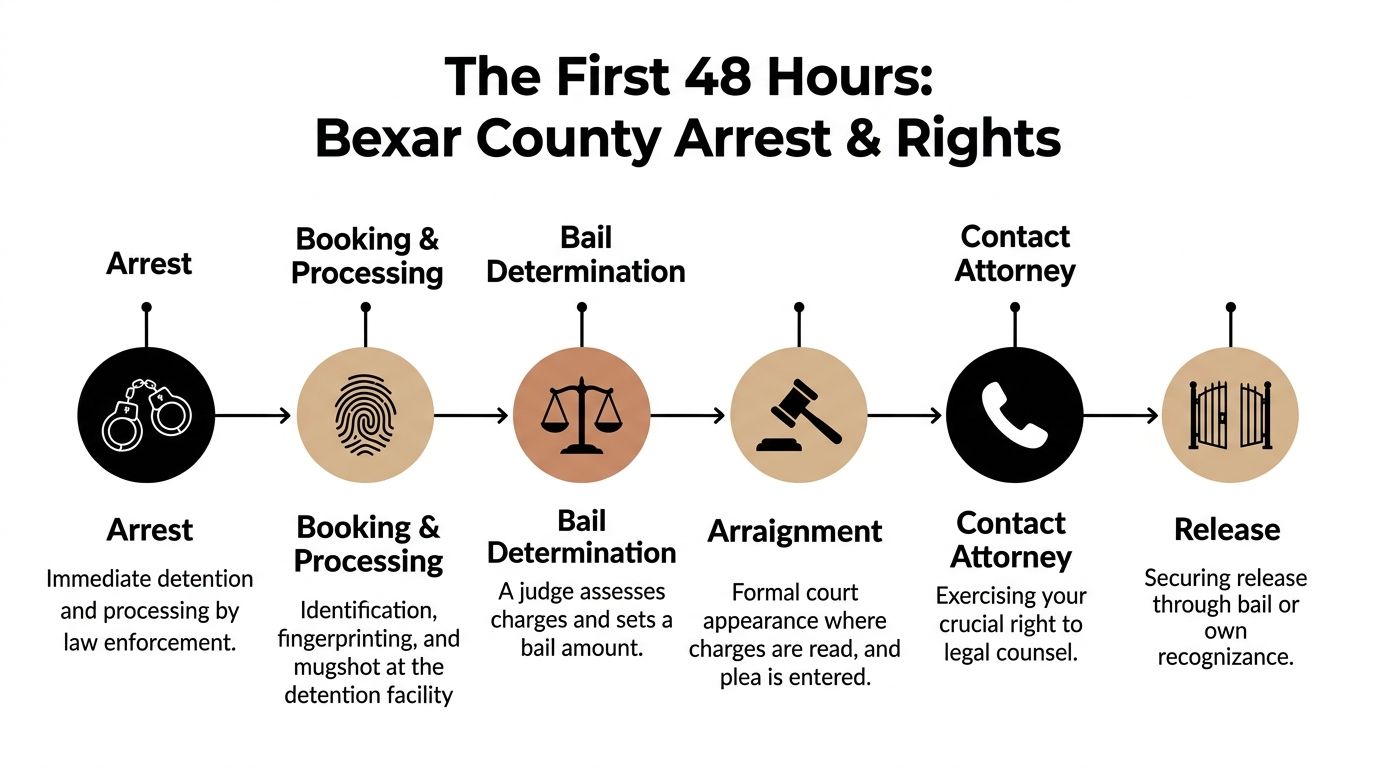
The First 48 Hours Bail Arraignment and Your Rights
The first two days after an arrest in Bexar County can feel like everything is happening at once. It helps to break the process into parts.
Booking and bail
After arrest, you're usually taken to a detention facility for booking. Officers collect identifying information, fingerprints, and a mugshot. That doesn't mean the state has proved anything. It means the case has entered the system.
Next comes bail. Bail is money or security meant to ensure you return to court. In Texas, bail can be cash, a bond through a bondsman, or in some cases release on personal recognizance. If you want a clearer explanation of Bail and Bond in Texas Criminal Cases, that guide explains how bail is set and the options for securing release.
A local example helps. In nearby Comal County, a typical bond for aggravated assault is $30,000, and a defendant may pay a non-refundable 10% fee to a bail bondsman, such as $3,000, with the bondsman often requiring half of that fee upfront before posting bail, according to this discussion of San Antonio-area bail practice. That doesn't mean every Bexar County assault case will use the same amount, but it shows how quickly release costs can become a real issue for families.
What happens at arraignment
An arraignment hearing in Bexar County is the first initial hearing after an arrest, where you learn the specific charges, your rights, whether counsel is assigned or must be requested, and the judge reviews factors like criminal history, family proximity, and flight risk before deciding release or detention, as described in this overview of Bexar County arraignment hearings.
That hearing is important because it sets the tone for the case.
At arraignment, you should focus on three things:
- Understanding the charge: Know exactly what offense the state filed.
- Protecting your rights: Don't treat arraignment like a time to explain your side.
- Getting counsel involved quickly: Early legal work can affect release conditions, evidence preservation, and defense strategy.
For a fuller walk-through, see what to expect at a Texas arraignment hearing.
The most expensive mistake in the first 48 hours is usually talking too much, too early, to the wrong people.
Your rights are still active
Many people assume their rights matter only in a police interview room. They matter everywhere. Jail calls, texts to family, social media posts, and angry messages to the complaining witness can all become problems later.
If your arrest happened during a mental health crisis, depression, or another condition affecting judgment, it may also help your family understand the broader issue of understanding mental health disability. That kind of context doesn't replace a legal defense, but it can matter when a lawyer evaluates treatment records, mitigation, or bond conditions.
How to Find the Right San Antonio Defense Attorney
Choosing a lawyer while you're scared and under pressure is hard. Common starting points include search results, ads, or a friend's recommendation. That's a start, but it's not enough if you want the right fit for your case.

Look for local and charge-specific experience
A criminal defense lawyer in San Antonio should understand more than criminal law in the abstract. Your lawyer should know how local courts move, how prosecutors handle common case types, and what issues tend to matter early in Bexar County.
That's especially true in DWI cases. There has been an 18% year-over-year increase in DWI arrests in Bexar County, and local commentary has noted a lack of clear guidance on how those recent San Antonio enforcement trends affect first-time offenders, including local prosecution strategy, scheduling delays, and breath-testing issues, according to this San Antonio criminal attorney resource.
That kind of local knowledge matters if you're looking for a Texas DWI attorney, a lawyer handling Texas assault defense, or counsel for drug possession, theft, or felony allegations.
What to verify before you call
Don't just ask whether a lawyer “handles criminal cases.” Ask whether the lawyer regularly handles your kind of charge.
A useful checklist:
- Charge focus: Does the lawyer handle DWI, assault, drug possession, theft, or felony cases like yours on a regular basis?
- Courtroom readiness: Can the lawyer try a case, or does the practice revolve almost entirely around quick pleas?
- Bexar County familiarity: Does the lawyer understand local court settings, filing habits, and pretrial practice?
- Related legal issues: If your case involves family violence, immigration concerns, or licensing problems, can the lawyer spot those issues early?
For some families, legal stress overlaps with military service, deployments, or base-related concerns. In that setting, this article offering advice for military families can help you ask better questions about specialized defense needs.
Watch how the lawyer explains your case
A good consultation shouldn't leave you more confused than when you started. A strong lawyer should be able to explain, in plain English, things like:
- the difference between a misdemeanor and felony,
- what the prosecutor has to prove,
- how plea bargaining works,
- when a case might be set for trial,
- and whether a protective order or family court issue could complicate the defense.
Here's a short video that can help you think about what to look for during that search:
If you're comparing firms, one practical option is the Law Office of Bryan Fagan PLLC, which handles criminal defense matters across Texas, including San Antonio cases involving misdemeanors, felonies, DWI, assault, theft, drug charges, protective orders, and record-clearing work. The point isn't to hire the first lawyer you find. It's to hire one who fits the facts and risks of your case.
The Consultation Questions to Ask Before You Hire
The consultation is your interview. You're not there just to hear a sales pitch. You're there to learn whether the lawyer has the experience, time, judgment, and communication style your case needs.
A key reason to take that meeting seriously is outcome difference. Defendants with skilled criminal defense representation achieve favorable plea bargains or reduced sentences at up to 75% higher rates than self-represented people, according to this discussion of criminal attorney hiring outcomes.

The questions that tell you the most
Ask direct questions and listen for direct answers.
- Who will personally handle my case? Some firms have one lawyer do the consultation and another person handle the court appearances.
- How much experience do you have with this exact charge in San Antonio? A DWI case is different from an assault family violence allegation. A shoplifting case is different from a felony theft prosecution.
- What is your first move after being hired? You want to hear about evidence review, witness contact, bond conditions, and strategy. Not vague reassurance.
- How do you communicate with clients? Ask whether updates come by phone, email, portal, or staff.
- How often do you go to trial? Trial readiness affects plea negotiations.
- What problems do you see in my case right now? An honest lawyer should be able to identify risk, not just optimism.
Ask this plainly: “If the prosecutor doesn't offer something reasonable, are you prepared to take this case to trial?”
Understand the fee structure
Legal fees aren't all billed the same way. Ask for the structure in writing.
| Fee type | What it usually means | What to ask |
|---|---|---|
| Flat fee | One set fee for a defined part of the case | Does it include motions, trial prep, and court appearances? |
| Hourly | You pay for time spent on the case | How often are bills sent, and what work is billed separately? |
| Retainer | An advance payment placed against future work | When does the lawyer ask for more funds if the case becomes more complex? |
The cheapest option isn't always the safest one. A low quote may mean limited time, limited investigation, or pressure to plead quickly.
Ask about defense strategy, not just price
If you're charged under Texas Penal Code provisions involving assault, theft, or drug crimes, your lawyer should explain what the state must prove and what defenses may apply. In a DWI case, ask about the stop, testing, officer observations, and license issues. In a family violence allegation, ask whether there may also be a protective order hearing.
A useful sign of quality is when the lawyer explains trade-offs. Sometimes filing an early motion is smart. Sometimes waiting for more discovery is smarter. Sometimes silence helps. Sometimes proactive mitigation helps.
The right lawyer won't promise a dismissal. The right lawyer will tell you how the case is likely to be fought.
Building Your Defense Strategy After You Hire
Once you hire counsel, the work becomes more focused. At this point, a lot of clients finally feel some relief, because the case stops being a mystery and starts becoming a plan.

Step one is getting the evidence
Your lawyer begins with discovery, which is the process of obtaining the evidence the state plans to use. That may include offense reports, body camera video, witness statements, lab results, dispatch records, photos, and prior statements.
Then your lawyer starts testing that evidence.
In a DWI case, that may mean looking at the basis for the traffic stop, officer instructions, testing procedures, and timing. In a drug possession case, the focus may shift to search and seizure issues. In an assault case, the defense may center on self-defense, credibility, injuries, and whether the state can prove intent under the Texas Penal Code.
Most cases resolve before trial, but trial readiness still matters
There are more than 252,159 criminal defense lawyers practicing in the United States as of 2025, and about 90% of criminal defendants plead guilty, while only 2% of cases achieve dismissal before adjudication, according to national criminal defense statistics collected here. Those numbers tell you something important. Defense work often turns on pretrial negotiation, motions, and advantage, not courtroom speeches alone.
A plea offer means very little if the prosecutor knows the defense lawyer isn't prepared to challenge the case.
That's why strong defense lawyers prepare as if trial could happen, even when resolution is possible. Trial readiness can improve plea bargaining because prosecutors have to weigh the risk of litigating weak points in their case.
Family law issues can change the defense plan
In San Antonio, one of the most overlooked problems is the overlap between criminal charges and family law. A domestic violence accusation may trigger a protective order case. That can affect where you live, whether you can contact your child's other parent, and what happens in later custody disputes.
If your case involves an alleged threat, assault, or child-safety accusation, your criminal strategy and family-law strategy need to work together. A statement that seems harmless in one court can damage you in another. That's why these cases need careful coordination.
Expert review can matter in serious cases
Some cases also need outside experts. If a case involves disputed medical findings, injury timing, or cause of death issues, a lawyer may consult a board-certified forensic pathologist to evaluate whether the state's medical theory holds up.
That doesn't happen in every case. But when the facts are technical, expert review can change how a defense is built, how cross-examination is prepared, and whether a plea offer makes sense.
Moving Forward Expunctions and Sealing Your Record
Your case doesn't end when court ends. If you don't plan for your record, the damage can follow you into job applications, housing, professional licensing, and background checks.
Texas gives some people a path forward through expunction and nondisclosure.
Expunction versus nondisclosure
An expunction is the stronger remedy. It removes qualifying records from public view by ordering agencies to destroy or return records covered by the order. This relief may be available in certain dismissals, acquittals, and some other qualifying outcomes.
An order of nondisclosure does something different. It seals qualifying criminal history information from public disclosure, but it does not erase the event completely. Some government agencies may still see it.
If you want a practical overview, review how to expunge your record in Texas.
Why early planning matters
In federal criminal cases, 88% of felony defendants with publicly financed attorneys and 77% with private counsel received prison sentences, according to federal defense data published by the Bureau of Justice Statistics. That doesn't mean every case ends badly. It means no lawyer can guarantee a dismissal, especially in serious prosecutions.
The same source also highlights a common failure point in criminal matters. People neglect pretrial motions and post-case relief such as expunctions, nondisclosures, and record-sealing requests that may reduce long-term harm.
Long-view advice: Don't treat record clearing like an afterthought. Ask about it before the case is fully over.
For rehabilitation-focused clients, this is one of the most important conversations to have. The right result isn't only about surviving the criminal charge. It's about protecting the life you want after it.
If you've been charged with a crime in Texas, call The Law Office of Bryan Fagan, PLLC for a free and confidential consultation. Our defense team is ready to protect your rights.