Skip to content
Being arrested in Texas can be terrifying, and even the suspicion of a warrant can keep you up at night. Maybe you missed a court date in San Marcos. Maybe an officer mentioned “possible warrants” during a traffic stop. Maybe you heard that detectives are reviewing a DWI, assault, theft, or drug case and you are waiting for the next knock at the door.
That fear is real. But a warrant search is not the end of the story. It is the first move in a legal strategy.
If you are dealing with a hays county texas warrant search, the most important thing to know is this: the right response is calm, fast, and organized. Texas criminal procedure gives courts and law enforcement several ways to issue, serve, and enforce warrants. It also gives you options to address the warrant, defend the underlying charge, and in some cases clear your record after the case is over.
The Worry of an Outstanding Warrant in Hays County
A lot of people assume warrants only happen in serious felony cases. That is not true.
In Hays County, a warrant can start with something as simple as a missed court setting, unpaid fine, or failure to appear after a citation. It can also begin after a police investigation into a more serious allegation such as DWI, assault, theft, burglary, or drug possession. The legal reason matters, but the emotional reaction is usually the same. Your stomach drops, and every unknown feels bigger than it is.
What clients usually worry about first
Individuals typically are not asking legal theory questions at first. They are asking practical ones.
- Will I get arrested at work
- Can police stop me and take me to jail immediately
- Should I call the court myself
- What if the online search says nothing
- Can this be handled without sitting in jail
Those are the right questions.
Under Texas criminal procedure, a warrant is not just paperwork. It is a court-authorized order that can change your day very quickly. A bench warrant often grows out of a court process problem, such as failing to appear. An arrest warrant usually means an officer presented facts to a magistrate and asked for authority to take someone into custody. If the underlying allegation is family violence, theft, resisting arrest, DWI, or drug possession, the warrant often becomes the moment where the case turns from uncertain to active.
Fear makes people do the wrong thing
The worst responses are usually driven by panic.
Some people avoid driving but keep going to work, school, and appointments as if the warrant will somehow stay dormant. Others call random offices and give statements that do not help them. Some decide to “wait and see” because they hope the county has not updated its records yet.
That approach creates risk. A routine contact with police can suddenly become a jail booking. If the allegation involves Texas Penal Code § 22.01 assault, Texas Penal Code § 31.03 theft, or Texas Penal Code § 49.04 DWI, the warrant issue is only one part of the problem. The underlying charge still has to be defended.
Practical takeaway: If you think a warrant may exist, treat that as a legal problem that needs a plan, not as a personal failure.
You still have options
A warrant does not mean you have already lost your case. It does not mean conviction is automatic. It does not mean jail is the only outcome.
In many situations, the smartest move is to confirm the warrant through official channels, stop talking about the facts of the case, and start working on resolution. That can include a controlled surrender, a request to quash a warrant, a bond hearing, plea discussions, trial preparation, or post-case record relief if the result supports it.
The key is timing. The earlier you act, the more choices you usually have.
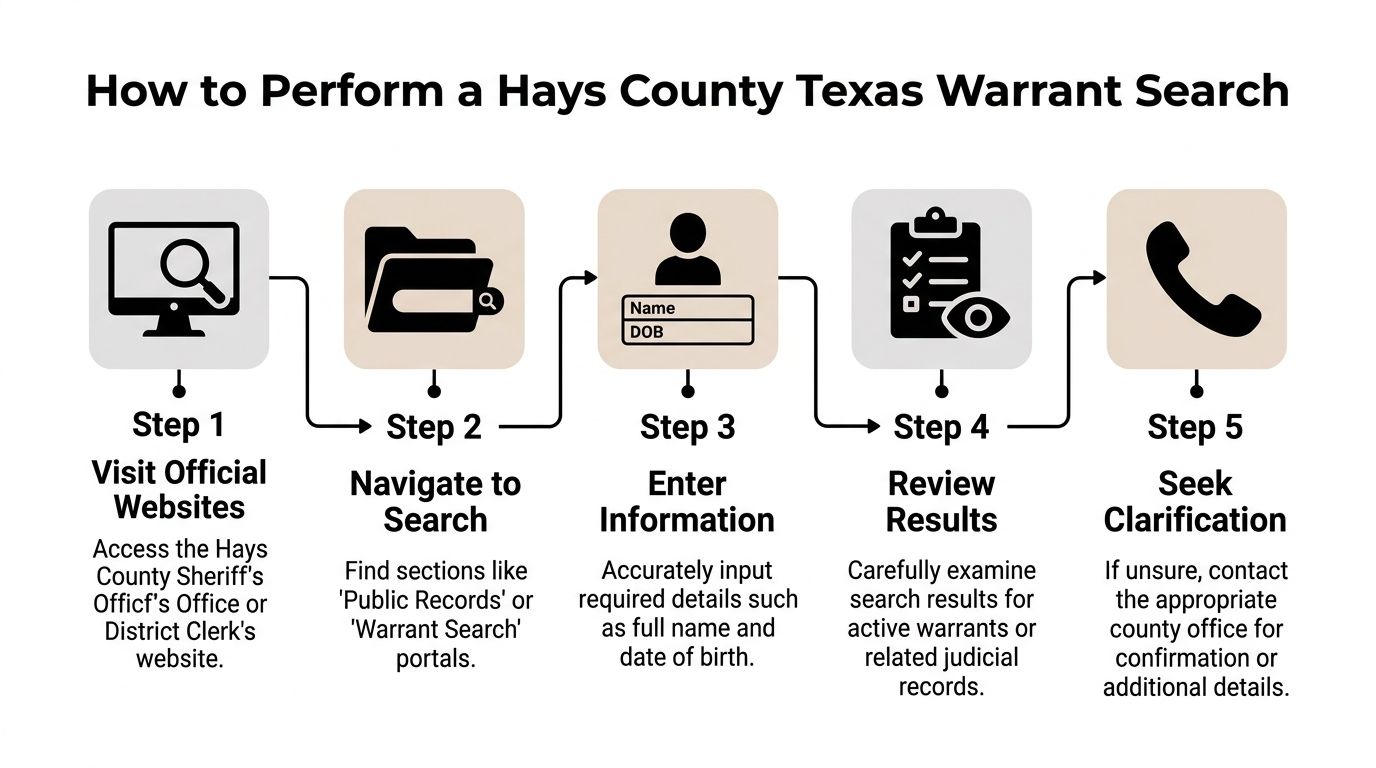
How to Perform a Hays County Texas Warrant Search
The best hays county texas warrant search is not a single search. It is a layered check through official systems.
Attorneys use multiple channels because no one database is perfect. According to the Hays County Sheriff’s process summary, the standard method is a four-step approach using the Sheriff’s website, the Texas DPS Criminal History Search, the Precinct 4 Constable, and District Clerk records. That same guidance warns that 20-30% of searches can yield false negatives from unupdated databases and notes that non-response to courtesy postcards can trigger statewide database entry within 1-2 weeks through Precinct 4 Constable procedures, as described by the Hays County Sheriff’s Support Services Bureau.
Start with the Hays County Sheriff’s website
This is usually the first check because it is direct and local.
If you already know the issue is likely in Hays County, the Sheriff’s online resources are the most logical first stop. Search using your full legal name and any identifying information the portal requests. Be careful with spelling, suffixes, and middle names. A small entry mistake can cause you to miss a record.
This step is useful for obvious, already-posted local warrant information. It is less useful when the case is brand new, when records have not propagated yet, or when the matter sits in a related court database instead of the warrant page.
Use the Texas DPS Criminal History Search
The next check is broader.
DPS records can help you identify arrests, dispositions, deferred adjudications, and Class C convictions that may connect to a Hays County matter. If your concern involves more than one county, this is often where the bigger picture starts to appear. Someone who moved between Austin-area counties can have pieces of the problem in different places.
This search is also helpful when the issue is not just “Do I have a warrant?” but “What court event or charge created the warrant?”
Contact the Precinct 4 Constable when the facts point there
The verified guidance specifically identifies Precinct 4 Constable at 512-858-7605 as part of the official search process. That matters in real life because some people first learn about a pending enforcement issue through a courtesy postcard rather than an arrest.
If you ignore that postcard, the office may move the warrant into a statewide database after 1-2 weeks, according to the same Hays County Sheriff source linked above. Once that happens, the practical risk goes up.
At this point, trade-offs matter. Calling yourself may clarify whether the office is actively handling the warrant. It may also feel stressful and can create confusion if you do not know what to ask. If the allegation is serious, many people are better served by having counsel manage the contact.
Check District Clerk records
A District Clerk search fills in gaps that warrant portals do not always show cleanly.
Case records often reveal the court, charge type, setting history, bond information, and other entries that explain why the warrant exists. That context matters. A bench warrant tied to a missed hearing calls for one strategy. A probable-cause arrest warrant tied to a fresh felony investigation calls for another.
The Hays County guidance also notes that a District Clerk search can be done online for free through the county’s public access tools. That makes it a practical piece of the puzzle even if you are just starting.
Why phone calls often do not solve the problem
People understandably want to call one office and get one answer. That is not usually how this works.
Telephone disclosures are often limited because staff do not want to give incomplete or mistaken information. Different agencies also hold different pieces of the record. The Sheriff may show one thing, the court another, and DPS something else. That does not mean anyone is hiding the ball. It means the system is split across functions.
Tip: Search first. Then verify. Do not assume one “no record found” result means you are clear.
What information to gather before you search
Have these basics ready:
- Full legal name: Include suffixes and middle names if you use them.
- Date of birth: This helps separate you from people with similar names.
- Prior case number if you have it: Old citations, bond paperwork, or court notices can help.
- County and court clues: If the issue began in a JP court, municipal court, or district court, that narrows the search.
What works and what does not
A quick comparison helps:
| Method | Best use | Main limitation |
|---|---|---|
| Sheriff website | Fast local first check | May miss newly entered or lagging records |
| DPS search | Wider criminal history context | Not every issue is immediately obvious from the result |
| Precinct 4 Constable | Useful for postcard or local enforcement follow-up | Direct contact can feel risky without a strategy |
| District Clerk records | Shows court-level case context | You may need to know what you are looking at |
If your concern is a missed court date, also read this explanation of a capias charge in Texas. A capias or bench-type process often surprises people because it grows out of a court order, not a new street arrest.
Understanding Your Warrant Search Results
A search result can look simple and still be hard to read. Names, abbreviations, court codes, and charge labels do not always tell you what really matters.
The first question is not just whether a warrant exists. The first question is what kind of warrant it is.

Bench warrant versus arrest warrant
A bench warrant usually comes from the court itself. Common reasons include failing to appear, missing a compliance deadline, or violating a court order tied to an existing case. These often show up in lower-level matters, but they should never be brushed off. A missed hearing in a misdemeanor theft or Class C case can still lead to custody.
An arrest warrant usually means law enforcement presented probable cause to a magistrate. That is different in both tone and consequence. It often signals an active criminal allegation such as assault, drug possession, burglary, robbery, or DWI.
If the charge involves family violence or a repeat allegation, the court may treat release conditions more carefully. If the accusation is felony level, bond and surrender planning become more important.
How fast a warrant can go active
One reason online results can be confusing is that the legal process can move faster than people expect.
In Hays County, the normal timeline for obtaining a search warrant is often 2-4 hours during business hours, and urgent cases can move in under 1 hour through telephonic or electronic testimony under Texas Code of Criminal Procedure § 18.01, according to this summary of the Hays County warrant issuance process. That timing concerns search warrants, but the practical lesson for readers is broader: local warrant-related processes can move quickly.
If you are waiting to “see if anything happens,” that wait may not be long.
Common terms that confuse people
Some entries look more serious than they are. Others look minor and are not.
- FTA: Usually means failure to appear.
- Capias: A court order directing law enforcement to take someone into custody.
- Probable cause: The legal standard a magistrate reviews before issuing many warrants.
- Bond forfeiture or revocation: A sign that release conditions may already be in trouble.
- Disposition pending: The case is still open or not fully updated.
A clear search is not always a clean bill of health
The Hays County methodology referenced earlier warns about false negatives from stale or unupdated databases. That means a “no record found” result can be comforting, but it is not always final.
This is especially true when:
- You recently missed court.
- You know an officer submitted a case.
- You received a postcard or notice.
- Another county may also be involved.
- The incident is fresh and records may not have synced yet.
Key point: Search results are clues. Court records, agency confirmation, and legal strategy turn those clues into reliable answers.
How to read the seriousness of the result
A practical way to assess what you found is to ask four questions:
Is this tied to procedure or a new allegation?
A missed hearing and a fresh felony investigation call for different next steps.What court issued it?
JP, county court, and district court cases often move differently.What is the underlying charge?
A DWI under Texas Penal Code § 49.04, a theft under Texas Penal Code § 31.03, or an assault under Texas Penal Code § 22.01 each creates different defense issues.Is bond information listed?
If so, surrender planning may be more straightforward. If not, a hearing may be needed.
You Found a Warrant Now What
Once you confirm a warrant, the right move is action. Not panic. Not hiding. Not hoping it disappears.
The practical goal is to resolve the warrant in a controlled way while protecting your defense in the underlying case.

First, do not make it worse
A lot can go wrong in the first few hours after someone learns about a warrant.
Do not flee. Do not post about it online. Do not call witnesses, alleged victims, or investigating officers to “clear things up.” And do not confuse turning yourself in with admitting guilt. They are very different things.
If police are investigating a charge such as assault, theft, drug possession, or DWI, your statements can become evidence. Texas law gives you the right to remain silent. Use that right.
Why waiting is risky in Hays County
Hays County law enforcement agencies share data in a way that makes ignoring a warrant especially dangerous.
The county uses the Citizens Connect platform, described as the first in Texas where all agencies in the county share real-time crime, arrest, inmate, and warrant information on a single public portal. That system includes the Sheriff’s Office and local police agencies, and the same source states that Hays County Crime Stoppers facilitated numerous arrests through this information-sharing environment, as reported by Hays County active warrant search information.
In plain terms, a traffic stop in Kyle, a call in San Marcos, or another police contact can expose the warrant quickly.
The best immediate steps
A clear sequence helps:
Confirm the warrant through reliable records
Do not rely on rumors, social media, or one partial screenshot.Stop discussing the facts of the incident
This includes texts, calls, and casual conversations.Prepare for a controlled response
In many cases, a planned surrender is better than a surprise arrest.Address bond early
If a bond amount exists, arrange for it. If not, be ready to request a hearing.Start defending the charge, not just the warrant
The case does not end when the warrant is cleared.
Walk-through surrender can be the smarter option
A walk-through surrender is often the most practical path when available. The idea is simple. Instead of waiting to be arrested at a bad time and bad place, you arrange to appear, process the warrant, and address bond in a more controlled setting.
That can reduce disruption to work and family. It can also help you avoid the chaos of being picked up unexpectedly during a traffic stop or at home.
Whether that is realistic depends on the court, charge level, bond status, and any special concerns such as prior failures to appear, probation issues, or allegations involving violence.
If you need background on how Texas warrant arrests generally work, this overview of an arrest warrant in Texas gives a helpful foundation.
After arrest, what happens next
People feel better when they know the sequence.
After an arrest on a warrant, you may go through booking, fingerprinting, and jail intake. From there, the process usually turns to bond and first-court appearances. In a misdemeanor case, that may move quickly. In a felony case, release conditions can be more involved.
Then the underlying criminal case begins to matter in a bigger way:
- Arraignment or first appearance: You are informed of the accusation and your rights.
- Bond conditions: The court may restrict travel, contact, firearms, alcohol use, or reporting requirements.
- Plea bargaining: Prosecutors may offer a negotiated resolution, but the right answer depends on the evidence and your goals.
- Trial preparation: If negotiations do not lead to an acceptable outcome, the case may move toward motions and trial.
- Sentencing issues: If there is a conviction or plea, punishment and alternatives become critical.
Here is a short video that helps explain how quickly criminal procedure choices can affect the rest of the case.
What works: A planned response, bond preparation, and silence about the facts.
What fails: Waiting for a random arrest and trying to explain everything on the spot.
Your Legal Options for Resolving a Warrant
Resolving a warrant is not one-size-fits-all. The right move depends on the type of warrant, the court, the charge, your history, and whether the case is procedural or substantive.
Some people need a quick court fix. Others need a full defense plan tied to a pending prosecution.

Option one involves asking the court to pull the warrant back
In some cases, the best move is to seek a motion to quash or another request that asks the court to recall the warrant.
This is most common when the warrant grew from a missed hearing, notice problem, or procedural issue rather than a fresh arrest scenario. Judges are more receptive when the person acts quickly, shows respect for the court, and has a practical plan to get the case moving again.
This does not erase the underlying charge. It changes how the court addresses your nonappearance or warrant status.
Option two is a planned surrender with bond strategy
This is often the best fit when the warrant is active and recall is unlikely.
A planned surrender can limit disruption and give you a path to release. If the bond set by the court is too high, Texas procedure may allow a bond reduction hearing. That hearing focuses on fairness, flight risk, public safety, and your ties to the community.
This matters in charges like DWI, assault, theft, and drug possession because the bond terms can shape the whole case. A harsh bond condition can affect your work, family, treatment access, or travel.
Option three is using amnesty when the case qualifies
For lower-level matters, timing can make a major difference.
The Hays County law enforcement portal summary states that local courts often announce amnesty periods for outstanding Class C misdemeanor warrants and that these periods have reached 75% clearance for low-level cases. The same source states that more serious unresolved cases are pursued in warrant roundups with 90%+ apprehension rates in targeted zones, as noted in the Hays County Citizens Connect information portal summary.
That tells you something important. A traffic-ticket-style court problem and a serious criminal allegation should not be treated the same way.
A side-by-side look at common paths
| Path | Best for | Main advantage | Main limitation |
|---|---|---|---|
| Motion to quash or recall | Missed court or procedural warrant | May avoid unnecessary custody | Does not dispose of the actual charge |
| Planned surrender | Active arrest warrant | More control over timing and bond | Still involves formal processing |
| Amnesty resolution | Qualified low-level court matters | Safer path to resolve without arrest fear | Usually not available for serious charges |
| Trial-focused defense | Disputed criminal allegations | Targets the accusation itself | Takes time and preparation |
Do not separate the warrant from the charge
Many people make a costly mistake by focusing only on “getting rid of the warrant.”
That is too narrow.
If the charge is theft under Texas Penal Code § 31.03, the defense may center on value, intent, ownership, or mistaken identity. If the charge is assault under Texas Penal Code § 22.01, the case may turn on self-defense, witness credibility, or whether any threat was imminent. If the charge is DWI under Texas Penal Code § 49.04, the evidence may include field sobriety testing, body camera video, blood or breath issues, and the legality of the stop.
The best warrant strategy supports the defense strategy. It does not replace it.
Bench warrants need their own approach
If your issue is specifically a bench warrant, a simple resource on how to resolve a bench warrant can help you understand the practical mechanics before you make decisions. That kind of warrant often comes from a court process problem, but the fix still depends on the exact court and case posture.
Best practice: Ask two separate questions. How do I clear the warrant? Then ask, how do I beat or reduce the underlying case?
Clearing Your Name After the Case Is Over
For many people, the warrant is the crisis. The record is the long-term problem.
Even after the case ends, a public record can affect housing, jobs, licensing, and reputation. Texas law offers two major forms of relief in many situations: expunction and nondisclosure. They are not the same, and using the wrong label can cause confusion.
Expunction destroys the record in qualifying cases
An expunction is the stronger remedy. In general terms, it is used when the law allows the arrest and case records to be erased from public view and destroyed by the agencies that hold them.
This relief is commonly discussed after outcomes such as dismissal, acquittal, or certain cases that were never formally pursued. Eligibility depends on the exact case history, waiting periods, and whether there was court-ordered supervision that blocks expunction.
If you want a practical starting point, this guide on how to get a record expunged helps explain the process in plain English.
Nondisclosure seals the record from public view
A nondisclosure order is different. It generally seals qualifying records from public access instead of destroying them.
This often matters for people who successfully completed deferred adjudication and want to move forward without a searchable public court history. But nondisclosure is not automatic. Some charges are excluded, and timing rules matter.
For someone who resolved a warrant tied to a lower-level offense, this can be a meaningful second phase of the legal strategy.
Post-conviction relief may still matter
Not every case ends in dismissal. Some end in plea agreements, probation, or convictions.
That does not always mean your options are over. Depending on the facts, post-conviction work may involve correcting records, addressing probation terms, seeking relief tied to old judgments, or pursuing remedies that reduce the long-term impact of the case. The details depend heavily on the offense level, the final disposition, and what happened in court.
Think about the whole timeline
A smart legal plan does not stop at “warrant resolved.”
It should ask:
- Can the underlying charge be dismissed or reduced
- If not, is deferred adjudication available
- If the case is over, do I qualify for expunction
- If not expunction, can I seek nondisclosure
- Are there collateral issues involving work, family, or licensing
That larger view matters for first-time offenders, professionals, students, and parents. A warrant can feel like the whole story when it happens. It is not. In many cases, it is just one chapter.
If you’ve been charged with a crime in Texas, call The Law Office of Bryan Fagan, PLLC for a free and confidential consultation. Our defense team is ready to protect your rights. Law Office of Bryan Fagan PLLC.