Being arrested in Texas can be terrifying. Your heart races, an officer gives fast commands, and one split-second reaction can turn a tense stop into a separate criminal charge.
That's where many people get blindsided by resisting arrest in Texas. You may think, “I wasn't fighting.” You may believe the officer had no right to arrest you in the first place. You may only remember pulling your arm back, stepping away, or panicking. Those details matter.
If you're in that position right now, take a breath. You still have rights, and a charge is not a conviction. What matters now is understanding what Texas law says, where people get confused, and what steps can help protect your future.
An Arrest Can Escalate Quickly You Have Rights
A common scene starts with something small. You're pulled over late at night. Or officers arrive after an argument, a DWI stop, or a complaint from a neighbor. You ask questions. The officer grabs your wrist to cuff you. You tense up, pull back, or turn your body away because you're scared.
A few minutes later, you're accused of more than the original issue. Now you're facing a resisting arrest charge too.
That's why panic is so dangerous during police contact. In the moment, people often focus on whether the stop feels fair. The law often focuses on what your body did next.

Why people get confused so fast
Many Texans assume police must read Miranda warnings immediately. That isn't always how it works. If you're unsure about that point, this guide on whether you can be arrested without being read your rights in Texas helps explain the difference between being arrested and being questioned.
People also mix up fear with guilt. You can be innocent of the underlying offense and still face allegations based on your reaction during the arrest itself. That's one reason these cases are so upsetting. They often grow out of confusion, not criminal intent.
Practical rule: If an officer is trying to arrest or move you, arguing with your body is usually what creates the added charge.
What you should focus on right now
If you or a family member has been arrested, start with these basics:
- Stay calm about the process: The first report rarely tells the whole story.
- Protect your words: What you say after the arrest can affect how police and prosecutors describe your intent.
- Get legal advice early: Resisting arrest charges often appear beside DWI, assault, theft, or drug possession allegations, and each charge can affect the others.
You don't need to solve everything tonight. You do need clear information and a plan.
Defining Resisting Arrest Under Texas Law
Texas law uses a very specific definition. Under Texas Penal Code § 38.03, resisting arrest is legally defined as intentionally preventing or obstructing a known peace officer from effecting an arrest, search, or transportation by using force against the officer or another person. The statute explicitly establishes that the legality of the arrest or search is not a defense against prosecution (Wikipedia summary of Texas Penal Code § 38.03).
That sentence is dense, so break it into parts. Prosecutors generally focus on three ideas: intent, force, and a known peace officer.
Intent means more than being upset
The State has to show that you acted on purpose. If your movement was reflexive, accidental, or caused by confusion, that can matter. Intent is often argued from body camera footage, officer testimony, witness statements, and your own words during the encounter.
If you shouted, “Don't touch me,” then jerked away, the prosecution may say that shows a deliberate effort to obstruct. If you stumbled while being grabbed, the defense may argue that wasn't intentional resistance.
Force can be small
Many people make a dangerous mistake. In everyday language, “force” sounds like punching, kicking, or wrestling. In this statute, it can be much less. Pulling your arm away, stiffening up during handcuffing, or interfering with restraints may be enough.
Think of it this way. Texas doesn't require a fistfight for this charge. Sometimes the allegation is merely that your body physically opposed the officer's attempt to control you.
By contrast, verbal protest alone usually isn't enough. Complaining, arguing, or saying “this is unfair” is different from physically resisting.
You can object with your voice and still avoid creating the separate issue that prosecutors call force.
The officer must be someone you knew was an officer
The law also requires a known peace officer. That matters in chaotic settings. If the person wasn't clearly identifiable, or if the scene was so confusing that you didn't know who was trying to restrain you, that may affect the case.
This is one reason details matter so much. Uniforms, marked vehicles, lighting, body camera footage, and what was said at the scene can all become important.
Why classification matters
If you're trying to understand where this offense fits in the bigger picture, Felony vs. Misdemeanor Charges in Texas gives a useful overview of how Texas classifies criminal offenses and the penalty range tied to each level.
For many readers, the hardest part of this law is not the definition of force. It's the rule that an allegedly unlawful arrest still doesn't automatically excuse physical resistance. That misunderstanding causes real damage in court.
Resisting Arrest vs Evading Arrest and Obstruction
A lot of clients use these terms interchangeably. Texas law doesn't.
Resisting arrest usually involves physical force during an arrest, search, or transportation. Evading arrest usually means trying to get away. Obstruction is a broader label people use in conversation, but the legal issues can be very different depending on the exact charge filed.
If you want a fuller discussion of fleeing-related charges, this page on evading arrest under Texas Penal Code is a helpful companion.
Texas offense comparison
| Offense | Governing Statute | Core Action Required | Typical Example |
|---|---|---|---|
| Resisting Arrest | Texas Penal Code § 38.03 | Using force to prevent or obstruct an arrest, search, or transportation | Pulling your arm away while an officer is trying to handcuff you |
| Evading Arrest | Texas Penal Code § 38.04 | Fleeing from an officer trying to lawfully detain or arrest you | Running from a traffic stop or taking off on foot |
| Obstruction | Varies by charge | Hindering or interfering with official duties in a broader sense | Interfering with a public official in a way charged under a different statute |
The key difference is the action
Resisting arrest is often about what happens at arm's length. The officer is already trying to control your body, and the accusation is that you physically interfered.
Evading arrest is usually about movement away from the officer. Running, driving off, or otherwise trying to escape is the core idea.
Obstruction is trickier because people use that word casually, while prosecutors charge specific statutes. If someone says you were “charged with obstruction,” always ask for the exact citation. The wording in conversation may not match the law on the paperwork.
Why this distinction matters for your defense
A defense attorney doesn't just ask, “Did the police overcharge this case?” The first question is often, “Did they charge the right offense at all?”
For example:
- A fleeing case may not fit resisting arrest: If the allegation is only that you ran, the State still has to prove the elements of the charge they filed.
- A verbal dispute may not equal force: Heated words can look bad, but the statute for resisting arrest still turns on physical resistance.
- A chaotic arrest can create overlapping reports: Officers may describe the same seconds in different ways, which can matter when comparing resisting and evading allegations.
That's why careful reading of the complaint, affidavit, and video matters. Small wording changes can shape the whole defense.
Penalties for a Resisting Arrest Conviction in Texas
The stakes are serious even when the charge starts as a misdemeanor. A resisting arrest case can affect work, school, housing, professional licensing, and future background checks. It can also complicate related charges such as assault, theft, drug possession, or a DWI case.
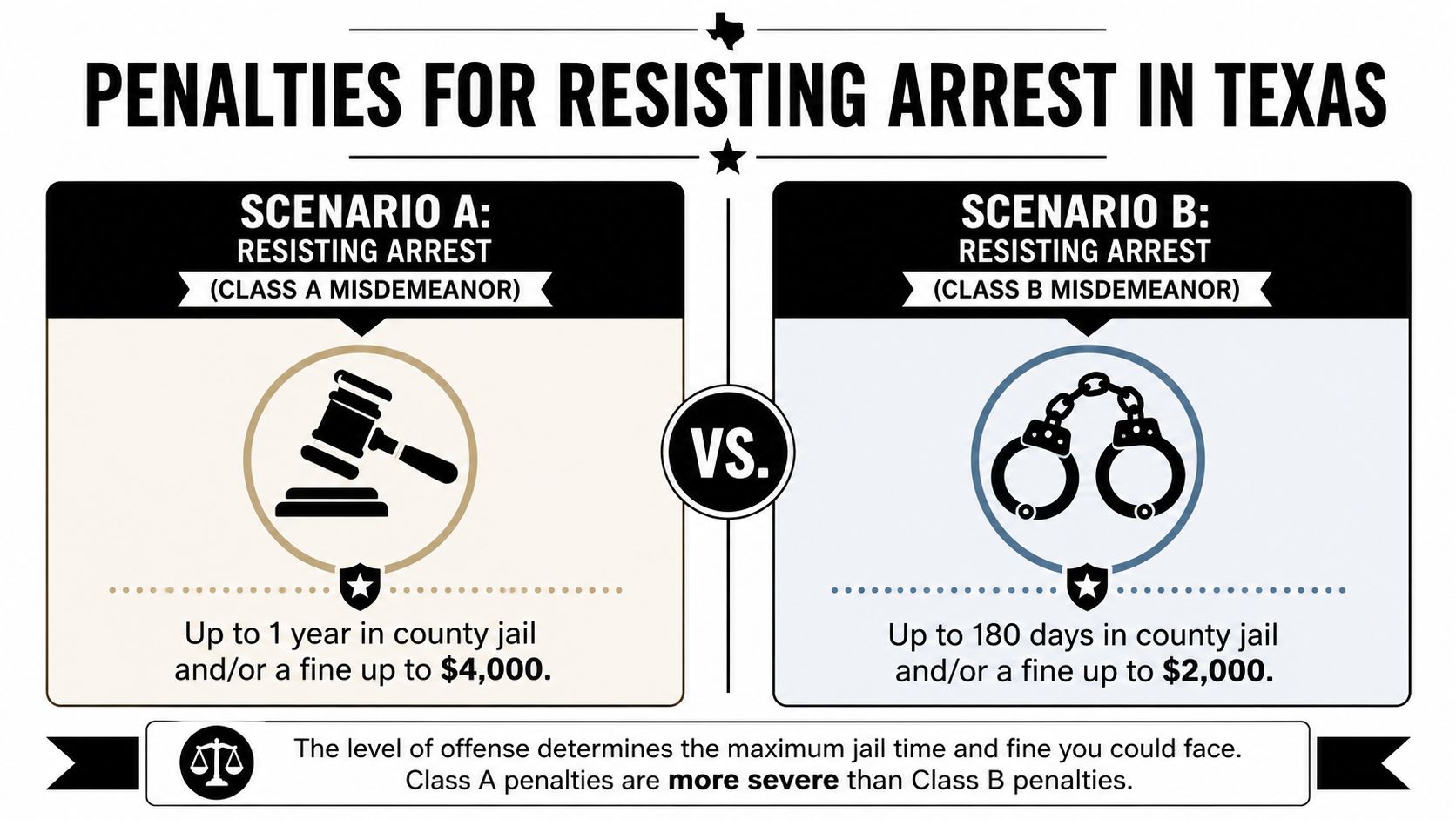
The baseline rule is straightforward. A standard Class A misdemeanor of resisting arrest has a two-year statute of limitations and is punishable by up to one year in county jail and a $4,000 fine. If enhanced to a third-degree felony by use of a deadly weapon, the statute of limitations is three years, and penalties increase to 2-10 years in prison and a $10,000 fine (Kevin Bennett Law on Texas resisting arrest penalties).
What the misdemeanor level means
A Class A misdemeanor is not a minor ticket-level problem. It is one of the most serious misdemeanor categories in Texas. If you're convicted, the court can impose jail time, a fine, or both.
That also means the case deserves a serious response from the start. People sometimes underestimate misdemeanor charges because they aren't labeled as felonies. That can be a costly mistake.
When the charge becomes much more severe
The charge can be enhanced if the allegation includes use of a deadly weapon. Once that happens, the case moves into felony territory, with prison exposure instead of county jail exposure.
That distinction changes everything. It affects how prosecutors evaluate the case, how bond conditions may be handled, and how much long-term record damage you may face if there's a conviction.
The difference between a misdemeanor filing and a felony enhancement can shape your entire future, not just your next court date.
A careful note about visuals and labels
You may notice that online graphics or summaries sometimes oversimplify criminal classifications. The statute itself is what controls. If an infographic, police explanation, or internet post uses inconsistent labels, rely on the statute and the charging papers, not the shorthand version.
What happens after charging
Penalties are only one part of the picture. The process also matters:
- Arrest and booking: You're photographed, fingerprinted, and held pending release.
- Magistration or arraignment-type appearance: A judge addresses the charge, rights, and conditions.
- Plea negotiations: Your lawyer and the prosecutor may discuss dismissal, reduction, or alternative outcomes.
- Trial if needed: If no fair resolution is reached, the State must prove the case in court.
- Sentencing: If there's a plea or conviction, the judge decides the lawful punishment range.
Each stage creates opportunities to challenge the case.
Building a Defense Against Resisting Arrest Charges
The most common mistake in these cases is also the most understandable one. People say, “The arrest was illegal, so I had the right to resist.” In Texas, that argument usually fails.
Texas Penal Code §38.03(b) explicitly states that the unlawfulness of an arrest is "no defense." A more viable strategy is to challenge intent; prosecutors must prove the defendant intentionally prevented the arrest, not just passively pulled away. Recent case law shows a trend toward dismissing charges where force was "non-threatening" (Cofer & Connelly on Texas resisting arrest defenses).

The defense that usually doesn't work
If your entire strategy is “the officer shouldn't have arrested me,” you may miss stronger arguments. That issue can matter in other parts of a criminal case, especially if evidence was gathered improperly, but it doesn't automatically defeat a resisting arrest allegation.
That's frustrating. It also means your lawyer has to be precise.
Defenses that may fit the facts better
A more effective defense often focuses on what the State can prove.
- Lack of intent: Panic, reflex, pain response, or confusion may look very different from intentional resistance.
- No meaningful force: Some cases turn on whether the conduct really crossed the line into force under the statute.
- Knowledge of officer status: If you didn't know the person was a peace officer, that can be a serious issue.
- Video contradictions: Body camera, dash camera, and bystander video may not match the written report.
The phrase many people should learn is passive resistance. If the movement was minimal, non-aggressive, or more defensive than obstructive, the case may be weaker than the arrest report suggests.
Some resisting arrest cases are really disputes about interpretation. The officer may describe deliberate force. The video may show hesitation, fear, imbalance, or a brief non-threatening movement.
Related charges can change strategy
These cases often come paired with assault allegations. If the police claim you grabbed, struck, or shoved during the arrest, the defense may need to address both charges together. In that setting, this article on when assault charges include resisting arrest can help you understand how prosecutors may stack allegations.
A good defense starts by slowing the case down. Read the reports. Compare them to the footage. Separate fear from intent. Separate movement from force. Those are not small details. They are often the whole case.
What to Do During an Encounter and After an Arrest
What you do in the first minutes matters. What you do in the first few days matters just as much.
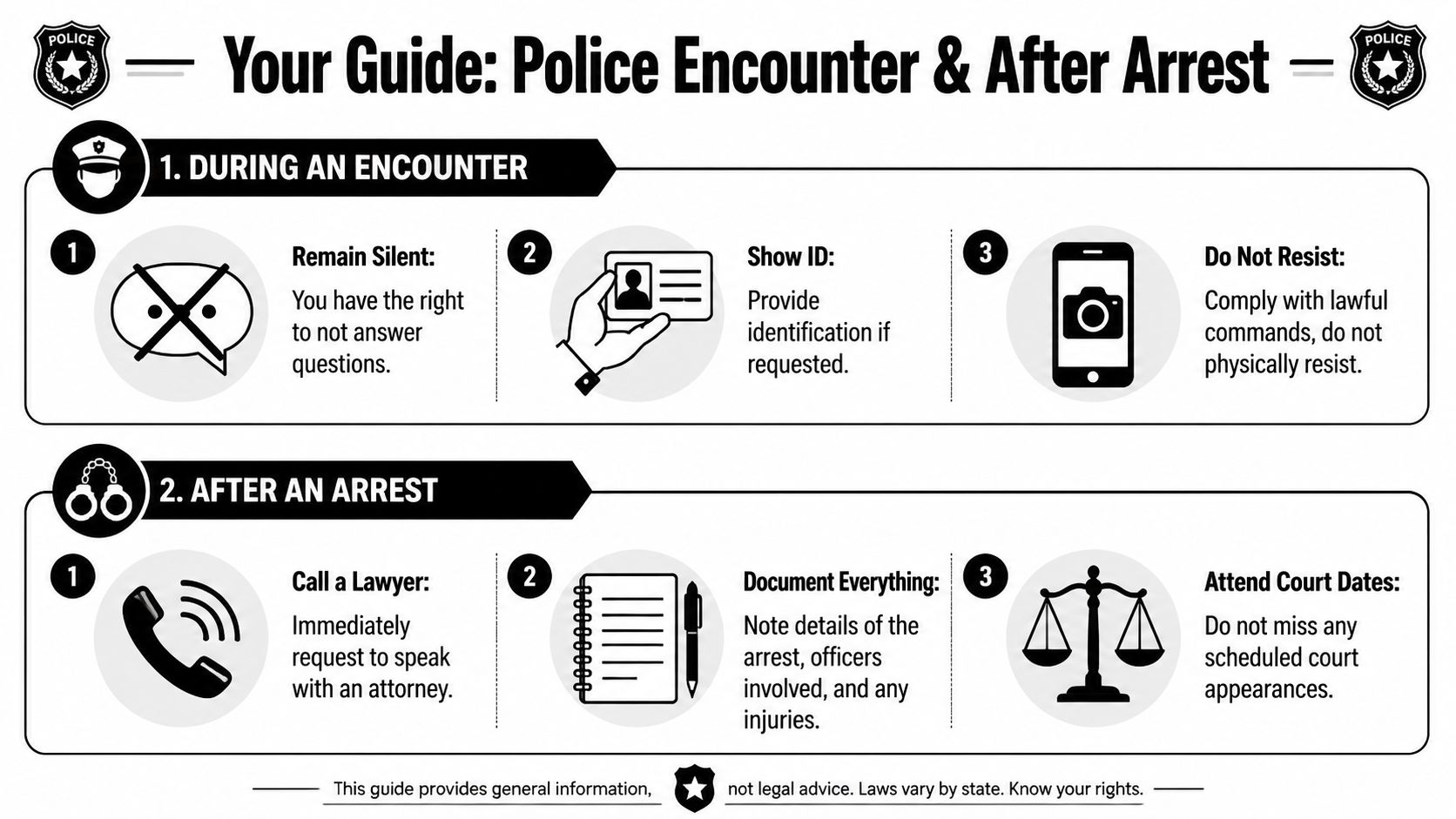
Here's a practical guide you can use if you're trying to reduce damage during a police encounter or respond wisely after an arrest.
During the encounter
Stay physically calm. The prosecution must prove the actor “intentionally” prevented or obstructed the officer and “knowingly” obstructed a peace officer. Your actions and words during the encounter are primary evidence of your state of mind, which is why calm compliance matters so much (Saputo Law on Texas resisting arrest).
Keep your hands visible. Sudden movements create fear, confusion, and bad reports.
Use simple words. Say, “I'm not resisting.” Say, “I want a lawyer.” Don't argue the whole case on the roadside.
Don't physically pull away. Even if you believe the stop is unfair, the roadside is not where you win that fight.
A short visual guide can help if your mind is racing:
After the arrest
Once you're booked, shift from survival mode to documentation mode.
- Ask for a lawyer quickly. Early legal advice can shape how the case develops. If you're wondering about timing, When to Hire a Criminal Defense Lawyer in Texas explains why waiting can hurt your options.
- Write down what happened. Note the officers, location, witnesses, injuries, and exact words you remember.
- Follow release conditions carefully. Bond conditions matter. If your case also involves intoxication allegations, this article explaining Texas DWI bail factors gives useful background on what can affect release decisions.
- Go to every court date. Missing court creates a new problem you don't need.
Later, review this visual reminder again if needed:
What the court process usually looks like
After arrest, many people want to know what comes next in plain English:
- Arraignment or first court appearance: The court addresses the accusation and your rights.
- Plea bargaining: Your lawyer may negotiate for dismissal, reduction, or a better outcome.
- Trial: If needed, the State must prove each element beyond a reasonable doubt.
- Sentencing: If there's a conviction or negotiated plea, the judge imposes a lawful sentence.
If you're also facing charges like a Texas DWI attorney matter, a Texas assault defense case, theft, or drug possession, your strategy should address all counts together.
How a Houston Criminal Lawyer Can Protect Your Future
A resisting arrest case can affect much more than one court date. A single allegation can show up when you apply for a job, renew a professional license, or deal with a custody dispute. Many people also make a costly assumption here. If the arrest felt unlawful, they believe the resisting charge should automatically fall apart. Texas law is not that simple, and that misunderstanding can shape the whole defense.
A Houston criminal lawyer works on two tracks at once. First, your lawyer addresses the charge in front of the court. Second, your lawyer works to limit the long-term damage to your record and reputation. That matters because resisting arrest cases often turn on small details, such as whether you used force, whether the officer was making an arrest or only trying to detain you, and whether the State is overstating a tense, fast-moving moment.
A good defense review is not just about reading the police report. It usually means studying body camera video, dash camera footage, witness statements, medical records, dispatch logs, and the exact wording of the charging document. It also means testing weak spots in the State's theory. For example, a lawyer may argue that your conduct was passive rather than forcible, that the officer misread reflexive movement as intentional resistance, or that the evidence does not prove every element the prosecutor must prove beyond a reasonable doubt. That passive-resistance issue is easy to miss, but it can matter in close cases.
The Law Office of Bryan Fagan, PLLC handles Texas criminal defense matters across major case stages, including arrest, bail issues, plea negotiations, trial, and post-conviction relief. The firm also handles related charges such as DWI, assault, theft, and drug offenses, which often overlap with resisting arrest allegations.
Looking beyond the criminal case
Your lawyer should also help you plan for what happens after the case ends. Ask whether you may qualify for expunction, nondisclosure, or other forms of record relief if the law allows it. Those options work like different filters. Some clear a record from public view in certain situations, while others limit who can see it. The right option depends on how your case ends.
Online arrest information is a separate problem. Even after a case is dismissed or resolved, old booking information can continue to circulate. If that is a concern, this arrest record removal guide gives general background on digital privacy issues tied to arrest records.
The point is straightforward. Treat a resisting arrest charge seriously and early. With the right legal review, you may be able to challenge the force element, correct the common mistake about unlawful arrests and resistance, and protect your future on more than one front.