Skip to content
Being arrested in Texas can be terrifying, especially when a routine traffic stop suddenly turns into a felony accusation. You may have acted in panic. You may have thought hiding, tossing, deleting, or getting rid of something would make the situation smaller. Instead, the situation may have grown fast.
That's what makes tampering with evidence Texas cases so stressful. Many people don't realize they can face this charge even if an officer never saw the item. If you're reading this after an arrest for DWI, drug possession, assault, theft, or another allegation, you need clear answers, not jargon.
Texas law treats evidence tampering as a serious interference with an investigation. But being charged is not the same as being convicted. The details matter. Your timing matters. Your words matter. What police saw, what they assumed, and what prosecutors can prove matter most.
Facing a Tampering With Evidence Charge in Texas?
The moment usually starts small. You see flashing lights behind you. Your stomach drops. You think about the open container on the floorboard, the pills in the console, the bag under the seat, or the messages on your phone tied to a fight, a theft claim, or a drug case.
In that split second, a person might shove something out of sight, toss it out the window, or delete messages. What felt like a quick fix can lead to a separate criminal accusation.

A common example looks like this. A driver gets stopped late at night. Maybe the stop began as a lane violation or speeding issue. The officer walks up, and the driver tries to hide a small item before contact is made. Minutes later, the officer alleges not only DWI or drug possession, but also tampering with physical evidence.
That shift matters. A tampering charge can become the most dangerous part of the case.
Why this charge catches people off guard
It is often thought that evidence tampering only applies if police already found the item and then watched someone destroy it. Texas law can be broader than that. The state may argue that you knew an investigation was about to happen and acted to keep evidence from being used.
Practical rule: Panic is understandable, but panic-based decisions often create the hardest criminal cases to defend.
If you're trying to understand how defense lawyers break down charges like this, it helps to see how counsel studies facts, timelines, and police reports when building a defense strategy in Texas criminal cases.
One bad moment doesn't define your whole case
You may be a first-time offender. You may have no prior record. You may be a working professional, a student, or a parent who made a frightened decision during a stop or an argument. Those facts don't erase a charge, but they do matter when your lawyer starts shaping a defense, negotiating with prosecutors, and planning for court.
The important thing right now is to slow down and learn what the state has to prove.
What Is Tampering With Evidence Under Texas Penal Code § 37.09?
Tampering with evidence in Texas comes from Texas Penal Code § 37.09. The statute sounds technical, but the basic idea is simple. Prosecutors must show more than possession of something illegal. They have to prove a specific legal combination of facts.
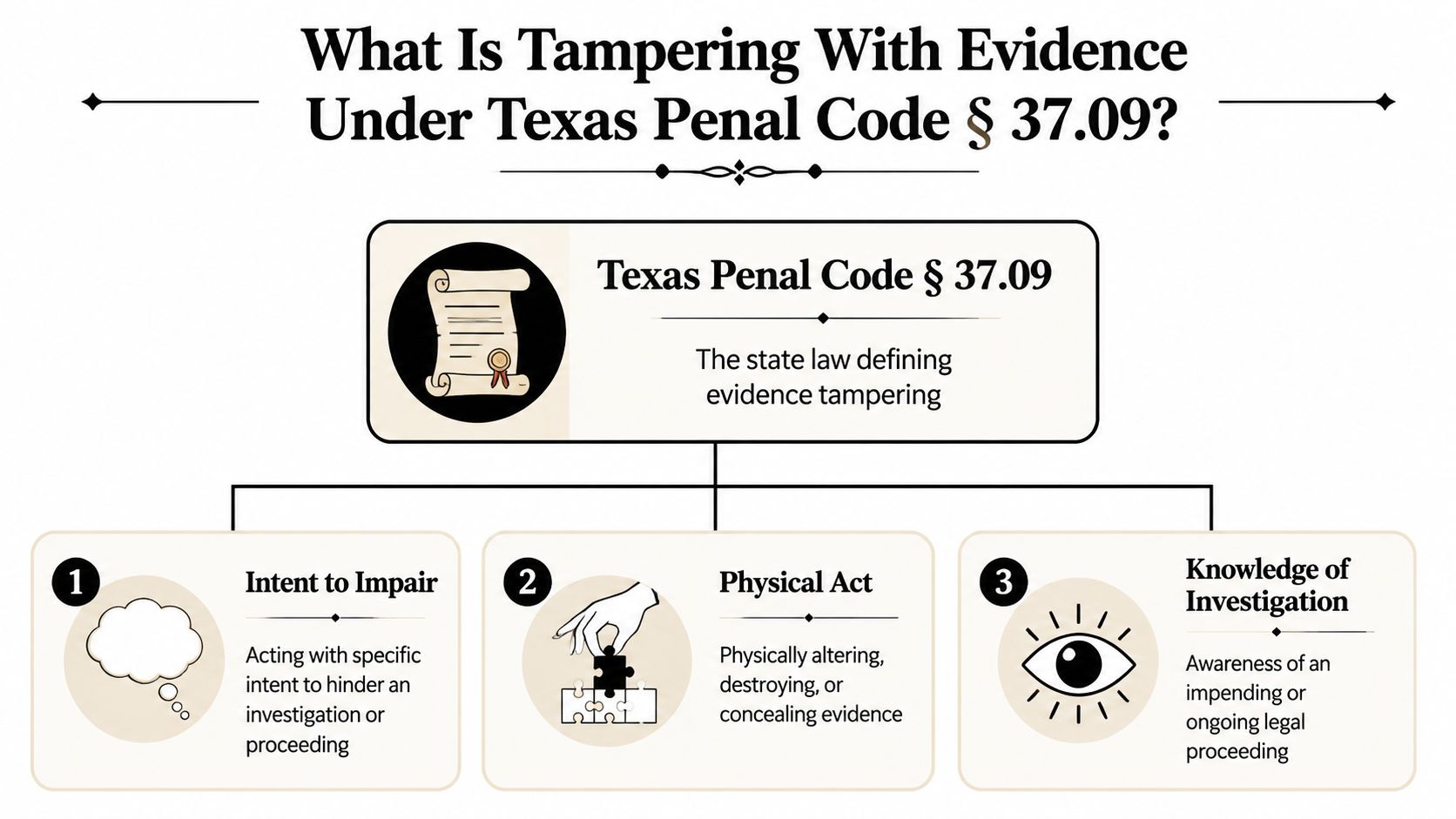
The three parts prosecutors usually focus on
Think of the law as having three moving parts:
| Legal element | What it means in plain English |
|---|---|
| Knowledge | You knew an investigation or official proceeding was pending or in progress |
| Intent | You meant to impair the item as evidence |
| Act | You altered, destroyed, concealed, or falsified the item |
If the prosecution can't prove all three, the charge gets weaker.
Under Texas Penal Code § 37.09 as summarized by FindLaw, the state must show simultaneous knowledge that an investigation is pending or in progress and specific intent to impair the evidence's verity, legibility, or availability. That same summary also reflects the key point many people miss. Courts have held that intent can still exist even if the suspect destroys the item before an officer explicitly discovers it, as long as the suspect anticipated the investigation would follow.
What the law means by verity, legibility, or availability
These words sound formal, but they describe everyday actions.
- Verity means truthfulness. If someone changes a document or object so it no longer reflects the truth, prosecutors may argue verity was impaired.
- Legibility usually comes up with records, notes, messages, or paperwork. If you erase or distort something so it can't be read, that can become part of the allegation.
- Availability often matters most in street-level cases. If an item is swallowed, tossed, hidden, flushed, smashed, or deleted so police can't recover or use it, the state may argue its availability was impaired.
The state doesn't have to prove you handled evidence in a dramatic way. A simple act, if done with the required knowledge and intent, can be enough for prosecutors to file the charge.
Why tampering and obstruction are related but not identical
People often mix up tampering, obstruction, and resisting arrest. They overlap, but they aren't the same offense. If you want a plain-language comparison, this overview of obstruction of justice in Texas helps explain how interference charges differ.
It also helps to understand where this offense fits in the larger system of charging levels. Felony vs. Misdemeanor Charges in Texas explains how Texas classifies offenses and the penalty range for each level.
In cases involving electronic records, phones, drives, or stored files, the practical issue is often whether information was intentionally destroyed or unavailable for another reason. Businesses looking at lawful disposal practices sometimes review resources like Beyond Surplus for data destruction to understand what secure handling and documented destruction can look like outside a criminal setting. In a criminal case, though, the question is much narrower. What did you know, and what did you intend when the evidence disappeared?
How Everyday Situations Can Lead to Tampering Charges
A tampering charge rarely appears by itself. It usually grows out of another stressful event. That's why people charged with DWI, assault, theft, or drug possession are often stunned when prosecutors add this offense on top.
Traffic stops and roadside panic
A Texas DWI attorney often sees this pattern. A driver gets stopped, worries about an open container or a controlled substance, and tries to move it before the officer reaches the window. In another case, a passenger may try to hide a pipe, pill bottle, or small bag while the officer is still approaching.
A drug possession investigation can escalate the same way. Someone sees police coming and tries to swallow or throw away an item. The person may think, "They never saw it, so they can't charge me." That assumption is dangerous.
As explained by BHW Law Firm's discussion of tampering with evidence in Texas, courts have recognized a point many articles leave out. If a person anticipates an investigation will begin when contraband is discovered and destroys it beforehand, that can still qualify as tampering under Texas Penal Code § 37.09.
It doesn't only happen in drug cases
A Houston criminal lawyer may also see tampering accusations in cases involving messages, emails, and records.
Consider these examples:
- Assault allegations involving deleted texts after a heated argument.
- Theft investigations where someone shreds receipts or changes paperwork.
- Family violence cases where a person removes call logs or messages tied to threats.
- White-collar matters involving altered business records or missing files.
In each situation, the state looks at what the person believed was coming next. If prosecutors think you acted because you expected police, a court case, or an official proceeding, they may frame your action as evidence tampering instead of ordinary disposal.
Many people get into trouble because they focus on whether the officer announced an investigation. The legal fight often centers on whether the person reasonably anticipated one.
Why timing creates confusion
This is the hardest point for many readers. They assume there is a clean line where an officer says, "You are under investigation," and only then can tampering happen. Real cases often don't work that way.
A prosecutor may argue the investigation became "pending" from the circumstances. The flashing lights, the officer approaching, the questions being asked, the stop itself, or the discovery of related facts may all become part of that argument.
That is why an ordinary traffic stop, a domestic disturbance call, or a search tied to a theft case can suddenly turn into a tampering accusation.
The Penalties for Tampering With Evidence in Texas
A person deletes messages, tosses a phone, or hides an object before an officer ever lays eyes on it. Then the charge arrives. That catches many people off guard, especially in Texas, because the punishment can be severe even when the state's theory is that you acted in anticipation of an investigation rather than during a formal one.
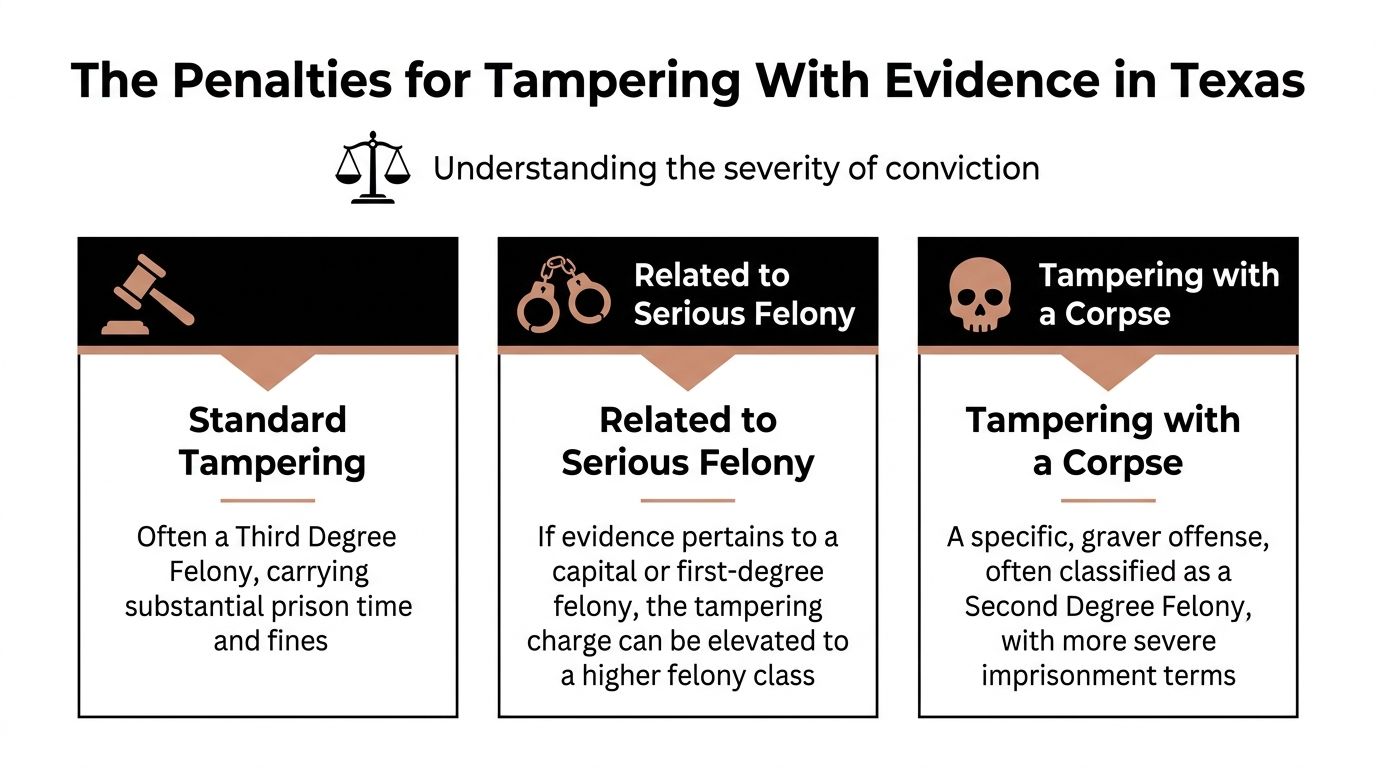
Under Texas Penal Code § 37.09, tampering is often charged as a third-degree felony. In practical terms, that means the case is treated as a serious prison-level offense, not a minor add-on. A summary of Texas tampering and fabrication penalties from Saputo Law notes that this charge commonly carries 2 to 10 years in prison and up to a $10,000 fine.
How punishment can change with the facts
The penalty level usually tracks the kind of evidence involved and the type of case prosecutors say you were trying to affect. A simple way to read it is this: the more serious the underlying matter, the more serious the tampering charge tends to become.
| Situation | Charge level | Possible punishment |
|---|---|---|
| Evidence connected to a misdemeanor case | Class A misdemeanor | Up to 1 year in jail and up to $4,000 fine |
| Evidence connected to a felony case | Third-degree felony | 2 to 10 years in prison and up to $10,000 fine |
| Tampering involving a human corpse | Second-degree felony | 2 to 20 years in prison and up to $10,000 fine |
The penalty ranges in that chart reflect the offense overview collected by Texas Criminal Defense Group's explanation of evidence tampering penalties.
Texas law can also increase the stakes when alleged tampering contributes to the wrongful conviction of an innocent person. In that setting, the offense can be punished as a second-degree felony, which carries 2 to 20 years in prison.
Timing matters here too. If prosecutors argue you destroyed or concealed something because you expected police contact, expected charges, or expected a case to follow, they may still seek a felony filing. For many clients, that is the hardest part to grasp. The law does not always wait for an officer to say, "You are under investigation," before exposure begins.
There are also filing deadlines, called statutes of limitation. As noted in the same Saputo Law source, felony tampering charges generally have a 3-year limitations period, while misdemeanor-level charges generally have a 2-year period.
Before looking at strategy, it helps to hear a plain-language overview of how serious Texas courts can treat this allegation.
The consequences go beyond jail and fines
The sentence is only part of the problem.
A tampering conviction can affect employment, professional licenses, housing applications, firearm rights, and the way prosecutors view you in any later case. Allegations like this carry a built-in narrative. The state often frames them as proof that a person tried to hide the truth. That theme can shape bond arguments, plea discussions, and sentencing requests long before a case ever reaches trial.
This is one reason defense lawyers treat tampering charges differently from ordinary paperwork offenses or minor obstruction allegations. The accusation changes how the entire case is presented.
If you want a clearer sense of how lawyers attack the state's proof, this guide on how evidence is challenged in Texas criminal cases helps explain where these cases can weaken.
Why prosecutors press this charge hard
From the prosecution's side, tampering is useful because it lets them argue intent through conduct. They may claim the act of deleting, hiding, moving, or destroying something shows consciousness of guilt. In anticipation cases, they often try to build that argument from surrounding facts such as the timing, the setting, and what they say the person expected was about to happen.
That does not mean the accusation is automatically valid. It does mean the penalty exposure is real, and the defense has to answer both parts of the case. The underlying accusation, and the claim that your actions were meant to impair evidence.
Common Defenses Against Evidence Tampering Allegations
Being charged doesn't mean the state can prove the case. In many tampering with evidence Texas cases, the entire fight turns on weak inferences. Police may suspect what happened. Suspicion is not enough.

The state still has to prove knowledge and intent
One defense is lack of knowledge. If you didn't know an investigation was pending or in progress, the charge may fail. Another is lack of intent. You may have dropped something, misplaced something, or acted for a reason unrelated to hiding evidence.
Texas courts have recognized limits here. As discussed in BHW Law Firm's review of Texas tampering cases, an officer does not need to physically see the evidence before a suspect destroys it. But if the only proof is that a defendant threw an item out a window, without other signs showing knowledge of an investigation or intent to impair evidence, that act alone may not meet the legal threshold.
That distinction matters. A throwing motion is not the same thing as a proven tampering offense.
Defense themes that often matter
A lawyer may challenge the case from several angles:
- No pending investigation you knew about. The timeline may show you acted before you were aware of police presence or before any official inquiry could reasonably be anticipated.
- No intent to impair evidence. The state must prove purpose, not guesswork.
- Weak identification of the item. Police may say something was tossed, but not know what it was.
- Gaps in observation. Body camera footage, dash camera video, and witness accounts may not line up.
- Unlawful police conduct. If officers violated your rights during the stop, search, or arrest, some evidence may be challenged.
"The prosecution has to prove what you knew and what you meant to do. Those are often the most contested facts in the courtroom."
Building the defense case
A careful defense review usually starts with the record. That includes police reports, video, dispatch timing, witness statements, and any forensic handling of the alleged evidence. A lawyer may compare what the officer claimed to see with what the camera shows.
If you want to understand how lawyers attack weak proof, this guide on how evidence is challenged in Texas criminal cases gives useful context.
In some cases, the right strategy is negotiating for a reduction or dismissal. In others, the better path is taking the case to trial because the state can't prove the mental state required by law.
What to Do If You Are Charged With Tampering With Evidence
The first hours and days after an arrest matter. If police accuse you of tampering with evidence, your job is not to talk your way out of it. Your job is to protect yourself.
Start with these immediate steps
Stay silent
You have the right to remain silent. Use it. Police may act casual and ask for your side of the story, but your explanation can lock you into facts before your lawyer sees the evidence.
Don't consent to searches
If officers ask to search your car, phone, home, or personal property, you can refuse consent. Don't argue. Don't interfere. Just state clearly that you do not consent.
Ask for a lawyer
Early legal advice matters in felony and misdemeanor cases alike. If you're dealing with drug possession, a DWI arrest, assault allegations, or theft accusations tied to a tampering claim, counsel needs to evaluate both charges together.
What the court process usually looks like
After arrest, many people feel lost because criminal procedure moves fast. A simplified path often looks like this:
| Stage | What usually happens |
|---|---|
| Arrest and booking | Police process you, list charges, and hold you pending release or bond |
| Arraignment or first court appearance | The court addresses the charge and your basic rights |
| Plea bargaining | Your lawyer and the prosecutor discuss possible resolutions |
| Trial | If no agreement is reached, the state must prove guilt beyond a reasonable doubt |
| Sentencing | If there is a conviction or plea, the court decides punishment |
Some people also need help with bond conditions, protective-order issues, or cases where criminal allegations overlap with family conflict.
Think beyond the immediate charge
Even if your case ends without prison time, the record can continue to affect your life. That's why it helps to ask early about long-term options:
- Expunctions may be available in some situations when the law allows records to be removed.
- Record sealing or nondisclosure may help limit public access in eligible cases.
- Post-conviction relief can matter for people focused on rehabilitation and rebuilding.
If you're trying to decide when to bring in counsel, when to hire a criminal defense lawyer in Texas explains why early representation can shape the outcome. One option for people facing these issues is the Law Office of Bryan Fagan PLLC, a Texas criminal defense firm that handles charges ranging from DWI and drug possession to assault, theft, felony cases, expunctions, and record-related relief.
Next move: Don't discuss the facts with friends, family, or on social media. Those statements can come back into the case.
The strongest step you can take right now is to get legal advice before making any more statements and before accepting the prosecution's version of what happened.
If you've been charged with a crime in Texas, call The Law Office of Bryan Fagan, PLLC for a free and confidential consultation. Our defense team is ready to protect your rights.