Seeing red and blue lights behind you can trigger instant panic. Your chest tightens, your mind races, and bad ideas can feel reasonable for a few seconds. If you kept driving, sped up, turned onto side streets, or got out and ran, you may be asking the same question a lot of Texans ask in a moment like this: what happens if you run from police in Texas?
The short answer is that Texas takes it seriously, and the consequences can rise fast. But panic is not the same thing as guilt, and a charge is not the same thing as a conviction. What matters now is understanding what the state must prove, what mistakes people make after arrest, and where a defense lawyer can attack the case.
The Moment the Red and Blue Lights Appear
The first few seconds are more critical than generally perceived. Maybe you were driving home late, worried about a warrant, a suspended license, drugs in the car, or just the fear of dealing with police. Maybe you thought, “I'm almost home,” or “I just need a safer place to pull over.” Those facts can matter later.

Panic often turns one problem into several. A traffic stop can become an arrest. A misdemeanor can become a felony. A case that might have been manageable can start to look much more dangerous once the state says you tried to flee.
Panic is common, but it doesn't erase risk
I tell clients this often. The law doesn't stop because you were scared, but fear does help explain why people make fast, bad choices. That explanation can matter when a defense attorney starts looking at intent, timing, road conditions, and whether you were refusing to stop or trying to make sense of a chaotic moment.
If you're reading this after an arrest, focus on what you can control now. Learn how officers and prosecutors frame these cases, and make sure you understand your protections during police contact. A good starting point is this guide to your rights during a traffic stop in Texas criminal cases.
Practical rule: The state's version of those first seconds is rarely the only version. Video, audio, witness statements, and timing details can change how the case is charged.
Your future isn't decided at the roadside
People often assume that if the officer says “evading,” the outcome is locked in. It isn't. The charge depends on details. Did the officer give a clear signal? Did you know it was law enforcement? Did you intentionally flee? Were you on foot, or did the state claim you used a vehicle? Those questions shape the entire case.
The Two Main Laws for Fleeing Police in Texas
Texas doesn't treat every “running from police” case the same way. Prosecutors usually look at two different legal paths, and they are not identical.
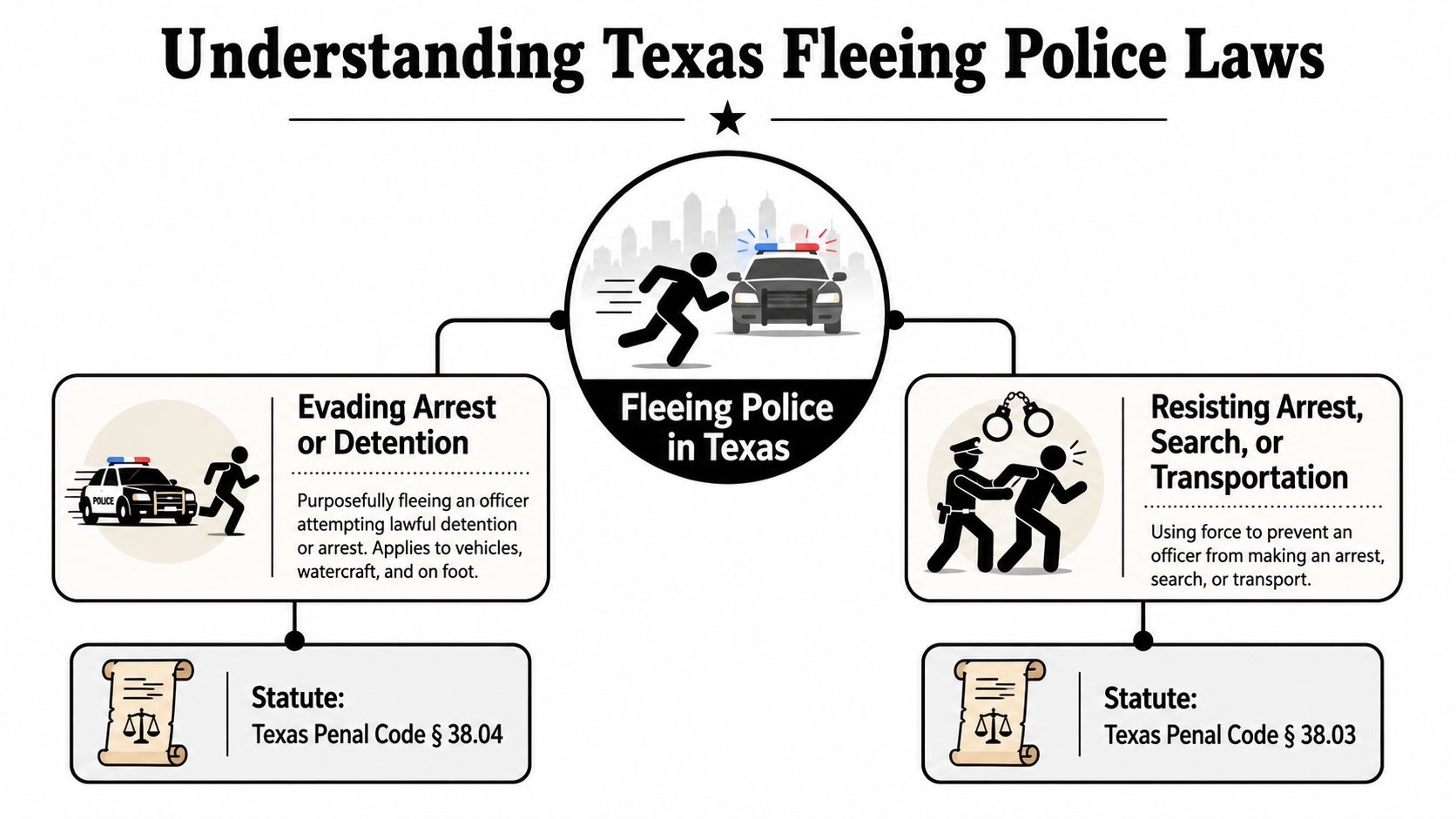
One path is evading arrest or detention under Texas Penal Code § 38.04. The other is fleeing or attempting to elude a police officer under Texas Transportation Code § 545.421. A legal summary notes that Texas distinguishes between these offenses, and that the transportation code offense is often a Class B misdemeanor while the penal code violation starts as a Class A misdemeanor and can escalate quickly, as described in this Texas evading police overview from Justia.
Evading arrest or detention under Penal Code 38.04
This is the charge many people mean when they talk about “evading.” In plain English, the state is saying you intentionally fled from someone you knew was a peace officer or federal special investigator who was lawfully trying to arrest or detain you.
That word intentionally matters. The prosecutor doesn't just have to show movement. The prosecutor has to argue that you meant to get away instead of comply.
Common fights in these cases include:
- Whether the stop was clear: If the officer's signal was confusing, delayed, or hard to see, that can matter.
- Whether you knew it was law enforcement: This can become important at night, in heavy traffic, or when an unmarked vehicle is involved.
- Whether you were fleeing: Slowing down, looking for a lit area, or pulling over after a short delay may not fit the state's preferred story as neatly as the police report suggests.
Fleeing or attempting to elude under Transportation Code 545.421
This charge comes up more often in traffic-stop settings. The focus is usually on whether a driver failed to stop after a visible or audible police signal.
This embedded video gives a basic visual overview before we get into the practical differences defense lawyers look for.
The practical difference is this. Penal Code 38.04 usually centers on avoiding detention or arrest. Transportation Code 545.421 usually centers on failing to stop when an officer signals during a traffic enforcement setting. The facts can overlap, and charging decisions can get messy.
One bad assumption hurts a lot of people: “If I only drove a few more blocks, it can't be evading.” That's not automatically true, and it's not automatically false either. The details decide it.
Why prosecutors like having both tools
Think of these laws as two separate toolboxes. One is built for detention and arrest situations. The other is built for police-stop and eluding situations. A defense lawyer's job is to force the state to prove it picked the right toolbox and can prove every required element.
Misdemeanor vs Felony A Breakdown of Evading Arrest Penalties
A common surprise is how sharply Texas separates running on foot from running in a vehicle. That distinction can change the case from a misdemeanor to a felony.
Under Texas Penal Code § 38.04, evading arrest is a Class A misdemeanor if you flee on foot, but it becomes a state jail felony if you use a vehicle. The punishment ranges tied to that jump are substantial, as summarized in this discussion of Texas evading arrest penalties.
Texas Evading Arrest Penalties at a Glance
| Circumstance | Offense Level | Potential Jail/Prison Time | Maximum Fine |
|---|---|---|---|
| Fleeing on foot | Class A misdemeanor | Up to 1 year in jail | Up to $4,000 |
| Fleeing using a vehicle | State jail felony | 180 days to 2 years in a state jail facility | Up to $10,000 |
Why the vehicle issue changes everything
Texas treats vehicle flight as more dangerous because cars create risk for officers, other drivers, passengers, and pedestrians. Once the state says a vehicle was used to flee, the exposure gets much more serious.
That doesn't mean the state's claim is always right. In some cases, officers describe “fleeing” when a driver says they were trying to pull over safely, find a public location, or avoid stopping on a dangerous shoulder. Sometimes the timing between signal and stop is short. Sometimes the report uses loaded language that the body camera or dash camera doesn't fully support.
Practical consequences beyond the chart
A felony charge affects more than sentencing exposure. It changes how prosecutors negotiate, how judges view bond conditions, and how employers and landlords may react if the case stays on your record.
If you're trying to understand the stakes, it helps to know the broader difference between offense levels in Texas. This overview of misdemeanor vs felony in Texas gives the larger context.
Bottom line: In these cases, “Was a vehicle used?” isn't a side issue. It can be the issue that changes the whole case.
What people often misunderstand
People sometimes think a short chase doesn't count, or that slowing down protects them from a felony filing. That's not a safe assumption. The state will focus on whether you intentionally failed to stop after a lawful effort to detain or arrest.
At the same time, defense work often starts right there. If the vehicle never became a tool of flight, or if the facts support delayed compliance rather than intentional evasion, the charge may be challenged, reduced, or negotiated from a stronger position.
Aggravating Factors That Escalate an Evading Charge
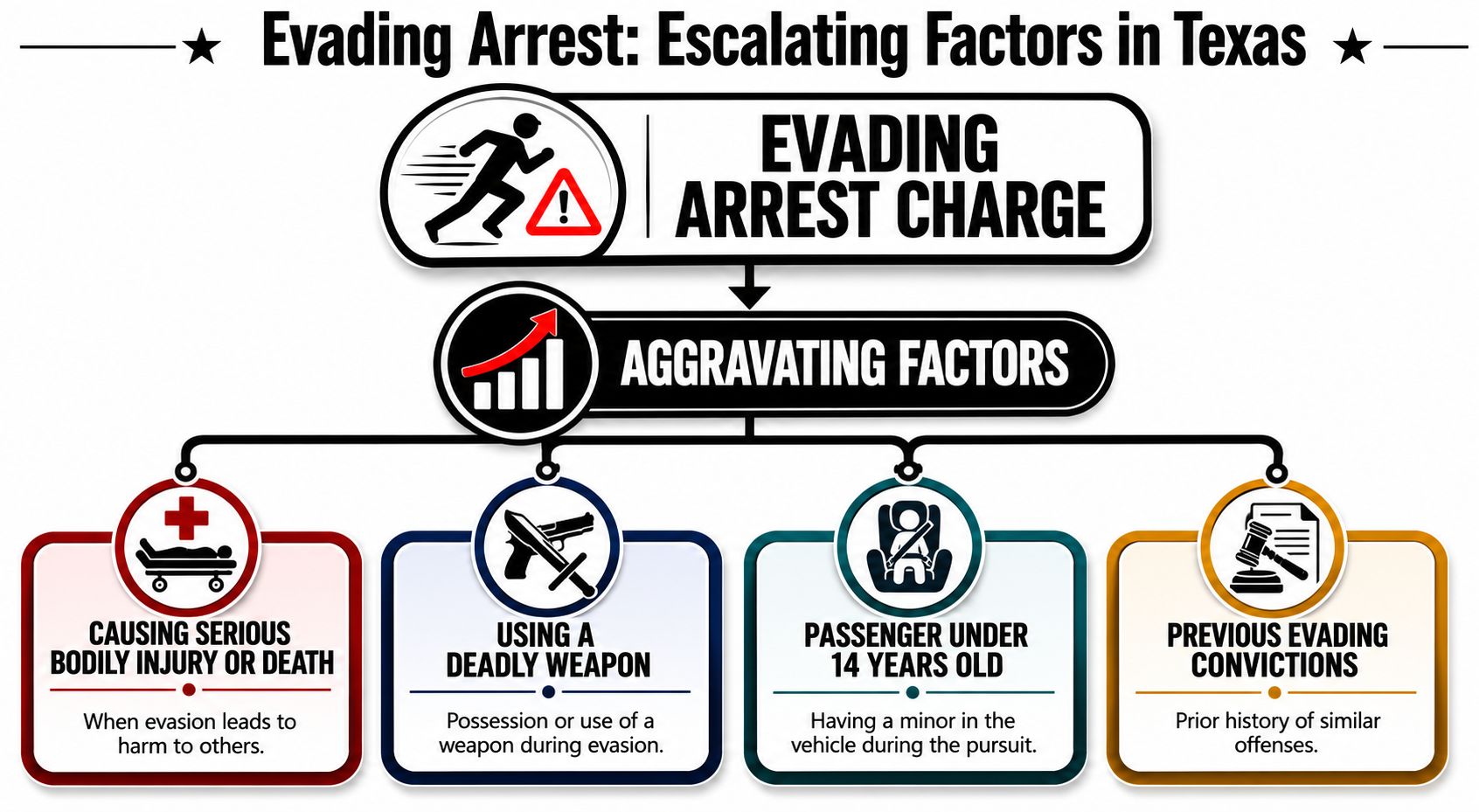
An evading case can get worse quickly when the facts suggest more danger or more harm. Once aggravating facts enter the picture, prosecutors usually become less flexible and the court may treat the case much more harshly.
Injury and death can raise the level fast
If evading arrest in a vehicle causes serious bodily injury, the charge can be enhanced to a third-degree felony. If it results in death, it becomes a second-degree felony, with a potential prison sentence of 2 to 20 years, according to this Texas fleeing or eluding summary.
A common example is a pursuit that ends in a crash at an intersection. Once someone is badly hurt, the case is no longer just about refusing to stop. It becomes about the harm tied to that decision.
Prior history and dangerous driving facts matter
Texas law also escalates exposure when aggravating facts exist, including prior evading convictions, serious bodily injury, or death. Prosecutors also pay close attention to conduct during the chase. Speeding through traffic, running red lights, and other dangerous actions can shape both charging and negotiation decisions.
That means a file may contain more than one fight at once:
- The prior conviction issue: Is the prior offense valid, final, and usable the way the state claims?
- The injury question: Did the alleged evasion cause the injury, or did other factors contribute?
- The danger narrative: Are officers describing ordinary bad driving as something more dramatic to support a harsher charge?
A police report often reads like a finished story. A defense lawyer reads it like a draft that still has to be tested.
The line between a bad case and a life-changing case
The legal jump matters, but so does the human one. Once injury, death, or prior history enters the file, judges may look at bond, release terms, and plea options differently. Prosecutors may also be less willing to treat the case as a momentary panic response.
Careful factual review matters most. Video timing, crash reconstruction, witness statements, medical records, and dispatch audio can all affect whether an aggravating factor really fits.
The Domino Effect Related Charges and Hidden Consequences
Evading charges rarely arrive alone. In practice, they often sit next to the charge that made the driver panic in the first place. That could be DWI, drug possession, unlawful carry issues, theft allegations, outstanding warrants, or a traffic case that suddenly turned into something larger.
A person who runs doesn't erase the original problem. They usually add to it. That means your lawyer may need to defend several cases at once, not just the evading allegation.
One stop can become several cases
Here are some of the most common add-on problems I see in these situations:
- DWI or drug evidence: If officers search after the stop or arrest, prosecutors may file separate intoxication or possession charges.
- Reckless driving allegations: Dangerous driving facts can shape both the evading case and the traffic-related charges around it.
- Warrant consequences: If police were already trying to arrest you on an open warrant, the evading claim may become only one piece of a larger custody problem.
If a person doesn't appear in court after release, that creates another layer of trouble. In some situations, families begin looking into options like hiring a bail enforcement agent to understand how Texas fugitive recovery works and what can happen after a bond problem spirals.
The penalties don't end at sentencing
Even when the case doesn't involve the worst facts, the fallout can keep going long after court dates end.
Collateral consequences can include:
- Driver's license problems: A criminal traffic-related case can affect your ability to drive and keep insurance.
- Employment trouble: Background checks may flag arrests, pending cases, or convictions.
- Housing and professional licensing issues: Landlords and licensing boards often react to fleeing-related allegations, especially felony filings.
- Civil exposure after a crash: If someone was hurt or property was damaged, you may also face claims outside criminal court.
Why the domino effect matters to defense strategy
A smart defense doesn't look at the evading count in isolation. It asks what charge can be weakened first, what evidence may be suppressible, whether one allegation is driving the others, and how a plea in one case may affect another.
That's especially important for rehabilitation-focused readers. Depending on the result, some people may later explore expunction, nondisclosure, or other forms of record relief. Those options depend heavily on how the case ends, which makes early strategy matter.
Building Your Defense What to Do If You Are Charged
The patrol car lights up behind you. You do not stop right away because the road is dark, traffic is tight, or you panic for a few seconds. By the time the report is written, those few seconds may be described as an intentional attempt to flee.
That is why the defense starts with the elements, not the accusation.
In an evading case, the State still has to prove that you intentionally fled from a person you knew was a peace officer or federal special investigator who was lawfully trying to arrest or detain you. That gives your lawyer real places to push back. In many cases, the fight centers on whether the signal to stop was clear, whether you understood who was trying to stop you, whether you were looking for a safe place to pull over, and whether the facts really support the claim that a vehicle was used to flee. Those are not side issues. They often decide the case.
The first moves after arrest
The first day matters. So does the first conversation.
If you have been arrested, do four things right away:
- Stop talking about the facts. Do not explain the case from the patrol car, the jail phone, text messages, or social media.
- Preserve evidence before it disappears. Save phone location data, dash cam footage, rideshare records, call logs, and messages that show where you were going and what you were doing.
- Write down your memory while it is fresh. Include the route, lighting, traffic, weather, when you first noticed police, and what you did next. Give it to your lawyer.
- Get legal advice early. Bond conditions, early statements, and rushed plea discussions can affect the outcome long before trial.
If you need a practical checklist for those first hours, review this guide on what to do immediately after getting arrested in Texas.
What a defense lawyer looks for
A good defense lawyer does not stop at, "Did you run?" The better question is, "What can the prosecutor prove, and what evidence is weak?"
That review is specific. It often includes:
- Signal clarity: Were the lights, siren, hand gestures, or verbal commands clear enough for a driver or pedestrian to understand?
- Identification of the officer: Was the officer in a marked unit, in uniform, or otherwise clearly identifiable?
- Intent: Did your actions show an attempt to escape, or do they fit a different explanation, such as trying to reach a safe, well-lit place to stop?
- Lawfulness of the stop or detention: Did the officer have legal grounds to detain or arrest you in the first place?
- Vehicle allegation: Do the facts show evasion by vehicle, or is the State stretching the evidence to reach a higher-grade charge?
- Video and dispatch records: Do body cam, dash cam, radio traffic, or GPS timestamps match the report?
- Witness perception: Did passengers, bystanders, or other officers see the same event the way the charging officer described it?
Small facts can carry a case. A short delay before stopping may look very different on video than it does in a police narrative. A turn into a gas station or parking lot may support a safe-stop explanation rather than an intent to flee. I have seen cases change direction because the timeline was tighter, the road darker, or the officer's signal less clear than the report suggested.
For broader background on how these issues arise, see this analysis of fleeing and eluding defenses in Texas.
What happens in court
Evading cases usually follow a familiar path, but the pressure points differ from case to case.
- Arraignment and bond review: The court addresses the charge and sets or reviews release conditions.
- Discovery and evidence review: Your attorney obtains reports, video, dispatch logs, and other records.
- Pretrial investigation: The defense tests the officer's version against the physical evidence, timeline, and legal basis for the stop.
- Negotiation: If the proof on intent, signal clarity, or vehicle use is weak, the State may be more open to reducing the charge or resolving the case on better terms.
- Hearings or trial: The defense can challenge the stop, the admissibility of evidence, and whether the State has met each legal element.
- Post-case record strategy: If the result allows it, the next step may include examining options such as nondisclosure or other record relief.
Law Office of Bryan Fagan PLLC handles Texas criminal cases from arrest through trial and also assists with expunctions, nondisclosures, record sealing, and post-conviction relief for clients trying to rebuild after a case ends.
What helps and what hurts
The clients in the best position usually do a few things early. They preserve evidence. They keep quiet about the facts. They show up to court. They give their lawyer the details that seem minor but often are not.
The choices that create problems are just as consistent:
- Talking in hopes of clearing things up
- Deleting messages or recordings
- Posting your version online
- Assuming the police report is the final word
- Waiting until plea talks begin to prepare a defense
An evading charge is serious. It is also a charge with elements the State must prove, and those elements can be challenged with careful work. If you are charged, the goal is not panic and it is not guesswork. The goal is to protect your rights early, test the State's evidence hard, and build the strongest defense the facts will support.