Being arrested for family violence in Texas can turn your life upside down in a single night. You may have been taken from your home, handed bond conditions you barely understood, and told you're facing a felony called Continuous Violence Against the Family. If that's where you are right now, the fear is real. So is the confusion.
This charge sounds broad and overwhelming, but it isn't limitless. Texas law has specific rules the State must prove. That matters, because once you understand what prosecutors are alleging, you can start making smart decisions instead of reacting out of panic.
For many people, the first shock is realizing this case can affect far more than jail time. A charge tied to family violence can reach into child custody disputes, professional licensing, immigration problems, firearm restrictions, and your job search. That's why a calm, strategic response matters from the start.
An Arrest Can Be Terrifying You Are Not Alone
If you've been arrested for continuous violence against the family texas cases, you're probably dealing with more than a criminal charge. You may also be trying to figure out where you'll stay, whether you can see your children, whether you can contact your spouse or partner, and what happens at your next court date.
That pressure causes people to make avoidable mistakes. They send texts they shouldn't send. They try to explain everything to police. They think they can smooth things over with the other person involved. In family violence cases, those moves often make the case harder, not easier.
What this charge usually feels like at the start
Most clients describe the first few days the same way:
- Everything moves fast: Arrest, jail release, bond terms, court dates, and protective order issues can happen quickly.
- The paperwork is hard to read: Charging documents use statutory language that doesn't sound like normal conversation.
- The stakes feel unclear: You may know it's serious, but not understand why this case is being filed as a felony instead of a misdemeanor.
- Other parts of life start shifting: Employers, family court judges, and immigration officials may all care about what happens in the criminal case.
Practical rule: The first goal is to stop the damage from spreading. That starts with silence, compliance, and a defense plan.
What happens after an arrest in Texas
A Texas criminal case usually moves through familiar stages, even when the facts are unique:
- Arrest and booking. Police take you into custody and the case is entered into the system.
- Magistration or first appearance. A judge may address bond, conditions of release, and no-contact rules.
- Arraignment or formal court setting. You hear the charge and begin entering the court process.
- Investigation and evidence review. Prosecutors gather records. Your defense lawyer should be doing the same.
- Plea bargaining or pretrial litigation. Some cases can be resolved without trial. Some shouldn't be.
- Trial and sentencing if needed. If the case proceeds, a jury or judge decides guilt, and sentencing follows if there's a conviction.
If you're also facing another charge such as DWI, theft, or drug possession, the same basic lesson applies. Early decisions matter. The strongest defense usually starts before the State has framed the whole story for the court.
A criminal allegation is not a conviction. It is the beginning of a legal fight, and there are ways to challenge what the State says happened.
What Is Continuous Violence Against the Family in Texas
A lot of people are shocked to learn they can face one felony charge even when police are talking about more than one argument, more than one date, or more than one household incident. That is how this statute works.
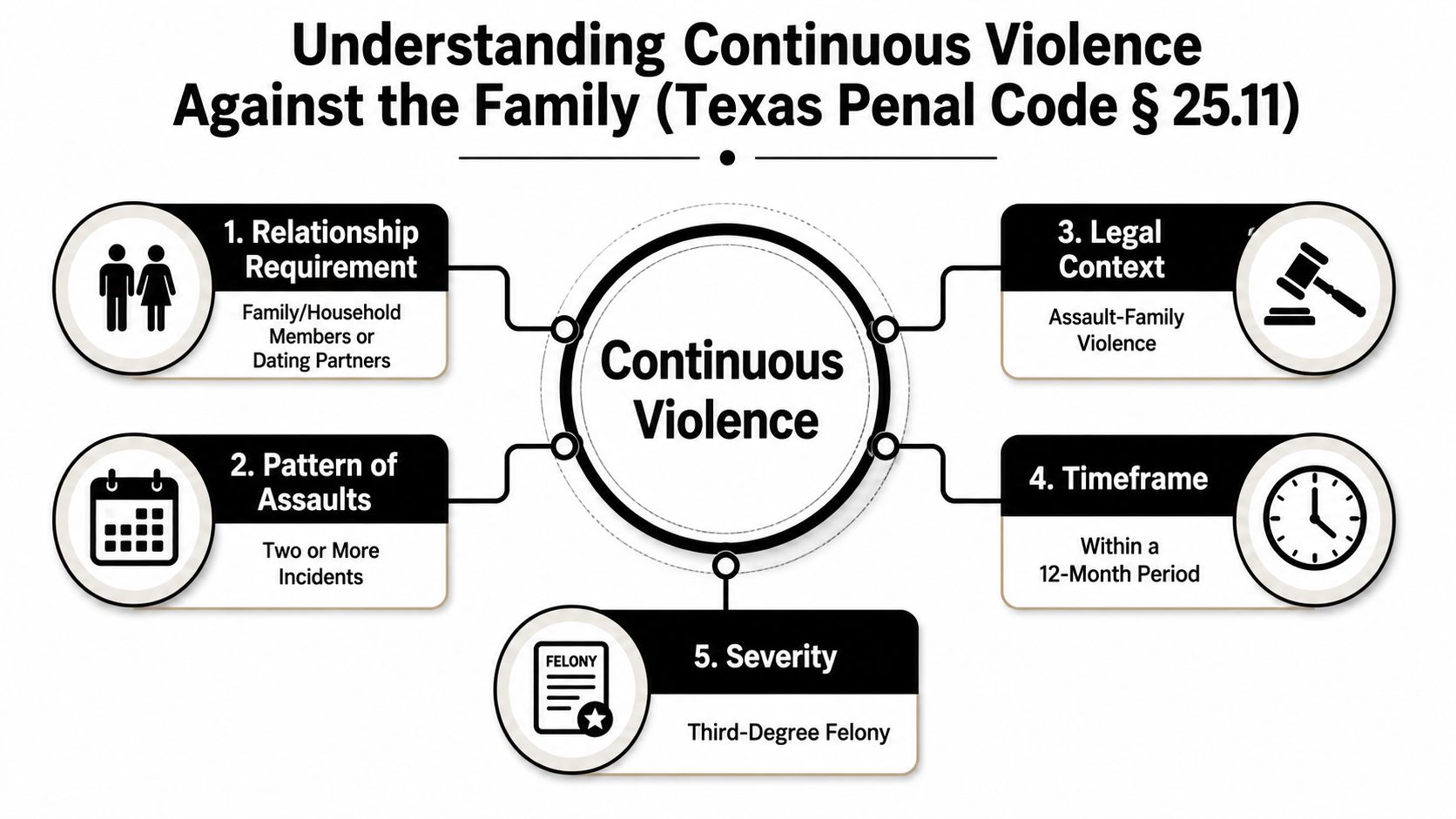
Under Texas Penal Code § 25.11, continuous violence against the family is a third-degree felony. The State must claim that, during a 12-month period, you committed two or more assaults that caused bodily injury against someone who qualifies as a family member, household member, or dating partner. The penalty range for a third-degree felony is generally 2 to 10 years in prison and up to a $10,000 fine under Texas Penal Code punishment provisions for third-degree felonies.
The three core parts prosecutors focus on
In practice, prosecutors usually build this charge around three questions:
- Were there at least two separate assault allegations involving bodily injury?
- Was the alleged victim a family member, household member, or dating partner under Texas law?
- Did those allegations fall within the same 12-month period? TexasLawHelp's explanation of Texas criminal statutes of limitation and charging deadlines gives useful background on how timing rules matter in criminal cases.
This charge often changes the entire posture of a case. Instead of arguing about one incident, the defense has to examine texts, calls, prior reports, witness timelines, medical records, and relationship history across a longer period. That broader record can create risk for the State too. If the timeline is sloppy, the relationship does not fit the statute, or one alleged incident is weak, the prosecution may have trouble proving the felony as charged.
Who counts as family under this law
Texas defines these relationships broadly. The law can apply to current or former spouses, relatives, people who live in the same household, and people in a dating relationship. The allegations do not always have to involve the same person in every incident, which is one reason these cases can become more complicated than clients expect.
That broad definition matters outside criminal court. The same allegation can affect temporary orders in a custody case, create immigration problems for a non-citizen, and raise red flags with employers running background checks. I tell clients early that the criminal charge is only one part of the problem. The defense strategy has to account for the ripple effect.
If you want to compare this felony to the charge that often appears in the police report first, review how assault family violence is charged in Texas.
A Section 25.11 case is a pattern allegation. The State is trying to prove repeated conduct within a defined period, and the defense has to test every part of that story.
How This Charge Is Different from Simple Assault
A client often comes in expecting to defend one bad night, one argument, one police report. Then they learn the filing accuses them of a pattern, not just a single incident. That changes the risk, the defense strategy, and the pressure points in the case.
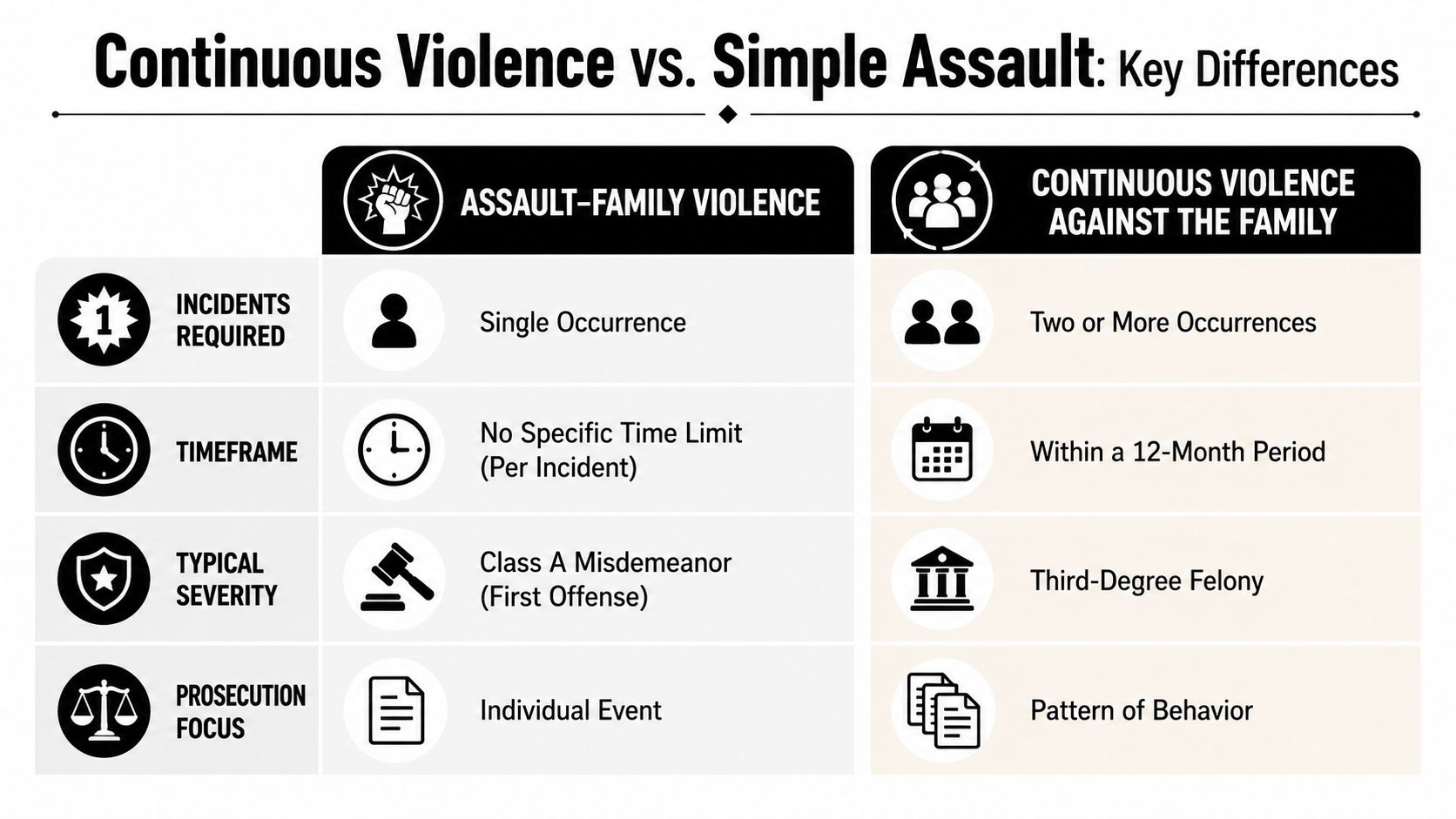
Side by side comparison
| Issue | Assault Family Violence | Continuous Violence Against the Family |
|---|---|---|
| Basic accusation | One assault allegation | Two or more bodily injury assaults |
| Time focus | One incident | A 12-month pattern |
| Typical charge level | Often a misdemeanor on a first offense | Third-degree felony |
| What the State emphasizes | A single event | Repeated conduct over time |
The Texas Department of Public Safety publishes annual family violence data showing that assault allegations make up a large share of reported family violence cases. That matters here because prosecutors use the continuous violence statute to charge repeated allegations as one felony case, instead of treating each accusation as a separate misdemeanor event.
The legal difference has practical consequences right away. In a simple assault case, the defense can often center on one date, one set of injuries, one witness account, and one officer's observations. In a continuous violence case, the State tries to stitch together multiple incidents into a single narrative about the relationship itself. Jurors are not just asked whether something happened once. They are asked whether the prosecution proved repeated bodily injury assaults within the statutory time period.
That broader framing also affects negotiations. A prosecutor handling one misdemeanor allegation may be more focused on weaknesses in a specific report. A prosecutor handling a continuous violence charge may view the case through a public-safety lens and be less flexible, even where one or more alleged incidents are poorly documented.
This is also where many people underestimate the collateral damage. A single assault allegation can already create problems with protective orders, custody disputes, job applications, and immigration screening. A felony pattern allegation creates a different level of concern in family court and with outside decision-makers because it suggests ongoing conduct, not an isolated accusation. In some cases, issues tied to memory, trauma response, and delayed reporting also become part of the evidence fight, which is why careful review of records and documentation of complex trauma for legal arguments can matter in both prosecution and defense analysis.
From a defense standpoint, the goal is not to argue at a high level that the charge feels unfair. The goal is to break the pattern into parts, test each allegation separately, and force the State to prove the felony the way Texas law requires.
Common Scenarios and Proving the Case in Court
A common fact pattern looks like this: police are called after an argument, they see an injury or hear one accusation, and then the investigation expands. By the time charges are filed, the case is no longer about one night. The State may claim there were multiple assaults over months and charge them together as one felony.

That changes how the case is tried and how it affects the rest of your life. Allegations spread across time can influence protective order hearings, temporary custody decisions, job screening, and immigration review long before a criminal case reaches trial.
How prosecutors usually build the story
Prosecutors often try to assemble a timeline from different sources rather than rely on one clean piece of evidence. The file may include:
- Police reports: Officers may describe injuries, statements at the scene, prior calls, and the emotional state of the people involved.
- Photographs and medical records: These records are used to support the claim that bodily injury occurred and to connect an injury to a specific event.
- Texts, voicemails, and social media messages: The State may argue these messages show fear, admissions, threats, apologies, or contact between the parties near the alleged incidents.
- Witness testimony: Children, relatives, neighbors, coworkers, and responding officers can all become witnesses.
- Recorded calls: 911 calls and jail calls can shape the jury's first impression of the case.
The problem for the State is that a timeline built from fragments can have weak points. A photo may show an injury but not when it happened. A witness may repeat what someone else said rather than what they personally saw. Messages may be incomplete, sarcastic, or stripped of context. Good defense work starts by separating assumption from proof and by building a criminal defense strategy around the State's actual evidence.
The jury issue that makes these cases harder
Continuous violence cases carry a jury-charge problem that many defendants do not expect. Under Texas law, jurors must unanimously agree that the defendant committed two or more assaults within a 12-month period against a qualifying family or household member. They do not have to agree on the same specific underlying assaults. Texas courts have addressed this in opinions interpreting Penal Code Section 25.11 and the unanimity requirement in continuous-course-of-conduct offenses.
In practical terms, one juror may believe Incident A and Incident B happened, while another believes Incident B and Incident C happened. If all jurors agree the State proved at least two qualifying assaults during the charged period, that can support a conviction.
That is why these cases demand disciplined timeline work. Defense counsel has to test dates, challenge whether the incidents were separate events, examine whether there was bodily injury each time, and force the State to prove more than a troubled relationship.
When trauma evidence may matter
Some cases involve delayed reporting, changed stories, memory gaps, recantation, or conduct that looks confusing to outsiders. Those facts can matter in both directions. Prosecutors may use them to explain why a complaining witness stayed in the relationship or reported later. The defense may need to examine whether trauma, stress, substance use, outside pressure, or family court conflict affected memory and reporting.
In the right case, outside material on documentation of complex trauma for legal arguments can help you understand why trauma-related evidence may affect credibility, behavior, and case framing. That issue also reaches beyond the criminal courtroom. The same allegations may later be used in custody litigation, immigration filings, or workplace background reviews, so the factual record built early in the criminal case matters more than many people realize.
Building Your Defense Against These Serious Charges
A lot can happen in the first week after an arrest. A protective order hearing may be set. Bond conditions may cut you off from your home or children. Screenshots, texts, and 911 audio start getting collected before you have had a fair chance to explain what happened.
That is why defense work in these cases has to start early and stay organized. The job is not just to argue that the relationship was difficult. The job is to test whether the State can prove a continuous-violence case under the statute, with admissible evidence, consistent timelines, and qualifying incidents.
I usually break the defense into three tracks at once. First, challenge the charge itself. Second, control the evidence. Third, protect the client from avoidable fallout outside the criminal case.
Start with the charging theory, then pressure-test it
Continuous violence against the family is a specific felony allegation. Prosecutors still have to prove the right relationship, at least two qualifying assaults, and the required time frame. If one part is weak, the entire case can shift.
A disciplined defense often focuses on questions like these:
- Did the alleged incidents occur within the charged 12-month period?
- Are prosecutors relying on separate events, or retelling one argument several different ways?
- Is there proof of bodily injury for each alleged assault?
- Does the evidence show the complaining witness falls within the statute's family or dating relationship categories?
- Are there texts, medical records, photos, witness statements, or location data that cut against the accusation?
Those details decide cases.
Defense strategy is not one-size-fits-all
Some cases turn on credibility. Others turn on missing proof, bad police work, or a timeline that falls apart once records are subpoenaed. Self-defense may be a real issue. In another case, the better approach is to challenge whether the alleged acts were distinct criminal episodes at all.
Trade-offs matter here. A fast plea may reduce immediate risk for one client, but it can create serious problems later in a custody case, a professional licensing review, or an immigration matter. Trial may offer the best chance to clear the allegation, but it also carries exposure if the State's witnesses present well and prior statements come in cleanly. Good defense work means making that decision with open eyes, based on the actual file, not panic.
For a clearer look at that process, see how criminal defense attorneys build a defense strategy.
The criminal case can shape the record everywhere else
In family-violence cases, the defense is also about what gets written down, what gets filed, and what gets left unanswered. Statements made in bond court, counseling records, social media posts, and agreed protective-order language can all echo into divorce proceedings, child custody litigation, workplace investigations, and immigration screening.
That is one reason lawyers have to look beyond the police report. Relationship dynamics are often messy, and prosecutors may frame that complexity as a pattern of abuse. In the right case, context matters. So does a careful understanding of trauma's impact on intimacy, especially when the State is trying to explain delayed reporting, reconciliation, or conflicting behavior inside the relationship.
What good defense work looks like in practice
It is methodical.
The defense may subpoena phone records, pull body-camera footage, compare witness statements line by line, examine medical records, and map each alleged incident against travel, work, or child-exchange schedules. If the evidence supports it, counsel may push for a reduction, attack the felony filing, or prepare for trial with a focused theory the jury can follow.
The State often wants the jury to see a broad story of repeated violence. The defense has to bring the case back to proof, incident by incident, word by word, record by record.
The Ripple Effect Collateral Consequences of a Conviction
A felony conviction in this kind of case rarely stays inside the criminal courtroom. It can follow you into family court, job applications, licensing reviews, and immigration screening.
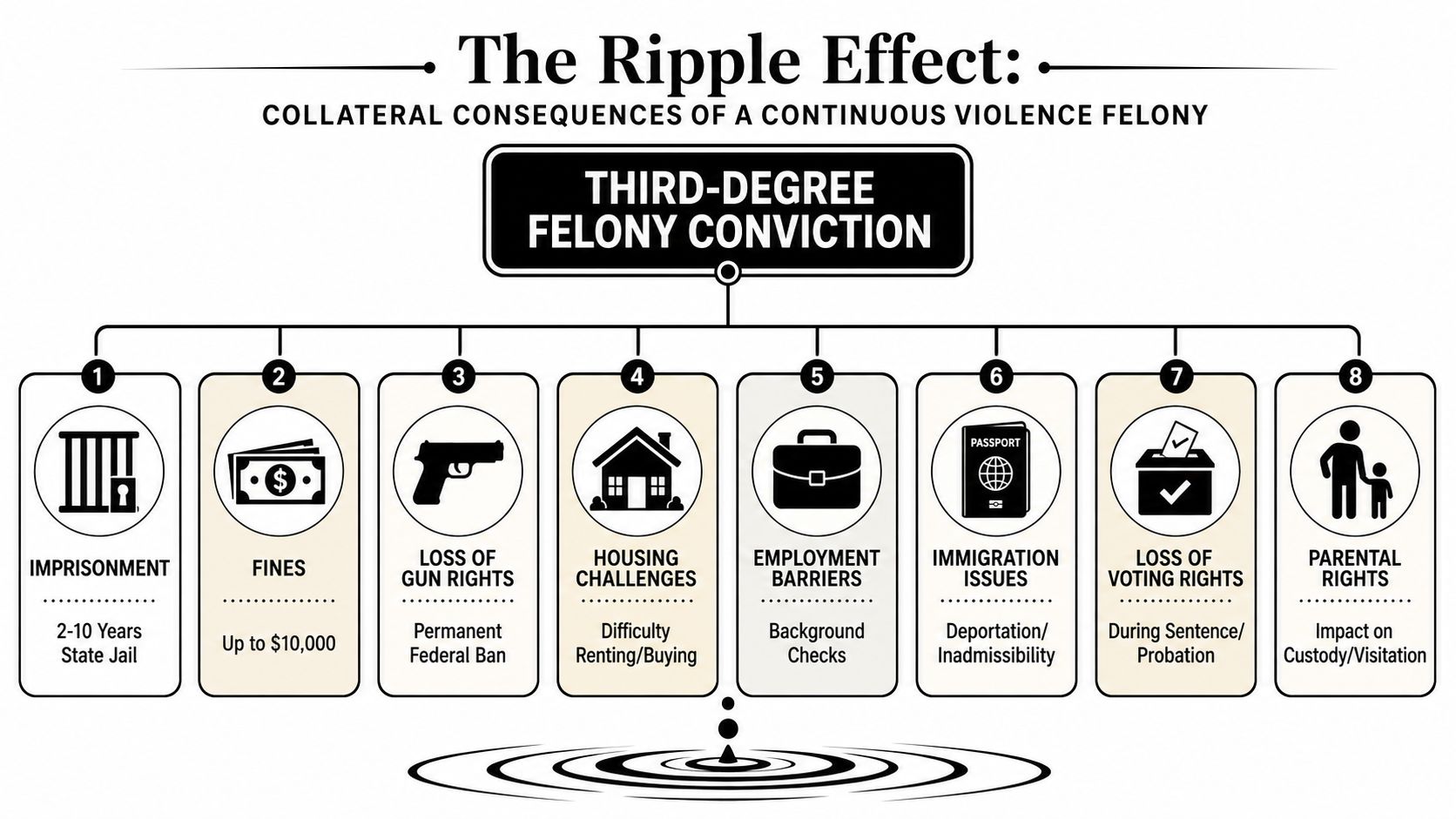
Criminal penalties are only the start
A conviction under this statute carries a prison range of 2 to 10 years and a possible fine up to $10,000 under the Section 25.11 penalty structure discussed earlier. But clients are often hit just as hard by what comes next.
Family law is the first example. If you are in the middle of a divorce, SAPCR, or custody fight, the criminal case can shape temporary orders, possession schedules, and how a judge views safety concerns in the home. Courts handling child-related issues take violence allegations very seriously.
This short video gives a useful overview of how felony consequences can spread into daily life.
Work, status, and relationships can all be affected
Employment is another major concern. Background checks can affect hiring, promotion, security-sensitive work, and professional licenses. A Houston criminal lawyer handling a family violence felony also has to think about what the case means for nurses, teachers, CDL holders, contractors, and anyone whose work depends on trust or licensing review.
Immigration consequences can be severe. Non-citizens should never treat a plea offer as routine in a family violence case. Criminal and immigration counsel often need to coordinate before any final decision is made.
Relationships can suffer too, even outside the courtroom. If you're trying to understand how trauma can change closeness, communication, and trust inside a relationship, this counseling resource on trauma's impact on intimacy offers helpful context. It does not answer the legal issues, but it can help explain why family allegations often unfold in emotionally complex ways.
Can the record ever be cleared
People often ask about expunctions, record sealing, and post-conviction relief. Those options may exist in some Texas criminal matters, but they depend heavily on how the case ends. A dismissal, acquittal, or qualifying result may open the door to record-related relief. A conviction creates a much harder path.
That's one reason the early defense work matters so much. The better the case is handled at the front end, the more options you may preserve later.
What to Do Right Now If You Have Been Charged
You do not need a perfect plan tonight. You need a safe one.
Five steps that help immediately
- Use your right to remain silent. Be polite, but don't try to explain the case to police, investigators, or anyone gathering evidence.
- Follow every bond condition exactly. If the court entered a no-contact order, obey it fully. Even a well-meaning text can create a new problem.
- Write down what happened for your lawyer. Put dates, locations, witnesses, messages, and injuries in private notes for your defense counsel.
- Don't try to fix the relationship on your own. Reaching out to the other person often leads to more allegations, more evidence, or a bond violation.
- Call defense counsel quickly. Early representation can help with court settings, evidence preservation, protective-order overlap, and plea decisions.
Keep the focus on legal protection
If you also need broader family-safety information, this outside resource offers general guidance for domestic violence situations. For the criminal side, immediate steps after release matter too, and this guide on what to do immediately after getting arrested in Texas is a useful starting point.
If your case eventually ends favorably, ask your lawyer about expunction, nondisclosure, record sealing, or other post-conviction relief options that may help you move forward. Those remedies are case-specific, but they are worth discussing early so you understand what outcomes preserve future opportunities.
A continuous violence charge is serious, but it is still a charge. Your next steps can protect your rights, your family position, and your future.
If you've been charged with a crime in Texas, call Law Office of Bryan Fagan PLLC for a free and confidential consultation. Our defense team is ready to protect your rights.