Skip to content
Being arrested in Texas can be terrifying, especially if a traffic stop or street encounter suddenly turns into an allegation that you tried to run. You may be replaying every second in your mind, wondering whether panic, confusion, or one bad decision is about to define your future.
If you're worried about evading arrest Texas charges, start with this: a charge is not a conviction. Texas law has specific rules, prosecutors still have to prove the case, and you have options at every stage. If you're in Houston, Dallas, Austin, San Antonio, or a nearby community, the process may feel fast and impersonal, but your defense should be careful, personal, and strategic.
What to Do When You See Flashing Lights in Texas
Late at night, you glance in your mirror and see red and blue lights. Your hands tighten on the steering wheel. Maybe you weren't sure the officer meant you. Maybe you panicked because you already had another legal problem hanging over your head. Maybe you drove a little farther before stopping because the road felt unsafe.
That moment matters.

A lot of evading cases don't begin with someone planning to run from police. They begin with fear, confusion, noise, darkness, or a split-second choice that looks much worse once it's written in a police report. That's why the first issue isn't shame. It's clarity.
Focus on safety and calm
If you see flashing lights, pull over safely as soon as you reasonably can. Keep your hands visible. Don't argue on the roadside. Don't explain too much. Don't make sudden movements. If you're unsure what your rights are during the stop itself, this guide on your rights during a traffic stop in Texas criminal cases gives practical help in plain language.
Practical rule: Your job in the moment is safety. Your defense happens later, with your lawyer, not on the shoulder of the road.
If you've already been charged
If police say you evaded arrest, the label can sound final. It isn't. The prosecutor still has to prove what you knew, what you intended, and whether the officer was acting lawfully. Those details often become the center of the case.
People facing this charge are often also dealing with related accusations such as DWI, drug possession, theft, or assault. A Texas DWI attorney or Houston criminal lawyer doesn't look only at one line in the charging document. The core work is looking at the entire event, second by second, and testing whether the state's version is complete and accurate.
Understanding Evading Arrest Under Texas Law
Texas doesn't treat every failure to stop as evading arrest. The law is narrower than many people think. Under Texas Penal Code §38.04(a), evading arrest happens only when a person intentionally flees from a peace officer or federal special investigator they know is trying to lawfully arrest or detain them, as stated in Texas Penal Code Section 38.04.
The three parts prosecutors must prove
A referee calling a foul illustrates this principle. The call doesn't count unless the right player, the right action, and the right rule all line up. In an evading case, the state usually has to show these core points:
- Intentional flight means you chose to flee. Panic can matter, but accidental movement or misunderstanding isn't the same as intentional flight.
- Knowledge of the officer means you knew the person pursuing you was a peace officer or federal special investigator.
- Lawful arrest or detention means the officer was attempting to make a lawful stop, detention, or arrest.
If even one of those pieces is weak, the charge may become much harder to prove.
Where people get confused
Some readers assume, "I didn't stop right away, so I'm guilty." That's not always true. Delay alone doesn't answer the legal question. The issue is whether you intentionally fled while knowing a lawful police stop was happening.
For example, if someone keeps driving briefly to find a safe, well-lit place, that fact can matter. If someone doesn't realize an unmarked vehicle is connected to law enforcement, that can matter too. If an officer didn't have legal grounds for the detention, that issue may shape the whole defense.
A criminal charge often sounds simpler than the law actually is. The police report may use one sentence. Your defense may depend on ten separate facts inside that sentence.
Why charge level matters
The way Texas classifies offenses also affects strategy. If you want broader context on levels of criminal charges, Felony vs. Misdemeanor Charges in Texas explains how Texas classifies offenses and the penalty range for each level. That distinction matters because an evading allegation can begin as one level and move sharply upward based on specific facts.
Penalties for Evading Arrest in Texas
The punishment for evading arrest in Texas depends heavily on how the allegation happened and whether anyone was hurt. The legal exposure can shift quickly from a misdemeanor to a serious felony.
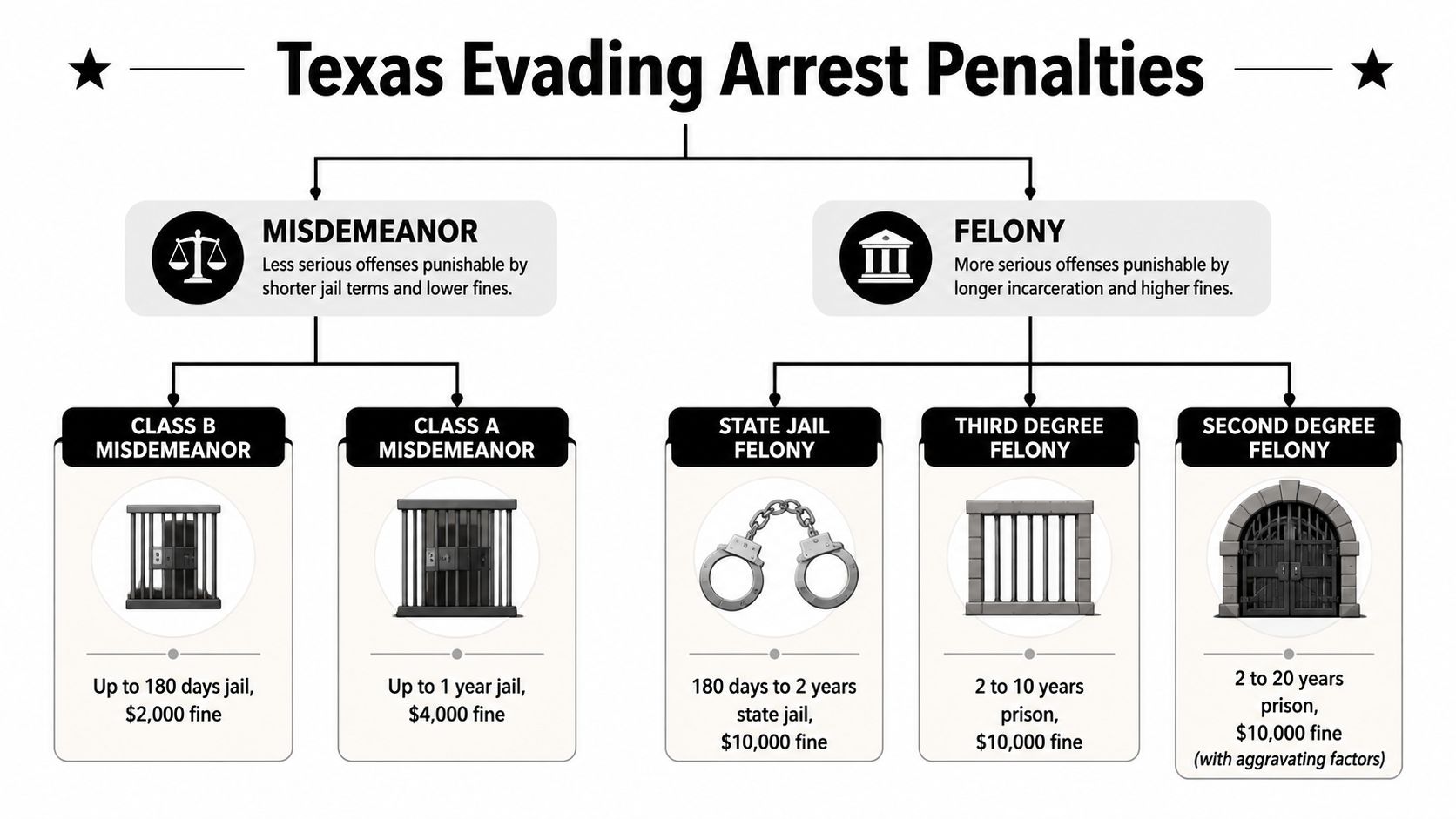
Under Texas Penal Code § 38.04, fleeing on foot is a Class A misdemeanor punishable by up to 1 year in county jail and a fine of up to $4,000, while using a vehicle makes it a state jail felony punishable by 180 days to 2 years in a state jail facility and fines up to $10,000. If the defendant has a prior conviction under the statute or causes serious bodily injury, the charge can become a third-degree felony with 2 to 10 years in prison and fines up to $10,000. If someone dies as a direct result of the officer's attempt to apprehend the fleeing defendant, it can become a second-degree felony with 2 to 20 years in prison and fines up to $10,000, according to this summary of Texas evading arrest penalties under Penal Code 38.04.
Penalty levels at a glance
| Charge level | General trigger | Possible punishment |
|---|---|---|
| Class A misdemeanor | Fleeing on foot without the aggravating factors discussed above | Up to 1 year in county jail and up to $4,000 fine |
| State jail felony | Using a vehicle, truck, motorcycle, or watercraft to flee | 180 days to 2 years in a state jail facility and up to $10,000 fine |
| Third-degree felony | Prior conviction under the statute or serious bodily injury during the pursuit | 2 to 10 years in prison and up to $10,000 fine |
| Second-degree felony | Death resulting from the officer's attempt to apprehend the fleeing person | 2 to 20 years in prison and up to $10,000 fine |
Why these allegations feel overwhelming
An evading charge doesn't stay inside the courtroom. It can affect work, family responsibilities, immigration issues, professional licensing, and housing. If the facts also involve alcohol, drugs, weapons, or an accident, prosecutors may review the case through a harsher lens.
That's one reason people often compare these allegations to other high-risk driving-related felonies in different states. For a useful example of how another state approaches a serious Florida felony traffic charge, Ticket Shield, PLLC discusses fleeing and eluding in a way that helps show why these cases are treated so seriously.
One fact issue can change everything
The legal level of the case often turns on one detail. Was there a vehicle involved? Was anyone injured? Did the state claim a prior conviction? Did the event lead to a death? Those are not side issues. They are often the difference between local jail exposure and prison exposure.
A Texas assault defense lawyer or Houston criminal lawyer looking at an evading case will often study these aggravating facts early, because that's where charge reduction arguments may begin.
The Critical Difference Between Fleeing on Foot and by Vehicle
Two people can both be accused of running from police, yet face very different legal realities.
One person bolts down an alley after an officer tries to detain him. Another jumps into a car and drives away. Commonly, both situations may sound like "running." Under Texas law, they are not treated the same way, and that difference can shape the entire case.
Side by side comparison
Here's the practical divide:
On foot
This often stays at the misdemeanor level if the higher-level aggravating facts aren't present. The case still matters, but the punishment range and defense posture are different.By vehicle
Once a vehicle enters the story, prosecutors often view the case as more dangerous from the start. That usually changes bond arguments, negotiation strategy, and the risk of a felony record.
Why Texas treats vehicle cases more harshly
A person on foot can create a problem for police. A person fleeing in a car, truck, motorcycle, or watercraft can create danger for officers, passengers, pedestrians, and other drivers. That's the practical reason these cases get more serious attention.
Consider two short examples.
A man leaves a convenience store, sees officers approach, and runs across a parking lot. Another driver sees flashing lights, accelerates through traffic, and keeps going. Even if both claim panic, the second event creates a much broader safety risk. That difference affects how police write the report, how prosecutors charge the case, and how a judge may view public safety.
Vehicle-based allegations often require a different defense strategy because the state will usually frame the case around danger, not just disobedience.
If your case involved a car or truck, this article on what happens if you run from police in Texas gives added context on how these cases are commonly charged and defended.
Common Defenses Against Texas Evading Arrest Charges
Being charged doesn't mean the state's case is solid. In many evading cases, the defense begins by slowing the story down and challenging what police and prosecutors assume happened.
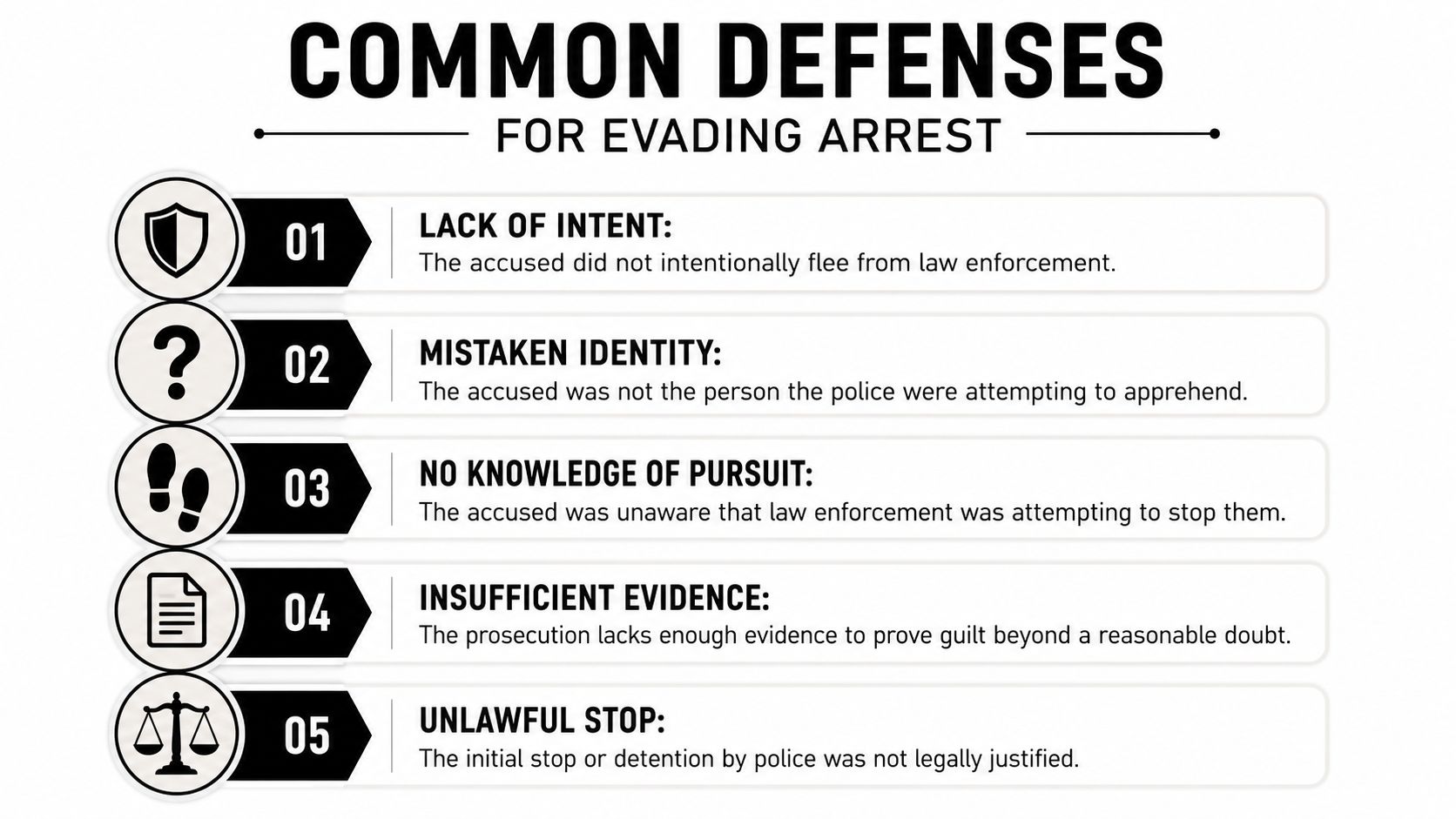
One useful starting point is understanding the basic defense themes recognized in practice. Common defenses include showing the person did not know the pursuer was a peace officer, that the officer was not lawfully trying to arrest or detain them, or that any movement away was accidental or unintentional, as discussed in this explanation of defenses to evading arrest charges in Texas.
A quick video overview
Some people understand legal issues better when they hear them explained aloud. This short video can help frame the issues before you dig into the details.
Defense themes that often matter
You didn't know it was law enforcement
This can matter in situations involving poor visibility, confusing surroundings, or vehicles that didn't clearly identify the officer.You didn't intend to flee
The statute requires intentional flight. If you were confused, moving to a safer location, or reacting without understanding what was happening, that can be legally important.The stop was unlawful
If the officer wasn't lawfully trying to detain or arrest you, that may undercut a required element of the charge.The evidence is thin or inconsistent
Video, dispatch timing, witness accounts, and officer reports don't always line up. A defense lawyer looks for contradictions, missing details, and exaggerated assumptions.You may be charged with the wrong offense
Some cases involve overlap with resisting arrest accusations. The legal difference matters, and this overview of resisting arrest in Texas can help you understand where prosecutors sometimes blur the lines.
What your lawyer is really looking for
A strong defense doesn't rely on one dramatic argument. It usually comes from careful fact work.
Your lawyer may review dashcam video, bodycam footage, dispatch records, location details, lighting conditions, witness statements, and the timing of commands. In a city like Houston or Dallas, traffic patterns and road design can matter. In Austin or San Antonio, festival traffic, downtown congestion, or poorly lit roads may affect what a driver perceived.
The question isn't only whether police told the story clearly. The question is whether they can prove every legal element beyond a reasonable doubt.
If you're also facing related charges such as DWI, assault, or drug possession, your defense has to account for all of them together. A Texas DWI attorney or Texas assault defense lawyer may approach the evading allegation as one piece of a larger case strategy.
Navigating the Court Process Step by Step
You don't just fear the charge itself. You fear the unknown. Once you're accused, the court process can feel like a machine that's already moving before you've had time to breathe.
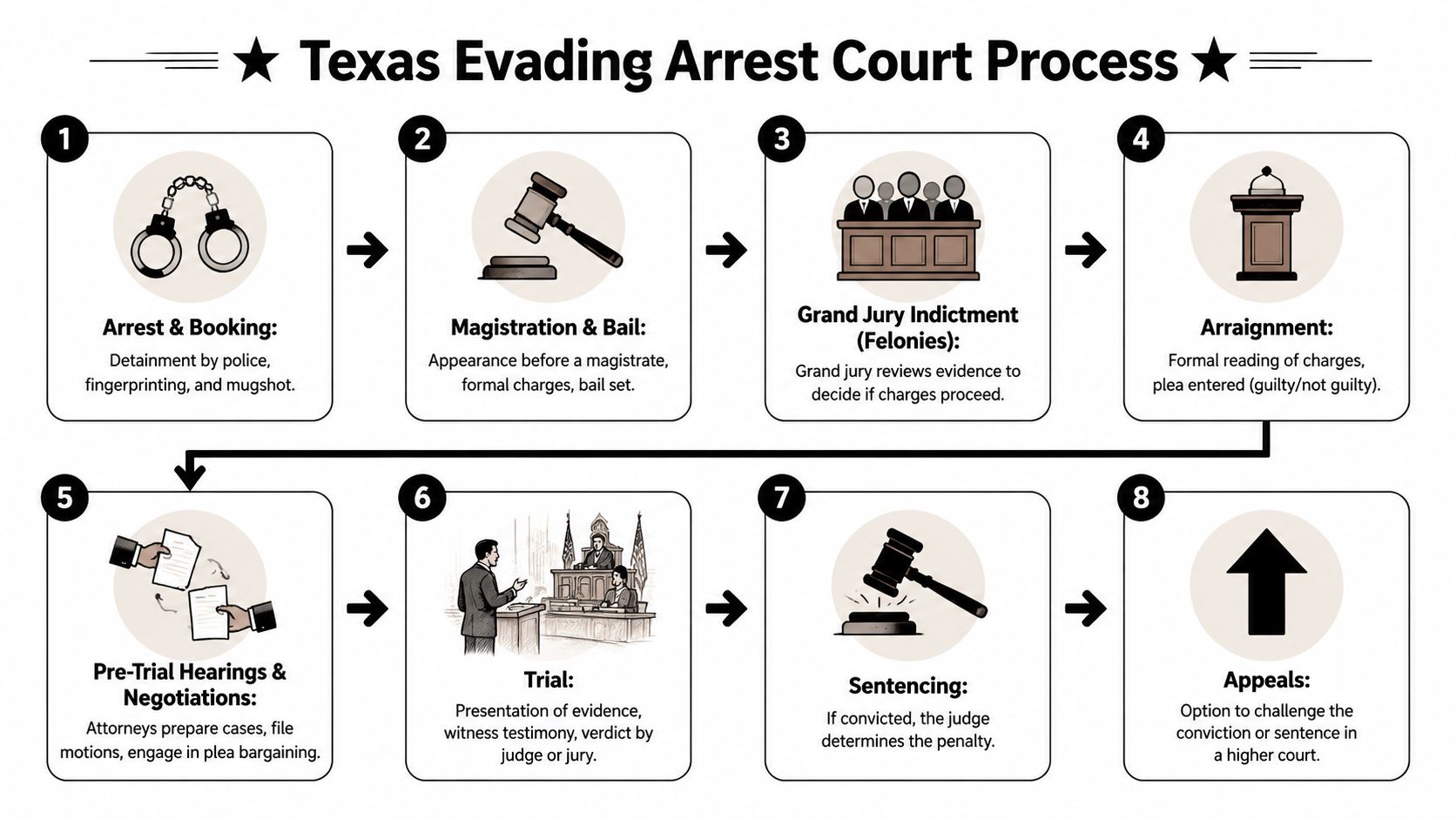
Arrest, booking, and the first appearance
After arrest, officers usually take you through booking. That often includes fingerprints, a photo, and the formal entry of the charge into the system. Soon after, you'll appear before a magistrate or judge who addresses the accusation and bond conditions.
If the case is a felony, the process can become more formal and more demanding quickly. Early legal advice matters because statements, bond conditions, and first impressions can affect what happens next.
Arraignment and early case decisions
At arraignment, the charge is formally presented and a plea is entered. In plain terms, the court ensures you understand what you're accused of.
After that, your case usually moves into pretrial work. That stage may include:
Evidence review
Your lawyer studies reports, videos, witness statements, and charging documents.Motions and legal challenges
The defense may challenge the stop, detention, identification, or admissibility of evidence.Negotiations
Some cases move toward dismissal, reduction, or a plea bargain. Others don't.Trial preparation
If the state won't offer a fair result, your lawyer prepares to present the case to a judge or jury.
Court dates can look routine from the outside, but each hearing can change leverage, evidence issues, and the path to resolution.
Plea bargaining, trial, and sentencing
A plea bargain is not always a bad result, and a trial is not always the right move. The right path depends on the evidence, the charge level, your history, and your goals. Some people need to protect a professional license. Others need to avoid a conviction that could damage immigration status or family stability.
If the case goes to trial, the prosecution has to present evidence and prove the charge. Your lawyer cross-examines witnesses, challenges weak points, and argues for acquittal. If there's a conviction, sentencing follows.
After sentencing, some people still have options. Depending on the outcome, post-conviction relief may include an appeal or other legal remedies. If the case ends favorably, you may also explore expunction or record sealing. Those tools can be important for people trying to rebuild after an arrest, especially first-time offenders.
If you want to understand why timing matters so much, When to Hire a Criminal Defense Lawyer in Texas explains why early representation matters after an arrest or investigation.
Protecting Your Future and How Our Firm Can Help
An evading arrest allegation can put a lot at risk. Your freedom matters, but so do your job, your housing, your family responsibilities, and your peace of mind. The legal system may treat your case like a file number. You shouldn't.
People in Houston, Dallas, Austin, and San Antonio often need more than a courtroom argument. They need a plan. That plan may involve challenging intent, disputing whether the stop was lawful, negotiating from a position of strength, preparing for trial, and thinking ahead about what happens after the case ends.
For some readers, the next question is about life after the case. Depending on the result, options like expunction, record sealing, or other post-conviction relief may help you move forward. Those remedies aren't available in every situation, but they matter for rehabilitation-focused clients who want a clean start after an arrest or conviction.
One option for people who need defense guidance in these matters is Law Office of Bryan Fagan PLLC, a Texas criminal defense firm that handles misdemeanor and felony allegations, related charges such as DWI, theft, assault, and drug possession, as well as expunctions, nondisclosures, record sealing, and post-conviction relief.
The most important next step is simple. Get legal advice early, before panic turns into avoidable damage.
If you've been charged with a crime in Texas, call The Law Office of Bryan Fagan, PLLC for a free and confidential consultation. Our defense team is ready to protect your rights.